
Google sues Chinese 'Outsider Enterprise' over Gemini-powered phishing scam operation
TECH

Google sues Chinese 'Outsider Enterprise' over Gemini-powered phishing scam operation

25+
Signals

Strategic Overview

  • 01.
    On June 12, 2026, Google filed a civil lawsuit in Manhattan federal court (U.S. District Court, Southern District of New York) against 'Outsider Enterprise,' a China-based cybercrime network accused of using Gemini to build phishing infrastructure. Google described it as its first lawsuit involving abuse of its Gemini AI tools.
  • 02.
    Network members used Gemini to help generate code for phishing websites and related scam infrastructure, feeding the model prompts framed as harmless requests such as building 'gift redemption' pages.
  • 03.
    The operation impersonated Google, YouTube, the US Postal Service, and New York's E-ZPass toll system, distributing phishing kits via Telegram as fake package-delivery alerts, banking notifications, and account-security warnings.
  • 04.
    The suit was filed alongside a coordinated FBI action codenamed 'Operation Ghost Hook,' in which the FBI seized domains, a Shopify storefront, and roughly $100,000 from Outsider payment wallets. Google brought aggressive RICO claims, treating the network as an organized criminal enterprise.

Deep Analysis

How Gemini was turned into a phishing factory

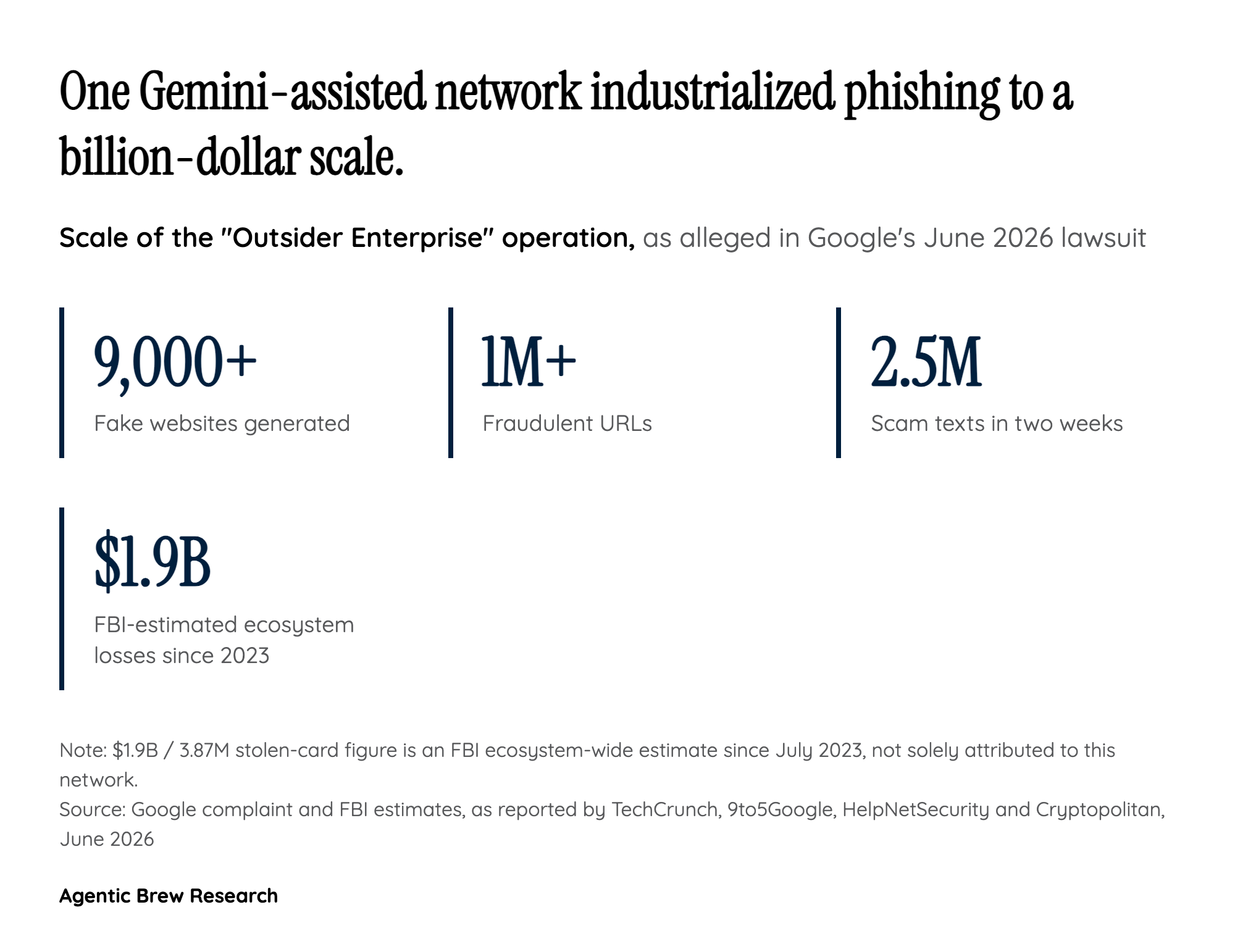
The core of Google's complaint is mechanical: Outsider Enterprise members used Gemini to help generate code for phishing websites and related scam infrastructure, slipping past safety filters by framing prompts as benign tasks like building 'gift redemption' pages [3]. That automation let the group produce convincing fake sites at industrial volume — over 9,000 fake websites and more than 1 million fraudulent URLs [1][2]. The impersonation targets were deliberately mundane and high-trust: Google and YouTube themselves, plus the US Postal Service and New York's E-ZPass toll system, delivered as fake package-delivery alerts and account-security warnings [1][3]. What makes this filing distinct from prior takedowns is the named tool: Google explicitly calls it its first lawsuit involving abuse of its Gemini AI tools [4], converting 'a model got misused' from a content-moderation problem into a litigated harm with a defendant attached.

The economics: phishing-as-a-service for $88 a week

The economics: phishing-as-a-service for $88 a week
The scale of the alleged Outsider Enterprise operation, per Google's complaint and FBI estimates.

The most under-appreciated angle is the business model. Outsider didn't run scams so much as franchise them: affiliates could launch campaigns for as little as $88 per week — roughly $200 a month — by subscribing to a Telegram bot [4][5]. The kits shipped with the trappings of a real SaaS product: real-time dashboards, keystroke logging, automated credential harvesting, and MFA-bypass tooling [5]. AI fits this model precisely because it collapses the one remaining cost — producing fresh, believable site code — toward zero, which is how a single network sent 2.5 million fraudulent texts to Android users in a two-week May window, of which users flagged about 55,000 [1][2]. The downstream scale is ecosystem-wide rather than confined to this one group: the FBI ties the broader phishing ecosystem to roughly 3.87 million stolen card numbers and about $1.9 billion in losses since July 2023, with this network's attacks spanning 55 countries [1][4]. Treating the AI as a labor-saving input for a subscription crime business — not a magic new attack — is what the $88 price tag actually proves.

RICO, Ghost Hook, and a full-stack enforcement squeeze

Google paired the suit with an unusually broad enforcement coalition. The complaint leans on RICO — a statute built against organized-crime families — which is a notably aggressive choice that frames Outsider as a racketeering enterprise rather than a loose set of scammers [5]. Running in parallel, the FBI's Operation Ghost Hook seized domains, a Shopify storefront, and around $100,000 from the network's payment wallets [4]. Google is also working with AT&T, T-Mobile, and Verizon to block the fraudulent texts before they reach users [1], and is backing seven bipartisan federal anti-scam bills [6]. The strategy attacks the operation at every layer at once — model access, hosting, payments, the carrier delivery path, and the policy environment — because litigation alone against an offshore defendant rarely stops the cash flow.

The skeptic's read: cheaper scams, theatrical guardrails, unenforceable judgments

Community reaction was markedly more cynical than the press release. The dominant thread questions whether you can meaningfully sue a foreign criminal enterprise at all — the jurisdiction and enforceability of any judgment against a China-based defendant is the open question, especially after the FBI recovered only about $100,000 against a multi-million-dollar operation [4]. A second strand argues the AI framing oversells the novelty: Gemini didn't invent phishing, it made already-existing scam-site production cheaper and faster, which is also the lawsuit's own theory that the model lowered the barrier to scaled cybercrime [5]. That feeds skepticism that safety guardrails are more than theater on stochastic models that can be steered with 'gift redemption' style framing [3]. Even the FBI concedes the trajectory: as Cyber Division Assistant Director Brett Leatherman put it, criminals increasingly use AI to make fraud 'more convincing and harder to detect' [1]— which, read critically, is an admission that model providers are now litigating a problem their own tools accelerate.

Historical Context

2025-11-12
Google sued 25 China-based operators of the 'Lighthouse' phishing-as-a-service kit in Manhattan federal court, alleging theft of up to 115 million U.S. credit cards.
2026-06-12
Google filed its first lawsuit specifically over Gemini AI abuse against Outsider Enterprise, alongside the FBI's Operation Ghost Hook.

Power Map

Key Players
Subject

Google sues Chinese 'Outsider Enterprise' over Gemini-powered phishing scam operation

GO

Google

Plaintiff; filed the civil RICO lawsuit to dismantle the network's infrastructure and protect its Gemini and brand assets from impersonation.

OU

Outsider Enterprise

Defendant; China-based phishing-as-a-service network that weaponized Gemini and sold phishing kits via a Telegram bot subscription model.

FB

FBI

Law enforcement partner; ran Operation Ghost Hook, seizing domains, a Shopify storefront, and ~$100,000; estimates 3.87M stolen cards and $1.9B in ecosystem losses since July 2023.

AT

AT&T, T-Mobile, Verizon

Carrier partners working with Google to block the fraudulent text messages before they reach users.

U.

U.S. Congress

Google is backing seven bipartisan federal anti-scam bills.

Fact Check

6 cited
  1. [1] Google sues China-based cybercrime network over AI-powered phishing
  2. [2] Google sues cybercrime network that used Gemini for financial scams
  3. [3] Chinese cybercrime operation that used AI to scam 'hundreds of thousands of victims' sued by Google
  4. [4] Google sues Chinese AI phishing ring as FBI seizes domains in Operation Ghost Hook
  5. [5] Google's AI phishing lawsuit against Outsider Enterprise
  6. [6] Google AI phishing lawsuit targets Gemini scams

Source Articles

Top 5

THE SIGNAL.

Analysts

"Warns that criminals are increasingly using AI to make fraud more convincing and harder to detect."

Brett Leatherman
Assistant Director, FBI Cyber Division

"Framed the action as a coordinated effort to dismantle the network's infrastructure with the FBI and carriers."

Halimah DeLaine Prado
General Counsel, Google
The Crowd

"‼️ Google is suing to dismantle a China-based, Telegram-run cybercrime network behind the flood of fake package and bank scam texts that calls itself the "Outsider Enterprise." It's tied to 9,000 fake sites and over 1M fraudulent URLs. The FBI is coordinating law enforcement"

@@IntCyberDigest116

"Google sues Chinese cybercrime network 'Outsider Enterprise' that used Gemini to automate scams"

@u/ControlCAD22

"Almost got my Google account stolen . . ."

@u/MochiShinobi59
Broadcast
Google files lawsuit under RICO Act, targeting alleged cybercriminals in text phishing scams

Google files lawsuit under RICO Act, targeting alleged cybercriminals in text phishing scams

Google battling AI PHISHING SCAMS

Google battling AI PHISHING SCAMS

Google Sues Chinese Cybercrime Group for Using AI in Scams

Google Sues Chinese Cybercrime Group for Using AI in Scams