Gemini in Chrome expands to all US Android users, auto browse comes to mobile
TECH

Gemini in Chrome expands to all US Android users, auto browse comes to mobile

26+
Signals

Strategic Overview

  • 01.
    Google has completed the rollout of Gemini in Chrome to all Android users in the US, expanding a feature that began as a limited preview around May 2026.
  • 02.
    The expansion also brings auto browse - Gemini's agentic, multi-step task-completion capability - to mobile for the first time, available to Google AI Pro and AI Ultra subscribers in the US.
  • 03.
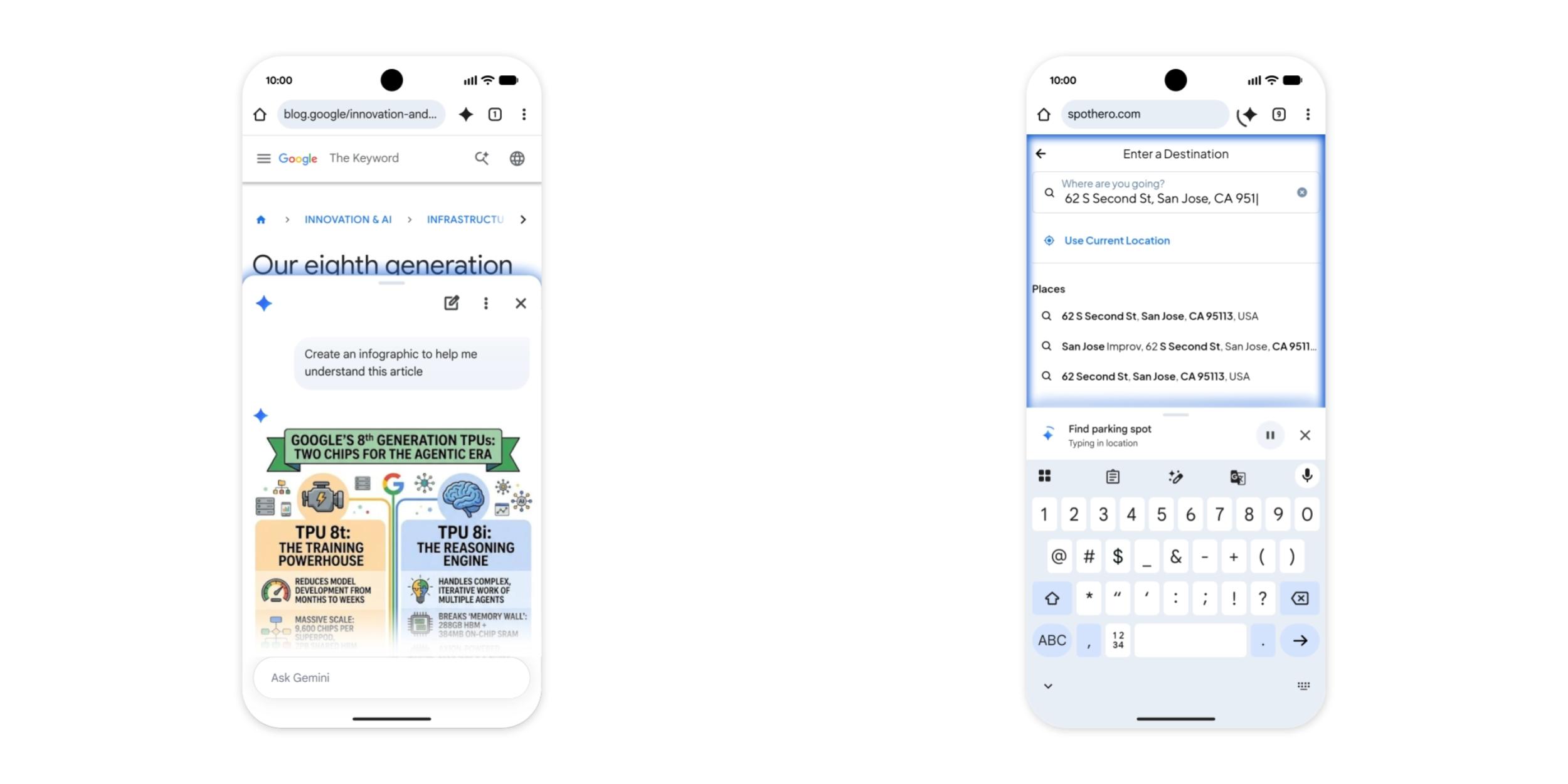
    On Android, Gemini in Chrome can summarize pages, answer questions about content a user is viewing, connect to Google Calendar and Keep, and generate or edit images using Google's Nano Banana tool.
  • 04.
    Auto browse can handle multi-step web tasks such as booking event parking, updating a recurring order, organizing travel, comparing hotel prices, or scheduling appointments, subject to daily request caps of 20 for AI Pro and 200 for AI Ultra subscribers.

The Fifteen-Month De-Risking Playbook

Google didn't flip a single switch for Gemini in Chrome - it built out access in careful stages over roughly fifteen months. The integration debuted at Google I/O in May 2025 as a desktop-only feature for paying Google AI Pro and Ultra subscribers [1]. By September 2025, Google had widened the desktop version to all US Mac and Windows users for free, and used that moment to preview early agentic capabilities like booking a haircut or ordering groceries [2]. Android got the same treatment on a delay: a limited preview from around May 2026, followed by the full rollout to all US Android users on August 18, 2026 [3], alongside the first mobile release of the paid-tier-only auto browse feature [4].

That cadence - subscriber preview first, general availability months later, mobile trailing desktop by roughly a year - reads less like a routine feature launch and more like a deliberate de-risking strategy. Google lets its most engaged, highest-willingness-to-pay users find the rough edges of an AI agent that can click, type, and buy things on their behalf before exposing that capability to the much larger and more casual population of free Android Chrome users. The free tier gets the tamer version - summarization, Q&A, calendar hooks - while the capability that can actually take autonomous action on the open web stays gated behind a subscription and over a year of desktop testing.
A Feature Users Didn't Ask to Have Installed

Official messaging framed the Android launch as a clean expansion - 'Gemini in Chrome, your browsing assistant, is now available to all Android users in the U.S.' [4]- but that isn't how a slice of the people who actually received the update experienced it. Within a day of the announcement, threads on r/Android and r/AndroidQuestions converged on the same specific complaint: Chrome had added a new bottom bar carrying a Gemini icon that nobody explicitly opted into, sitting below an address bar that stayed put at the top. One thread titled its post 'How TF do I get Gemini out of my Android Chrome toolbar??' and described the icon as something that 'grosses me out' - notably, disabling the standalone Gemini app on the phone did nothing to remove the Chrome-embedded version, because the toolbar icon is compiled into the browser itself, not the separate app.

The workaround that spread across both threads was a Chrome flag, not a settings toggle: typing chrome://flags/#android-bottom-bar into the address bar, switching it to Disabled, and restarting the browser. That an opt-out only exists behind a developer-facing flags page - rather than in Chrome's regular settings menu - is itself telling: Google shipped the bottom bar as the default experience for all US Android users, not as an opt-in trial, and treated removability as an edge case rather than a first-class control.

Auto Browse's Blast-Radius Problem

The feature Google is most eager to talk about - auto browse navigating sites and completing multi-step tasks on a user's behalf - is also the one carrying the most risk, and Google's own materials don't pretend otherwise. Google's support documentation states plainly that auto browse 'can make mistakes or act unexpectedly, including completing a purchase without permission,' and advises users to actively monitor tasks in progress [5]. The mitigations are procedural rather than absolute: auto browse shows its plan before starting and lets a user take over or stop a task mid-flight [7], and it requires explicit confirmation before completing sensitive actions like a purchase [6]. Usage is also capped - 20 multi-step auto browse requests per day for AI Pro subscribers, 200 per day for AI Ultra subscribers [7]- functioning as a soft limit on how much autonomous action any one account can trigger. In practice, that control surface is visible rather than abstract: auto browse runs its task in a background tab while a person keeps using their phone for something else, with a small cursor indicator tracking the task's progress on screen, and a person can step in to pause or take over at any moment, not just at the plan-approval or purchase-confirmation checkpoints. That's a deliberate design choice - the Chrome and Gemini teams have described wanting to keep a manual-flow option sitting alongside automation rather than push every task through a fully autonomous path.

Google has previously detailed a deeper architecture behind these guardrails, including a second 'User Alignment Critic' model that vets the primary agent's actions and 'Agent Origin Sets' that restrict which sites an agent can wander into during a task [8]. Security researchers covering that architecture take the threat seriously rather than dismissing it: coverage of the security layer frames indirect prompt injection - malicious instructions hidden in a web page's content, ready to hijack an agent that reads it - as the primary new threat category agentic browsers introduce, noting that once a browser starts submitting forms and interacting with third-party services autonomously, 'the blast radius of a mistake - or a malicious prompt - grows considerably' [9]. Google calls the system 'secure by design' [8]; independent security coverage treats that as a claim still being tested at scale, not a settled fact - which is exactly the gap this Android rollout now puts in front of tens of millions more people.

The Real Play Is Distribution, Not Just Convenience

Strip away the security debate and the UI complaints, and there's a more mundane explanation for why Google keeps pushing Gemini into surfaces people didn't ask to have it in: distribution. Chrome is the default browser on the vast majority of Android phones sold in the US, which makes it the cheapest possible channel for Google to put an AI assistant in front of people who would otherwise never open the standalone Gemini app. Coverage of the launch explicitly frames it against Microsoft's Copilot integration in Edge [10]- the two companies are running the same play, using ownership of a mass-market browser to bootstrap AI assistant usage rather than competing purely on model quality.

One r/Android commenter made this case more bluntly than any of the official materials did: pushing Gemini into Chrome for everyone, whether or not they asked for it, gives Google 'a huge advantage over a company like Anthropic which tends to have better models' - the point being that distribution reach, not model benchmarks, is the actual battleground here. That framing helps explain both halves of this story at once. The forced bottom bar isn't just a design misstep - it's the predictable cost of a distribution strategy: if the goal is exposure at Android's full scale, a default-on rollout will always beat an opt-in one, even at the price of a wave of 'how do I turn this off' threads.

Historical Context

2025-05-20
Google announced Gemini integration in Chrome at Google I/O 2025.
2025-05-21
Gemini in Chrome began rolling out on desktop (Windows/macOS) to Google AI Pro and AI Ultra subscribers in the US.
2025-09-18
Google expanded Gemini in Chrome to all US Mac and Windows desktop users for free and previewed early agentic browsing capabilities such as booking a haircut or ordering groceries.
2025-12-08
Google published its agentic browsing security architecture for Gemini in Chrome, including a User Alignment Critic model and Agent Origin Sets, alongside a bug bounty of up to $20,000 for demonstrated security breaches.
2026-05
Gemini in Chrome for Android began a limited preview rollout ahead of the full August 2026 expansion.

Power Map

Key Players
Subject

Gemini in Chrome expands to all US Android users, auto browse comes to mobile

GO

Google / Chrome team

Owns and ships the Gemini-in-Chrome integration and auto browse; sets both the pace of the rollout and the security guardrails that determine how much autonomy the agent gets.

GO

Google AI Pro and AI Ultra subscribers

The only users with access to auto browse; their willingness to trust an agent with purchases and multi-step tasks effectively test-drives the feature before it reaches free users.

GE

General US Android Chrome users

Now receive Gemini in Chrome's core features - page summarization, in-page Q&A, Google Calendar and Keep integration, and Nano Banana image editing - by default and free of charge, making them the largest population using Gemini in Chrome even though most cannot access auto browse.

MI

Microsoft (Copilot in Edge)

Runs a parallel browser-embedded AI assistant strategy that coverage of this launch directly compares it against, making browser-level AI a two-company distribution race for now.

Fact Check

10 cited
  1. [1] Google is launching a Gemini integration in Chrome
  2. [2] Google brings Gemini in Chrome to US users, unveils agentic browsing capabilities and more
  3. [3] Gemini in Chrome for Android finishes rolling out to all US users
  4. [4] Gemini in Chrome, your browsing assistant, is now available to all Android users in the US
  5. [5] Auto browse in Gemini for Chrome on Android - Google Support
  6. [6] Gemini in Chrome on Android now available to everyone, with auto browse for subscribers
  7. [7] Google Chrome on Android gets agentic browsing, image generation, and more
  8. [8] Architecting security for agentic browsing in Chrome
  9. [9] Google Chrome adds new security layer for Gemini AI agentic browsing
  10. [10] Gemini is now available in Chrome with agentic auto browse for all Android users in the US

Source Articles

Top 3

THE SIGNAL.

Analysts

Google describes auto browse as 'built to be secure by design,' pointing to a dedicated User Alignment Critic model that reviews the primary agent's actions and Agent Origin Sets that restrict which sites an agent can visit mid-task.

Google
Official product and security messaging, Chrome team

Posting in a personal capacity rather than through the official Chrome account, Tabriz framed the Android launch directly for users: asking Gemini questions about the page you're on, connecting it to your other Google apps, and - for AI Pro and Ultra subscribers - handing it multi-step 'digital chores' through auto browse.

Parisa Tabriz
VP of Engineering, Google Chrome

Analysts caution that once a browser can submit forms and interact with third-party sites autonomously, indirect prompt injection becomes the primary new threat, noting that 'the blast radius of a mistake - or a malicious prompt - grows considerably.'

Security industry analysts
Independent security commentary (via BleepingComputer coverage)
The Crowd

Wherever the day takes you, browsing on Android just got a whole lot smarter. 📱⚡️ Gemini in Chrome is now available for Android users in the U.S.! Use it to summarize long pages, connect with your favorite Google apps, and generate images in your browser. Google AI Pro & Ultra

@@googlechrome479

Google is rolling out Gemini in Chrome for Android across the U.S., featuring AI summaries, app integrations, and agentic Auto Browse.

@@chromeunboxed241

📢 Gemini in @googlechrome is now available to all @Android users in the US today! Ask about web pages, connect to Google apps, & more when browsing on your phone. And if you’re a Pro/Ultra subscriber, try out auto browse to help with multi-step digital chores. 📱🕸️✨💚

@@laparisa21

Gemini in Chrome is now available to all Android users in the U.S.

@u/FragmentedChicken0
Broadcast
Gemini in Chrome: Help right where you need it

Gemini in Chrome: Help right where you need it

Gemini in Chrome: Your agentic browsing assistant

Gemini in Chrome: Your agentic browsing assistant

NEW Gemini in Chrome Updates | Hands on with the Latest Chrome AI Features

NEW Gemini in Chrome Updates | Hands on with the Latest Chrome AI Features