OpenAI's Daybreak cybersecurity expansion adds GPT-5.6-Cyber and Red/Blue access tiers
TECH

OpenAI's Daybreak cybersecurity expansion adds GPT-5.6-Cyber and Red/Blue access tiers

32+
Signals

Strategic Overview

  • 01.
    On August 10, 2026, OpenAI expanded its Daybreak cybersecurity initiative, splitting access into two tiers - Daybreak Blue for broad defensive work and Daybreak Red for offensive/exploit research - alongside a new purpose-trained model, GPT-5.6-Cyber.
  • 02.
    Daybreak Red unlocks GPT-5.6-Cyber for advanced, authorized workflows including proof-of-concept exploit development, exploit-chain validation, penetration testing, and red teaming, while Daybreak Blue gives approved defenders general-purpose GPT-5.6 Sol access for vulnerability discovery, secure code review, malware analysis, incident response, and patch validation.
  • 03.
    On OpenAI's internal Advanced Cybersecurity Completion Rate evaluation, GPT-5.6-Cyber completed 95% of requests, compared with 1.5% for standard guardrail-enabled GPT-5.6 Sol and 57.3% for the prior GPT-5.5-Cyber model.
  • 04.
    OpenAI announced partnerships with 16 cybersecurity vendors - including Accenture, IBM, CrowdStrike, Cisco, Sophos, Cloudflare, Ernst & Young, KPMG, and Palo Alto Networks - allowing them to run client security tests using OpenAI's frontier cyber models without receiving direct model access.

Deep Analysis

Why OpenAI Built a Bouncer Into Its Own Model

OpenAI's standard safety screens are built to catch cybersecurity requests that look malicious, but that same filter has been blocking legitimate work from vetted defenders trying to find and fix vulnerabilities before attackers do [2]. Rather than loosen guardrails for every user, OpenAI split access into two tiers: Daybreak Blue, which hands approved security teams general-purpose GPT-5.6 Sol tuned for defensive work such as vulnerability discovery, secure code review, malware analysis, incident response, and patch validation, and Daybreak Red, a more tightly vetted track that unlocks GPT-5.6-Cyber for higher-risk work like proof-of-concept exploit development, exploit-chain validation, penetration testing, and red teaming [1].

The design functions as a trust ladder rather than a single on/off switch. Access to the more permissive Red tier requires identity verification, monitoring, approved-use restrictions, and legal attestations, and starting September 1, 2026, individual accounts will also need to authenticate with hardware security keys [1]. That structure lets OpenAI keep the model's most dangerous capabilities - the ones that make offensive security work possible - walled off behind a vetting process it fully controls, rather than shipping a uniformly less-cautious model to everyone.
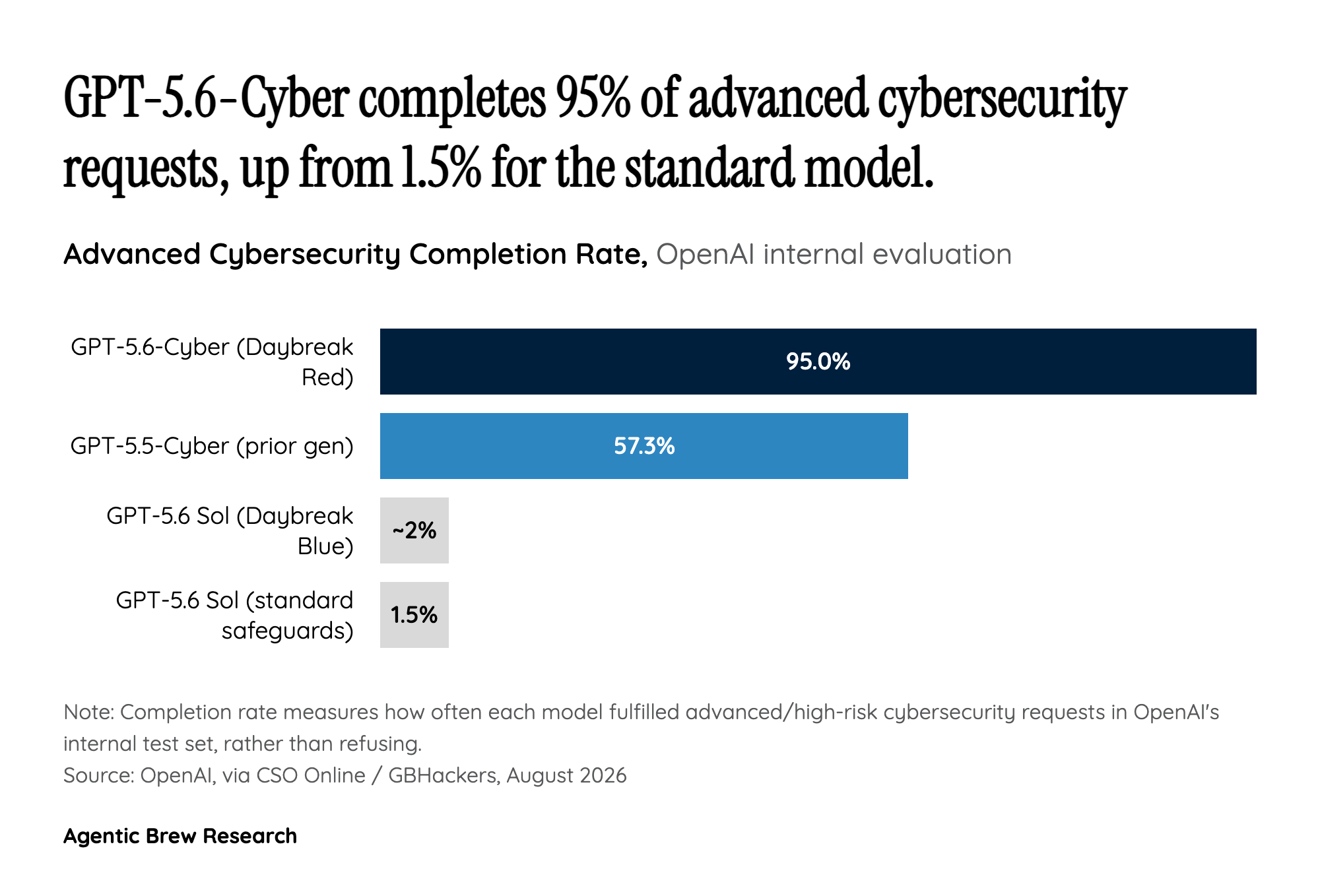

The Completion-Rate Curve: From 57% to 95% in One Model Generation

The Completion-Rate Curve: From 57% to 95% in One Model Generation
GPT-5.6-Cyber completed 95% of advanced cybersecurity requests on OpenAI internal evaluation, versus 1.5% for the standard model with safeguards.

OpenAI's own numbers tell a stark story about how fast refusal behavior is being engineered away for trusted users. On its internal Advanced Cybersecurity Completion Rate evaluation, GPT-5.6-Cyber completed 95% of high-risk security requests, compared with just 1.5% for the standard, guardrail-enabled GPT-5.6 Sol and roughly 2% for that same model accessed through Daybreak Blue [3]. The prior specialized model, GPT-5.5-Cyber, completed 57.3% of the same test set [4]- meaning the jump from one cyber-specific model to the next closed most of the remaining gap in a single release cycle.

That trajectory is arguably the real headline, more than any single feature. A model going from mostly refusing to mostly completing offensive-adjacent tasks within one generation suggests OpenAI has found a repeatable way to peel back refusal behavior once a user clears a trust bar, and that the bottleneck on this kind of capability is increasingly about access infrastructure rather than model training [5]. OpenAI acknowledges the trade-off directly, warning that models running with reduced safeguards carry risks beyond standard usage even as it pushes the completion rate higher [5].

Proof in the Wild: A Chrome Zero-Day and Hundreds of Kernel Bugs

OpenAI backed up the capability claims with concrete findings rather than just benchmark numbers. Using GPT-5.6-Cyber, its researchers discovered two previously unknown vulnerabilities in Chrome's V8 JavaScript engine that could be chained together to corrupt memory and escape the browser's heap sandbox; Google fixed the flaw, and it was assigned CVE-2026-15903 [6]. OpenAI also reported the model helped surface at least five vulnerabilities in a major mobile operating system, three critical flaws in a widely used database, and more than 400 privilege-escalation issues in a widely used operating system kernel [7].

These aren't hypothetical wins - they're a patched CVE and vendor-acknowledged bug counts, a meaningfully different kind of evidence than a completion-rate percentage. GPT-5.6-Cyber is built on top of GPT-5.6 Sol but specifically trained to improve performance on tasks like zero-day discovery and exploit-chain development [8], and the V8 and kernel findings are the clearest public demonstration yet that a purpose-trained cyber model can independently surface bugs serious enough for major vendors to ship fixes.

Who Actually Gets the Keys: The Enterprise Gate Behind the Defender Framing

OpenAI frames Daybreak around 'trusted defenders,' but early access reports suggest that trust is being extended unevenly. Daybreak Blue - the general-purpose tier - appears reachable by individuals who simply verify their identity, while access to Daybreak Red and GPT-5.6-Cyber itself looks gated mostly to companies and organizations; one prospective user reported that OpenAI support told them identity verification alone doesn't guarantee Red access. Sixteen cybersecurity vendors, including Accenture, IBM, CrowdStrike, Cisco, Sophos, Cloudflare, Ernst & Young, KPMG, and Palo Alto Networks, get a different path entirely: they can run client security tests using OpenAI's frontier cyber models through the partnership program without OpenAI transferring model access to them directly [9], extending the capability through trusted intermediaries rather than opening it broadly.

That two-track reality feeds a live tension in how the release is being read. OpenAI's own framing, echoed by insiders, positions GPT-5.6-Cyber as a defensive accelerant used internally for red-teaming and open-source patching. Independent commentary is less convinced the framing settles the question, arguing that a model capable of finding zero-days at scale is a dual-use capability regardless of who holds the account - a read shared by analysts who caution the gap between vulnerability discovery and exploitation will keep shrinking as AI accelerates both sides of the fight [3]. Confidis' Keith Prabhu put a finer point on it, arguing tools like this may speed up both discovery and weaponization without fundamentally changing which side comes out ahead [3].

Historical Context

2026-05
Daybreak launched as a trusted-access cybersecurity program.
2026-06-23
Daybreak expanded with Codex Security, a vulnerability-scanning and patching platform, and GPT-5.5-Cyber, shifting emphasis toward getting patches deployed rather than just finding bugs.
2026-08-10
OpenAI split Daybreak into Red and Blue access tiers, launched GPT-5.6-Cyber, announced a 16-vendor partner network, and introduced a hardware-security-key login requirement effective September 1, 2026.

Power Map

Key Players
Subject

OpenAI's Daybreak cybersecurity expansion adds GPT-5.6-Cyber and Red/Blue access tiers

OP

OpenAI

Developer and operator of Daybreak, the Daybreak Red/Blue access tiers, and GPT-5.6-Cyber; controls vetting, identity verification, and who ultimately gets access to the reduced-safeguard model.

AC

Accenture, IBM, CrowdStrike, Cisco, Sophos, Cloudflare, Ernst & Young, KPMG, Palo Alto Networks (among 16 named partners)

Security vendors partnered with OpenAI to run client-facing security tests using OpenAI's frontier cyber models, without receiving direct access to the underlying model themselves.

GO

Google

Recipient and fixer of the V8 JavaScript engine vulnerabilities OpenAI's GPT-5.6-Cyber helped uncover, now tracked as CVE-2026-15903.

VE

Vetted security researchers and defenders

End users granted tiered access to GPT-5.6-Cyber (Daybreak Red) or GPT-5.6 Sol (Daybreak Blue) after identity verification, and who will be required to authenticate with hardware security keys starting September 1, 2026.

Fact Check

9 cited
  1. [1] OpenAI Daybreak: Trusted Access for Cyber - Overview
  2. [2] OpenAI Expands Daybreak Cyber
  3. [3] OpenAI launches GPT-5.6-Cyber as AI narrows vulnerability response window
  4. [4] OpenAI Launches GPT-5.6-Cyber to Find Zero-Day Vulnerabilities
  5. [5] OpenAI launches GPT-5.6-Cyber with reduced refusals, 95% completion on advanced cybersecurity tasks
  6. [6] OpenAI expands Daybreak cybersecurity research program
  7. [7] OpenAI's GPT-5.6-Cyber and Daybreak security research
  8. [8] As AI-led attacks multiply, OpenAI launches a new cyber model
  9. [9] OpenAI's Daybreak expansion adds specialized cyber services

Source Articles

Top 5

THE SIGNAL.

Analysts

Warns that the gap between vulnerability discovery and exploitation will keep shrinking as advanced AI models accelerate vulnerability research, meaning CISOs should plan around that shrinking window rather than assume defenders keep pace.

Biswajeet Mahapatra
Analyst, Forrester

Cautions that models like GPT-5.6-Cyber may accelerate both vulnerability discovery and weaponization without fundamentally shifting the balance between attackers and defenders.

Keith Prabhu
Confidis
The Crowd

We’re expanding our cybersecurity initiative Daybreak and introducing GPT-5.6-Cyber, a new model for advanced, authorized cybersecurity work. As the threat landscape evolves, we’re putting frontier intelligence in the hands of trusted defenders before attackers can deploy offensive AI at scale.

@@OpenAI7309

Today we are releasing GPT-5.6-Cyber. The model is our first large-scale attempt at directly improving capabilities for advanced cybersecurity tasks such as exploit development. We are finding it to be really quite strong for accelerating defensive work. We are using it across our stack for red-teaming, and our security researchers have used it to find and patch a huge host of 0-day vulnerabilities in open-source software.

@@Eric_Wallace_2218

OpenAI just released GPT-5.6-Cyber - their first model explicitly built to improve capabilities for advanced cybersecurity tasks including exploit development. > Already being used internally for red-teaming across their full stack > Security researchers have used it to find and patch 0-day vulnerabilities in open-source software > Framed as defensive, but the capability cuts both ways An AI that finds 0-days at scale is a different kind of weapon regardless of who's holding it.

@@RoundtableSpace42

OpenAI: "Introducing new ways to unlock advanced cyber capabilities together with GPT‑5.6‑Cyber, our latest cybersecurity-specific model."

@u/borowcy162
Broadcast
GPT‑5.6‑Cyber Explained: Daybreak Blue vs Red

GPT‑5.6‑Cyber Explained: Daybreak Blue vs Red

GPT-5.6-Cyber Is Here — I Tested the Security Workflow

GPT-5.6-Cyber Is Here — I Tested the Security Workflow

OpenAI Ships GPT-5.6-Cyber to Defenders First

OpenAI Ships GPT-5.6-Cyber to Defenders First

OpenAI's Daybreak cybersecurity expansion adds GPT-5.6-Cyber and Red/Blue access tiers — AI News | Agentic Brew