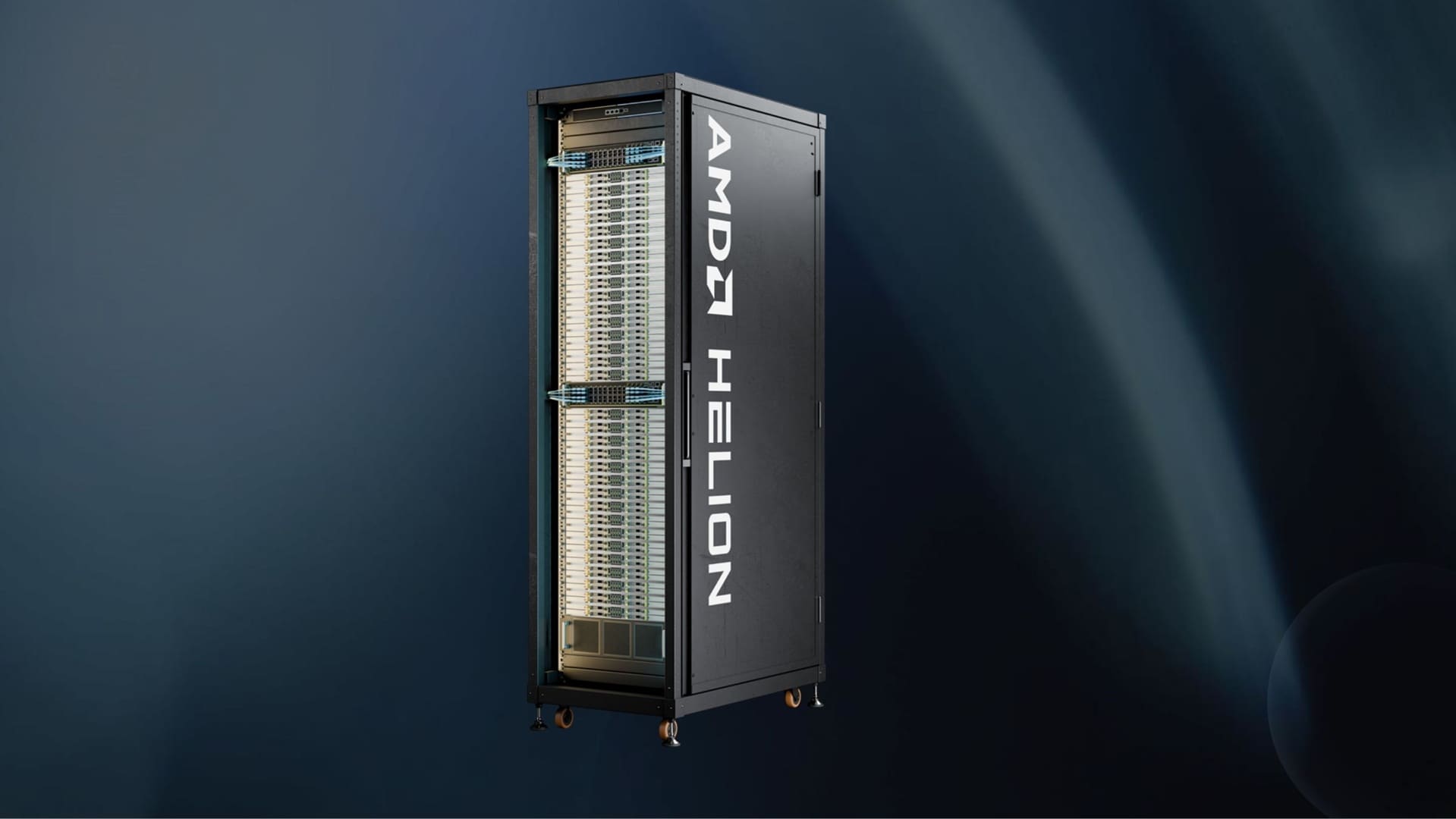
AMD Helion Agentic AI Rack
TECH

AMD Helion Agentic AI Rack

27+
Signals

Strategic Overview

  • 01.
    AMD unveiled Helion, an open rack-scale reference design for agentic AI built on Open Compute Project specifications, during CEO Lisa Su's keynote at the OCP Global Summit 2026 in San Jose on October 12, 2026.
  • 02.
    A CPU-only configuration powered by 6th Gen AMD EPYC ('Venice') processors supports up to 32,768 CPU cores, aimed at hyperscalers, neoclouds, and sovereign AI operators.
  • 03.
    An enterprise all-in-one configuration pairs EPYC CPU nodes with up to 16 AMD Instinct MI350P GPUs across two 8-GPU servers and up to 102 Tbps of networking bandwidth, housed in a 21-inch ORv3 rack spanning 44 rack units with both liquid- and air-cooled options.
  • 04.
    Helion includes an integrated token router that directs AI agents' model calls across frontier and open-source models, formally separating agent execution from model inference.
  • 05.
    Cisco, Dell Technologies, Hon Hai Technology Group (Foxconn), HPE, Lenovo, QCT, Supermicro, and Wiwynn have all announced support for the platform, with partner-built configurations planned for availability starting November 2026.
  • 06.
    AMD plans to contribute the Helion specification to the Open Compute Project for community development, extending the open-platform approach of its earlier Helios rack-scale design.

Deep Analysis

The CPU Rack Strikes Back: Why Agentic AI Doesn't Want More GPUs

For a decade, 'more AI compute' has meant 'more GPUs.' Helion quietly argues otherwise. AMD's CPU-only configuration packs up to 32,768 Zen 6 EPYC cores into a single Open Compute Project rack with no accelerators at all [1], a bet that a meaningful slice of agentic AI workloads - planning, tool-calling, orchestration, retrieval - are CPU-bound problems that GPUs can't help with. AMD CEO Lisa Su made the philosophy explicit at the OCP Global Summit 2026 keynote [2]: 'You don't need the same compute for every question. You want to route the right model and the right compute for the right application.'

That is a sharper claim than it sounds. Omdia analyst Lian Jye Su expects agentic AI to push the accelerator-to-CPU ratio from roughly 16:1 toward something close to 1:1, as agent workflow orchestration and code execution eat into what used to be almost pure GPU demand [3]. Gartner's Kanishka Chauhan is more skeptical of the novelty, framing Helion's CPU/GPU split as a reflection of workload divisions enterprises already use rather than a fundamentally new architecture - though he agrees inter-rack latency becomes a real constraint once agent workflows run long [3]. Independently, hardware-focused Reddit discussion converged on a similar read without AMD prompting it: commenters repeatedly pointed to always-on agents and reinforcement-learning rollout workloads - thousands of agent attempts scored and reinforced, rather than one-shot pretraining - as the use case that actually needs this much dedicated CPU headroom in the first place.

A Traffic Cop Inside the Rack: What the Token Router Actually Does

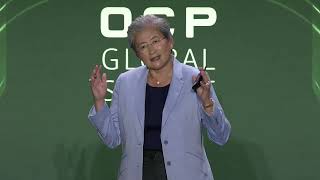
Buried inside the spec sheet is a feature that matters more than the core count: Helion ships with an integrated token router that decides, per request, whether an AI agent's call goes to a frontier model or a cheaper open-source one [4]. That is architecturally significant because it formally splits 'agent execution' (the CPU-heavy orchestration loop) from 'model inference' (the GPU-heavy generation step) - two things that have mostly lived together in a single GPU-centric box until now. In her OCP Global Summit 2026 keynote, Lisa Su described the intent directly: the router lets an organization send each query to 'the right model and the right compute for the right application' rather than running one model for everything.

The upside is real but so is the catch. Forrester principal analyst Charlie Dai argues the split enables independent scaling of CPU and GPU resources and better accelerator utilization - operators no longer have to over-provision GPUs just to feed an orchestration layer that doesn't need them. But he's equally clear about the tradeoff: 'the tradeoff is greater east-west network traffic, making low-latency networking, data locality, and composable rack architectures increasingly important' [3]. That is almost certainly why AMD's enterprise configuration is specced for up to 102 Tbps of networking bandwidth across a 44-rack-unit, 21-inch ORv3 chassis [5]- the network fabric, not the chip count, may be what determines whether the token-router architecture actually works at scale. AMD also hasn't yet detailed how the router integrates with existing agent frameworks, identity systems, or cost-governance tooling, so its practical value remains an announced feature awaiting real-world validation rather than a proven efficiency gain [6].

Reference Design, Not a Product: The Community's Reality Check

AMD's press materials and keynote stagecraft describe Helion as a finished answer; the hardware community reading the spec sheet is less convinced it is one. On r/hardware, cost estimates for the CPU-only configuration diverged wildly: one commenter pegged the EPYC cores alone at close to $2 million using a roughly $60-70-per-core estimate drawn from a reported $5 million price tag for a comparable Helios GPU rack, while another commenter claiming direct industry pricing experience countered that an all-in quoted cost - including RAM, SSDs, and data-center lifecycle - lands closer to $400 per core, with most of the money actually going to memory and storage rather than the CPUs themselves. Neither figure comes from AMD, and the gap between them is a reminder that a reference design has no sticker price until an OEM builds and prices an actual box.

That OEM dependency is the real caveat buried in AMD's own announcement: Cisco, Dell, Hon Hai, HPE, Lenovo, QCT, Supermicro, and Wiwynn are all committed to shipping Helion-based systems starting November 2026 [5], but Helion itself is a blueprint, not a product AMD sells directly - buyers still need an OEM partner's control-plane and orchestration software layered on top, a distinction one Reddit commenter flagged as especially important for regulated or sovereign-AI buyers in government, banking, and healthcare. A separate thread of skepticism pushed back on the 'game changer' framing itself, with one r/hardware commenter arguing this is less a new idea than a new application of a pattern used in historical supercomputer rack-scale CPU deployments - a useful corrective to how novel the keynote staging made Helion look.

An Open Blueprint vs. Nvidia's Walled Garden

The more strategically interesting move may not be the silicon at all but the licensing. AMD says it plans to contribute the Helion specification to the Open Compute Project for community development, extending the same open-platform approach it used for its earlier Helios rack-scale design [7]. Helios itself - the 'cousin' platform Lisa Su referenced in her OCP keynote, combining 72 GPUs and 18 EPYC CPUs when AMD first showed it in July 2026 [8]- already established the pattern: build on Meta's OCP Open Rack standard rather than a proprietary chassis, then let OEMs compete on implementation.

Lining up eight OEM/ODM partners - Cisco, Dell, Hon Hai, HPE, Lenovo, QCT, Supermicro, and Wiwynn - before the design has even shipped commercially is a direct bet that ecosystem breadth beats a tightly integrated single-vendor stack [5]. Taiwanese tech commentary covering the keynote additionally flagged that several of these manufacturing partners - including Hon Hai and Wiwynn - are Taiwan-based, an operational detail about where this hardware actually gets built that AMD's own press materials didn't emphasize. AMD's own announcement also name-checked OpenAI, Meta, Microsoft, and Oracle as having already deployed its prior Helios systems, framing enterprise and hyperscale demand for open rack-scale AI hardware as already proven out rather than speculative [2]. Whether that openness actually translates into faster adoption than more tightly integrated rack-scale approaches is the question Helion is designed to test over the next year - and it carries geopolitical texture AMD didn't address on stage: in the AMD_Stock Reddit community, two commenters disagreed over whether the CPU-only configuration's export status eases or complicates China sales, with one noting the underlying Venice EPYC core remains under an existing export ban regardless of GPU content, and speculating deployment might instead route through Malaysia.

Historical Context

2026-07
AMD showcased its earlier Helios rack-scale platform, built on the OCP Open Rack standard introduced by Meta, in configurations combining 72 GPUs and 18 EPYC CPUs - the platform Helion builds on with the same open-platform approach.
2026-10-12
Lisa Su delivered the opening keynote at OCP Global Summit 2026 in San Jose, where Helion was formally unveiled alongside the 6th Gen EPYC 'Verano' CPU.

Power Map

Key Players
Subject

AMD Helion Agentic AI Rack

AM

AMD

Designer of the Helion open rack-scale reference design; supplies EPYC CPUs, Instinct MI350P GPUs, and the token router software; plans to contribute the spec to OCP for broader ecosystem adoption.

DE

Dell Technologies, Cisco, HPE, Lenovo, Supermicro, QCT, Wiwynn, Hon Hai Technology Group (Foxconn)

OEM/ODM ecosystem partners expected to build and ship commercial Helion-based rack configurations starting November 2026, giving enterprises and hyperscalers multiple vendor options for deployment.

OP

Open Compute Project (OCP)

Standards body hosting the summit where Helion was unveiled; will receive AMD's contributed specification, giving the broader data center industry a shared open blueprint rather than a proprietary AMD-only design.

OP

OpenAI, Meta, Microsoft, Oracle

Early deployers of AMD's prior Helios rack-scale systems, cited by AMD as evidence of hyperscaler demand for its rack-scale AI designs ahead of Helion.

Fact Check

8 cited
  1. [1] AMD Helion Rack Crams 32,768 EPYC Zen 6 Cores Into One CPU-Only Agentic AI Blueprint
  2. [2] OCP 2026: AMD CEO Lisa Su Keynote Takeaways
  3. [3] AMD Unveils Helion as Agentic AI Fuels Demand for Data Center CPUs
  4. [4] AMD Helion Rack-Scale Solutions
  5. [5] Introducing AMD Helion: Agentic AI Compute at Rack Scale
  6. [6] AMD Unveils Helion Open Rack With 32,768 EPYC Cores For Agents
  7. [7] Introducing AMD Helion: Agentic AI Compute at Rack Scale (StockTitan)
  8. [8] AMD Showcases Helios Rack-Scale Platform Built on the OCP Open Rack for AI Introduced by Meta

Source Articles

Top 5

THE SIGNAL.

Analysts

“Argues agentic AI workloads are heterogeneous and require AMD to combine EPYC compute, open software, and flexible rack designs so partners can tailor systems to customer needs: 'Agentic AI is not a single workload. It spans personal agents, enterprise applications...To do that takes optimized compute and infrastructure that can adapt to different workloads.'”

Dan McNamara
SVP and General Manager, Compute and Enterprise AI, AMD

“Frames Helion within AMD's broader open-ecosystem strategy, arguing agentic AI needs a mix of CPUs, GPUs, and purpose-built chips rather than a one-size-fits-all accelerator, with token routing matching compute to the task: 'You don't need the same compute for every question. You want to route the right model and the right compute for the right application.'”

Lisa Su
Chair and CEO, AMD

“Sees the separation of agent execution from model inference as enabling independent scaling of CPU and GPU resources and better accelerator utilization, but warns it increases east-west network traffic demands: 'the tradeoff is greater east-west network traffic, making low-latency networking, data locality, and composable rack architectures increasingly important.'”

Charlie Dai
Principal Analyst, Forrester

“Expects agentic AI to shift the ratio of accelerators to CPUs from roughly 16:1 toward closer to 1:1, as AI agent workflow orchestration and code execution drive up CPU demand relative to GPU demand.”

Lian Jye Su
Analyst, Omdia

“Views Helion's architecture as reflecting existing enterprise AI workload divisions rather than a fundamentally new design, while flagging that inter-rack latency becomes critical for long-running agent workflows.”

Kanishka Chauhan
Analyst, Gartner
The Crowd

“- $AMD CEO Lisa Su presented at OCP 2026 Global Summit on open infrastructure for agentic AI deployment at scale. - $AMD announced Helion agentic AI rack based on Open Compute Project spec, powered by $AMD compute. - $AMD introduced 6th Gen EPYC 'Verano' data center CPU with”

@@PhotonCap41

“@Meta @OpenAI @AnthropicAI @Microsoft @OracleCloud Introducing AMD Helion: a new flexible, open rack-scale architecture designed for the agentic era. Built to support diverse AI workloads across hyperscale and enterprise environments. https://t.co/7elbsLkCdO”

@@AMD31

“OCP GLOBAL SUMMIT 2026, DAY 1, COMPLETE ANALYSIS (1/8) OCP Global Summit 2026, Day 1, Monday, October 12, 2026 Coverage: this report covers OCP Global Summit 2026 day 1, Monday, October 12, 2026 (Pacific time), and is built from the day's public posts and photos: 1,376 posts”

@@TheValueist23

“AMD Unveils Helion Open Rack With 32,768 EPYC Cores For Agents”

@u/GanacheNegative1988104
Broadcast
Building the Next Era of AI Infrastructure

Building the Next Era of AI Infrastructure

【完整實錄】台南出身的蘇姿丰:「打造下一個 AI 基礎建設時代」|OCP 開幕主題演講 27 分鐘全場不剪(中英字幕)

【完整實錄】台南出身的蘇姿丰:「打造下一個 AI 基礎建設時代」|OCP 開幕主題演講 27 分鐘全場不剪(中英字幕)

台南出身的 AMD 執行長,新機櫃夥伴 8 家是台灣廠!蘇姿丰 OCP 主題演講精華|發表 AI 代理機櫃 Helion、親手秀出 Verano 芯片(中英字幕)

台南出身的 AMD 執行長,新機櫃夥伴 8 家是台灣廠!蘇姿丰 OCP 主題演講精華|發表 AI 代理機櫃 Helion、親手秀出 Verano 芯片(中英字幕)

AMD Helion Agentic AI Rack — AI News | Agentic Brew