Microsoft launches $2.5B Frontier Company, a 6,000-engineer applied-AI deployment and consulting unit
TECH

Microsoft launches $2.5B Frontier Company, a 6,000-engineer applied-AI deployment and consulting unit

32+
Signals

Strategic Overview

  • 01.
    Microsoft launched Microsoft Frontier Company on July 2, 2026, committing $2.5 billion and roughly 6,000 industry, engineering, and AI experts to embed inside enterprise customers and help them design, deploy, and continuously improve AI systems.
  • 02.
    The unit runs on the forward-deployed engineering model, sending Microsoft's own technical staff to work on-site inside a customer's operations rather than selling software and walking away.
  • 03.
    Rodrigo Kede Lima, previously president of Microsoft Asia, was named president of the new organization, which is staffed largely from Microsoft's existing engineering, consulting, support, and sales teams.
  • 04.
    The move follows a wave of similar 2026 launches - Amazon's $1 billion forward-deployed engineering org and earlier ventures from OpenAI and Anthropic - all adopting a model Palantir pioneered roughly two decades ago.

Deep Analysis

Microsoft Just Conceded That Shipping Software Isn't Enough

The most revealing thing about Microsoft Frontier Company is not the $2.5 billion price tag - it is the admission buried inside it. For a company that has spent fifty years selling licenses and, lately, per-seat Copilot subscriptions, standing up a 6,000-person unit whose entire job is to physically embed engineers inside customers is a concession that the product alone does not close the value gap [1].

The mechanism is what the industry calls forward-deployed engineering: instead of handing a customer a tool and a quickstart guide, Microsoft sends its own technical staff to co-design, build, deploy, and continuously improve AI systems on-site rather than selling a tool and walking away [2]. Under the hood, the unit leans on Microsoft Foundry and access to more than 11,000 hosted AI models, and it wraps engagements in a FinOps methodology built to put a hard ROI number on every project [2]. That last part matters more than it sounds. Enterprises in 2026 are no longer impressed by demos; they are being asked by their own boards to show returns, and a model that dazzles in a sandbox but stalls in a messy production environment is exactly the failure Frontier is designed to prevent.

Microsoft is careful not to call this what it plainly resembles. Commercial CEO Judson Althoff insisted the effort goes beyond what has been labeled as forward-deployed engineering and will be the largest, most capable, outcome-driven engineering organization in the industry [4]. The branding gymnastics are telling: the company wants the reach of a consultancy without the low-margin reputation of one.
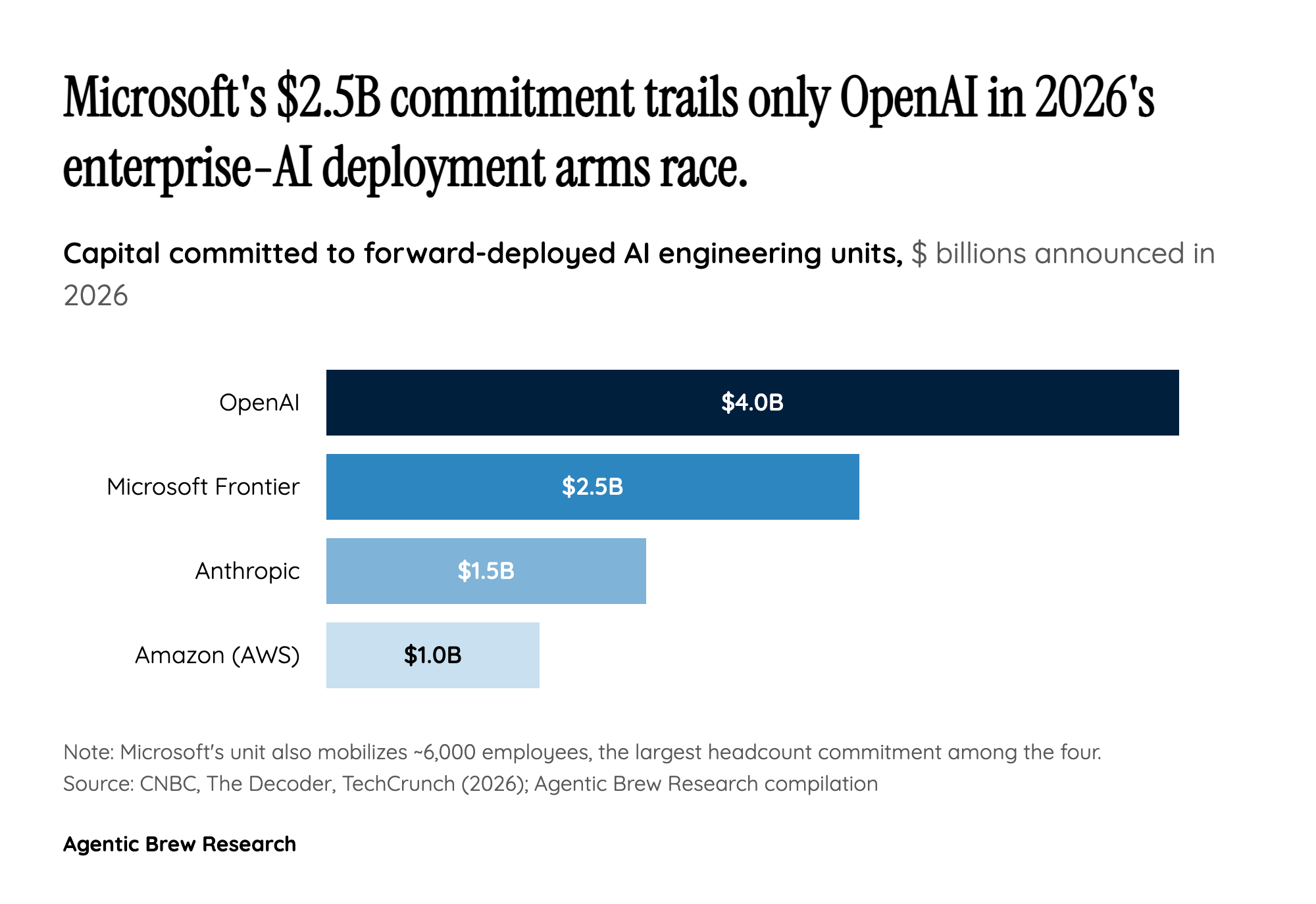

The $9 Billion Arms Race Copying a Two-Decade-Old Playbook

The $9 Billion Arms Race Copying a Two-Decade-Old Playbook
Capital committed to forward-deployed AI engineering units in 2026. Microsoft's $2.5B ranks second to OpenAI in dollars but is the largest by headcount at ~6,000 people.

Frontier did not appear in a vacuum. In the span of a single year, the four biggest names in AI have collectively committed close to $9 billion to the same idea. OpenAI stood up a roughly $4 billion professional-services effort, Anthropic a roughly $1.5 billion venture aimed at mid-sized firms, and Amazon a $1 billion unit announced just two days before Microsoft's [3]. Amazon's version is instructive as a benchmark: it runs in tight cycles of about 45 days with small pods of engineers dropped into each client [6].

What makes the stampede almost ironic is that none of it is new. The forward-deployed engineer model was pioneered by Palantir roughly two decades ago, and Althoff himself credits Palantir with popularizing the title the whole industry is now adopting [2]. The frontier labs spent years arguing that sufficiently capable models would make integration trivial; the collective $9 billion pivot is a quiet retraction of that thesis.

Microsoft's specific bet is to win on scale and incumbency. Its $2.5 billion commitment is second only to OpenAI's in dollars, but its 6,000-person headcount is the largest of the group, and it starts with something the labs lack: an installed base of Fortune 500 customers already running on Azure. Amazon following OpenAI and Anthropic into the same market within months [5]tells you this is now table stakes, not a differentiator - the differentiation is who can staff it deepest and reach the most existing accounts.

Why the Skeptics Call It 'Consulting in a Trench Coat'

The reception outside Microsoft's own press channels has been sharply skeptical, and the skepticism is more interesting than the launch messaging. Across developer and industry forums, the dominant read is that Frontier is a rebranded Microsoft Consulting Services - and that a company confident its AI products worked would not need to deploy 6,000 people to make them stick. The logic is uncomfortable but coherent: if the software delivered ROI on its own, the customer would not need an embedded army to extract it.

Two sharper critiques recur. The first is a credibility problem by association: commenters with direct delivery experience warn that embedded AI consulting tends to drift toward the same graduate-heavy, high-bill-rate dynamics that gave large integrators a mixed reputation, and predict enterprise buyers will end up cleaning up after the engagements. The second is a pointed charge of hypocrisy. Microsoft's launch language leans hard on being open, model-diverse, and against vendor lock-in, and skeptics flagged the obvious tension - the exception, they argue, is always Microsoft itself, and 6,000 engineers embedded in your operations is precisely how a platform deepens lock-in rather than loosening it.

There is even a contrarian-to-the-contrarians view worth noting: some observers argue that locking enterprises harder into the Microsoft AI ecosystem is not a bug but the entire strategic point. That framing accepts the critics' mechanics and simply disagrees about whether it is bad for Microsoft. Either way, the community consensus is that Frontier is a distribution and revenue move dressed as a customer-success mission.

Who Gets Squeezed: The Consulting Giants Microsoft Now Partners With

The most consequential second-order effect is what Frontier does to the systems-integrator economy. By fielding 6,000 embedded engineers, Microsoft steps directly onto ground long held by Accenture, EY, KPMG, PwC, and Capgemini [3]. The awkwardness is that these same firms are named as scaling partners for the effort [2]- Microsoft is simultaneously competing with the consultancies and depending on them to reach global scale.

That creates a genuine channel-conflict question that the launch does not resolve, and partner-side voices in the community reaction raised it directly: if Microsoft embeds its own engineers to do the high-value integration work in service of driving Azure consumption, where does that leave the partners whose business is billing for exactly that work? For the integrators, Frontier is both a lead-generation machine and an existential nudge to move further up the value stack before the platform vendor eats the middle.

The broader signal is a strategic redefinition of what an AI platform company sells. The pivot is from selling software to selling outcomes, measured in FinOps ROI rather than seats or consumption [2]. If that model works, every hyperscaler and frontier lab will be judged not on benchmark scores but on how reliably they can drag a skeptical enterprise from pilot to production - and the consulting industry's most profitable decade may quietly change owners.

Historical Context

2005
Pioneered the forward-deployed engineer model, embedding its own engineers inside customer operations - the template the AI industry is now adopting.
2026
Both stood up forward-deployed engineering ventures earlier in 2026, with OpenAI committing roughly $4 billion and Anthropic roughly $1.5 billion to hands-on enterprise deployment.
2026-06-30
Announced a $1 billion forward-deployed engineering unit running roughly 45-day engagements with small engineer pods, two days before Microsoft's Frontier launch.

Power Map

Key Players
Subject

Microsoft launches $2.5B Frontier Company, a 6,000-engineer applied-AI deployment and consulting unit

RO

Rodrigo Kede Lima

President of Microsoft Frontier Company and former president of Microsoft Asia; runs the new unit day-to-day and owns its enterprise-transformation mandate.

JU

Judson Althoff

CEO of Microsoft's Commercial Business; announced the venture and set its outcome-driven positioning, making him the executive whose credibility is tied to whether Frontier delivers measurable customer ROI.

LO

London Stock Exchange Group, Unilever, Land O'Lakes

Named early enterprise customers whose deployments become the proof points Microsoft needs to validate the embedded-engineering model at scale.

AC

Accenture, Capgemini, EY, KPMG, PwC

Global systems integrators positioned as scaling partners for Frontier, even as Microsoft's own 6,000 embedded engineers move directly onto turf these firms have historically owned.

PA

Palantir

Originator of the forward-deployed engineer model roughly two decades ago; its playbook is now the template Microsoft, Amazon, OpenAI, and Anthropic are all racing to copy.

Fact Check

6 cited
  1. [1] Microsoft commits $2.5 billion, 6,000 employees to new AI implementation unit
  2. [2] Microsoft launches AI-focused professional services business with $2.5B investment
  3. [3] Microsoft launches $2.5 billion Frontier Company to embed 6,000 AI engineers inside enterprise clients
  4. [4] Microsoft Commits $2.5 Billion and 6,000 Employees to New AI Deployment Unit
  5. [5] Amazon launches new $1 billion FDE org following OpenAI and Anthropic
  6. [6] AWS builds AI forward-deployed engineer force

Source Articles

Top 5

THE SIGNAL.

Analysts

"Frames Frontier as bigger than conventional forward-deployed engineering, calling it the largest, most capable, outcome-driven engineering organization in the industry."

Judson Althoff
CEO, Microsoft Commercial Business

"Justifies the unit by arguing that customers are at very different stages of AI adoption and are still trying to figure out how to turn AI into measurable business outcomes."

Judson Althoff
CEO, Microsoft Commercial Business
The Crowd

"Microsoft Frontier Company is here. A new operating business built for Frontier Transformation, powered by deep industry knowledge, change management, and enterprise-grade AI engineering. Six thousand experts working side-by-side with customers with intelligence and trust at the core."

@@Microsoft188

"Introducing Microsoft Frontier Company — built to deliver Frontier Transformation through AI. We're embedding 6k industry and engineering experts in customer organizations to co-design, deploy and continuously improve AI systems for real business outcomes."

@@MSFTnews37

"Microsoft launched Microsoft Frontier Company, a new enterprise AI deployment business backed by a $2.5 billion commitment and 6,000 industry and engineering experts to help customers implement Microsoft's existing AI tools. The initiative, highlighted by Microsoft Commercial"

@@TradedVC0

"Microsoft launches its own AI deployment company with $2.5 billion commitment"

@u/rkhunter_45
Broadcast
Microsoft's Frontier Company Bets $2.5B on Enterprise AI

Microsoft's Frontier Company Bets $2.5B on Enterprise AI

Microsoft's $2.5B AI Support Bet, Fired AI Agents, and Why Admin Assistants May Make a Comeback

Microsoft's $2.5B AI Support Bet, Fired AI Agents, and Why Admin Assistants May Make a Comeback

Microsoft Shifts Strategy on Enterprise AI

Microsoft Shifts Strategy on Enterprise AI