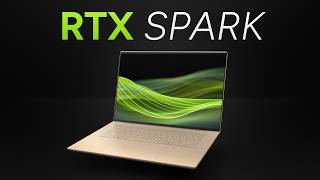
Nvidia RTX Spark AI PC chip
TECH

Nvidia RTX Spark AI PC chip

37+
Signals

Strategic Overview

  • 01.
    Nvidia and Microsoft unveiled RTX Spark on May 31, 2026 at GTC Taipei / Computex 2026 as the first Arm-based Windows PC superchip, pairing a 20-core Grace CPU co-designed with MediaTek to a Blackwell RTX GPU with 6,144 CUDA cores over NVLink-C2C.
  • 02.
    The platform delivers up to 1 petaflop of FP4 AI compute and up to 128GB of unified LPDDR5X memory, enough to run 120-billion-parameter models locally with context up to one million tokens.
  • 03.
    RTX Spark devices ship in Fall 2026 as Copilot+ certified PCs from Microsoft Surface, ASUS, Dell, HP, Lenovo and MSI, with 30+ laptops and 10+ desktops planned and Acer plus Gigabyte to follow.
  • 04.
    Windows on RTX Spark relies on the Windows 11 Prism emulator for x86/x86-64 apps and adds OS-level optimizations for unified memory and heterogeneous scheduling; Nvidia has already mapped a multi-generation roadmap through Vera Rubin Spark (2027-2028) and Rosa Feynman Spark (2029-2030).

Deep Analysis

Stack ownership, not a chip launch: RTX Spark is Nvidia's vertical-integration endgame

The hardware reads as a laptop announcement, but the strategic shape is closer to Apple's M-series moment. RTX Spark fuses a 20-core Grace Arm CPU co-designed with MediaTek, a Blackwell RTX GPU with 6,144 CUDA cores, an NPU, and up to 128GB of unified LPDDR5X over NVLink-C2C — one die where Nvidia previously sold only the discrete GPU [1][5]. IDC's Tom Mainelli reads the move plainly: "Nvidia getting into the space is Jensen recognizing that he wants to own every bit of the AI stack in some shape" [7]. The point is not winning a benchmark; it is extending CUDA, TensorRT, DLSS and RTX from the datacenter into the consumer endpoint so that every layer where developers and OEMs make decisions runs on Nvidia silicon by default. Microsoft is the willing accomplice — Satya Nadella's pitch of "unmetered intelligence to every home and every desk with Windows" requires premium silicon that mainstream Copilot+ chips cannot deliver, and Nvidia is the only vendor with both the GPU mindshare and a credible 1-petaflop FP4 budget to fill that slot [1][2]. The roadmap reinforces the read: Grace+Blackwell in 2026, Vera Rubin Spark with LPDDR6 in 2027-2028, and Rosa Feynman Spark in 2029-2030 is not a one-shot product but a multi-generation platform commitment to OEMs [8].
The Apple Silicon comparison Nvidia wants you to make — and the one it doesn't

Linus Tech Tips' framing — "NVIDIA Just Slapped Apple Silicon" — is the comparison Nvidia is happiest to live with: an Arm SoC, unified memory, ultraportable form factors, and a tight Windows integration that mirrors macOS's hardware-OS marriage. The favorable side of the analogy is real. 128GB of unified LPDDR5X means a 120-billion-parameter model can sit in memory with context up to one million tokens, which is the kind of headroom local-LLM workloads have begged for and which discrete-GPU PCs structurally cannot match [3]. The unfavorable side of the analogy is the one Nvidia is quieter about: Apple controls its own OS and ported its entire app ecosystem with Rosetta 2; Nvidia is renting Windows and inheriting the Windows 11 Prism emulator for x86/x86-64 apps [4][5]. Reddit's r/pcmasterrace skeptics — including the widely-read "Am I missing something with RTX Spark?" thread — are pointing at exactly this seam, asking whether Prism is mature enough to avoid the compatibility drag that flattened earlier Windows-on-Arm launches. The Apple Silicon comparison flatters Nvidia's hardware; it does not yet describe its software.

The market quietly splits: a $2,000+ workstation tier above Copilot+ mainstream

Analyst consensus is forming around a three-tier AI PC market, and RTX Spark is openly designed for the top one. Computerworld's roundup describes sub-$1,500 mainstream Copilot+ laptops from Intel, AMD and Qualcomm, $2,000+ RTX Spark workstations, and specialist developer machines as the new shape of the segment [6]. The pricing leak from letsdatascience pegs the entry RTX Spark systems at roughly $2,000-$2,900+, consistent with CCS Insight's Ian Fogg, who expects Spark to "carry a significant price premium" and "initially target buyers seeking workstation-class performance" [6][12]. Pareekh Jain is blunter — "more likely to be a high-end enterprise AI workstation category than a mass-market PC category" — and Greyhound's Sanchit Vir Gogia's line that issuing Spark to every employee would be "sending a Formula One car to fetch the milk" captures why corporate IT will likely buy this for specific job functions (developers, designers, ML engineers) rather than the fleet [6]. That positioning is strategically useful for Nvidia. It avoids a price war with Intel and AMD's volume Copilot+ silicon while letting Nvidia book the highest-margin slice of the AI PC TAM — exactly the same play it ran in the datacenter, where it ignored commodity inference and harvested training. Intel, AMD and Qualcomm shares slid on the announcement for a reason: even if Spark only takes the top tier, that is where most of the profit lives [10][11].

The community reality check: hype on X, skepticism on Reddit, and what's actually unproven

The social shape is unusually bifurcated. Nvidia's own channel pushed the "agentic AI PC" framing to millions; YouTube coverage from Linus Tech Tips and Dave2D each cleared a million views with broadly favorable but probing framing — Linus's "elephant in the room" chapter on Windows-on-Arm compatibility, his "time to get uncomfortable" beat near the close, and Dave2D's reframing of Nvidia as silicon-vendor-turned-OEM-shaper all hint at unresolved questions. Reddit's r/pcmasterrace went the other way: the top thread mocked Jensen's "ask and the PC does the work" framing as investor-deck marketing rather than substance. What deserves scrutiny before the Fall 2026 ship date is the Windows 11 Prism emulation of x86/x86-64 apps — the load-bearing assumption that lets Nvidia avoid a repeat of the earlier Windows-on-Arm compatibility drag [4][5]. That, more than any spec-sheet headline, is what separates a market-shifting platform from another premium-priced curiosity. The gap between the X-side hype and the Reddit-side skepticism is roughly the size of that single unknown.

Second-order effects: cloud AI economics, OEM dependence, and the agentic-PC bet

If RTX Spark ships at scale, the most underappreciated knock-on effect is on cloud AI pricing. Persistent, 24/7 on-device agents running 120B-parameter models locally undercut the per-seat and per-request economics that hyperscalers built their AI gross margins around, a pressure point Computerworld's roundup flags explicitly [6]. That is awkward for Microsoft, which sells both Copilot cloud seats and now wants Spark devices to push intelligence to the edge — the agentic-PC bet implicitly assumes that on-device inference will expand the total AI TAM faster than it cannibalizes Azure usage. The second-order effect for OEMs is dependency: Dell, HP, Lenovo, ASUS, MSI and Microsoft Surface are simultaneously launch partners and price-takers in a category where Nvidia controls the silicon, the GPU drivers, the CUDA stack and the marketing narrative [2][4]. The roadmap through Rosa Feynman in 2029-2030 turns that one-off product decision into a multi-year platform commitment for those OEMs [8]. The third effect is on the agentic AI thesis itself. Jensen's "R2D2 / C3PO" framing on Tom's Guide — that the future personal AI is a companion that lives with you rather than an app you launch — is only credible if the on-device inference works, runs cool enough for a laptop chassis, and stays compatible with the x86 apps people actually use [9]. RTX Spark is the first piece of consumer hardware that is even credibly aimed at that pitch, which is why this announcement matters even before the first unit ships.

Historical Context

2026
Qualcomm's exclusive Windows-on-Arm arrangement with Microsoft expired, removing the contractual barrier that had kept Nvidia and MediaTek out of the Arm Windows PC segment.
2026-05-31
Joint RTX Spark unveiling at Nvidia GTC Taipei during Computex 2026 week, framed by Jensen Huang and Satya Nadella as the start of the agentic AI PC era.
2026-06-01
Nvidia disclosed a multi-generation Spark roadmap: Grace+Blackwell in 2026, Vera Rubin Spark with LPDDR6 in 2027-2028, and Rosa Feynman Spark in 2029-2030, signaling long-term commitment to the PC platform.
2026
First RTX Spark laptops and compact desktops planned from Microsoft Surface, ASUS, Dell, HP, Lenovo and MSI in Fall 2026, with Nvidia previewing 30+ laptops and 10+ desktops and Acer plus Gigabyte joining in a second wave.

Power Map

Key Players
Subject

Nvidia RTX Spark AI PC chip

NV

Nvidia

Designer and lead vendor of RTX Spark, pivoting from a datacenter GPU supplier to a full Windows PC platform owner so it can extend CUDA, TensorRT and RTX all the way to the consumer endpoint.

MI

Microsoft

Co-announced the platform and is integrating RTX Spark into the Copilot+ tier and its agentic Windows OS vision, with Surface Laptop Ultra among the launch devices.

ME

MediaTek

Co-developed the custom 20-core Grace Arm CPU, supplying the CPU design expertise Nvidia lacked to enter the Windows-on-Arm PC market.

AR

Arm

ISA provider positioning RTX Spark as the marquee proof point that Arm-based PCs can anchor the agentic computing era.

AS

ASUS, Dell, HP, Lenovo, MSI and Microsoft Surface

Initial OEM launch partners shipping the first wave of RTX Spark laptops and small-form-factor desktops in Fall 2026.

IN

Intel, AMD and Qualcomm

Incumbent PC silicon vendors directly threatened by RTX Spark; their shares reportedly slid on the announcement as Nvidia attacks the highest-margin slice of the AI PC market.

Fact Check

12 cited
  1. [1] NVIDIA RTX Spark Reinvents Windows PCs With Microsoft for the Age of Personal AI
  2. [2] Introducing a powerful new chapter for Windows PCs accelerated by NVIDIA RTX Spark
  3. [3] Nvidia unveils RTX Spark superchip at Computex 2026
  4. [4] Nvidia enters the Windows PC market with RTX Spark
  5. [5] Nvidia RTX Spark
  6. [6] RTX Spark may split the AI PC market into mainstream laptops and premium workstations
  7. [7] Nvidia's new PC chips are CEO's bid to own every part of AI stack
  8. [8] NVIDIA confirms RTX Spark roadmap with Rubin in 2027 and Rosa Feynman in 2029
  9. [9] I spoke to Nvidia CEO Jensen Huang about RTX Spark
  10. [10] NVIDIA RTX Spark brings Blackwell AI to Windows laptops this Fall; Intel, AMD shares slide
  11. [11] Nvidia debuts RTX Spark processor for Windows laptops, taking aim at Intel, AMD
  12. [12] RTX Spark N1X forces $2,900 minimum PC price

Source Articles

Top 5

THE SIGNAL.

Analysts

"Pitches RTX Spark as a generational reinvention of the PC where users describe intent and the machine executes: "The PC is being reinvented. For forty years, you launched apps. Click. Type. With RTX Spark and Microsoft Windows, you ask — the PC does the work.""

Jensen Huang
Founder and CEO, Nvidia

"Frames RTX Spark as the silicon Microsoft needs to bring always-on AI to every Windows device: "Our goal is to deliver unmetered intelligence to every home and every desk with Windows.""

Satya Nadella
Chairman and CEO, Microsoft

"Reads RTX Spark as a stack-ownership move, not a PC product: "Nvidia getting into the space is Jensen recognizing that he wants to own every bit of the AI stack in some shape.""

Tom Mainelli
Analyst, IDC

"Argues this is a workstation play, not a consumer one: "In the near term, RTX Spark is more likely to be a high-end enterprise AI workstation category than a mass-market PC category.""

Pareekh Jain
CEO, Pareekh Consulting

"Calls RTX Spark overkill for typical office AI workloads: "Issuing Spark to every employee for that would be sending a Formula One car to fetch the milk.""

Sanchit Vir Gogia
Analyst, Greyhound Research

"Expects a steep premium that funnels Spark to workstation buyers first: "RTX Spark will likely carry a significant price premium and will initially target buyers seeking workstation-class performance.""

Ian Fogg
Research Director, CCS Insight
The Crowd

"Welcome to the NVIDIA RTX Spark channel. A new superchip for the age of personal AI. Don't worry, your favorite NVIDIA local AI content continues on right here, just with a new headliner. Let's get started..."

@@NVIDIARTXSpark7607

"NVIDIA RTX Spark reinvents @Windows PCs for the era of personal AI agents, offering a new class of computer that moves from tool to teammate."

@@NVIDIARTXSpark1794

"This is the context where Jensen Huang said "ARM is perfect." Jensen at Computex explaining NVIDIA's new RTX Spark: "We wanted to reinvent the computer." - ARM 20-core CPU with excellent single-thread performance - New NVFP4 format to compress LLMs and fit powerful AI directly in system memory - Full CUDA + Tensor Core integration so agents get blazing-fast tool responses Adobe, Blender, Autodesk, Siemens — everything accelerated for the Agentic AI era. This is how NVIDIA is rebuilding the PC for the next 40 years. ARM + NVIDIA is the perfect combination. #RTXSpark #NVIDIA #Computex2026 #AgenticAI #ARM"

@@SVTrivo33

"NVIDIA just announced the RTX Spark CPU, developed with Microsoft, at Computex."

@u/pedro197400
Broadcast
NVIDIA RTX Spark Reinvents Windows PCs for the Age of Personal AI

NVIDIA RTX Spark Reinvents Windows PCs for the Age of Personal AI

NVIDIA Just Slapped Apple Silicon - RTX Spark

NVIDIA Just Slapped Apple Silicon - RTX Spark

Nvidia's New Laptops - RTX Spark

Nvidia's New Laptops - RTX Spark