Nvidia's reported acquisition of Hugging Face
TECH

Nvidia's reported acquisition of Hugging Face

29+
Signals

Strategic Overview

  • 01.
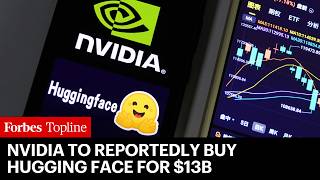
    Nvidia is reportedly nearing a deal to acquire Hugging Face for about $12.9 billion, a figure that could total roughly $14 billion once a reported $1 billion employee retention package is included; neither company has confirmed the deal.
  • 02.
    If completed, this would be Nvidia's largest acquisition ever, more than $6 billion above the $6.9 billion it paid for networking company Mellanox in 2020.
  • 03.
    Hugging Face turned down a $500 million Nvidia investment about a year earlier that would have valued the company at $7 billion, reportedly because it did not want a single dominant investor.
  • 04.
    Hugging Face's estimated annual revenue is roughly $100-150 million, up from about $50 million in 2024, meaning the reported deal price implies a revenue multiple of about 86x to 129x.

Deep Analysis

A Control Premium, Not a Cash-Flow Multiple

Strip away the headline number and the deal only makes sense as a bet on influence rather than earnings. Hugging Face's estimated annual revenue sits around $100-150 million, up from roughly $50 million in 2024, which puts the reported $12.9 billion price at an implied 86x to 129x revenue multiple [1][2]. That dwarfs Nvidia's own prior record: the $6.9 billion it paid for networking firm Mellanox in 2020, which would become the second-largest deal in company history if this one closes [3]. The number looks even more striking next to what Nvidia was willing to pay barely a year earlier: Hugging Face turned down a $500 million investment that would have valued it at just $7 billion, reportedly because it did not want a single dominant investor [4]. Futurum Group's Nick Patience argues the real asset being purchased is not the balance sheet but the relationship: "What NVIDIA stands to gain is something harder to replicate: a direct relationship with the millions of developers who decide which models become default choices" [1]. At roughly 26 times the investment Nvidia was offering just a year earlier, the price only computes as a bet on control of a chokepoint, not on cash flow.

Financial-market reaction to the reported price adds a layer largely absent from the mainstream financial coverage above: social commentary, including a widely-shared breakdown by finance commentator Paul Bonnet, framed the deal primarily as a payout story for Hugging Face's early backers, with investors splitting an estimated $7.3 billion in gains on less than $400 million invested, a roughly 20x blended return, and Lux Capital singled out as the single biggest winner. Reflecting a similar read, market commentator Shay Boloor described Nvidia as buying "one of AI's biggest open-source distribution layers... creating a natural outlet for the massive amount of AI compute it is helping finance," a demand-side rationale that complements the control-premium logic above rather than replacing it. Even as that framing spread, the deal remained formally unconfirmed: when Bloomberg TV reported a roughly $13 billion valuation, Hugging Face co-founder Thomas Wolf declined to comment on specifics, saying only that the startup "has always attracted interest."
Where Neutrality Actually Gets Tested: Hardware Backends

The abstract worry about platform neutrality has a concrete mechanism. Hugging Face today hosts models built for AMD GPUs, Apple silicon, Google TPUs, and Nvidia hardware side by side, and that cross-hardware openness is what frameworks like Apple's MLX rely on to reach Hugging Face's user base [5][6]. The New Stack frames the risk as structural rather than a matter of stated policy: "An independent platform would've had no real reason to pick hardware winners. Under Nvidia ownership, the pressure to prioritize its own silicon becomes built-in" [5]. Commentary circulating since the deal broke has zeroed in on one especially concrete pressure point: Hugging Face's reported ownership of llama.cpp, the widely used inference engine whose Metal, Vulkan, and CPU backends are what let non-Nvidia hardware, including Macs, run open models efficiently. Whether Nvidia would ever throttle or simply under-invest in those backends relative to CUDA is unresolved, but it is the specific lever observers are watching, not an abstract governance promise.

A Hedge Against the Custom-Silicon Wave

The deal reads less like empire-building for its own sake and more like defense. Nvidia currently holds an estimated 85% of the AI chip market and posted about $96.2 billion in revenue with a 75% profit margin, but that dominance is precisely what is drawing challengers [7]. Google is running its own TPUs for Gemini, Anthropic has hired a former Google TPU lead, OpenAI's in-development chip has reportedly beaten Nvidia, AMD, and Google chips in internal tests, and Google, OpenAI, and Meta are all working with Broadcom on custom silicon [7]. Owning the platform where open models actually get distributed lets Nvidia keep a large swath of the ecosystem, from startups to governments to individual developers, downloading and running models on whatever hardware they already have, most of which is still Nvidia's. Forrester's Charlie Dai frames the strategic logic this way: "Nvidia has already built an extended ecosystem through GPUs, CUDA, networking, inference software, and AI frameworks. If this deal is confirmed, Hugging Face would give it a stronger position at the developer, model distribution, and community layers, which will strategically help shape where AI workloads are built and deployed" [8].

GitHub or Sun Microsystems: Which Precedent Applies

The closest comparable in scale and shape is Microsoft's 2018 purchase of GitHub, which stayed broadly open and accessible even as Microsoft gradually wove in its own AI tools and cloud services, a template some analysts point to as the likely path here [6]. But that is not the only historical comparison being drawn. Commentary elsewhere has reached instead for a starkly different precedent: Oracle's acquisition of Sun Microsystems, remembered by critics for souring developer trust badly enough that it spawned defensive forks such as MariaDB out of MySQL and LibreOffice out of OpenOffice. The disagreement matters because the two precedents predict opposite outcomes - gradual, largely benign integration versus a slow-motion trust collapse that pushes the community to fork or flee. Nothing in the current reporting settles which pattern applies, and that unresolved tension is itself what Hugging Face's developer base appears to be watching for.

The Unstated Rationale: Competing With China's Open Models

A less-discussed but recurring thread in reaction to the deal is geopolitical rather than purely commercial. Hugging Face's own usage data reportedly shows models from Chinese labs accounting for a large and rising share of platform downloads, including a majority of open-model downloads even inside the US by some accounts. Nvidia CEO Jensen Huang's own recent public defense of open-source AI, joined by Microsoft, Amazon, and Meta but notably not Anthropic, has been read by some observers as connected to the timing of this deal. Under that reading, owning Hugging Face is less about squeezing rivals and more about keeping a Western, Nvidia-adjacent alternative competitive against open weights trained in China, since open models overwhelmingly run on Nvidia GPUs regardless of who trains them. That framing is speculative and largely absent from mainstream financial coverage of the deal, but it recurs often enough in commentary to be a real, if unconfirmed, part of the strategic picture.

Historical Context

2016
Founded originally as a chatbot company before becoming the leading open-source hub for AI models and datasets.
2018
Microsoft acquired GitHub and kept it broadly accessible while gradually integrating its own AI tools and cloud services, a precedent some analysts cite as a possible template for Nvidia and Hugging Face.
2020
Nvidia's $6.9 billion acquisition of Mellanox stood as its previous largest deal, a mark the reported Hugging Face price would surpass.
2023-08
Raised $235 million in a Series D round led by Salesforce Ventures, with Nvidia, Google, Amazon, Intel, Qualcomm, IBM, Sequoia, and Lux Capital participating, setting a $4.5 billion valuation.
2025
Hugging Face rejected a $500 million Nvidia investment offer that would have valued it at $7 billion, reportedly to avoid a single dominant investor.

Power Map

Key Players
Subject

Nvidia's reported acquisition of Hugging Face

JE

Jensen Huang (Nvidia CEO)

Leading Nvidia's push beyond chips into AI model distribution; the deal is described as his biggest expansion move yet to broaden Nvidia's customer base and secure a developer-facing distribution layer.

CL

Clem Delangue (Hugging Face CEO)

Leads the company being acquired; previously rejected Nvidia's smaller investment offer over independence concerns and has noted competitive pressure from Chinese open-source AI.

AM

AMD, Intel, and custom-silicon efforts at Google, Amazon, and OpenAI

Rival hardware players with a direct interest in Hugging Face remaining neutral; likely to raise concerns during regulatory review and may accelerate investment in independent model-distribution alternatives.

HY

Hyperscalers and model vendors

Face new competitive pressure at the developer and distribution layer if Nvidia controls the dominant model hub; Forrester's Charlie Dai says the deal would help Nvidia shape where AI workloads are built and deployed.

Fact Check

8 cited
  1. [1] Nvidia Nears $12.9B Deal for Hugging Face: Escalating AI Ecosystem Strategy
  2. [2] Nvidia's $12.9B Hugging Face Bid Could Reshape Open-Source AI
  3. [3] Nvidia Buying Hugging Face for Nearly $13 Billion
  4. [4] Nvidia Discussed Buying AI Startup Hugging Face, Insider Says
  5. [5] Nvidia Hugging Face Acquisition Neutrality
  6. [6] Can Hugging Face Stay Neutral After Nvidia's $12.9 Billion Acquisition?
  7. [7] Nvidia, Hugging Face, Chips and Open Source
  8. [8] Nvidia's Hugging Face Acquisition Could Pose a Big Threat to Hyperscalers

Source Articles

Top 5

THE SIGNAL.

Analysts

Says Nvidia already commands an extended ecosystem through GPUs, CUDA, networking, and inference software, and that Hugging Face would extend that dominance into the developer and model-distribution layer, pressuring hyperscalers and alternative hardware vendors: "Nvidia has already built an extended ecosystem through GPUs, CUDA, networking, inference software, and AI frameworks. If this deal is confirmed, Hugging Face would give it a stronger position at the developer, model distribution, and community layers, which will strategically help shape where AI workloads are built and deployed."

Charlie Dai
VP Principal Analyst, Forrester

Argues the real prize is the direct developer relationship Hugging Face provides rather than its financials, and separately warns that regulators will scrutinize the deal as compounding Nvidia's existing market power: "What NVIDIA stands to gain is something harder to replicate: a direct relationship with the millions of developers who decide which models become default choices," and "Expect regulators to examine whether Hugging Face's role as a model-distribution chokepoint would compound existing concerns about NVIDIA's market position."

Nick Patience
VP, AI Platforms, Futurum Group

Warns that an Nvidia-owned Hugging Face could subtly steer the platform toward its own hardware even without an overt policy change, citing Microsoft's ownership of GitHub as a precedent for gradual integration rather than immediate disruption: "An independent platform would've had no real reason to pick hardware winners. Under Nvidia ownership, the pressure to prioritize its own silicon becomes built-in."

Unnamed industry commentary
Analysis, The New Stack
The Crowd

Nvidia acquires Hugging Face for ~$12.9bn. But who gets the money? My usual breakdown below. Investors are sharing ~$7.3bn of profits on <$400m invested. A cool ~20x blended. 1) The single biggest winner here? Lux Capital. Lux is taking the crown for the most $ returned

@@PaulBonnet1901

$NVDA has agreed to buy Hugging Face for $12.9B to own one of AI's biggest open-source distribution layers. Hugging Face gives Nvidia a way to push more models toward its hardware while creating a natural outlet for the massive amount of AI compute it is helping finance.

@@StockSavvyShay426

Nvidia is nearing an agreement to acquire Hugging Face in a deal that would value the AI startup at roughly $13 billion, according to news reports. Co-founder Thomas Wolf declined to comment on those reports, but he did say the AI startup has always attracted interest and offers

@@BloombergTV67

Nvidia agrees to buy Hugging Face for $12.9 billion, report says

@u/Force_Hammer3800
Broadcast
The Real Reason NVIDIA Is Buying Hugging Face

The Real Reason NVIDIA Is Buying Hugging Face

NVIDIA Buys Hugging Face the GitHub for AI - Not the Worst Outcome

NVIDIA Buys Hugging Face the GitHub for AI - Not the Worst Outcome

Nvidia Has Reportedly Agreed To Buy AI Model Hosting Platform Hugging Face For $13 Billion

Nvidia Has Reportedly Agreed To Buy AI Model Hosting Platform Hugging Face For $13 Billion

Nvidia's reported acquisition of Hugging Face — AI News | Agentic Brew