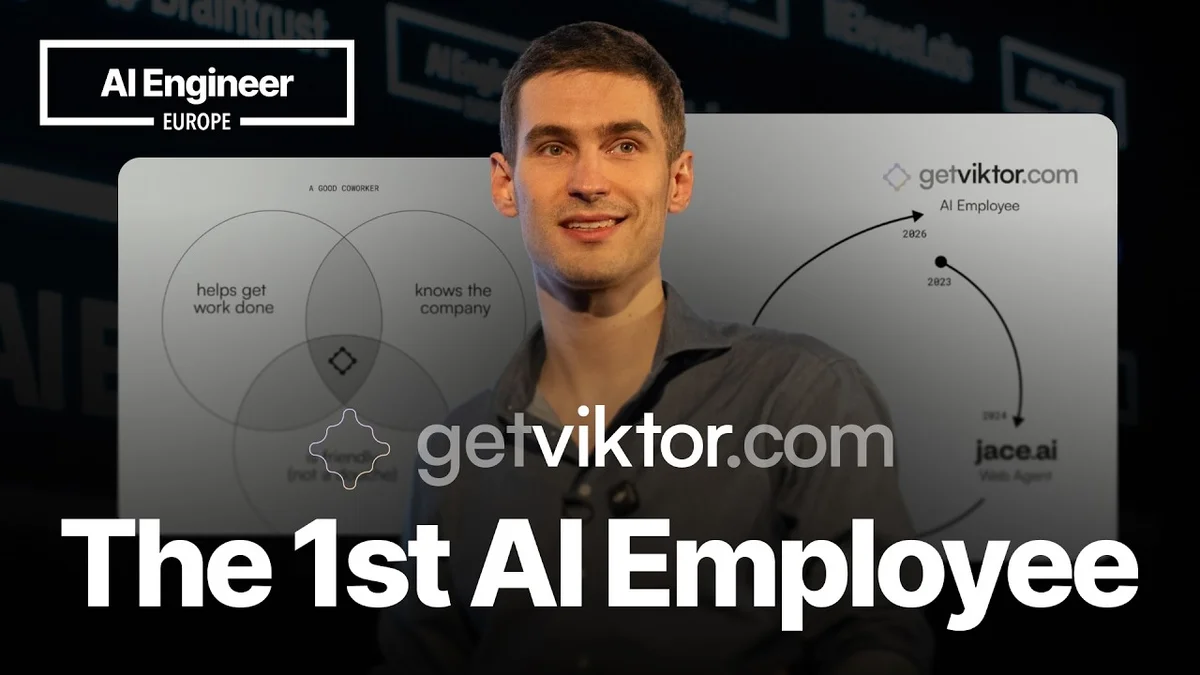
Zeta Labs launches AI employee Viktor in Microsoft Teams
TECH

Zeta Labs launches AI employee Viktor in Microsoft Teams

24+
Signals

Strategic Overview

  • 01.
    On June 18, 2026, Zeta Labs brought Viktor, its self-described AI employee, to Microsoft Teams, expanding from its Slack-native origins into the Microsoft ecosystem.
  • 02.
    Rather than acting as a passive chatbot, Viktor lives inside Teams channels as a coworker, executing multi-step workflows such as report generation, project setup, and data syncing in response to plain-language requests, with one license covering an entire channel team.
  • 03.
    Viktor connects to 3,000+ tools, maintains persistent memory, and writes and runs code to produce reports, dashboards, and web apps; it is SOC 2 Type 1 certified.
  • 04.
    The launch positions Viktor as an autonomous executor against Microsoft's own Copilot, which assists and drafts rather than completing delegated tasks end-to-end.

An employee, not an assistant: the execution-layer thesis

Viktor's core claim is that it does not draft, suggest, or summarize — it executes. Where most workplace AI generates text, Viktor maintains a persistent workspace, connects to a company's actual tools, and performs actions end-to-end [1][2]. A request like 'create a project brief from last week's meeting notes and share it with the marketing team' is meant to result in a finished, shared brief rather than a draft handed back for review [2]. Each instance runs on its own persistent cloud computer where it writes and runs code to produce PDFs, dashboards, and web apps. The strategic bet, endorsed by lead investor Accel, is that owning the execution layer for an entire team — not assisting one individual — is where the next tens of billions of dollars of AI adoption sit [3]. Crucially, Viktor goes to where work is already discussed: it lives natively inside Slack and now Teams channels, converting in-channel conversation into completed tasks rather than asking teams to adopt yet another app or dashboard [1].

A collision on Microsoft's own turf

By launching inside Teams, Viktor competes with Microsoft Copilot on Microsoft's home platform. The two products embody opposing philosophies of workplace AI: Copilot drafts content and offers suggestions under human oversight, while Viktor positions itself as an autonomous agent that takes delegated workflows and finishes them [2]. On Teams, Viktor integrates with the Microsoft 365 stack — SharePoint, Outlook, Planner, To Do, Power Automate — alongside third-party SaaS such as Salesforce, Jira, and Workday, and ships SOC 2 Type 1 certification [1][2]. Because an autonomous agent taking real actions carries far more risk than a text generator, Viktor wraps execution in enterprise governance: admins define permitted actions, restrict sensitive channels, require human approval for high-risk tasks, and log every interaction, with customer data excluded from public model training [2]. The framing is explicitly a 'hire' rather than a tool, aimed at operations teams, agencies, and growing businesses that want automation without adding headcount [1].

The credit-burn gap between the pitch and the practice

The promotional layer around Viktor is loud and bullish — hands-on creator accounts describe adding it to Teams, asking it to pull email numbers and draft campaigns, and watching it execute in-channel, and the founder frames it as a teammate handling roughly ten-minute tasks autonomously. But much of that buzz appears to be part of a paid creator program, and the most substantive critical discussion sits elsewhere. Early community feedback centers less on capability than on usage economics: the recurring complaint is credit burn, where connecting apps, re-reading environments, and running Viktor on a schedule consume credits quickly. The sharpest version of the critique argues this cost is structural, not a tuning issue — tools in this tier tend to re-ingest context from scratch on each run rather than diffing against cached state, because a true checkpoint or caching layer is technically hard and often skipped to ship fast. With pricing at a free tier carrying $100 in credits and a $50-per-month team plan for 20,000 credits [4], that consumption model is the load-bearing question for buyers weighing the autonomous-employee pitch against monthly cost.

The hard part is scaling one agent to a whole company

Beneath the product framing sits a genuinely difficult engineering problem that explains why a channel-native agent is non-trivial. The founder describes the chat surface as a deceptively complex input: threads, direct messages, edits, deletions, and emoji reactions all carry meaning an agent must interpret correctly. Harder still is memory isolation when a single Viktor serves hundreds of users across many channels and DMs — context from one conversation must never leak into another. The team also reports that swapping the underlying model for a cheaper one produces user-noticeable regressions, which constrains how aggressively the economics can be optimized. Independent hands-on comparisons frame Viktor as the autonomous end of the spectrum — working for you rather than with you — and credit it with built-in memory that learns a business over time, the same persistent-memory capability that makes the multi-user isolation challenge so central to the product.

Historical Context

2024
Raised $2.9M pre-seed and launched JACE, an early autonomous AI agent that became the foundation for Viktor's agent infrastructure.
2026-02
Viktor publicly launched, initially as a Slack-native AI coworker.
2026-05-19
Raised a $75M Series A led by Accel (total funding $77.9M), described as the largest ever raised by a Polish-founded company.
2026-06-18
Launched Viktor on Microsoft Teams, expanding from Slack into the Microsoft ecosystem.

Power Map

Key Players
Subject

Zeta Labs launches AI employee Viktor in Microsoft Teams

ZE

Zeta Labs

Developer of Viktor, founded by former Meta engineers Fryderyk Wiatrowski (CEO) and Peter Albert (CTO). Viktor builds on the company's earlier autonomous agent product, JACE.

MI

Microsoft

Owner of the new deployment platform, Teams. Viktor is positioned as an autonomous executor competing directly with Microsoft Copilot, which assists rather than executes end-to-end.

AC

Accel

VC that led Viktor's $75M Series A; partner Zhenya Loginov publicly endorsed the team-centric product strategy over individual-assistant approaches.

ST

Stewart Butterfield and Cal Henderson

Slack cofounders and angel investors in Viktor's Series A, a notable backing given Viktor's origins as a Slack-native product.

Fact Check

4 cited
  1. [1] Zeta Labs' AI employee Viktor lands on Microsoft Teams to execute work inside channels
  2. [2] Zeta Labs brings AI employee Viktor to Microsoft Teams
  3. [3] Viktor AI startup raises $75 million for virtual coworker
  4. [4] Viktor — the AI employee that lives in Slack and Microsoft Teams

Source Articles

Top 4

THE SIGNAL.

Analysts

"Praises Viktor's decision to build for the team rather than for individual assistance, calling it a defining product choice: "Most of these products, if not all of them, are focused on individual assistance…not for the team, and that was one of the big kind of product choices that [Viktor] made that we thought was fantastic.""

Zhenya Loginov
Partner, Accel

"Frames personal work assistance as the next major wave of AI adoption: "We feel the personal work assistance is really the big third wave of AI adoption that can yield tens of billions of dollars.""

Zhenya Loginov
Partner, Accel
The Crowd

"Viktor's $75M Series A led by Accel signals a clear shift for AI at work: AI coworkers inside collaboration platforms such as Slack and Microsoft Teams, connected to 3,000+ tools. AI should reduce friction and give people more space for judgment. @viktor__com Partner"

@@antgrasso61

"I added Viktor to my Microsoft Teams this week. Asked it to pull the email numbers and draft next week's campaigns. It did it in the channel, then offered to schedule. Teams has an AI employee now. @viktor__com"

@@ecomchasedimond33

"Everyone is building AI you talk to. Zeta Labs just raised $75M for AI that actually WORKS for you inside Slack + Teams. No dashboards. No extra tabs. No "open another app." Just message → execution. This feels like the real AI-agent shift."

@@Shruti_081037

"GetViktor.com Referral Credits Round Up!"

@u/dentonbros1
Broadcast
Viktor: AI Coworker That Lives in Slack — Fryderyk Wiatrowski

Viktor: AI Coworker That Lives in Slack — Fryderyk Wiatrowski

Viktor Just Killed Claude Code For Teams

Viktor Just Killed Claude Code For Teams

Claude Cowork vs Viktor - AI co-pilot vs autonomous AI agent

Claude Cowork vs Viktor - AI co-pilot vs autonomous AI agent