
Coatue: AI is automating white-collar and software engineering work
TECH

Coatue: AI is automating white-collar and software engineering work

20+
Signals

Strategic Overview

  • 01.
    Coatue's 2026 market report frames AI's opportunity as capturing white-collar payroll, sizing a Total Digital AI market above $4 trillion split evenly between a $2 trillion coding market and a $2 trillion non-developer white-collar market.
  • 02.
    Coatue uses OpenAI's Codex as its coding-automation exhibit; OpenAI's own data shows knowledge workers who are not engineers now make up about 20% of Codex users and are growing more than three times as fast as developers.
  • 03.
    OpenAI reports Codex has surpassed 5 million weekly active users, up more than sixfold since its February desktop-app launch.
  • 04.
    Coatue projects roughly $12 trillion in AI capital expenditure will be deployed between 2026 and 2031, which it calls one of the largest coordinated capital mobilizations in private-industry history.

Deep Analysis

Software Is the Canary: Why Coatue Started With Code

Coatue's pitch opens with a single, deliberately provocative chart. It plots what share of OpenAI's internal output tokens are generated by Codex, the company's coding agent, versus ChatGPT - and by Coatue's own chart, inside OpenAI's engineering function Codex usage has crossed 50%. The point is not that OpenAI is unusual but that it is a preview: at the company sitting closest to the frontier, more than half of engineering 'output' is already produced by an agent rather than typed by a human.

The underlying claim is economic, not merely technical. In the agentic paradigm, Coatue argues, the marginal cost of producing software is collapsing toward zero [1], which makes software engineering the first knowledge domain where AI economics visibly bite. The external evidence lines up with the story: OpenAI reports Codex has surpassed 5 million weekly active users, up roughly sixfold since its February desktop launch [2], and - the detail that turns a developer tool into a white-collar thesis - knowledge workers who are not engineers now account for about 20% of Codex users and are growing more than three times as fast as developers [3].

Follow the Payroll: A $4 Trillion Bet on Replacing Salaries

Follow the Payroll: A $4 Trillion Bet on Replacing Salaries
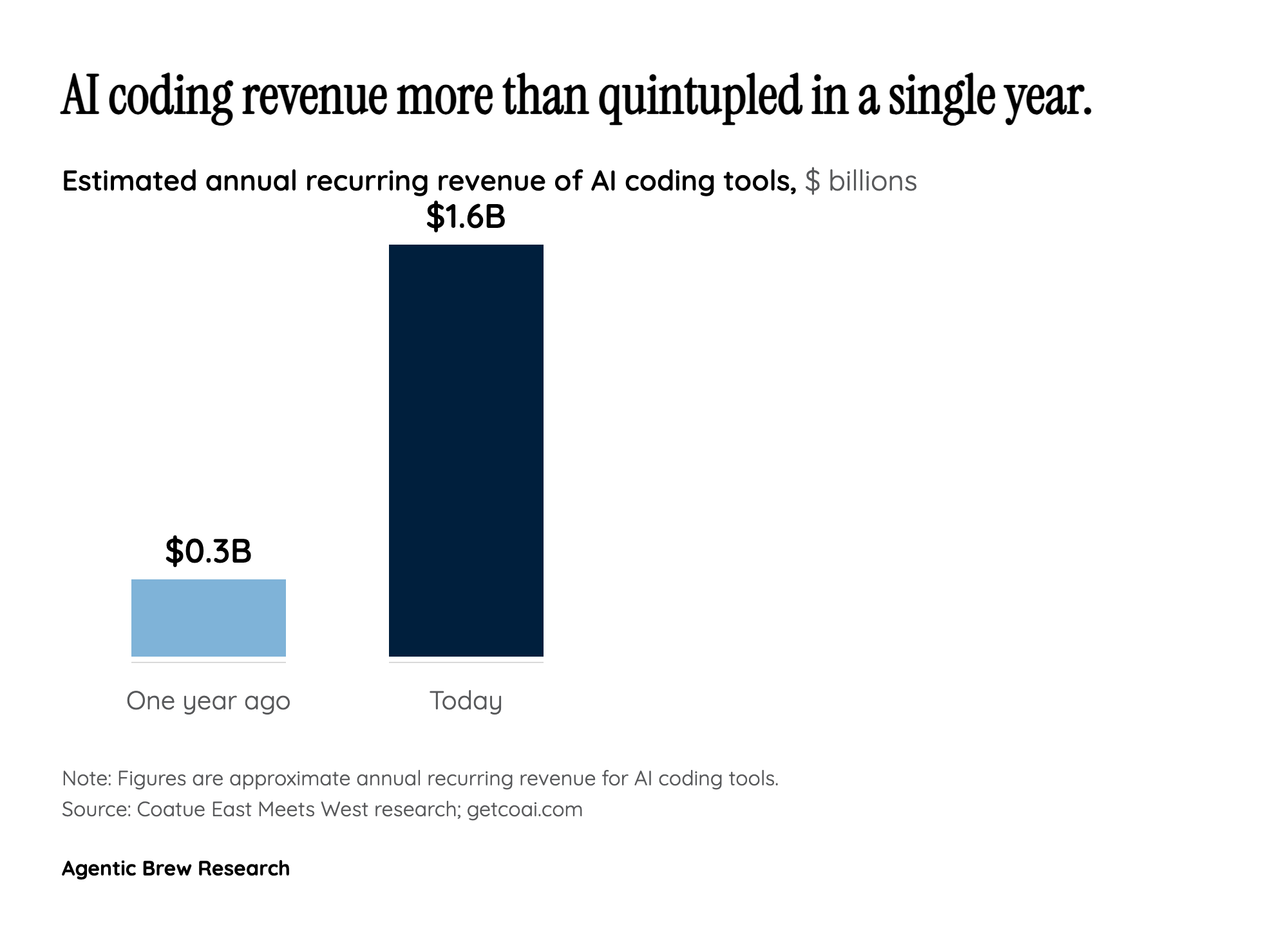
AI coding tool revenue climbed from roughly $300M to about $1.6B in annual recurring revenue in a single year.

What makes Coatue's deck land with investors is how it sizes the prize. The firm models AI not as incremental software spend but as a claim on payroll: it sizes a $2 trillion coding market at 40% of the world's $5 trillion engineering payroll, and adds a further $2 trillion by taking 50% of the roughly $4 trillion global SG&A (sales, general and administrative) budget - a combined Digital AI market north of $4 trillion [1]. Framing the opportunity as a transfer out of salary lines is precisely what makes the thesis about displacement rather than assistance.

The clearest near-term proof point is revenue that is already changing hands. AI coding tools grew from roughly $300 million to about $1.6 billion in annual recurring revenue in a single year [4], evidence that budget is beginning to flow from headcount toward software. That trajectory is also why the capital commitment is so large: Coatue projects roughly $12 trillion in AI capital expenditure between 2026 and 2031 [5]. The entire bet rests on one unproven premise - that agents actually absorb white-collar labor at scale rather than merely speeding it up.

The Great Separation Cuts Both Ways

Coatue's thesis carries a dangerous second edge for the very industry that produces AI. If agents drive the cost of code toward zero, the mid-tier software vendors selling that code lose their pricing power. Naval Ravikant framed it as the natural next turn of the old venture line: software ate the world, and now AI is eating software [6], warning that commoditized, undifferentiated SaaS is the most exposed while businesses with proprietary data or regulated moats endure.

Coatue packages this split as a 'great separation' between AI winners and losers [4], and public markets have begun to price it. A February 2026 selloff wiped more than $1 trillion from enterprise-software valuations [6]as investors reweighted toward the companies capturing AI value and away from those most likely to be disintermediated. The uncomfortable implication is that the same research used to justify enormous AI investment doubles as a warning to much of the existing software economy.

What the People in the Thesis Actually Say

For all the trillion-dollar framing, the workers whose jobs the thesis names are notably unconvinced. The dominant reaction across developer and general-tech communities is that AI is amplifying productivity rather than replacing roles wholesale - the felt reality is hiring slowdowns, role consolidation and heavier code-review load, not empty offices. One recurring skeptical argument aims straight at the vendors: if a tool could truly replace all white-collar work, its maker would use it to dominate markets rather than sell seats at a developer conference.

The harder data sits between the hype and the backlash. Research surfaced alongside Coatue's thesis finds that employment among early-career workers in the most AI-exposed occupations has fallen about 16% since ChatGPT's launch [7]- evidence that displacement is real but concentrated at the entry level, hitting careers before they start rather than erasing whole professions overnight. That gap - between a boardroom thesis of total automation and a ground-level experience of quiet erosion - is the tension worth watching.

Historical Context

2015
Coatue began holding its annual East Meets West conference, where the Laffonts deliver their 'State of the Markets' keynote.
2025
Coatue introduced its 'great separation' thesis and sized knowledge work as a multi-trillion-dollar market, the precursor to its 2026 white-collar-automation framing.
2026-06-02
OpenAI launched new Codex tools aimed at white-collar work and published data showing knowledge-worker adoption growing three times faster than developer adoption.

Power Map

Key Players
Subject

Coatue: AI is automating white-collar and software engineering work

CO

Coatue Management (Philippe and Thomas Laffont)

Author of the thesis; the crossover fund publishing the AI market framework and 'great separation' argument at its annual East Meets West conference. As a large AI investor its research shapes how the market reads AI's labor impact.

OP

OpenAI

Supplies the Codex usage data that serves as Coatue's empirical exhibit for coding automation; its internal token mix is the evidence that engineering work is already largely agent-produced.

AN

Anthropic (Claude Code)

Named in the report as a driver of surging code-token consumption, cited as evidence that software is the first knowledge domain being absorbed by AI agents.

AI

AI coding tool vendors (GitHub Copilot, Cursor, Windsurf, Replit, Cognition and peers)

The vendors monetizing engineering automation whose combined revenue growth Coatue points to as proof that coding work is being converted into software spend.

Fact Check

7 cited
  1. [1] Inside Coatue's Market Report 2026
  2. [2] OpenAI launches new Codex tools for white-collar work
  3. [3] Codex for knowledge work
  4. [4] Coatue Research Reveals AI Is Creating a Great Separation Between Winners and Losers
  5. [5] Coatue May 2026 AI Report
  6. [6] Naval Ravikant's AI Thesis Is Playing Out In Public Markets
  7. [7] The Real Job Destruction From AI Is Hitting Before Careers Can Start

Source Articles

Top 1

THE SIGNAL.

Analysts

"Argues AI is now absorbing the software layer itself, warning that commoditized mid-tier software is vulnerable to being absorbed while proprietary-data and regulated-compliance businesses keep durable value."

Naval Ravikant
Angel investor and AngelList founder

"Contends AI can replace whole job functions rather than merely making existing work more efficient, because in the agentic paradigm labor output is no longer capped by human headcount."

Coatue Management
Crossover investment firm, via founders Philippe and Thomas Laffont

"Finds the first measurable job destruction from AI is concentrated at the entry level, with employment among early-career workers in the most AI-exposed occupations down about 16% since ChatGPT's launch."

Yale School of Management (Insights, citing Stanford research)
Academic analysis of AI labor-market effects
The Crowd

"SITUATION EXPLAINED: Coatue just published a chart showing how fast AI agents are replacing internal white-collar functions at OpenAI itself. • Chart tracks what percent of OpenAI's internal output tokens are generated by Codex vs ChatGPT • Engineering crossed 50% Codex usage"

@@MTSlive67

"Applied Intuition CEO @qasar says the market for physical AI is "way, way bigger" than the market for white-collar AI: "I used to be at Y Combinator. I was the COO, ran the firm, and funded lots of interesting companies. And one of the analogies I used to use to help founders"

@@tbpn124

"Anthropic CEO Dario Amodei on AI and white-collar productivity: it starts by automating most of your tasks, but eventually it gets close to 100%."

@@realBigBrainAI42

"The "AI will automate all white collar work" crowd has a serious blind spot"

@u/Minute-Buy-8542751
Broadcast
Chips, Gigawatts, AI, & Agents: Coatue's Public Markets Update | CIO Jaimin Rangwalla

Chips, Gigawatts, AI, & Agents: Coatue's Public Markets Update | CIO Jaimin Rangwalla

Thomas Laffont, Coatue - Anthropic, Citrini Paper, AI Volatility & Next Mag 7

Thomas Laffont, Coatue - Anthropic, Citrini Paper, AI Volatility & Next Mag 7

How AI is Causing a White Collar Bloodbath

How AI is Causing a White Collar Bloodbath