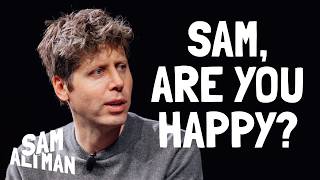
Sam Altman's 2026 interview: OpenAI roadmap, singularity, AI CEO succession
TECH

Sam Altman's 2026 interview: OpenAI roadmap, singularity, AI CEO succession

21+
Signals

Strategic Overview

  • 01.
    In a roughly 70-minute Relentless podcast interview with host Ti Morse (published around July 25, 2026), Sam Altman declared 'we are now in the singularity' and described a scaling loop of AI-directed robots building more data centers.
  • 02.
    Speaking separately at the Feb 19, 2026 AI Impact Summit in New Delhi, Altman said a future AI superintelligence could do a better job as OpenAI's CEO than 'certainly me' within a reasonably short time - a claim not made during the Relentless conversation.
  • 03.
    The popular 'chatbots to coding agents to persistent AI coworkers' roadmap framing, and Altman's account of dropping Sora to prioritize coding agents, both trace to separate 2026 appearances and explainers rather than to the Relentless interview itself.
  • 04.
    OpenAI's 2019 restructuring into a capped-profit company followed a specific funding crisis: Elon Musk pledged roughly $1 billion, then reneged, reportedly wanting control - not the vague 'near-collapse' framing some coverage has used.

Deep Analysis

What actually happened on Relentless - and what didn't

Sam Altman's roughly 70-minute conversation with Ti Morse on the Relentless podcast, published around July 25, 2026, is the specific occasion behind the 'we are now in the singularity' quote and the description of a scaling loop where AI-directed robots build more data centers [1][2]. But several other ideas now circulating as if they came from that same interview were actually said elsewhere. The 'chatbots to coding agents to persistent AI coworkers' roadmap phrasing traces to a separate 2026 explainer, not to anything confirmed as verbatim from Relentless. Altman's account of deprioritizing Sora to focus on coding agents surfaced in separate April 2026 interviews, and his 2015 founding-era recollection of the decision being 'kind of coin flippy' is from a separate occasion entirely. Even the claim that an AI could eventually do a better job as OpenAI's CEO than him predates Relentless: Altman first said it, in almost identical terms, at the Feb 19, 2026 AI Impact Summit in New Delhi. None of this makes the individual claims less real - it just means treating 'the interview' as a single container for all of Altman's 2026 talking points misreads a running set of separate public statements as one moment.
Who profits from the singularity being true

Reddit's reaction to the singularity quote (r/singularity, r/tech_x) was largely skeptical, with a recurring 'guy who profits from this happening says it's happening' framing - the argument that Altman has a financial incentive to declare the scaling era underway. That instinct lines up with a more precise critique from James Pethokoukis, who argues Altman's earlier 'gentle singularity' essay functions as a persuasion exercise: the strongest evidence he can find for a near-term AGI timeline is what CEOs say and where investment capital is flowing, not broad economic data, and he calls Altman's reassurances about job losses vague ('new jobs,' UBI 'I guess') [5]. Emile Torres, writing in Truthdig, pushes on a different seam: even taking Altman's vision at face value, the 'best case' he describes - humans merging with AI into disembodied digital minds - is functionally human extinction rather than survival, and is 'inherently exclusionary' since most people would never be digitized [4]. Between Reddit's suspicion of the incentive and Torres's critique of the endpoint itself, the skepticism isn't really about whether something is changing - it's about whether 'singularity' is the right word, and who benefits from everyone agreeing that it is.

Replaced by an AI, or replaced by a human?

Altman's own framing of OpenAI's future leadership is that an AI could eventually do the job better than he does - a claim he's made in similar form more than once in 2026. External critics are debating a different question entirely: whether Altman should be replaced by a human. Scott Galloway predicts OpenAI's board will replace Altman as CEO within roughly six months, and his proposed successor is board chair Bret Taylor, not an AI system - Galloway calls Altman 'an innovator, not an operator' and says the company needs 'an adult in the room' [6]. Gary Marcus adds a credibility argument rather than a succession plan, pointing to unmet AGI promises and a GPT-5 launch he calls 'late and short of expectations' as reasons to question Altman's leadership under financial and partnership pressure [7]. Satya Nadella's pushback is narrower than either: he isn't weighing in on succession at all, but specifically rejecting Altman's claim that OpenAI has 'basically built AGI,' and describing Microsoft's relationship with OpenAI as more complicated than a standard partnership [8]. Line them up and there are two entirely separate succession conversations happening in parallel - Altman's hypothetical about an AI successor, and critics' concrete argument for a human one - that get flattened together if you're not careful about who said what.

The real crisis behind OpenAI's 2019 restructuring

OpenAI's 2019 shift from nonprofit to a capped-profit structure is sometimes described loosely as a 'near-collapse,' but the documented version of events is more specific. Elon Musk had pledged roughly $1 billion to OpenAI and then didn't follow through - Vinod Khosla, who became the firm's first institutional investor, has said Musk wanted 'a private fiefdom with him in charge' and describes the reneged pledge as Musk effectively 'holding Altman and his team hostage' [3]. The shortfall is what pushed OpenAI to restructure and raise outside capital, and Khosla stepped in with a $50 million check at a $1 billion valuation - a 5 percent stake, and his largest initial investment in 40 years by a factor of two. It's a funding-crisis story about a specific reneged pledge, not a vague brush with organizational collapse, and it's worth keeping distinct from the current succession discussion, since it explains why OpenAI's ownership structure looks the way it does today, not how it might change tomorrow.

Historical Context

2019
Elon Musk pledged roughly $1 billion to OpenAI but did not follow through, reportedly because he wanted control of the organization - Khosla described it as Musk effectively 'holding Altman and his team hostage.' The shortfall forced OpenAI's 2019 restructuring into a capped-profit entity and led Khosla to make its first institutional investment: $50 million at a $1 billion valuation, his largest initial check in 40 years by a factor of two.

Power Map

Key Players
Subject

Sam Altman's 2026 interview: OpenAI roadmap, singularity, AI CEO succession

SA

Sam Altman

CEO of OpenAI; made the singularity and data-center scaling-loop remarks on the Relentless podcast, and the AI-CEO-succession remark separately at the Feb 2026 AI Impact Summit in New Delhi.

TI

Ti Morse

Host of the 'Relentless' podcast; conducted the ~70-minute interview with Altman, his first appearance on the show, published around July 25, 2026.

VI

Vinod Khosla

Founder of Khosla Ventures; became OpenAI's first institutional investor in 2019 after Elon Musk reneged on a pledged $1 billion.

Fact Check

8 cited
  1. [1] Digg: coverage of Altman's 'we are now in the singularity' quote and community reaction
  2. [2] Relentless podcast (host Ti Morse) on Apple Podcasts
  3. [3] Fortune: OpenAI's original VC bet - how Vinod Khosla stepped in after Elon Musk balked
  4. [4] Truthdig: Sam Altman's Dangerous Singularity Delusions
  5. [5] Faster, Please!: Sam Altman's 'gentle singularity' message
  6. [6] Benzinga: Scott Galloway predicts Sam Altman is out as OpenAI CEO within six months
  7. [7] Gary Marcus: The Rapid Rise and Slow Decline of
  8. [8] AInvest: OpenAI Altman addresses succession plans, IPO prospects, AI market challenges

Source Articles

Top 4

THE SIGNAL.

Analysts

"Argues Altman's post-singularity 'best case' - merging with AI into disembodied digital minds - is functionally human extinction rather than survival, calling the framing 'pro-extinctionist' and 'inherently exclusionary' since most people would be excluded from digitization."

Emile P. Torres
Truthdig contributor

"Calls Altman's 'gentle singularity' essay a persuasion exercise, arguing the strongest real-world evidence for a near-term AGI timeline is what CEOs say and where investment is flowing rather than broad economic data, and describes Altman's job-loss reassurances as vague."

James Pethokoukis
Writer, 'Faster, Please!' Substack (AEI-affiliated)

"Predicts OpenAI will replace Altman as CEO within roughly six months, proposing the board install chair Bret Taylor - a human successor, not an AI - calling Altman 'an innovator, not an operator' who needs 'an adult in the room.'"

Scott Galloway
Professor, NYU Stern

"Questions Altman's broader credibility, arguing his 'endless hints and promises around AGI haven't helped' and that GPT-5 was 'late and short of expectations,' citing financial-sustainability and partnership pressure (Apple pivoting to Google) as reasons to doubt his leadership."

Gary Marcus
AI researcher and author (Substack)

"Pushed back specifically on Altman's claim that OpenAI has 'basically built AGI,' downplaying the idea that anyone can currently declare AGI achieved, and described Microsoft's relationship with OpenAI as more complicated than a standard partnership."

Satya Nadella
CEO, Microsoft
The Crowd

"My first interview with @sama, Co-Founder of @OpenAI. 0:04 How to start a startup 3:30 Trusting exponentials 4:57 Operating in chaotic environments 6:12 Learning to enjoy painful experiences 8:03 Creating abundant intelligence 11:15 Keeping core suppliers on OpenAI's timelines"

@@ti_morse3988

"Sam Altman: "We are in the singularity." In a 1-hour interview, OpenAI's CEO explains where AI is actually heading. Key moments: 02:01 - Why startups have the biggest edge during platform shifts 18:10 - AI authoritarianism vs. liberty 41:42 - Why coding agents are improving"

@@0xGenAi15

"A NEW 69 MINUTE INTERVIEW WITH SAM ALTMAN JUST DROPPED He explains why he thinks the singularity has already begun, why Google should not have let OpenAI survive, why Codex is absorbing more of the company's attention, and what could come after the smartphone"

@@kepochnik10

"Sam Altman unambiguously confirms we are in the singularity"

@u/Kaarssteun681
Broadcast
The Power and Responsibility of Sam Altman

The Power and Responsibility of Sam Altman

Sam Altman in conversation with Patrick Collison

Sam Altman in conversation with Patrick Collison

We Interviewed Sam Altman at TreeHacks 2026

We Interviewed Sam Altman at TreeHacks 2026