The Real Product Is an 11-Hour Fine-Tune, Not the Base Model
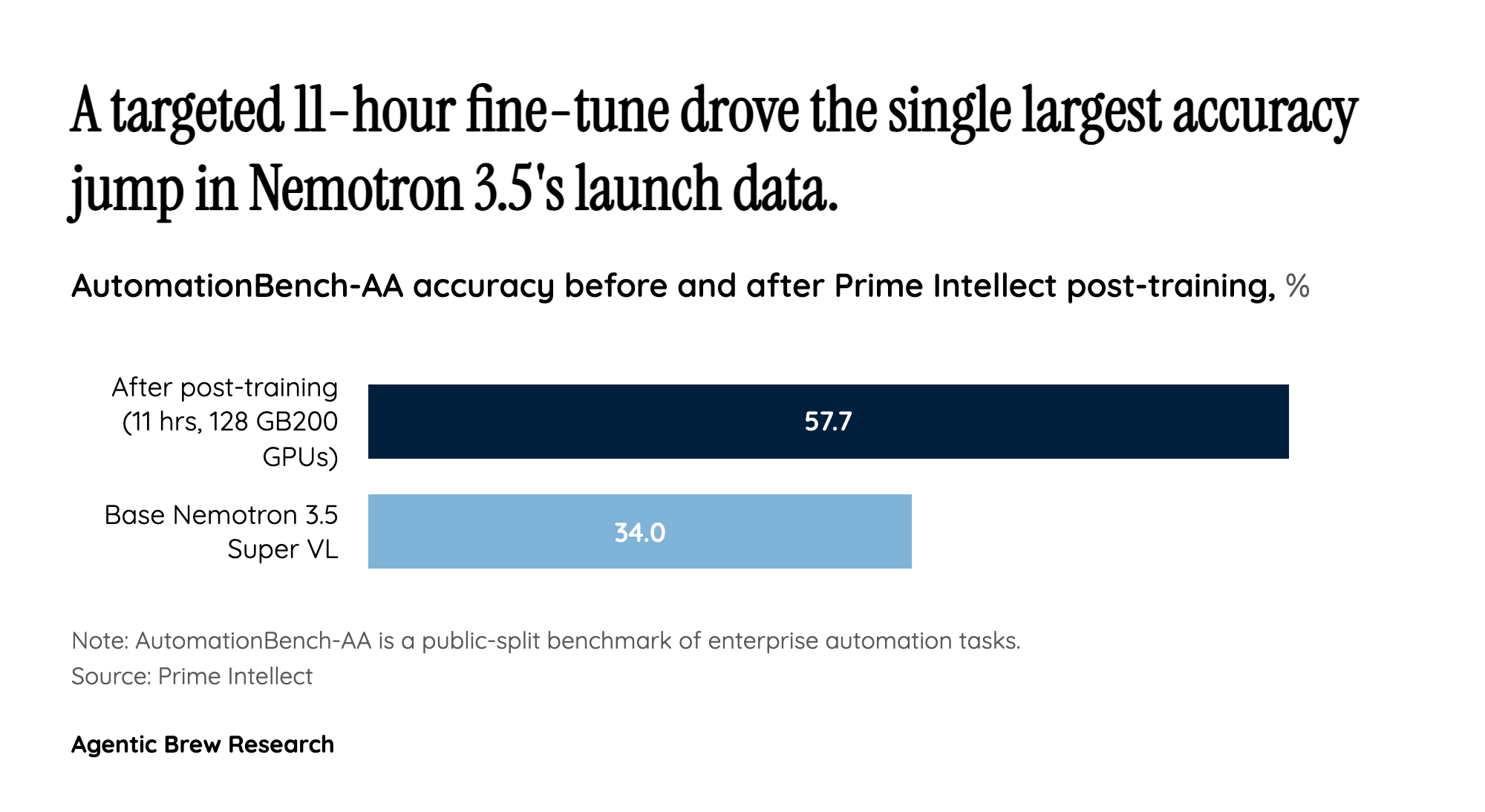
NVIDIA released Super VL as a 120-billion-parameter open mixture-of-experts model, but the headline performance jump on real enterprise automation work came not from NVIDIA's own pretraining - it came from a targeted post-training run by a third party. Prime Intellect built a 2,500-task dataset modeled on AutomationBench and ran reinforcement learning (GRPO) across 128 GB200 GPUs for roughly 11 hours, lifting Super VL's AutomationBench-AA accuracy from 34.0 percent to 57.7 percent [1]- a nearly 70 percent relative gain achieved in about 1,450 GPU-hours, not months of pretraining. Prime Intellect's own framing makes the point explicit: task quality, not additional training steps, is the bottleneck to further gains [1].
Mercor's parallel post-training runs with Harvey (legal), Cognition (software engineering), and Ramp (accounting) tell the same story at smaller scale: a few hundred domain-specific tasks moved Super VL's legal rubric score from 45.1 to 51.8 percent and its motion-drafting score up 23.2 points, while software-engineering Pass@1 climbed from 26.6 to 34.7 percent [2]. VentureBeat's caveat is the necessary gut check here - when post-trained variants beat Claude Opus 5 or GPT-6.1 Sol on narrow tasks, that is a credential for cheap specialization pipelines, not evidence the base Super VL model is broadly superior [3]. NVIDIA's open-weight bet looks less like a bid to win general leaderboards and more like a bid to be the cheapest substrate for enterprises to specialize themselves.