China restricts overseas travel for top private-sector AI researchers
TECH

China restricts overseas travel for top private-sector AI researchers

32+
Signals

Strategic Overview

  • 01.
    Beijing is now requiring state approval before top AI researchers, executives, and engineers at private firms travel abroad, extending rules previously reserved for nuclear scientists and state-owned entities.
  • 02.
    Selected researchers are being asked to hand passports to employers in what functions as an informal exit ban without judicial review, with the line between corporate policy and state directive intentionally blurred.
  • 03.
    Travel curbs are paired with capital controls: leading AI firms including Moonshot AI, StepFun, and ByteDance must seek NDRC approval before accepting U.S. investment, and Meta's $2 billion acquisition of Manus was blocked under the same regime.
  • 04.
    Officials cite three justifications: that researchers could leak sensitive information, that U.S. firms could acquire valuable IP, or that executives could be detained as diplomatic leverage abroad.

Deep Analysis

Passports as policy: the mechanism is an informal exit ban

The most consequential detail is how the regime works in practice. Top researchers at private Chinese AI firms are being asked to hand their passports to their employers, and the requirement functions as 'an exit ban applied informally and without judicial review'[1]. The arrangement straddles corporate policy and state directive — 'sometimes presented as a corporate policy and sometimes as government guidance; in practice the distinction is blurred'[1]. That blurring is the design feature, not a bug: it lets Beijing impose state-asset controls on private employees without ever having to issue a formal restriction that could be challenged in court or audited from abroad. Tom's Hardware reports that selection 'was assessed based on their impact on China's AI ambitions, not just where they work or their position within their company'[2]— meaning the list is curated by strategic value, not org chart, which is exactly how export-controlled scientist registries work in other domains.
Why now: a 2.7-point performance gap and a $100M poaching market

Why now: a 2.7-point performance gap and a $100M poaching market
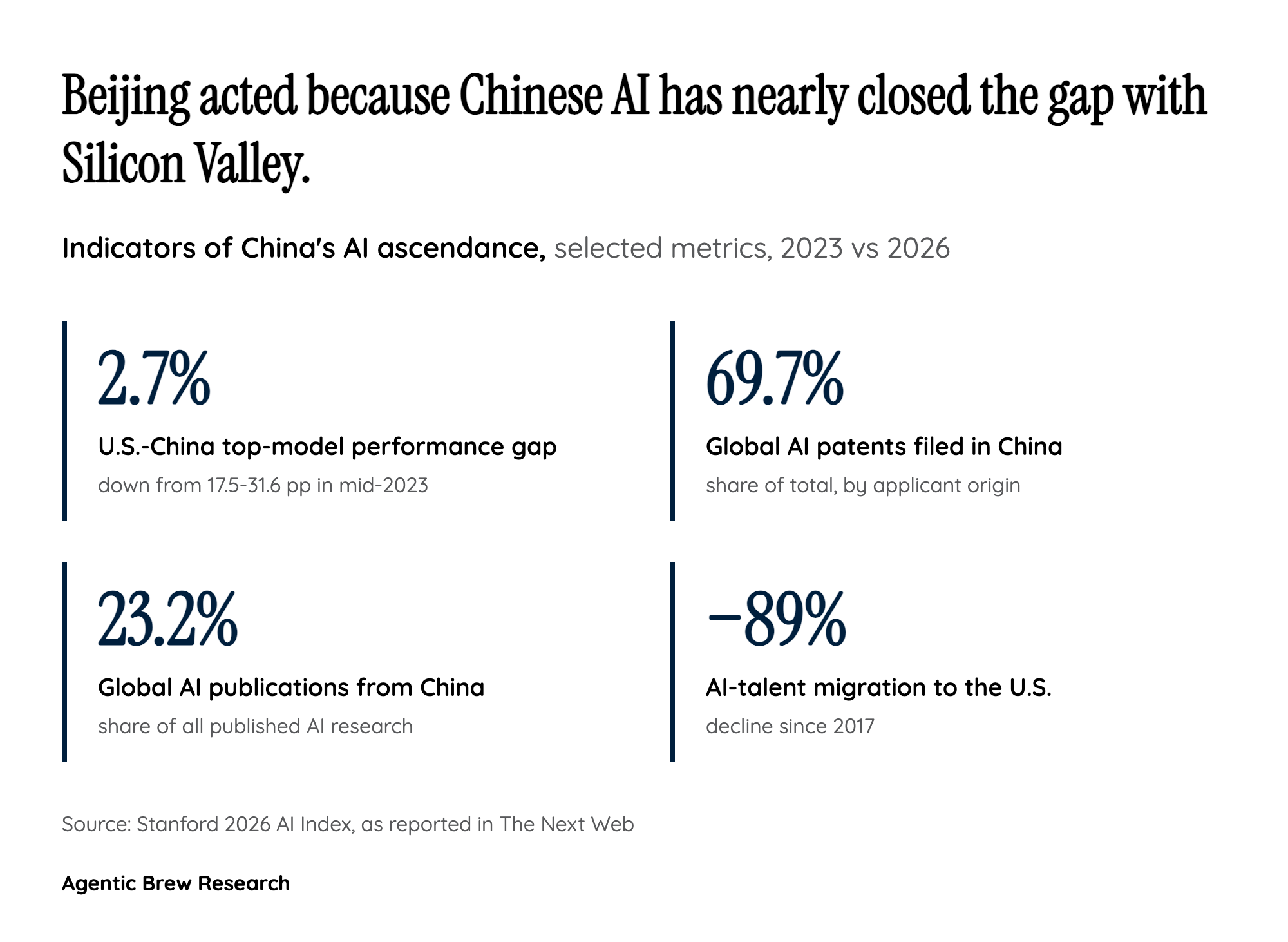
China now leads or rivals the U.S. on patents, publications, and model performance — the conditions that made Beijing treat AI researchers as strategic assets.

Beijing chose this moment because two trend lines crossed. Stanford's 2026 AI Index shows the performance gap between top U.S. and Chinese models collapsed from 17.5-31.6 percentage points in mid-2023 to just 2.7% today[1], China now files 69.7% of global AI patents and produces 23.2% of global publications[1], and AI-talent migration to the U.S. has declined 89% since 2017[1]. Chinese AI labs are finally competitive — and that competitiveness made their staff fantastically valuable to U.S. acquirers. Meta has reportedly offered $100 million signing bonuses and a $1.25 billion four-year package to poach AI founders[2]. When one Meta offer can rival a Chinese startup's entire enterprise value, voluntary loyalty stops being a credible retention strategy. Passport surrender is what you reach for when the market has decisively outbid you.

Twin locks: travel curbs + capital curbs = a closed talent-and-money loop

The travel restrictions are not a standalone policy — they 'sit alongside a tightening regime on the financial side'[1]. In late April 2026, the National Development and Reform Commission directed Moonshot AI, StepFun, and ByteDance to seek government clearance before accepting U.S. capital[1], and on April 27 it formally blocked Meta's $2 billion acquisition of Manus[3]. The pairing is what makes this strategically novel: bodies can't leave, and dollars can't enter. Manus is the case study — it relocated its corporate domicile from Beijing to Singapore in July 2025[3], and Beijing reversed the deal anyway, establishing precedent that geography no longer offers escape. Treasury Secretary Scott Bessent's response framed the rivalry in zero-sum terms: 'The real threat to AI safety is letting any nation other than the United States set the global standard'[3]. Both governments have stopped pretending this is anything other than industrial-policy war.

The self-sabotage paradox: reverse-brain-drain narrative meets exit ban

Beijing has spent years pitching itself as a magnet pulling Chinese AI researchers home from Silicon Valley. Joshua Chu, co-chair of the Hong Kong Web3 Association, notes that the new curbs treat passports and conference schedules as 'national security variables'[4]— which directly undermines the return narrative. A researcher abroad now must weigh not just salary but whether accepting a senior role at Alibaba or DeepSeek means surrendering travel autonomy indefinitely. One commenter on r/neoliberal flagged the second-order incentive: top Chinese students completing PhDs in the U.S. may hold out for American offers earlier in their careers, before any mainland firm can claim them, because once you're tagged as strategic talent you can't easily untag yourself. The policy intended to keep talent in may accelerate it leaving — or never coming back.

Second-order: fragmenting the global AI research commons

When outbound conference travel requires state approval and inbound capital requires NDRC clearance, the practical effect is two parallel research ecosystems. NeurIPS briefly banned submissions from sanctioned Chinese companies in late March 2026[3], mirroring Beijing's outbound clampdown from the other direction. The result is fewer Chinese researchers at NeurIPS, ICML, and ICLR; fewer joint papers; fewer cross-pollination collaborations of the kind that defined the transformer era. For builders outside China, this means the steady drip of paper-driven techniques from Chinese labs (the lineage that produced DeepSeek-R1, Qwen, and Kimi) will increasingly arrive via model releases and benchmarks rather than conference talks and corridor conversations. The decoupling has a human face, and it's now in passport offices on both sides of the Pacific.

Historical Context

2025-03
First public reports surface of DeepSeek employees surrendering passports and being warned against U.S. travel after the R1 model's release.
2025-07
Chinese AI agent startup Manus relocates its corporate domicile from Beijing to Singapore, the type of move the new policy is designed to prevent.
2025-12
Meta announces its $2 billion acquisition of Manus, triggering Beijing's later intervention.
2026-03-28
NeurIPS briefly bans submissions from sanctioned Chinese companies, signaling Western academic-conference pushback that mirrors Beijing's outbound restrictions.
2026-04-27
China's National Development and Reform Commission posts its decision blocking Meta's Manus acquisition and directs AI firms including Moonshot, StepFun and ByteDance to seek approval for U.S. capital.
2026-05-26
Bloomberg reports the previously narrow DeepSeek travel curbs have been broadened to top AI talent across the private sector, including Alibaba and other frontier firms.

Power Map

Key Players
Subject

China restricts overseas travel for top private-sector AI researchers

DE

DeepSeek

First private AI firm where the passport surrender policy was publicly observed in March 2026 following the success of its R1 model; staff handed in passports to prevent leaks.

AL

Alibaba Group Holding Ltd.

Among the major private frontier-AI firms whose top talent is now subject to overseas travel approval requirements under the expanded regime.

MO

Moonshot AI, StepFun, ByteDance

Targeted by China's National Development and Reform Commission in late April 2026 with instructions to reject U.S.-origin capital in upcoming funding rounds absent prior clearance.

NA

National Development and Reform Commission (NDRC)

Lead Chinese agency directing AI firms to seek government approval before accepting U.S. capital; also blocked Meta's $2 billion acquisition of Manus.

ME

Meta

Had its $2 billion acquisition of Singapore-relocated Chinese AI startup Manus reversed by Beijing's NDRC; separately accused of fueling the talent war with $100 million signing bonuses and a reported $1.25 billion four-year package.

MA

Manus (Butterfly Effect)

Chinese AI agent startup that relocated from Beijing to Singapore in July 2025; its acquisition by Meta was blocked by Beijing, becoming the canonical precedent the new curbs were designed around.

Fact Check

4 cited
  1. [1] China Expands Travel Curbs to Private AI Talent
  2. [2] Chinese AI Experts in Private Firms Now Required to Secure Approval Before International Travel
  3. [3] China Blocks Meta's $2 Billion Manus Deal as AI Tensions Rise
  4. [4] China Imposes Travel Limits on AI Workers at Private Firms: Report

Source Articles

Top 4

THE SIGNAL.

Analysts

"For frontier AI and semiconductor researchers at Chinese firms, passports and conference schedules are now treated as 'national security variables'; the curbs complicate China's 'reverse brain drain' narrative."

Joshua Chu
Lawyer and co-chair of the Hong Kong Web3 Association

"Framed the U.S.-China AI rivalry in zero-sum terms: 'It would be like channeling Hugo Chavez to get advice on how to run our economy. The real threat to AI safety is letting any nation other than the United States set the global standard.'"

Scott Bessent
U.S. Treasury Secretary

"Defended the Manus acquisition as legally compliant: 'The transaction complied fully with applicable law. We anticipate an appropriate resolution to the inquiry.'"

Meta spokesperson
Meta Platforms
The Crowd

"JUST IN: China is restricting foreign travel for top AI professionals at private companies, including firms like Alibaba & DeepSeek."

@@Polymarket910

"China is restricting overseas travel for top AI professionals in private firms such as Alibaba and DeepSeek, suggesting an escalation in measures intended to safeguard its technology and catch up to the US in a pivotal sphere. Government agencies have begun imposing restrictions"

@@business470

"*CHINA IS RESTRICTING OVERSEAS TRAVEL FOR TOP AI PROFESSIONALS IN PRIVATE FIRMS SUCH AS ALIBABA GROUP HOLDING AND DEEPSEEK"

@@Investingcom361

"China Clamps Down on Overseas Travel for AI Talent at Alibaba, DeepSeek"

@u/kaggleqrdl230
Broadcast
China Expands Travel Curbs to Top AI Talent | Bloomberg Tech 5/26/2026

China Expands Travel Curbs to Top AI Talent | Bloomberg Tech 5/26/2026

Why China is Stopping Its AI Leaders from Traveling to the U.S.

Why China is Stopping Its AI Leaders from Traveling to the U.S.

Inside the Restriction: China's AI Talent Banned from US Travel

Inside the Restriction: China's AI Talent Banned from US Travel