Big Tech AI Capex Spending Alarm
TECH

Big Tech AI Capex Spending Alarm

49+
Signals

Strategic Overview

  • 01.
    Alphabet's free cash flow turned negative for the first time in its 22 years as a public company in Q2 2026, driven by AI infrastructure spending.
  • 02.
    Alphabet raised its 2026 AI capex guidance for the third time this year, to $195-205 billion, and its stock fell 6-7.7% on earnings day despite revenue beating estimates.
  • 03.
    Moody's warned that 'unprecedented' AI spending threatens the credit quality of Amazon, Meta, Microsoft, Alphabet, Oracle and CoreWeave.
  • 04.
    Tesla also posted its first negative free cash flow in two years the same week, with its stock falling roughly 12-14.5 percent, and the selloff comes days before Meta, Microsoft and Amazon report earnings.

Deep Analysis

The Cash Flow Shock: Alphabet's Money Machine Turns Negative

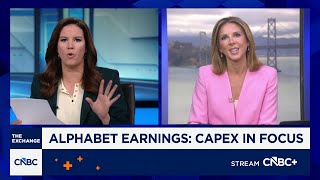
For the first time in the 22 years since Alphabet went public, the company's free cash flow turned negative in the second quarter of 2026 [1]. That is not a rounding error - it reflects Alphabet roughly doubling its own quarterly capital spending, to about $44.9 billion year over year, most of it poured into AI data centers, custom chips and cloud infrastructure [3]. Management didn't treat this as a one-off: it raised full-year 2026 capex guidance for the third time in 2026 alone, from a $180-190 billion range to $195-205 billion, and told investors 2027 spending will rise significantly and keep pressuring margins [1]. The market's reaction looked disproportionate to otherwise strong underlying growth - the stock still tumbled 6-7.7 percent on earnings day, because the $15 billion swing in guidance, not the quarter that just closed, is what investors are pricing [2].
Debt Takes Over: Why Moody's and Bond Investors Are Getting Nervous

The capex story isn't just a stock-market story, it's becoming a credit story. Moody's flagged AI spending as unprecedented and said it now threatens the credit quality of six companies it tracks - Amazon, Meta, Microsoft, Alphabet, Oracle and CoreWeave - because AI hardware demands enormous upfront cash while the revenue it's meant to generate arrives on a much longer timeline [4]. Bond investors are already voting with their orders: coverage on hyperscaler debt sales fell from nearly 5x in February 2026 to below 2x by July, forcing issuers like Amazon to offer 18-21 basis points of extra yield just to move a $25 billion bond issue [5]. JPMorgan estimates hyperscalers will need roughly $375 billion in bond proceeds between 2026 and 2030 to keep funding the buildout [5], even as its own analyst trimmed Alphabet's price target from $460 to $420 on the spending outlook [6]. CNBC described the shift bluntly back in February: Big Tech's AI bond binge has shattered the old unspoken deal with investors that hyperscalers would self-fund growth rather than lever up [7]. Collectively, hyperscaler USD debt has more than doubled to over $360 billion since last September [8].

The Domino Effect: Tesla Falls Too, and Meta, Microsoft, Amazon Are Next

The Domino Effect: Tesla Falls Too, and Meta, Microsoft, Amazon Are Next
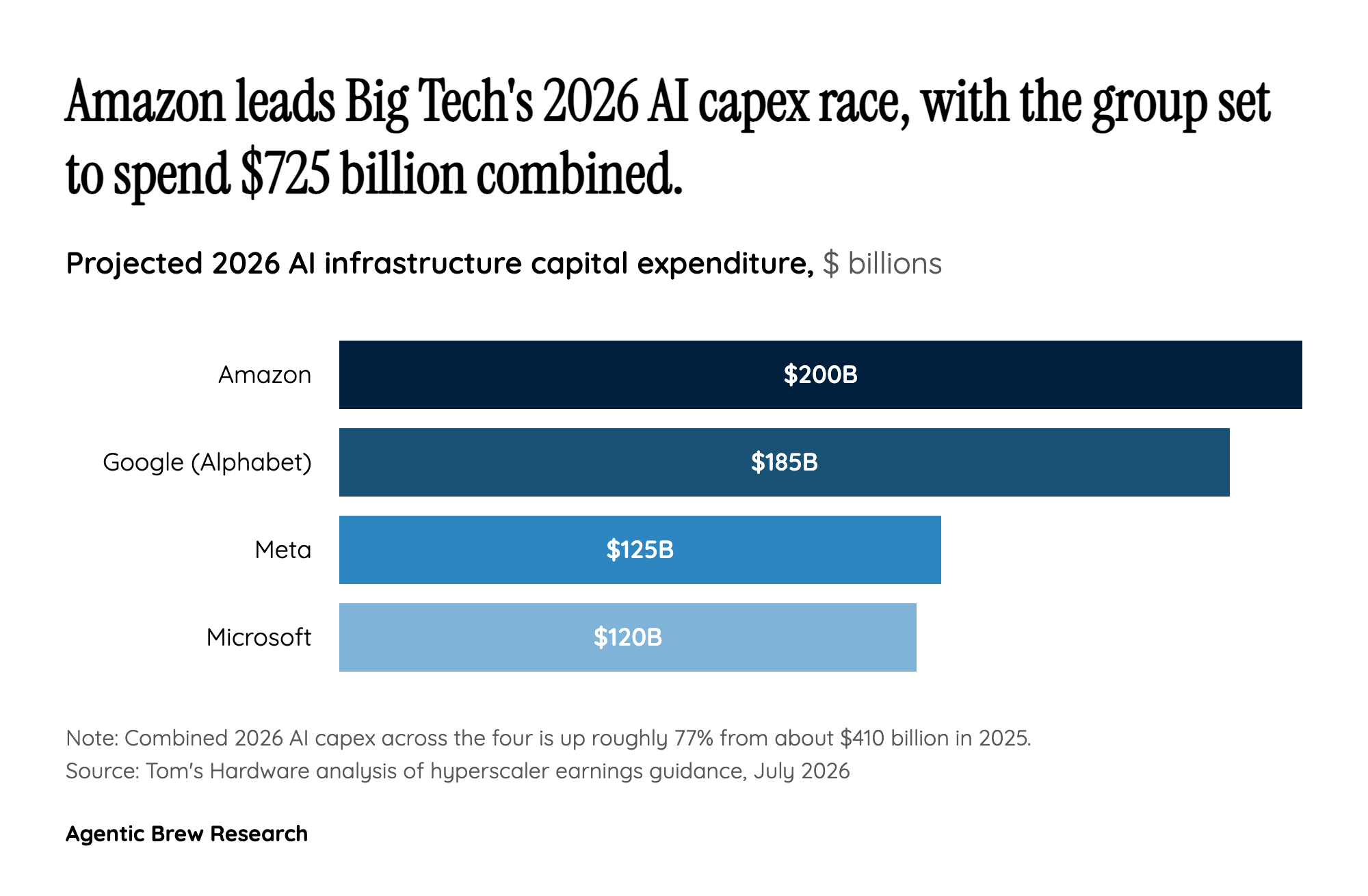
Projected 2026 AI infrastructure capex: Amazon ($200B), Google ($185B), Meta ($125B), Microsoft ($120B) - $725B combined, up ~77% from 2025.

Capex anxiety didn't stay contained to search-engine economics. Tesla, a company in an entirely different sector, posted its own first negative free cash flow in two years - about $1.1 billion - after burning roughly $5.8 billion on AI and robotics initiatives in the same quarter, and its stock fell 12-14.5 percent in its worst single-day drop in over a year [9]. That the two selloffs landed together, even though Tesla and Alphabet share no direct business relationship, shows investors are now pricing AI capex risk broadly rather than company by company [10]. The timing raises the stakes for what comes next: Meta and Microsoft report July 29, and Amazon reports July 30, with combined 2026 AI capex across the four projected near $725 billion, up roughly 77 percent from about $410 billion in 2025 [11][12]. Each now has to explain comparable or larger spending increases without repeating Alphabet's cash-flow scare, and Citi Research has warned that a pullback in AI investment, if it came instead, could generate a mild recession given how much current growth already depends on it [5].

Bubble or Buildout? The Case For and Against the Spending Spree

Not everyone reads the selloff the same way. JPMorgan's Jamie Dimon frames the scale plainly: AI capital spending went from $400 billion industrywide in 2025 to $700 billion in 2026, and could exceed a little over a trillion in 2027, while also cautioning markets are getting close to as good as it gets [13]. Guggenheim's Michael Morris thinks Alphabet alone could hit nearly $350 billion in 2027 capex, well above the roughly $265 billion Street consensus [6], and Baird's Colin Sebastian expects that spending to translate directly into margin pressure [14]. Alphabet's own CFO, Anat Ashkenazi, frames the acceleration differently - as a response to a supply-constrained environment where the company is racing to add capacity to meet demand it can't otherwise serve, saying it will keep investing as long as long-term ROI stays compelling [14]. Skeptics reach for a specific historical parallel: the 1999-2000 telecom buildout deployed roughly $500 billion in fiber over four years, and 85-95 percent of that fiber sat dark even four years after the bubble burst - a pace of overbuild today's AI infrastructure spending has already exceeded on an annual basis [15]. Whether this cycle ends the same way is exactly the open question investors are now pricing into both stocks and bonds at once.

Historical Context

1999-2000
The dot-com era telecom buildout deployed roughly $500 billion in fiber and switching gear over four years, with 85-95 percent of fiber laid remaining unused even four years after the bubble burst - a pace of overbuild today's annual AI infrastructure spend already exceeds.
2026-02
Big Tech's AI bond binge was described as having shattered the historical unspoken contract hyperscalers had with investors of self-funding growth rather than relying on debt.
2026-07-17
Bond order coverage for hyperscaler debt fell from nearly 5x in February 2026 to below 2x, and Citi Research warned a pullback in AI investment could generate a mild recession.
2026-07-18
CEO Jamie Dimon projected industry-wide AI capex could exceed a trillion dollars in 2027, while cautioning markets are close to as good as it gets.
2026-07-23
Both companies reported Q2 2026 earnings on the same day; Alphabet posted its first-ever negative free cash flow and raised 2026 capex guidance to $195-205 billion, while Tesla posted its first negative free cash flow in two years. Alphabet's stock fell 6-7.7 percent and Tesla's fell 12-14.5 percent.
2026-07-24
Moody's published a warning that AI spending threatens the credit quality of Amazon, Meta, Microsoft, Alphabet, Oracle and CoreWeave.
2026-07-29
Meta and Microsoft are scheduled to report earnings July 29, and Amazon on July 30, putting pressure on all three to justify their own AI capex without repeating Alphabet's cash-flow scare.

Power Map

Key Players
Subject

Big Tech AI Capex Spending Alarm

AL

Alphabet (Google)

First hyperscaler to post negative free cash flow tied to AI capex; raised 2026 guidance to $195-205 billion and signaled a significant 2027 increase, controlling how much of the AI buildout it self-funds versus finances with debt.

TE

Tesla

Reported its own first negative free cash flow in two years amid roughly $5.8 billion in quarterly AI spend, with its stock move amplifying the market's broader capex anxiety.

MO

Moody's

Credit rating agency whose downgrade warnings directly affect hyperscalers' borrowing costs and access to debt markets for future AI infrastructure spending.

ME

Meta Platforms, Microsoft, Amazon

Report earnings July 29-30, 2026, immediately after Alphabet and Tesla's selloff, and must justify comparable or larger capex; combined Big Four 2026 AI capex is projected near $725 billion, up about 77 percent year over year.

BO

Bond market / credit investors

Their softening demand for hyperscaler debt (order coverage down from nearly 5x to below 2x) is forcing issuers like Amazon to pay higher yields, directly raising the cost of financing the AI buildout.

JP

JPMorgan (Jamie Dimon, Doug Anmuth)

Dimon's trillion-dollar 2027 capex projection and analyst Doug Anmuth's cut to Alphabet's price target shape institutional investor sentiment and hyperscaler debt-issuance estimates.

Fact Check

15 cited
  1. [1] Alphabet's free cash flow turns negative
  2. [2] Alphabet's Q2 Earnings: Why Wall Street's Frosty Reaction Spells Danger For The AI Rally
  3. [3] AI: Alphabet Q2 2026 Negative Free Cash Flow AI Capex
  4. [4] Moody's warns AI spending threatens credit quality of Amazon, Meta, Alphabet
  5. [5] AI boom debt blitz: investor demand for hyperscaler bond issuance
  6. [6] Alphabet AI Q2 Spend: Capex To Hit $350B In 2027, Analysts Say
  7. [7] Big Tech's AI bond binge shatters unspoken contract with investors
  8. [8] Hyperscaler Debt Deluge: The New Driver of IG Spread Pressure
  9. [9] Tesla (TSLA) Faces Major Stock Drop Fueled By AI Concerns And Earnings Reports
  10. [10] Tesla Drops 12%, Alphabet Falls as AI Spending Concerns Mount
  11. [11] Zacks Investment Ideas Feature Highlights Microsoft, Alphabet and Amazon
  12. [12] Big Tech's AI Spending Plans Reach $725 Billion
  13. [13] JPMorgan CEO Jamie Dimon: AI Spending Could Reach A Trillion Dollars
  14. [14] 15 Billion Reasons Alphabet Shares Are Sinking After Reporting Strong Earnings Growth
  15. [15] AI Bubble 2026: Is The $600B Capex Splurge The New Fiber-Optic Overbuild?

Source Articles

Top 5

THE SIGNAL.

Analysts

"Says AI capital spending is scaling from $400 billion to $700 billion to a projected 'little over a trillion' next year, while cautioning markets are getting close to as good as it gets."

Jamie Dimon
CEO, JPMorgan Chase

"Expects Alphabet's 2027 capex to reach nearly $350 billion, well above Street consensus of $265 billion, after management reiterated a significant increase is coming."

Michael Morris
Analyst, Guggenheim Securities

"Flags plunging bond-cover ratios for hyperscalers as a sign investors may soon demand wider credit spreads to absorb additional AI-related debt supply."

Torsten Slok
Chief Economist, Apollo Global Management

"Says investors are uneasy about Alphabet's capex given its elevated price-to-earnings ratio, worried speculative AI spending may never translate into commensurate revenue."

Vsevolod Smirnov
CMO, Just2Trade

"Says the capex increase is driven by accelerating capacity delivery to meet demand in a supply-constrained environment, and the company will keep investing as long as long-term ROI stays compelling."

Anat Ashkenazi
CFO, Alphabet
The Crowd

"Q2 was an amazing quarter, with our AI investments redefining what's possible across every part of our business. Alphabet revenue grew 24% YoY and Google Cloud accelerated to 82% growth. We saw exciting momentum across the board from Search to YouTube to the Gemini app"

@@sundarpichai12574

"Good morning, Asia. While you were sleeping, one of our most-read stories was about Google burning through cash for the first time since going public decades ago as it raised its spending forecast for AI infrastructure. ft.trib.al/aew0dAG"

@@FT2498

"JUST IN: Bond market concerns over AI spending are growing as Alphabet's higher capex forecast pushes tech credit spreads wider, with investors demanding higher yields to finance the AI buildout."

@@Cointelegraph48

"Serious question about AI Capex after google earnings and circular financing."

@u/Top-Target-8346298
Broadcast
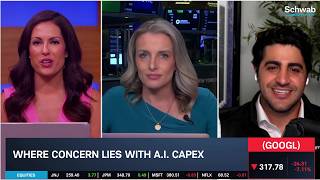
Alphabet earnings put the AI spending boom under scrutiny

Alphabet earnings put the AI spending boom under scrutiny

GOOGL Cash Flow Goes Negative: Shay Boloor Still Bullish on AI Standing

GOOGL Cash Flow Goes Negative: Shay Boloor Still Bullish on AI Standing

$750 Billion in AI CapEx — Who Wins and Who Gets Left Behind

$750 Billion in AI CapEx — Who Wins and Who Gets Left Behind