Amazon to sell custom AI chips externally, challenging Nvidia
TECH

Amazon to sell custom AI chips externally, challenging Nvidia

34+
Signals

Strategic Overview

  • 01.
    Amazon is in talks to sell its custom-designed Trainium AI chips directly to other companies for use in their own data centers, a sharp departure from its long-standing practice of only renting chip access through AWS. The shift would make Amazon a far more direct hardware competitor to Nvidia.
  • 02.
    Amazon AI Chief Peter DeSantis disclosed the talks to Bloomberg but declined to name potential buyers, framing external sales as part of a rapidly evolving AI infrastructure landscape rather than a threat to AWS's cloud business.
  • 03.
    CEO Andy Jassy signaled the move was coming, saying that selling chip racks to third parties is 'quite possible' and estimating that a standalone chip business serving AWS plus outside buyers could reach a roughly $50 billion annual run rate.
  • 04.
    Amazon argues Trainium does equivalent AI work more cheaply than comparable Nvidia GPUs, and executives say external sales won't significantly cannibalize cloud revenue because AI demand remains far from saturated.

Deep Analysis

The reversal: why a company that always refused to sell chips suddenly will

For years Amazon's answer to anyone who wanted to buy its silicon outright was no. Trainium and Inferentia existed to make AWS stickier and cheaper to run, not to ship in someone else's rack. The disclosure that AWS is now in talks to sell Trainium directly is therefore less a product announcement than a strategic about-face [1]. The logic Amazon offers is an abundance argument: there is, in its executives' framing, so much underconsumption in AI that demand dwarfs anything AWS can absorb internally, so selling racks externally expands reach without meaningfully cannibalizing cloud revenue [2].

CEO Andy Jassy telegraphed the shift earlier, calling third-party chip sales 'quite possible' [1]. Read against Amazon's own history, that is the tell: the company that turned its internal warehousing, compute, and logistics into external businesses is now eyeing the same playbook for silicon. The pattern is consistent enough that the surprise is less that Amazon would do it than that it waited this long.
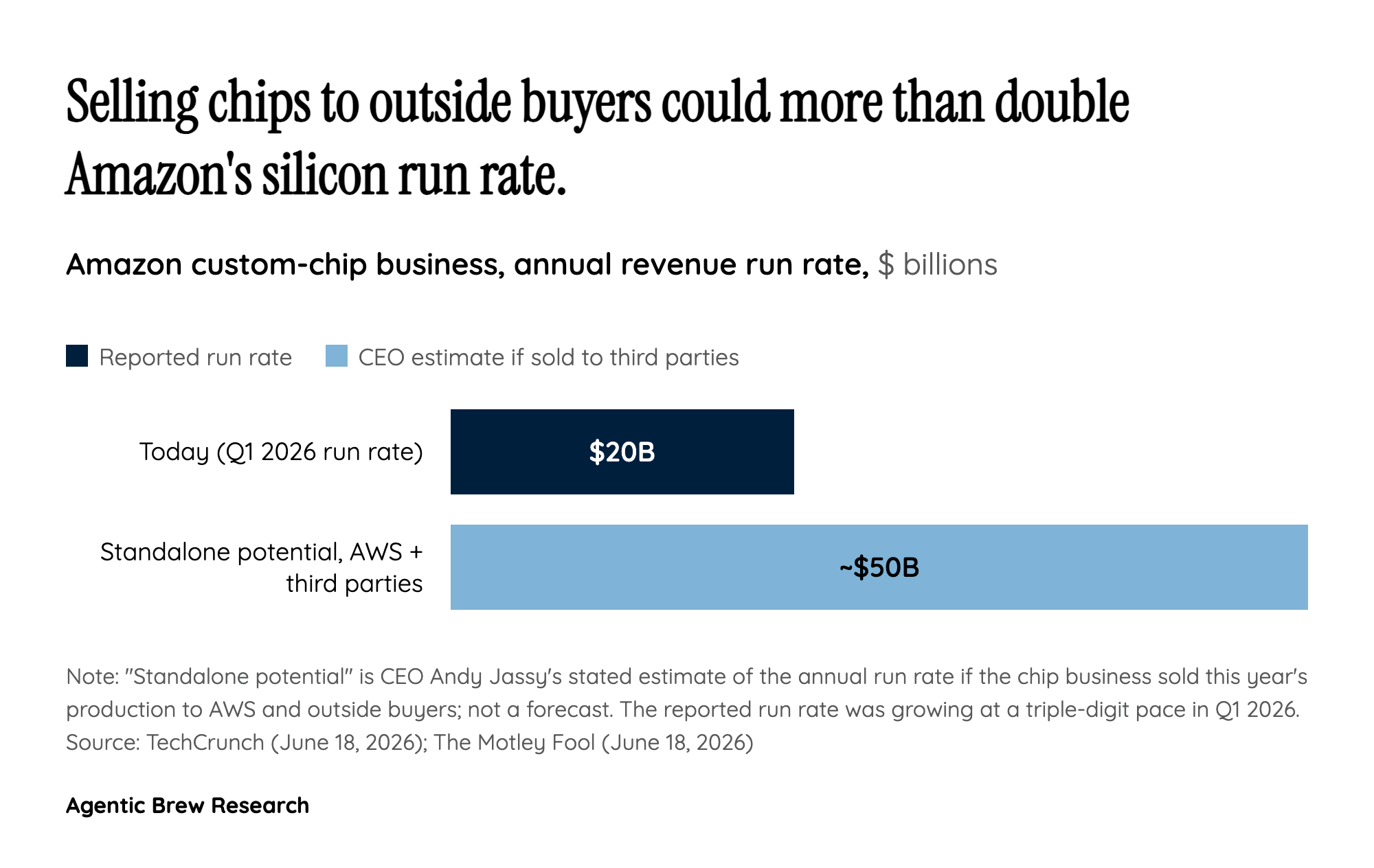

The real headline isn't beating Nvidia, it's a $50 billion silicon business

The real headline isn't beating Nvidia, it's a $50 billion silicon business
Amazon CEO Andy Jassy estimates the chip business could reach a ~$50B annual run rate selling to AWS plus third parties, up from a ~$20B run rate today.

Strip away the Nvidia-rivalry framing and a quieter number drives the story. Amazon's custom-chip business crossed a $20 billion annual revenue run rate in early 2026, growing at a triple-digit pace [3]. Jassy's estimate that a standalone chip operation selling to AWS and third parties could reach a roughly $50 billion run rate is what external sales are really about [1].

The leverage comes from vertical integration: Amazon designs the chip through Annapurna Labs, builds the server and rack around it, and controls the software stack, a combination that lets it argue Trainium does equivalent AI work more cheaply than comparable GPUs [4]. That owned-stack economics, not a single benchmark win, is the moat. The market read the news as additive rather than zero-sum: both Amazon and Nvidia shares rose roughly 3%, a signal investors believe the AI compute pie is widening fast enough to feed both vendors [3].

The skeptics' case: CUDA, fab capacity, and the rent-vs-sell question

The counterargument is sturdier than the stock pop suggests, and it splits three ways. First, Nvidia's deepest moat was never the silicon, it is CUDA and the developer ecosystem built on top of it, which a cheaper accelerator does not automatically dislodge. Second, the binding constraint on AI hardware is fab and memory supply: leading-edge manufacturing capacity and high-bandwidth memory are the bottleneck, and Trainium itself has reportedly sold out almost instantly to existing AWS customers, which caps how much Amazon can even ship externally in the near term [1]. Third, there is a basic economics doubt, that renting compute may simply be more profitable than selling chips outright, which is why Amazon resisted for so long.

Those three frictions are why one analyst's framing, that this is something to watch rather than fear, is the honest read: real long-term pressure on Nvidia's pricing power, but not an imminent unseating [3]. Community discussion mirrors the divide, with bullish investor voices treating Amazon as a standalone Nvidia challenger while more skeptical technical readers flag CUDA lock-in and supply limits as the part of the story the headline skips.

The bigger force: every hyperscaler is fleeing the Nvidia tax

Amazon's move is one instance of a category shift. Hyperscalers are increasingly reluctant to route a large slice of their capital spending through a single vendor, and custom ASICs purpose-built for AI are growing faster than the general GPU market because they can be made smaller, cheaper, and tuned for specific workloads. Google pioneered this with its TPU line; Amazon is running a similar playbook with Trainium and is widely seen as catching up rather than leading.

The throughline for 2026 is capex efficiency: the same pressure that makes a customer want a cheaper accelerator makes Amazon want to sell one. Notably, this is not a clean break from Nvidia. Amazon has also committed to deploying over a million Nvidia GPUs starting in 2026 [3], underscoring that the near-term reality is a multi-silicon world, not a winner-take-all switch.

Historical Context

2015-01-01
Amazon acquired the Israeli chip designer Annapurna Labs for approximately $350 million, forming the basis of its custom-silicon program.
2018-01-01
Amazon introduced its first Graviton general-purpose cloud CPU and Inferentia AI inference chip.
2020-01-01
The first-generation Trainium training chip debuted.
2023-11-01
Trainium2 was announced alongside the Graviton4 CPU at AWS re:Invent 2023.
2025-12-01
Trainium3 was deployed, cited as offering up to 50% lower cost to run for comparable performance than classic cloud servers.
2026-06-18
DeSantis told Bloomberg that AWS is in talks to sell Trainium chips directly to outside companies for their own data centers.

Power Map

Key Players
Subject

Amazon to sell custom AI chips externally, challenging Nvidia

PE

Peter DeSantis

Amazon AI Chief who disclosed the talks to Bloomberg and declined to name potential buyers, framing the move as a way to reach more customers.

AN

Andy Jassy

Amazon CEO who signaled that selling chip racks to third parties is 'quite possible' and pegged a standalone chip business at a ~$50B run rate.

NV

Nvidia

Incumbent AI accelerator leader (~$75.2B data center revenue in fiscal Q1 2027); the move pressures its long-term pricing power, though it still commands the bulk of the market.

AN

Anthropic

Major Trainium customer; committed to up to 5 gigawatts of capacity under a $100B/10-year AWS deal, with Claude running on over 1 million Trainium2 chips via Project Rainier.

OP

OpenAI

Trainium customer; AWS agreed to supply roughly 2 gigawatts of Trainium capacity.

AN

Annapurna Labs

Amazon's in-house semiconductor division, acquired in 2015, that designs Trainium, Inferentia, Graviton and Nitro silicon.

Fact Check

4 cited
  1. [1] Amazon hopes to challenge Nvidia more directly by selling its AI chips
  2. [2] Amazon explores selling AI chips
  3. [3] Amazon May Start Selling Its Custom AI Chips to Outside Companies
  4. [4] An exclusive tour of Amazon's Trainium lab, the chip that's won over Anthropic, OpenAI, even Apple

Source Articles

Top 5

THE SIGNAL.

Analysts

"Frames external chip sales as a natural step in evolving AI infrastructure and reaching more customers, not a threat to AWS: 'We view AI infrastructure as rapidly evolving. And we're constantly looking at ways to get to more customers.'"

Peter DeSantis
Amazon AI Chief

"Treats the development as something for Nvidia investors to monitor rather than fear, while acknowledging genuine long-term pressure on Nvidia's pricing power if Trainium reaches outside buyers: 'This is more of something to keep an eye on than fear.'"

Daniel Sparks
Analyst/contributor, The Motley Fool
The Crowd

"$AMZN's CEO just dropped a shareholder letter, and there are some BIG key updates: $AMZN has a $50B chip business challenging $NVDA, the CPU shortage is here, new big compute deals are coming: 1. It's clear $AMZN has now entered the chip business as a standalone business, taking"

@@RihardJarc895

"JUST IN: Amazon Is in Talks to Sell Nvidia Rival Chips to Other Companies - Bloomberg - $AMZN $NVDA"

@@AIStockSavvy41

"Amazon Explores Selling Custom AI Chips to Rival Nvidia The chips, like the largely sold-out Trainium3, offer cost-effective AI training as alternatives to Nvidia's GPUs and have already driven over $225 billion in AWS commitments from firms including OpenAI and Anthropic."

@@gudanglifehack0

"Amazon CEO Jassy says company could sell AI chips, raising stakes for Nvidia, AMD"

@u/King-of-Limbs-07559
Broadcast
How Nvidia GPUs Compare To Google's And Amazon's AI Chips

How Nvidia GPUs Compare To Google's And Amazon's AI Chips

Amazon Just Declared War On Nvidia With Their Latest AI Chip

Amazon Just Declared War On Nvidia With Their Latest AI Chip

Amazon Rushes Out Latest AI Chip to Take On Nvidia, Google

Amazon Rushes Out Latest AI Chip to Take On Nvidia, Google