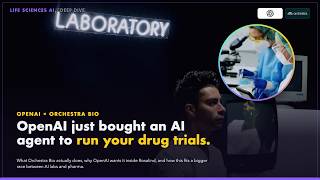
OpenAI acquires Orchestra Bio
TECH

OpenAI acquires Orchestra Bio

44+
Signals

Strategic Overview

  • 01.
    OpenAI announced on October 20, 2026 that it has acquired Orchestra Bio, a startup whose AI agents help biopharma teams coordinate the day-to-day mechanics of drug development; Orchestra's team and technology are joining OpenAI's Rosalind life sciences unit.
  • 02.
    Orchestra's agents are built to handle the operational grind inside a biotech program - tracking spend against budget, monitoring study progress, flagging likely delays, and resolving trial scheduling conflicts - while scientists and program leaders retain the final call on how to respond.
  • 03.
    Financial terms were not disclosed and OpenAI gave no timeline for when Orchestra's agents will reach its products; the deal follows Anthropic's roughly $400 million acquisition of Coefficient Bio, intensifying competition between the two labs over AI's role in pharma operations.
  • 04.
    The acquisition builds on OpenAI's existing life-sciences push, including the gated GPT-Rosalind reasoning model launched in April 2026, aimed at compressing a drug-development process that typically takes 10-15 years.

Deep Analysis

The Anthropic-OpenAI biotech acquisition race: scientific depth vs operational stickiness

OpenAI's purchase of Orchestra Bio is the clearest sign yet that the two leading AI labs are fighting over biotech from different angles. Anthropic's roughly $400 million acquisition of Coefficient Bio, a nine-person team of ex-Genentech scientists, bought scientific depth: people who can reason about molecular biology at the bench level [7][8]. OpenAI's move on Orchestra Bio, by contrast, targets the unglamorous layer of running a drug program - budgets, timelines, and the thousand small decisions that keep a trial on track [5]. One framing of the split: Anthropic paid for scientific depth, and OpenAI bought operational stickiness [5]. Terms of the OpenAI deal were not disclosed, unlike Anthropic's, which makes a direct cost comparison impossible, but the strategic split is unmistakable [3].

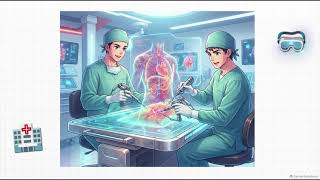
What Orchestra's agents actually do - and don't do

The most practical question raised by this deal, including skepticism visible in early community reaction, is whether Orchestra's agents run real experiments or simply organize spreadsheets. The research is specific: Orchestra's agents track spend against budget, monitor study progress, flag likely delays, and resolve trial scheduling conflicts [9]. When something breaks - say, a failed manufacturing batch - the agents map how that setback ripples through the rest of the program and lay out possible responses, but scientists and program leaders keep the final decision [1][3]. That is a meaningful distinction: Orchestra is not an autonomous experimentalist, it is a coordination and monitoring layer sitting on top of human-run programs. For a field where accountability for quality and release decisions is tightly regulated, keeping sign-off with people rather than agents is a deliberate design choice, not an afterthought [5].

The economics behind the deal: a 10-15 year, multi-billion-dollar problem

The number that makes this acquisition make sense is the one at the top of nearly every article about it: developing a drug in the US takes 10-15 years on average and costs more than $2.6 billion, with fewer than 10 percent of candidates that reach human trials ever making it to market [2][3]. OpenAI frames siloed systems and the constant back-and-forth between internal teams as a major contributor to that timeline, which is exactly the friction Orchestra's agents are built to cut [2]. Independent research backs the scale of the opportunity: Stanford's Virtual Biotech multiagent framework completed in six hours a task that would take a single agent 76.6 days, while matching human-reviewer accuracy 89.7 percent of the time on primary endpoint annotation [5]. That gap between what coordinated AI agents can already do and how little of it has reached day-to-day pharma operations is the opportunity OpenAI is buying into.

Buying a team, not just technology

Orchestra Bio had raised only about $20 million since 2022, a figure that drew open skepticism in early community discussion about whether a company that size has anything proprietary OpenAI could not build in-house. That skepticism is worth taking seriously rather than dismissing: Orchestra's own backers frame the deal less around a defensible technology moat and more around the team itself. 8VC, which led Orchestra's Series A, praised founder Ashoka Rajendra and CTO Andy Xu as being among the most product-oriented builders in life sciences, and argued that even modest improvements in speed and execution can have an outsized impact on drug development [4]. Combined with the lack of disclosed deal terms, the acquisition reads less like a bet on a novel algorithm and more like OpenAI buying a ready-made operational team and a working product to bolt onto Rosalind rather than building the coordination layer from scratch [5].

Orchestra's new home inside the still-gated Rosalind stack

Orchestra is not joining OpenAI as a standalone product - it is being folded into Rosalind, OpenAI's life sciences unit, where the team will work on both GPT-Rosalind, the company's life-sciences reasoning model, and Rosalind Workbench, a tool for planning experiments and interpreting results [2]. That matters because GPT-Rosalind itself is one of the most tightly gated AI launches in the industry: since its April 2026 debut, it has been available only in the United States and only to vetted enterprise customers through a Trusted Access Program, with early partners including Amgen, the Allen Institute, and Thermo Fisher Scientific [6]. Slotting an operational-coordination layer into that same gated ecosystem suggests OpenAI is building a vertically integrated, enterprise-only biotech stack rather than a broadly available consumer tool - a strategy that raises the stakes of who gets early access to AI-accelerated drug development and who does not.

Historical Context

2022
Founded in San Francisco by Ashoka Rajendra (CEO) and Andy Xu (CTO).
2025-08
Came out of stealth with about $20 million in funding from investors including Andreessen Horowitz, 8VC, Insight Partners, Definition Capital and Haystack.
2026-04-03
Completed a roughly $400 million stock acquisition of Coefficient Bio, a nine-person team of ex-Genentech scientists, folding them into its life-sciences group.
2026-04-16
Launched GPT-Rosalind, its first reasoning model built for life-sciences research, in a gated Trusted Access Program with early partners including Amgen, the Allen Institute and Thermo Fisher Scientific.
2026-06
Launched Claude Science following the Coefficient Bio acquisition.
2026-08-20
Reported that Claude generated more than 300,000 protein designs in a 64-hour autonomous campaign, with independent wet-lab validation from Adaptyv Bio and Twist Bioscience.
2026-10-20
Announced the acquisition of Orchestra Bio, folding its team and technology into the Rosalind life sciences unit.

Power Map

Key Players
Subject

OpenAI acquires Orchestra Bio

OP

OpenAI

Acquirer; folding Orchestra Bio's team and technology into its Rosalind life sciences unit alongside GPT-Rosalind and Rosalind Workbench

OR

Orchestra Bio

San Francisco startup founded in 2022 that built AI agents for coordinating drug-development programs; came out of stealth in August 2025 and was acquired by OpenAI on October 20, 2026

AS

Ashoka Rajendra and Andy Xu

Orchestra Bio's CEO and CTO respectively; Rajendra led the company's seed raise

AN

Anthropic

Rival AI lab whose roughly $400 million acquisition of Coefficient Bio and subsequent Claude Science launch set the competitive backdrop for OpenAI's move

8V

8VC

Lead investor in Orchestra Bio's Series A; publicly praised the team as among the most product-oriented builders in life sciences, arguing even modest execution gains can have an outsized impact

Fact Check

9 cited
  1. [1] OpenAI acquires Orchestra Bio to bring AI agents into drug development
  2. [2] OpenAI acquires Orchestra Bio to build AI agents that speed up drug development
  3. [3] OpenAI Buys Orchestra Bio to Bring AI Agents Into Drug Development
  4. [4] Orchestra Bio is Joining OpenAI
  5. [5] OpenAI Bets on Accelerating Drug Development Timelines With Orchestra Bio
  6. [6] OpenAI Launches Biotech-Specific AI Model GPT-Rosalind
  7. [7] Anthropic Acquires Startup Coefficient Bio for $400 Million
  8. [8] Anthropic Acquires Stealth AI Startup Coefficient Bio in $400M Deal
  9. [9] OpenAI Acquires Orchestra Bio for Life Sciences AI

Source Articles

Top 5

THE SIGNAL.

Analysts

“Says pharma AI investment has gone mostly to discovery and planning pilots while day-to-day execution remains largely manual, making Orchestra's operational focus a fill for a real gap rather than another isolated pilot.”

Megha Sinha, Founder and CEO of Kolter AI
Industry analyst on pharma AI investment patterns

“Praised the Orchestra team as among the most product-oriented builders in life sciences and argued that even modest gains in speed and execution can have an outsized impact on drug development.”

8VC investment team (Francisco Gimenez and Susan Liu)
Lead investor in Orchestra Bio's Series A

“Characterizes Anthropic's Coefficient Bio deal as paying for scientific depth, while OpenAI's Orchestra Bio deal buys operational stickiness inside existing drug-development workflows.”

Pharmaceutical Technology analysis
Comparative framing of OpenAI's and Anthropic's biotech acquisitions
The Crowd

“We've acquired Orchestra Bio, a platform that helps biopharma teams coordinate the complex process of drug development. Together, we'll build on Rosalind, our AI models and tools for life sciences research, to streamline those operations and help new treatments reach patients”

@@OpenAI7077

“Indian-origin Ashoka Rajendra sells his AI biotech startup Orchestra Bio to OpenAI. The 2022-founded firm uses AI agents for drug development. Rajendra joins OpenAI's Life Sciences team.”

@@india_plus_466

“SITUATION DETECTED: OpenAI has acquired Orchestra Bio to help people and AI agents collaborate on drug development”

@@MTSlive381

“OpenAI acquires Orchestra Bio to connect research AI with drug-development operations”

@u/ryanmerket14
Broadcast
OpenAI Acquires Orchestra Bio to Transform Drug Discovery

OpenAI Acquires Orchestra Bio to Transform Drug Discovery

From Meta's Muse Agent Privacy Incident to OpenAI's Orchestra Bio: AI's Next Challenges

From Meta's Muse Agent Privacy Incident to OpenAI's Orchestra Bio: AI's Next Challenges

OpenAI Bought an AI Agent to Run Drug Trials — What Orchestra Bio Does

OpenAI Bought an AI Agent to Run Drug Trials — What Orchestra Bio Does