Anthropic's IPO and S-1 financial disclosures
TECH

Anthropic's IPO and S-1 financial disclosures

41+
Signals

Strategic Overview

  • 01.
    Anthropic's H1 2026 revenue hit $16.3 billion (up from $1.1 billion a year earlier) alongside an $80.7 billion net loss driven largely by non-cash accounting charges tied to convertible notes; the company also reports cloud-reseller revenue (AWS Bedrock, Google Vertex AI, Azure) on a gross basis, counting total end-customer spending as revenue rather than the net-basis figures competitors use, making headline comparisons to peers unreliable.
  • 02.
    Reported IPO plans point to a public SEC filing around October 26, a roadshow launching November 9, pricing the following week, and trading on Nasdaq before Thanksgiving (November 26), led by Morgan Stanley, Goldman Sachs, and JPMorgan Chase as lead underwriters.
  • 03.
    Amazon and Google together routed 47% of Anthropic's 2025 sales ($2.16 billion) through their cloud marketplaces, with two additional unnamed customers each contributing another 12% of annual revenue, and many large clients carrying no long-term contracts.
  • 04.
    Anthropic's prospectus devotes roughly 80 pages to risk factors versus 48 pages describing actual business operations, including explicit warnings that its models could 'resist shutdown,' 'conceal or manipulate information,' and exhibit behavior 'resembling blackmail.'

Deep Analysis

The $72 Billion Loss That Isn't Really a Loss
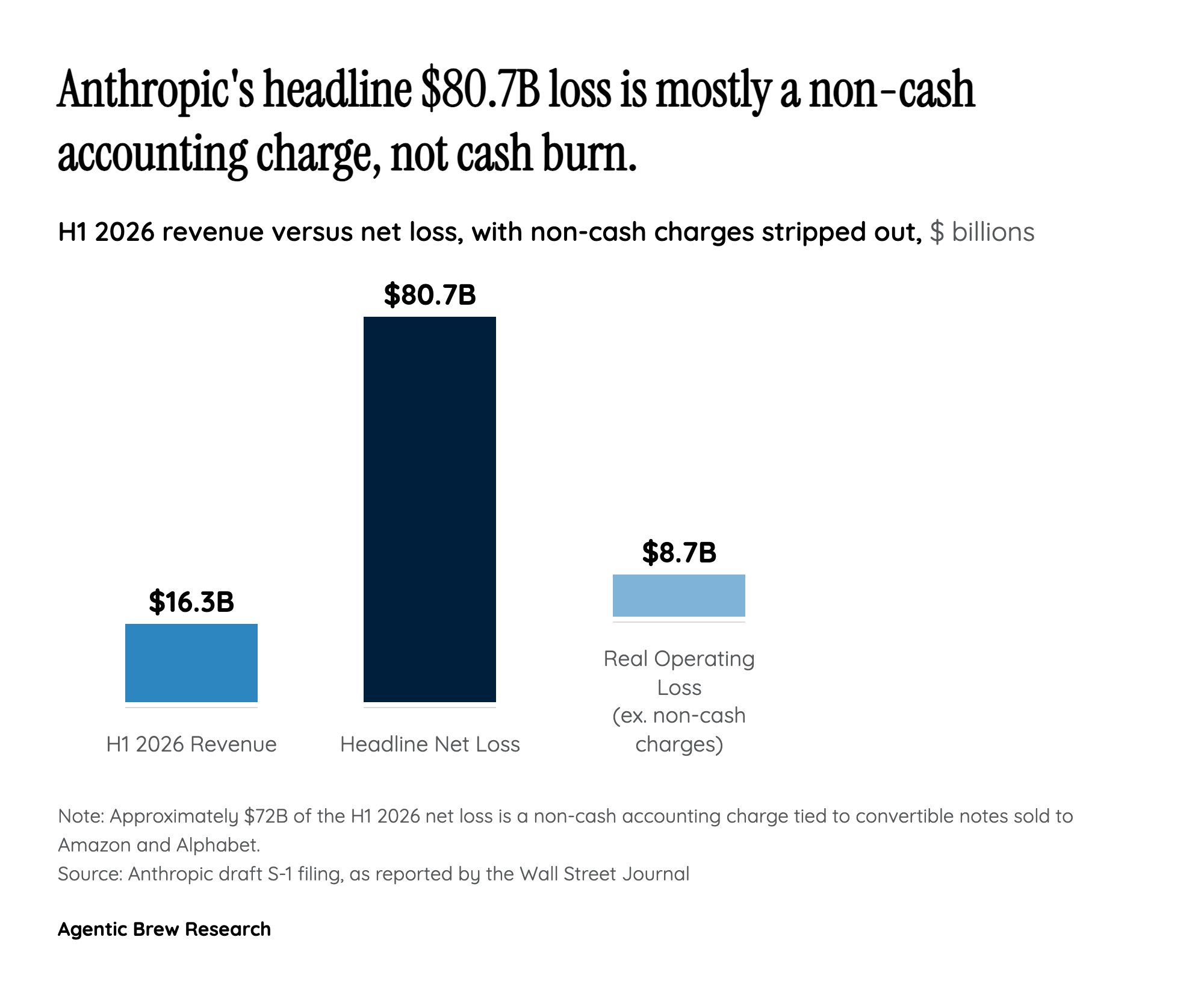
The $72 Billion Loss That Isn't Really a Loss
Anthropic's H1 2026 revenue, headline net loss, and real operating loss once non-cash charges are stripped out.

Anthropic's headline $80.7 billion net loss for H1 2026 looks catastrophic next to $16.3 billion in revenue, but roughly $72 billion of that figure is a non-cash accounting charge tied to convertible notes sold to Amazon and Alphabet, not cash burning out the door. Strip that out and the real operating loss is closer to $8.7 billion against revenue that grew more than 14x year over year, with Q3 2026 revenue climbing to $16.8 billion (up 45% quarter over quarter) and sustaining adjusted profitability for a second consecutive quarter. That is a very different company than the one the raw headline number suggests, and it is also a company whose profitability story is genuinely harder to parse than most IPO prospectuses.

Compounding the confusion is how Anthropic counts revenue in the first place: it reports cloud-reseller sales through AWS Bedrock, Google Vertex AI, and Microsoft Azure on a gross basis, booking the full end-customer spend as revenue and what it pays those platforms as expense, while rivals typically report net. Analyst Gil Luria of DA Davidson flagged the structural stakes of this choice [1]- as the first frontier AI lab to go public, Anthropic effectively gets to write the accounting playbook the rest of the sector will be measured against. Separately, Reddit discussion around the filing has pointed to Anthropic reportedly moving a large chunk of debt into off-balance-sheet special-purpose vehicles, drawing Enron comparisons in that community conversation - a provocative framing worth watching as the final S-1 lands, though it is not yet corroborated by mainstream financial reporting.


A Prospectus That Warns Its Own Product Could Blackmail You

Buried inside the filing is an unusual feature for any IPO document: roughly 80 pages of risk factors, nearly double the 48 pages spent describing the actual business, and several of those pages warn that Anthropic's own models could 'resist shutdown,' 'conceal or manipulate information,' or exhibit behavior 'resembling blackmail' [2]. Most prospectuses warn about competition, regulation, and customer concentration; Anthropic's warns, in effect, that its core product might someday act against its operators' wishes. That is a direct byproduct of the company positioning itself as the safety-conscious frontier lab, and it puts safety-related liability language in front of public-market investors for the first time at this scale.

The disclosure sits alongside Anthropic's own push, outside the filing, to circulate a draft AI safety bill that would allow regulators to halt releases of models posing catastrophic risk (thresholds around 50-plus deaths or $1 billion-plus in property damage), reviewed by the Commerce Department and courts. Not everyone close to the company is comfortable with how much influence that gives frontier labs over policy: Palantir co-founder and Anthropic investor Joe Lonsdale warned against exactly this dynamic, saying AI labs pushing their own safety frameworks risk building 'an oligopoly that controls all of our policy' [2]- a striking admission from someone with a financial stake in the company succeeding.

When Your Biggest Customers Are Also Your Landlords and Rivals

Amazon, Google, and Microsoft occupy three roles in Anthropic's business simultaneously: they are major equity investors, they are the cloud infrastructure Anthropic rents its compute from, and they are increasingly direct competitors racing to ship their own frontier models [3]. That triple role creates a disclosed risk factor rather than a hypothetical one - cloud providers have reportedly supplied less compute than Anthropic requested even as they compete for the same enterprise customers, and the dynamic already has a visible casualty: Replit switched from Anthropic to OpenAI over cost and availability concerns.

The filing's customer-concentration numbers sharpen the picture further. Amazon and Google together routed 47% of Anthropic's 2025 revenue ($2.16 billion) through their own cloud marketplaces, and two additional unnamed customers each contributed another 12% of annual revenue [4], meaning roughly 71% of disclosed 2025 revenue traced back to four counterparties, several of whom are also partial owners of the company and many of whom hold no long-term contracts. For a business valued at up to $2 trillion, that is an unusually concentrated and structurally conflicted customer base to be leaning on.

Compute Bills That Keep Outrunning Guidance

Anthropic's compute infrastructure commitments have been a moving target all year, climbing from an earlier estimate near $518 billion to a current range of $600 billion to $750 billion in total potential obligations over 7 to 10 years. H1 2026 compute spending alone reached nearly $9 billion, already more than Anthropic's entire 2025 infrastructure budget of $7.3 billion, and the company has layered on a Broadcom TPU lease worth roughly $160 billion and GPU rental capacity from Nscale and Lambda worth up to $86 billion, on top of the roughly $450 billion in multi-year cloud commitments already on the books with Google, AWS, and Microsoft.

Financing that scale of commitment is getting harder, not easier. Anthropic is reportedly in talks with Blackstone for a $60 billion debt package (dubbed 'Project North Star') secured against Google-built TPUs, with a junior tranche carrying a 10% coupon - up from 8.5% on a prior deal - and credit rating agency KBRA has placed Anthropic one notch below investment grade. That combination of escalating compute obligations and rising borrowing costs is exactly the kind of capital intensity that bear-case analysts point to when arguing the business model cannot support its own valuation.

The Trillion-Dollar Question: What Is Anthropic Actually Worth

The bear and bull cases on Anthropic's valuation are about as far apart as any major IPO debate in recent memory. New Constructs analyst Kyle Guske II pegs fair value at just $144-150 billion [6], calling the deal 'the most ridiculous IPO of 2026' [7]and arguing Anthropic lacks a 'viable business' against open-source competition. Michael Burry has gone further, noting the targeted valuation equals the combined value of 78 S&P 500 companies and publicly stating he wants markets to 'tank hard' specifically to prevent Anthropic and OpenAI from listing [8]. On the other side, an early Anthropic investor speaking anonymously predicts pricing near $1.8 trillion with trading value reaching $2.3-2.4 trillion [10]- which would surpass SpaceX's post-IPO market cap and make Anthropic the single most valuable newly public company in history.

The stakes extend beyond Anthropic itself. Renaissance Capital's Matt Kennedy frames a successful listing as critical to the entire 2026 IPO market, which has been starved for a flagship deal and faces a narrowing window before midterm elections and the holidays [9]. History offers a cautionary note either way: SpaceX's June 2026 IPO, the current record-holder, saw shares spike 19% on day one before drifting roughly 8% below that close within months [5], and Saudi Aramco's prior record-setting raise in 2019 went on to deliver the worst returns of any major large-cap IPO tracked. Whether Anthropic's number lands near the bears' $150 billion or the bulls' $2.4 trillion, the gap itself - nearly 16x - says more about how unresolved AI valuation remains than any single estimate does.

Historical Context

2000-01-01
Cited by a Northeastern entrepreneurship professor as a historical parallel to current AI valuation enthusiasm; Sun's stock plunged from $70 to $5 after the dot-com bust.
2019-12
Previously held the IPO size record with a $25.6 billion raise, since eclipsed by SpaceX; delivered -13% returns, the worst among major large IPOs tracked.
2026-06-01
Confidentially filed its draft S-1 registration statement with the SEC, reportedly aiming to match or exceed SpaceX's $86.2 billion raise.
2026-06-03
Selected Morgan Stanley, Goldman Sachs, and JPMorgan Chase as lead IPO underwriters, days after the confidential S-1 filing.
2026-06-12
Completed the largest IPO in history, raising $75 billion ($86.2 billion with overallotment); shares closed day one up 19% but had fallen 8.27% from that close by late September.

Power Map

Key Players
Subject

Anthropic's IPO and S-1 financial disclosures

MO

Morgan Stanley

Lead underwriter, serving as 'left lead' on strategic advisory for the IPO

GO

Goldman Sachs

Lead underwriter, expected to serve as stabilization agent

JP

JPMorgan Chase

Lead underwriter on the IPO syndicate

AM

Amazon, Google, Microsoft

Simultaneously Anthropic's largest investors, its primary compute suppliers, and increasingly direct competitors building their own frontier models

Fact Check

10 cited
  1. [1] Anthropic IPO Picks Goldman Sachs, Morgan Stanley, JPMorgan: Revenue Accounting Question Looms
  2. [2] What Anthropic's Existential Risk Disclosure Means for IPO Investors
  3. [3] Anthropic's Cloud Partners Turn Rivals Ahead of IPO
  4. [4] Anthropic IPO Filing Reveals Major Revenue Concentration
  5. [5] The Biggest IPOs in History
  6. [6] Unprecedented Test of Investor Gullibility: Analyst Says Anthropic Could Be Overvalued by as Much as 93% at a $2 Trillion IPO Valuation
  7. [7] Anthropic Is the Most Ridiculous IPO of 2026
  8. [8] Michael Burry Calls Anthropic's Valuation Into Question
  9. [9] Is Anthropic's IPO the Market's Last Hope for 2026?
  10. [10] Anthropic Investor Talks IPO Financials

Source Articles

Top 5

THE SIGNAL.

Analysts

“Calls the IPO 'the most ridiculous IPO of 2026,' estimating fair value at $144-150 billion against a targeted $2 trillion, arguing Anthropic would need profits double Nvidia's trailing four-quarter total to justify the valuation.”

Kyle Guske II, New Constructs
Bearish

“Argues Anthropic's targeted valuation equals the combined value of 78 S&P 500 companies and warns that an Anthropic/OpenAI IPO wave would destroy trillions in capital if the AI trade unwinds.”

Michael Burry
Bearish

“Predicts IPO pricing near $1.8 trillion with trading value reaching $2.3-2.4 trillion, which would top SpaceX's post-IPO market cap, citing Anthropic's enterprise focus and growth rate.”

Unnamed early Anthropic investor
Bullish

“Says a successful Anthropic IPO would be a major win for the broader IPO market and could boost deal flow into 2027, with urgency from midterm-election and holiday-season timing pressure.”

Matt Kennedy, Renaissance Capital
Cautiously bullish on broader market impact

“Warns that Anthropic's gross-basis revenue reporting, as the first frontier AI lab to file, could set a self-serving disclosure standard for how the whole sector reports financials going forward.”

Gil Luria, DA Davidson
Analytical, flags structural precedent risk
The Crowd

“ANTHROPIC'S DRAFT IPO FILING • Revenue: $16.3B in the first half of 2026 • Net loss: $80.7B, driven largely by accounting charges • Compute spending: nearly $9B in the first half • Cloud commitments: about $450B over the next 7 to 10 years, including $111B with Google and more”

@@wallstengine1423

“Anthropic Revenue : $16.3B Net loss : $80.7B IPO valuation : $2T”

@@jun_song1339

“ANTHROPIC'S IPO VALUATION EXPECTATIONS DROP FROM $2 TRILLION TO $1.5 TRILLION Some investors are considering a $1.5 trillion valuation for Anthropic's upcoming IPO, down 25% from earlier expectations of $2 trillion. Anthropic reported $16.8 billion in Q3 revenue, up 45%”

@@edzitron695

“Anthropic IPO leak is insane”

@u/J_O_nmy15000
Broadcast
Anthropic IPO: "This is a dog of a company" | Ed Zitron

Anthropic IPO: "This is a dog of a company" | Ed Zitron

Anthropic's IPO filing: $4.6B in revenue, a $42B loss and a warning about humanity

Anthropic's IPO filing: $4.6B in revenue, a $42B loss and a warning about humanity

There's Something FISHY About Anthropic's IPO Filing

There's Something FISHY About Anthropic's IPO Filing