The Wafer-Scale Trick That Makes 750 Tokens a Second Possible
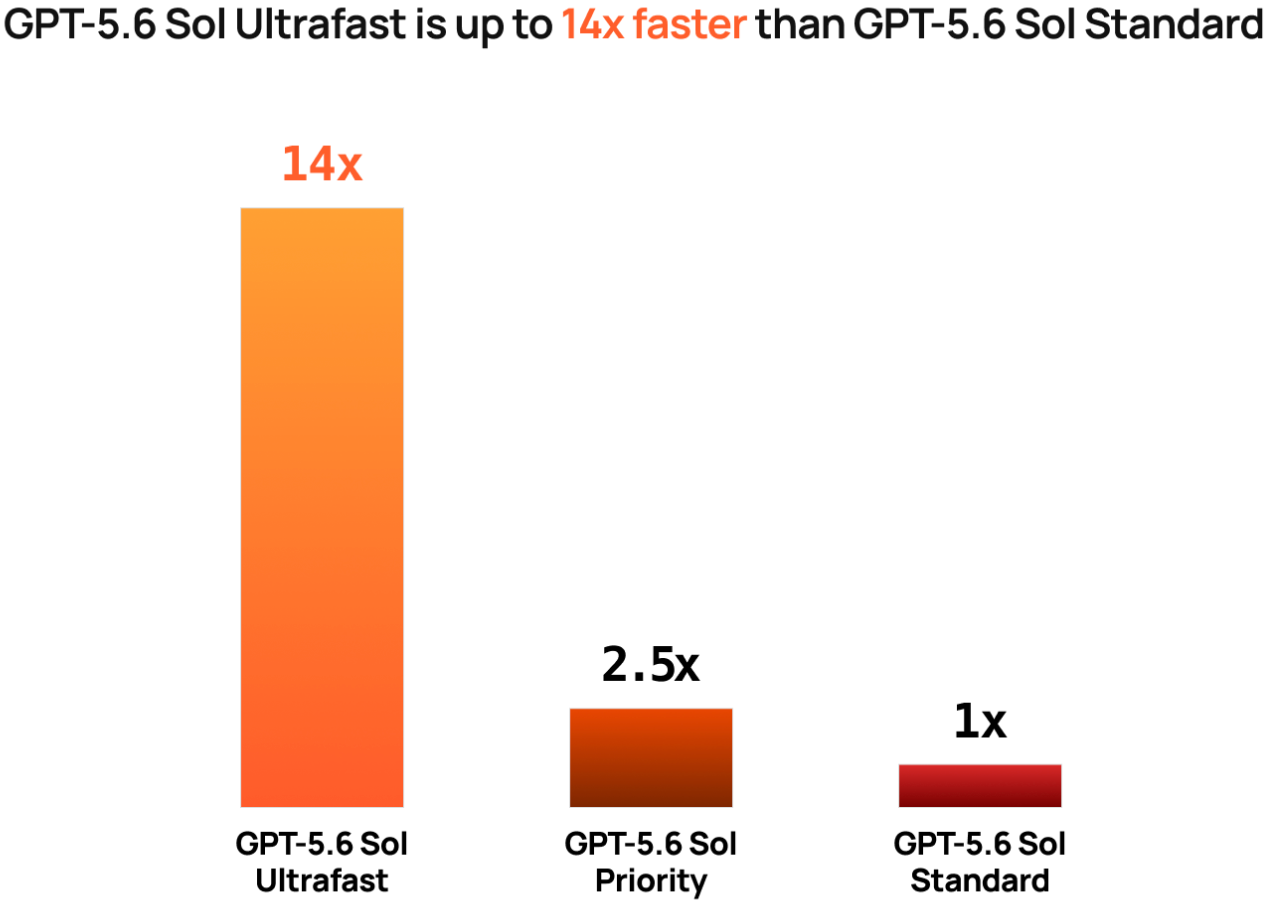
Ultrafast's headline number - up to 14x faster inference, topping out around 750 output tokens per second [1]- isn't achieved by shrinking the model. It's the same GPT-5.6 Sol, run on hardware that sidesteps the bottleneck that normally throttles large language models: memory bandwidth. On a standard GPU cluster, weights have to be shuttled between off-chip memory and processing cores for every token generated. Cerebras' Wafer-Scale Engine instead keeps 44 GB of SRAM directly on each wafer-sized chip [1], so the model's weights sit next to the compute rather than queuing behind a bus. OpenAI frames the result as a tradeoff-free kind of scaling: 'Until now, getting real-time speed typically meant choosing a smaller or more specialized model. Ultrafast points to progress in a new direction: more useful work per second.' [2]
The benchmark numbers back up the framing. On GDP-Val, a suite of economically valuable knowledge-work tasks like legal briefs and financial models, Ultrafast delivered a 5.6x end-to-end speedup with no measured loss in quality [1]. On Humanity's Last Exam, a 2,500-question benchmark, Ultrafast finished the full set in 11 hours 11 minutes versus 78 hours 27 minutes for Anthropic's Claude Fable 5 at comparable accuracy - roughly a 7x wall-clock difference [1]. That gap matters more than the raw tokens-per-second figure: it's the difference between a benchmark run that finishes overnight and one that finishes before lunch.