Zhipu GLM-5.3-Flash's Ox Alpha stealth launch and Chinese-chip inference claim
TECH

Zhipu GLM-5.3-Flash's Ox Alpha stealth launch and Chinese-chip inference claim

41+
Signals

Strategic Overview

  • 01.
    Zhipu AI (Z.ai) confirmed that its viral, anonymous preview model 'Ox Alpha' is GLM-5.3-Flash, releasing the open-weight model the same day after roughly a week of third-party testing.
  • 02.
    The model is a 320-billion total-parameter, 18-billion active-parameter Mixture-of-Experts system, the first natively multimodal model in the GLM-5 series, with a 1,048,576-token context window.
  • 03.
    Zhipu says the model's entire stealth-test traffic ran on a cluster of roughly 100,000 domestically produced Chinese chips at hardware efficiency and cost per token comparable to Nvidia GPUs.
  • 04.
    The model was released under the MIT license and is already available on OpenRouter (12 providers), Cloudflare Workers AI, and the GLM Coding Plan.

The Stealth Playbook: How a Free 'Mystery Model' Became a 62-Trillion-Token Coup

On August 20, 2026, an anonymous, free-to-use model called 'Ox Alpha' quietly appeared on OpenRouter, OpenCode, Cline, and Nous Research's portal, offering a 1-million-token context window and support for text, image, and video input [1]. No lab claimed it. For about a week it ran as a stealth test, absorbing real-world traffic instead of internal benchmarking - reportedly serving more than 100 trillion tokens a day in free usage and processing 62 trillion tokens in total before any company put its name on it [2]. That is an unusual way to launch a frontier-class model: skip the keynote, let the market find you first.

The unmasking came on August 27, 2026, when Zhipu AI (Z.ai) confirmed that Ox Alpha was in fact GLM-5.3-Flash, a 320-billion-parameter Mixture-of-Experts model, and released its weights the same day under the MIT license [3]. The reveal validated what the stealth run had already shown: GLM-5.3-Flash became OpenRouter's biggest launch to date, processing more than 11 trillion tokens in its first three days post-reveal and capturing close to 31 percent of the platform's weekly coding-model volume - the top spot [1]. Zhipu's Hong Kong-listed shares closed more than 12 percent higher the day of the announcement [1]. The stealth period was not incidental marketing; it was the model's own adoption curve, built before anyone knew whose model it was.
Nvidia-Comparable Cost Without Nvidia: A Claim the Industry Is Now Testing

The detail drawing the most scrutiny is not GLM-5.3-Flash's parameter count but where it ran. Zhipu says the entire stealth trial - all of that 100-trillion-tokens-a-day traffic - was carried on a cluster of roughly 100,000 domestically produced Chinese AI chips, with hardware efficiency and cost per token described as comparable to Nvidia GPUs [2]. Z.ai attributes part of that efficiency to a custom SGLang-based inference engine it says triples end-to-end serving throughput on the domestic hardware [4].

Analyst firm SemiAnalysis treated the claim as a bigger story than the model itself, noting it followed closely on OpenAI's own announcement of a proprietary inference chip and arguing that Nvidia's CUDA software moat is 'once again under scrutiny' [2]. The New Stack's framing was blunter: GLM-5.3-Flash is 'cheap, good, and served on Chinese chips' [9]. It is worth stressing that the efficiency and cost-parity figures are self-reported by Zhipu, not independently audited - though because the weights are now open and running on multiple third-party platforms, the claims are specific enough that outside developers can start testing them directly [4]. Set against ongoing US export controls on advanced chips to China, a real-world claim of Nvidia-comparable inference at scale on domestic silicon carries weight well beyond the benchmark charts.

Not Actually 'Flash': A Naming Mismatch That Sparked Its Own Pricing Debate

'Flash' branding usually signals small and cheap, but GLM-5.3-Flash's 320-billion total parameters (18 billion active) puts it well outside that category - deployment requires well over 320GB of memory, a scale closer to Zhipu's flagship releases than to its prior lightweight Flash and Air models. That mismatch drew pushback from the model's earliest self-hosting community, who took to calling it 'Gigaflash' rather than a true small-footprint variant.

On hosted platforms the pricing looks straightforwardly cheap: OpenRouter lists GLM-5.3-Flash at $0.075 per million input tokens and $0.25 per million output tokens, served by 12 providers including Z.ai, Together, Cloudflare, and Reka AI [5], and Zhipu prices it at roughly a tenth of its flagship GLM-5.3 [6]. But the comparison gets murkier once caching enters the picture - early community pricing debates suggest GLM-5.3-Flash's cached-token rate runs meaningfully higher than rival DeepSeek V4 Flash's, even though GLM-5.3-Flash tends to need fewer output tokens per completed task, muddying any simple cost-per-task verdict. A parallel strand of skepticism holds that some of the model's strongest benchmark showings reward flashy, commonly-rehearsed demo prompts rather than robust general engineering - a caution worth keeping in mind before treating any single benchmark number as decisive.

Under the Hood: A Hybrid-Attention, Natively Multimodal Architecture at 1M-Token Context

Under the Hood: A Hybrid-Attention, Natively Multimodal Architecture at 1M-Token Context
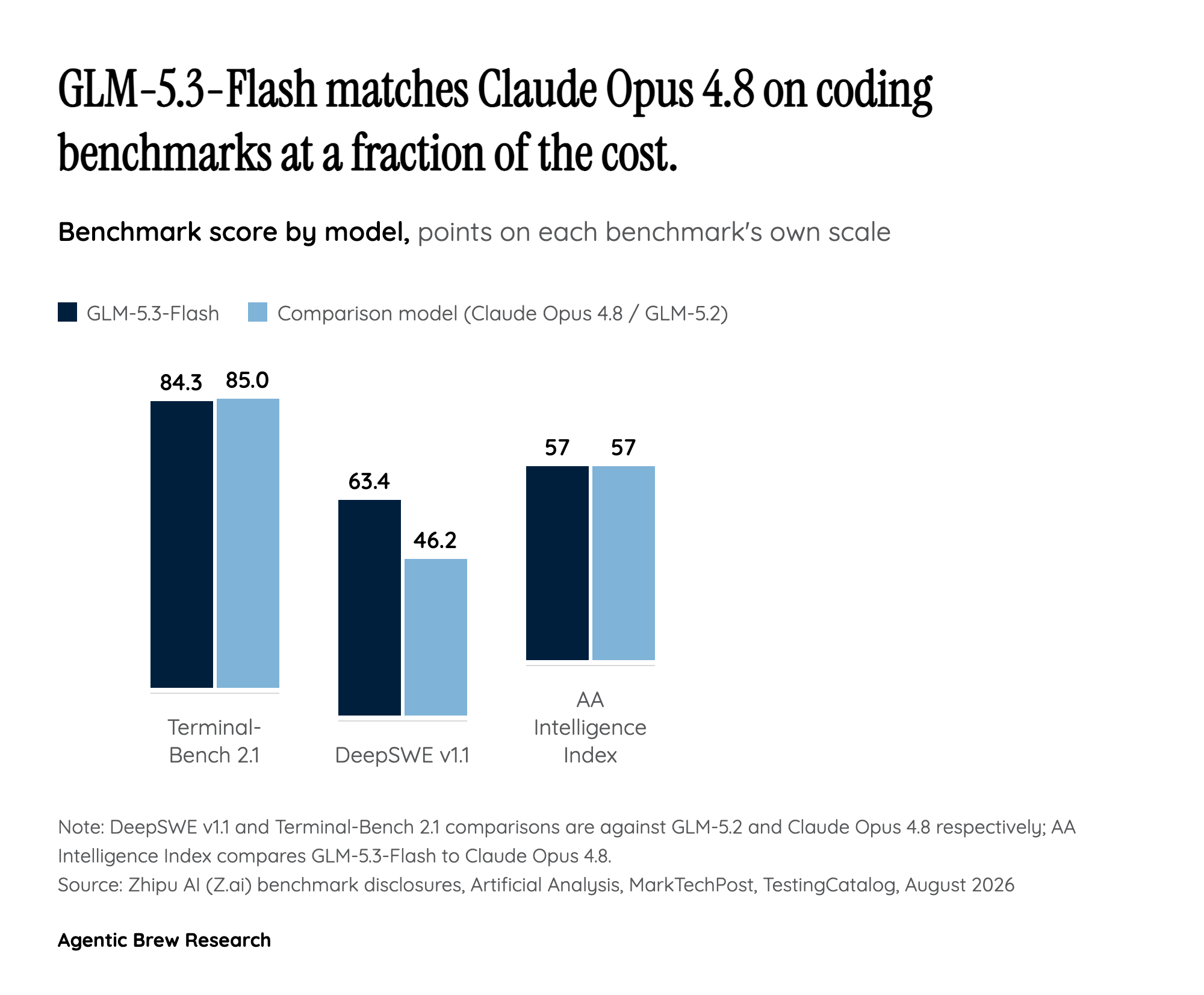
GLM-5.3-Flash matches Claude Opus 4.8 on coding benchmarks at a fraction of the cost.

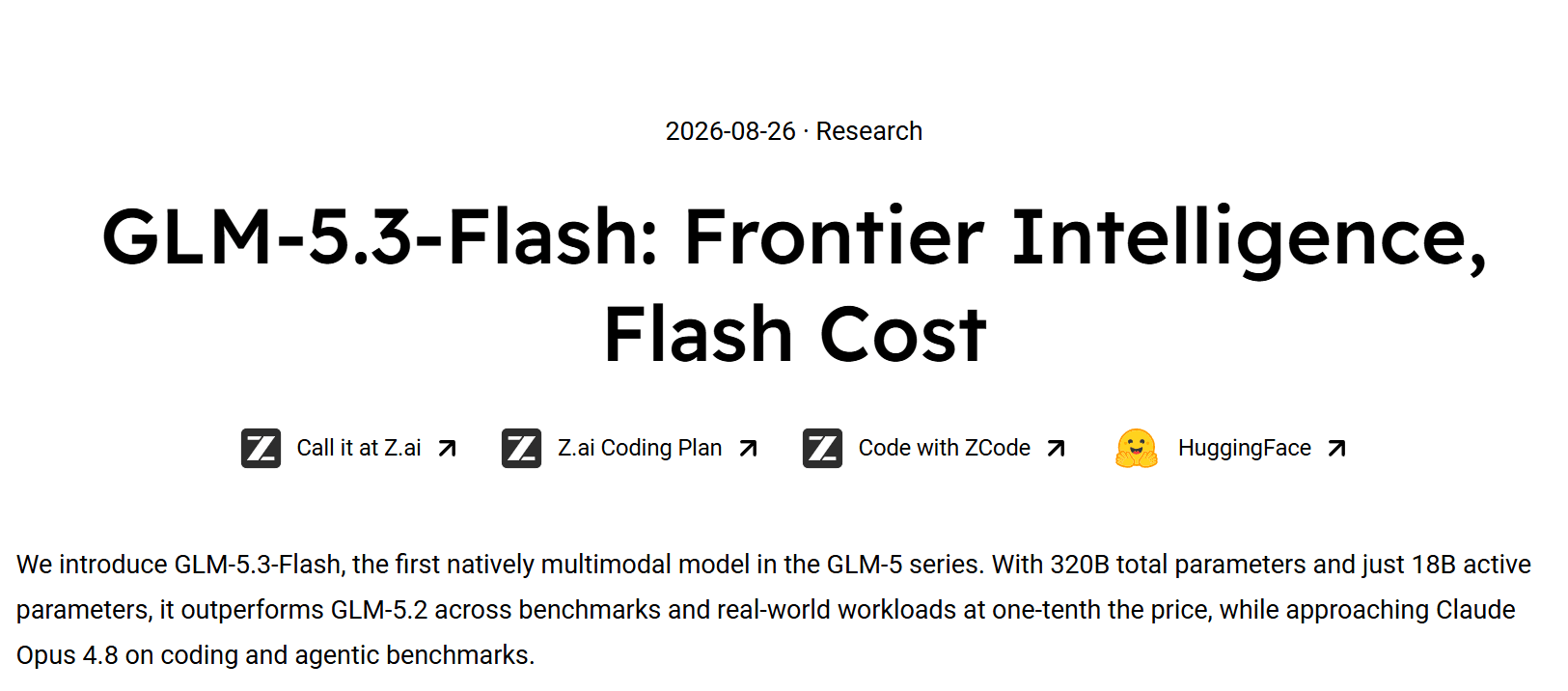
GLM-5.3-Flash is the first natively multimodal model in the GLM-5 series, built to handle text, images, video, visual documents, and interleaved multimodal inputs in one model rather than bolting vision on afterward [3]. Architecturally, its 45-layer language backbone interleaves KDA linear-attention layers with NoPE sparse multi-head-latent-attention layers, routes each token through 8 of 288 experts, and ships native FP8 weights alongside a multi-token-prediction draft layer for faster decoding [7]. That hybrid sparse-plus-linear design is what lets the model sustain a 1,048,576-token context window with a 131,072-token maximum output, trained on a 30-trillion-token multimodal corpus [7].

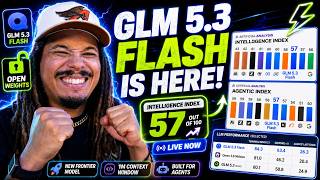
On public benchmarks, Zhipu reports an Artificial Analysis Intelligence Index score of 57, matching Claude Opus 4.8 and beating DeepSeek V4 Pro [1], a Terminal-Bench 2.1 score of 84.3 against Opus 4.8's 85.0, and a DeepSWE v1.1 score of 63.4, up sharply from GLM-5.2's 46.2 [6]. Those numbers, combined with the model's scale and open MIT license, are what make it plausible as a genuine frontier-adjacent release rather than a scaled-down convenience model - even as the naming continues to undersell how much compute it actually needs to run.

Historical Context

2026-02-11
GLM-5 was released as the newest major generation of Zhipu's GLM model family.
2026-06-22
GLM-5.2 was released, the direct architectural predecessor that GLM-5.3-Flash builds on and outperforms.
2026-08-14
GLM-5.3, the larger flagship model distinct from 5.3-Flash, was officially released aiming to rival Anthropic and OpenAI in coding.
2026-08-20
An anonymous, free-to-use model called 'Ox Alpha' quietly appeared on OpenRouter, OpenCode, Cline, and Nous Research's portal, later revealed to be GLM-5.3-Flash.
2026-08-26
Z.ai confirmed to Bloomberg that Ox Alpha was a new GLM-series iteration and announced weights would be released that night.
2026-08-27
Zhipu officially identified Ox Alpha as GLM-5.3-Flash and released the MIT-licensed open weights, with shares jumping more than 12 percent in Hong Kong trading.

Power Map

Key Players
Subject

Zhipu GLM-5.3-Flash's Ox Alpha stealth launch and Chinese-chip inference claim

ZH

Zhipu AI (Z.ai)

Developer of GLM-5.3-Flash; ran the anonymous 'Ox Alpha' stealth test, confirmed the model's identity, and released open weights, gaining a 12%+ Hong Kong stock jump and outsized market attention from the reveal.

OP

OpenRouter

Hosted the anonymous 'Ox Alpha' listing pre-reveal and became GLM-5.3-Flash's largest distribution channel post-reveal, processing over 11 trillion tokens in three days and about 31 percent of weekly coding-model volume.

CL

Cloudflare

Deployed GLM-5.3-Flash on Workers AI (@cf/zai-org/glm-5.3-flash) the same day as the official launch, extending distribution to its developer and AI Gateway customer base.

OP

OpenCode, Nous Research, and Cline

Platforms that hosted the free, anonymous 'Ox Alpha' preview before the reveal, contributing to the model's organic viral discovery and stress-testing at scale.

DO

Domestic Chinese AI chipmakers (unnamed cluster)

Supplied the ~100,000-chip cluster Zhipu says carried all inference traffic, central to the narrative of reduced Nvidia dependence amid export controls.

Fact Check

9 cited
  1. [1] Zhipu AI shares jump on viral Ox Alpha model revealed as GLM-5.3-Flash on Chinese chips
  2. [2] Zhipu (Z.ai) Unmasks the Mystery Ox Alpha Model as GLM-5.3-Flash, Revealing It Was Run Entirely on Chinese GPUs While Serving 100 Trillion Tokens/Day
  3. [3] Zhipu identifies Ox Alpha as GLM-5.3-Flash and releases model weights
  4. [4] The Chinese AI model GLM-5.3-Flash runs without Nvidia and costs a fraction of what the competition does
  5. [5] GLM 5.3 Flash - OpenRouter
  6. [6] Z.ai launches GLM-5.3-Flash under MIT license
  7. [7] Z.ai Releases GLM-5.3-Flash: A 320B-A18B Natively Multimodal MoE With a 1M-Token Context
  8. [8] GLM-5.3-Flash now available on Workers AI
  9. [9] Z.ai's GLM-5.3-Flash is Cheap, Good, and Served on Chinese Chips

Source Articles

Top 5

THE SIGNAL.

Analysts

Framed Zhipu's claim that all GLM-5.3-Flash traffic ran on domestic chips at Nvidia-comparable cost per token as evidence that Nvidia's CUDA software moat is coming under renewed scrutiny, linking it to OpenAI's own inference-chip announcement.

SemiAnalysis
Semiconductor and AI-infrastructure analyst firm

Characterized GLM-5.3-Flash as cheap, capable, and notable specifically for running entirely on Chinese chips.

Frederic Lardinois
Journalist, The New Stack

Argued Chinese labs like Zhipu keep pace with frontier US labs not through simple distillation but through faster release cadence, benchmark focus, and post-training efficiency, while noting the model's improved exploit-analysis capability raises dual-use safety concerns.

interconnects.ai (Nathan Lambert's publication)
AI research and industry analysis blog
The Crowd

Introducing GLM-5.3-Flash - Leading capabilities at a highly competitive price - Natively multimodal with a 1M-token context window - A 320B-A18B model released under the MIT License - Previously previewed as Ox Alpha, running entirely on Chinese AI chips Blog: [link]

@@Zai_org23121

Ox Alpha was an early version of GLM-5.3-Flash. The official release delivers stronger performance and significantly better stability. Huge thanks to @opencode and @OpenRouter for making it available to the community. And thank you to everyone who tried it, pushed it to its limits.

@@ZixuanLi_4472

Ox Alpha has been unveiled as GLM-5.3-Flash, but what's shocking is that the 100T tokens per day is served on Chinese chip. (1/...)

@@SemiAnalysis_2770

GLM-5.3-Flash: Frontier Intelligence, Flash Cost

@u/BriguePalhaco1200
Broadcast
Ox Alpha is GLM 5.3 Flash!!!

Ox Alpha is GLM 5.3 Flash!!!

GLM 5.3 Flash Might Be The New Mystery Model & NEW DeepSeek Model!

GLM 5.3 Flash Might Be The New Mystery Model & NEW DeepSeek Model!

GLM 5.3 Flash JUST DROPPED... And It's Almost As Good As MAX?!

GLM 5.3 Flash JUST DROPPED... And It's Almost As Good As MAX?!

Zhipu GLM-5.3-Flash's Ox Alpha stealth launch and Chinese-chip inference claim — AI News | Agentic Brew