Boundaries, not scale: the pretraining trick behind a 1B model beating a 7B one
The most quietly radical thing about LingBot-Vision is what it chooses to learn. Most self-supervised vision backbones - DINOv3 among them - train for semantic invariance: the model is rewarded for producing similar representations of the same object across crops, lighting, and augmentation. That objective is great for classification and retrieval, but for a robot that needs to know exactly where one object ends and the next begins, invariance is almost the wrong thing to optimize. LingBot-Vision flips it. It is boundary-centric, treating object boundaries as a native pretraining signal via masked boundary modeling rather than an afterthought derived from semantic features [2].
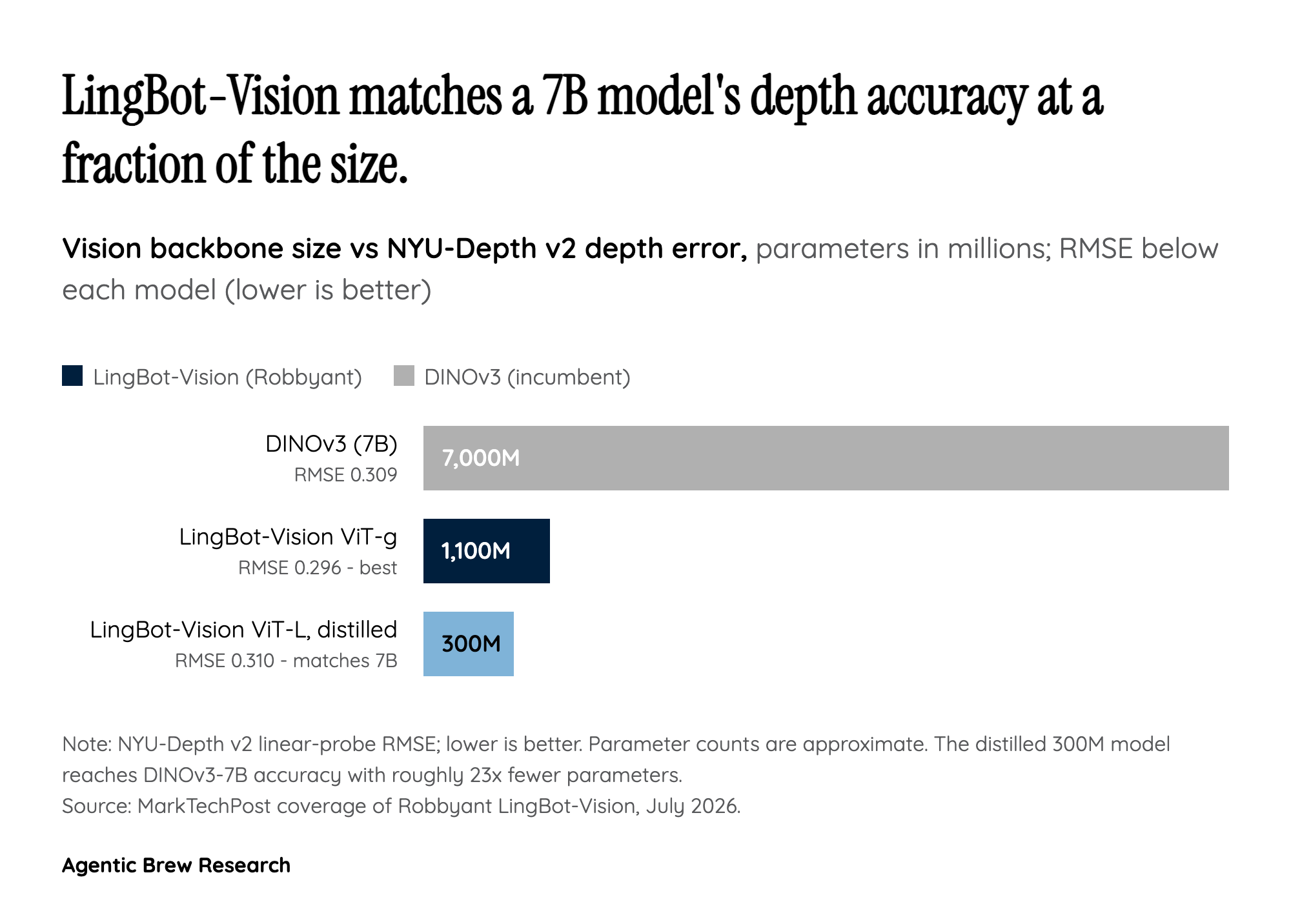
The payoff is a genuine efficiency-over-scale result: on NYU-Depth v2, the roughly 1.1B ViT-g backbone posts an RMSE of 0.296, ahead of the 7B DINOv3's 0.309, despite being pretrained on about 161M images versus DINOv3's far larger LVD-1689M corpus [2]. Distillation pushes the point further - a 0.3B ViT-L variant matches the 7B DINOv3 with roughly 23x fewer parameters [2]. For robotics, where every backbone runs on constrained onboard compute, that ratio matters more than a leaderboard rank. The family spans ViT-S/16 up to the flagship ViT-g/16, all Apache-2.0 on Hugging Face [2].