SpaceX-Nvidia Orbital AI Data Centers
TECH

SpaceX-Nvidia Orbital AI Data Centers

33+
Signals

Strategic Overview

  • 01.
    On August 4, 2026, SpaceX and Nvidia announced they are jointly developing the compute payload for the Starmind AI1 satellite, pairing Nvidia's new Rubin GPUs and Vera CPUs for what the companies call "datacenter-class space compute."
  • 02.
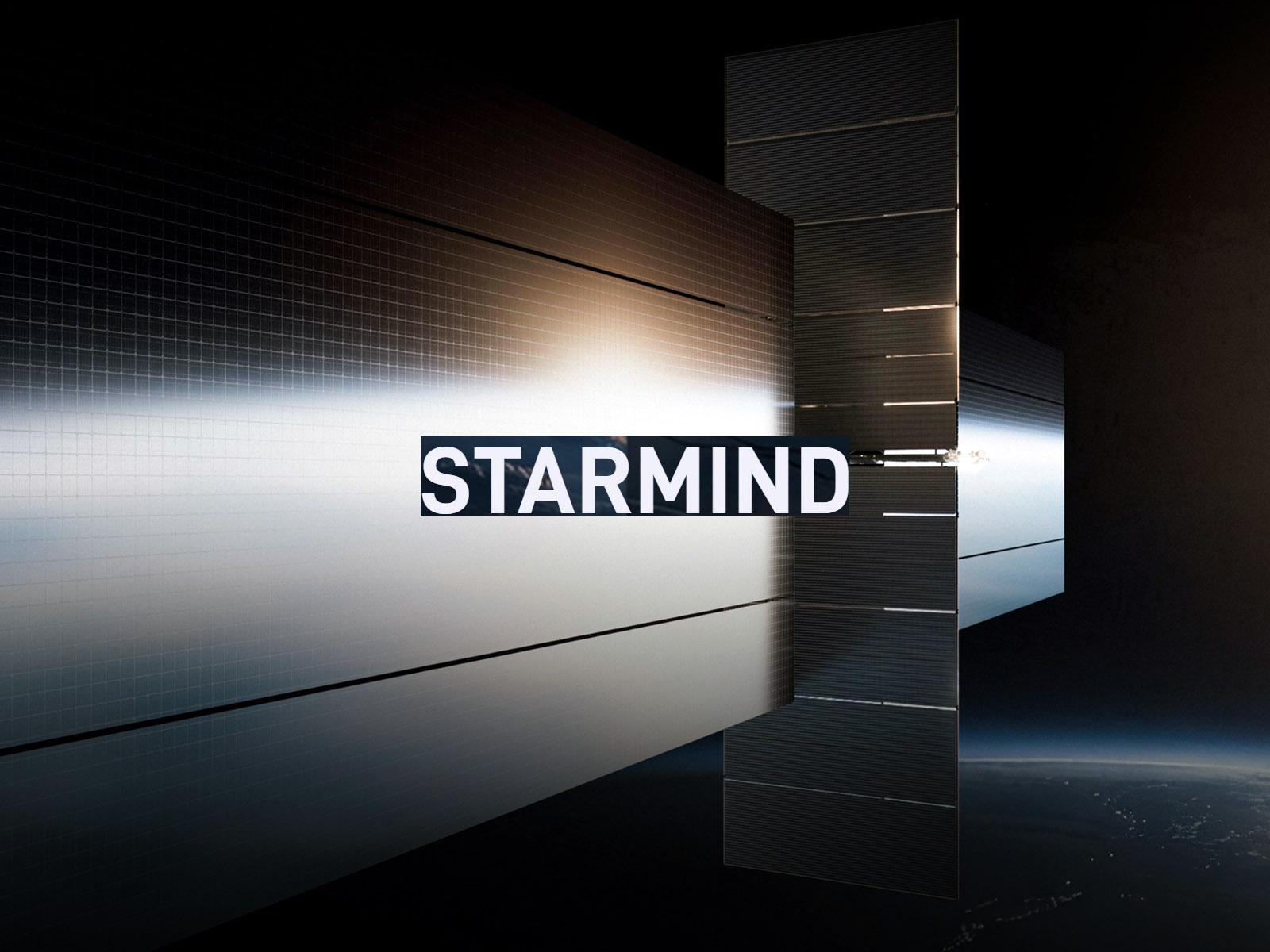
    SpaceX has revised the satellite's power targets upward since its initial spec, raising peak power by 67% to roughly 250 kW and average power by 33% to 160 kW - enough to run a full Nvidia Rubin NVL72 rack - while cooling relies on about 110 square meters of liquid radiators rejecting heat into the vacuum of space.
  • 03.
    SpaceX and Nvidia are targeting a megaconstellation of up to 1 million Starmind satellites - a target SpaceX had already outlined in FCC filings back in January 2026 - each acting as a node in what would become a distributed AI supercomputer in orbit, with prototype satellites due in early 2027 and volume manufacturing from a facility called Gigasat later that year.
  • 04.
    SpaceX frames the push into orbit as a way around terrestrial data-center bottlenecks - free round-the-clock solar power and natural vacuum cooling instead of grid power limits, zoning fights and water-supply concerns - and investors responded immediately, with SpaceX stock climbing nearly 9% and Nvidia shares up about 3% after the announcement.

Deep Analysis

The Power Upgrade That Signals This Is Real

On August 4, 2026, SpaceX and Nvidia announced they are jointly building the compute payload for the Starmind AI1 satellite [1], pairing Nvidia's new Rubin GPUs and Vera CPUs into what the companies call "datacenter-class space compute." What's notable isn't just the announcement itself but the trajectory behind it: SpaceX has already revised the satellite's power budget upward, adding 67% to peak power (up to roughly 250 kW, from an original 150 kW) and 33% to average power (up to 160 kW, from 120 kW) so a single AI1 unit can run a full Nvidia Rubin NVL72 rack [2]. Each satellite is designed to stand 20 meters tall with a 70-meter solar wingspan and roughly 110 square meters of liquid radiators that reject heat directly into the vacuum of space [2]. Nvidia frames the silicon itself as the bigger leap: the Rubin GPU inside its Space-1 Vera Rubin Module delivers up to 25x more AI compute for space-based inferencing than the H100 GPU it succeeds [12]. That is a lot of hardware commitment for something critics still dismiss as a slide deck. The market agreed: within hours of the announcement, SpaceX stock climbed nearly 9% and Nvidia shares gained about 3%, and Elon Musk's personal confirmation that SpaceX would use Nvidia GPUs exclusively pulled in more public engagement than SpaceX's own official announcement post - a sign of how much attention orbital compute is now commanding relative to Earth-bound AI infrastructure news.

The Physics Debate: Engineers vs. Skeptics

Nvidia CEO Jensen Huang frames the move into orbit as an inevitable extension of accelerated computing: "Space computing, the final frontier, has arrived... intelligence must live wherever data is generated." [12]Not everyone agrees on timing. Georgetown's Kathleen Curlee argues that widely cited 2030-2035 deployment timelines are simply not credible given the current state of the technology, and Northeastern engineering professor Josep Miquel Jornet points to a blunt physical constraint: in orbit, "there's nothing that can take heat away" the way air or water does on Earth [3]. Aerospace veterans push back on the pessimism. Portal Space Systems CEO Jeff Thornburg, a SpaceX veteran, argues the fundamentals are already proven: "We know how to launch rockets; we know how to put spacecraft into orbit; and we know how to build solar arrays" [3]- treating the timeline as an execution problem, not a scientific one. Planet's Chief Space Officer James Mason splits the difference: no new physics is required, but "power and thermal and doing that economically" [6]remain the real barrier. Skeptics go further than questioning the schedule. Futurism reports engineering estimates that a full-scale orbital data center station could weigh more than 113 million kilograms once radiation shielding, coolant, pumps and structural mass are counted in - far beyond what any current launch vehicle fleet could loft economically [4]. And even proven satellite operations carry real operational risk at constellation scale: Starlink alone performed roughly 300,000 collision-avoidance maneuvers in 2025 [5].

The Hidden Bottleneck: Bandwidth, Not Power

The Hidden Bottleneck: Bandwidth, Not Power
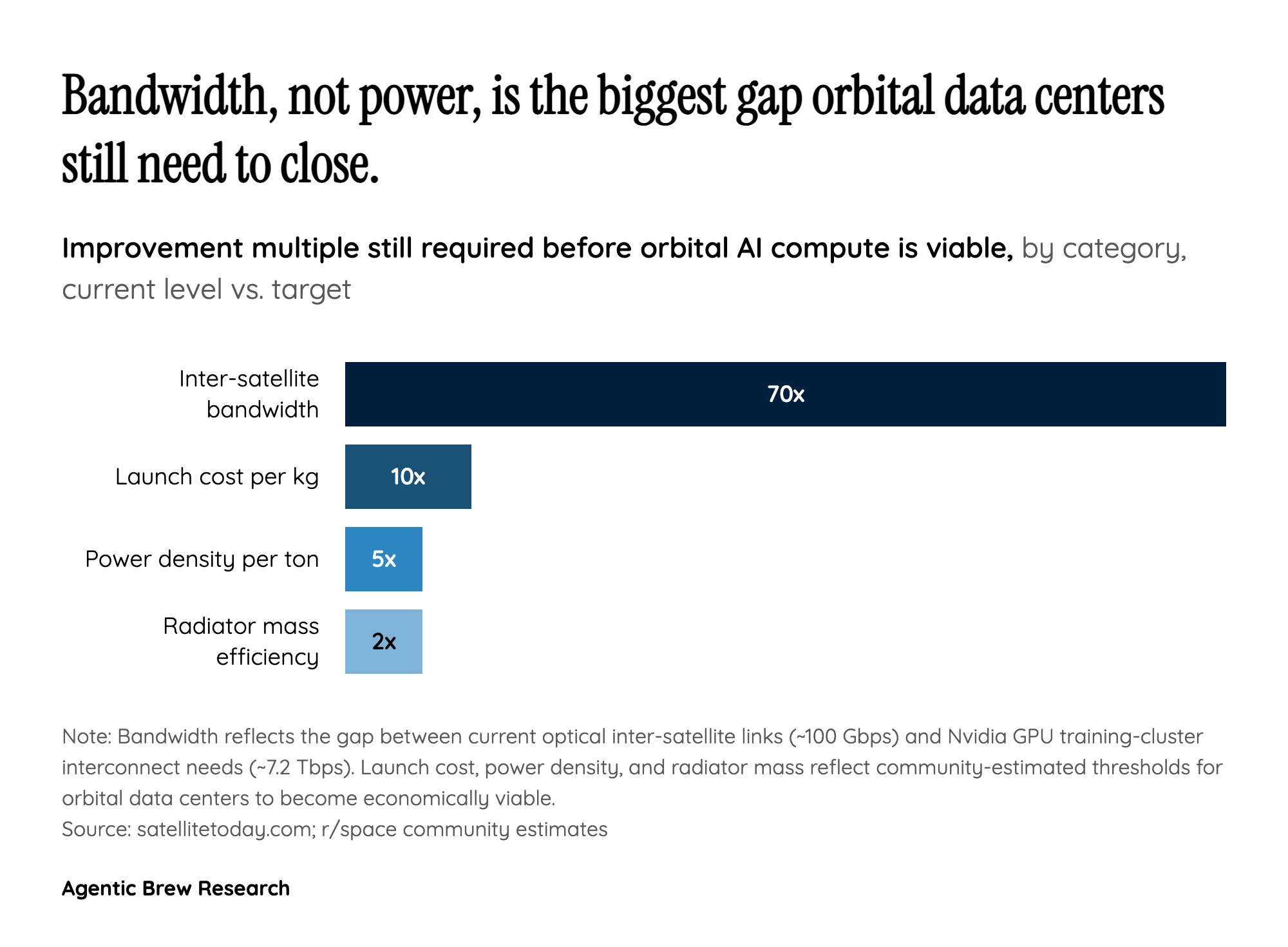
The bandwidth gap between current inter-satellite links and Nvidia's GPU training-cluster requirement is the single largest unsolved multiple in the orbital data center pitch - roughly 70x by the research's own figures (7.2 Tbps needed vs ~100 Gbps available today).

Much of the public debate fixates on power and cooling, but the numbers suggest the tighter near-term constraint may be moving data, not managing heat. Nvidia's GPU training clusters require roughly 7.2 terabits per second of interconnect bandwidth; today's optical inter-satellite links max out around 100 Gbps, a gap of roughly 70x [6]. That gap is why SpaceX's design routes processed results back to Earth through Starlink's existing laser inter-satellite link network rather than building new ground infrastructure [7]- a workaround for getting answers down, not for moving raw training data between satellites while they compute. Space-enthusiast communities have converged on similar math independently: back-of-envelope estimates put the needed jump at roughly 40x current inter-satellite bandwidth, alongside a roughly 10x cut in launch cost per kilogram, a multi-fold increase in power density per ton of satellite, and roughly half the radiator mass per square meter used today - all judged "very hard but not physically impossible."

A Crowded Orbital Landgrab

SpaceX and Nvidia are not alone in the race for orbital compute. Los Angeles startup Orbital Inc., led by CEO Euwyn Poon, has filed FCC plans for up to 100,000 satellites targeting 10 gigawatts of space-based computing power, arguing the complexity is almost entirely in launch logistics, with the remainder being first-principles physics and manufacturing [8]. Y Combinator-backed Starcloud got there first operationally, deploying the first Nvidia H100-class satellite in November 2025 and separately filing for its own 88,000-satellite constellation [9]. The competition extends well beyond the US too: China has reportedly outlined plans for a constellation of its own topping 200,000 satellites [13]. Google is running a parallel bet, Project Suncatcher, on its own TPU-based satellite clusters, even as it separately pays SpaceX a reported $920 million a month for access to roughly 110,000 Nvidia GPUs on the ground [10]- a reminder that today's real AI-compute money is still flowing through terrestrial infrastructure deals, not orbital ones. Axiom Space already has two dedicated orbital data-center nodes operating in low-Earth orbit as of January 2026, the first operational precedent for the category [11]. Across all of these competing bets, one point of consensus keeps surfacing: orbital storage for data sovereignty, rather than large-scale AI training or inference, is the most credible near-term business case [6]- everything else is still a wager on launch costs falling far enough, fast enough.

Historical Context

2016
Nvidia delivered its first DGX-1 supercomputer to SpaceX, the starting point of the companies' decade-long compute collaboration.
2024-09
Starcloud released a white paper detailing plans to build multiple gigawatts of AI compute in orbit, the first widely cited large-scale orbital data center proposal.
2025-11-02
Starcloud deployed an Nvidia H100-class system via a SpaceX Falcon 9 launch, becoming the first company to train a large language model in space.
2025-11
Google announced Project Suncatcher, aiming to launch solar-powered satellite constellations carrying its own AI chips, with a demonstration mission planned for 2027.
2026-01-11
Axiom Space launched the first two dedicated orbital data center nodes to low-Earth orbit.
2026-01
SpaceX filed FCC plans for a constellation of up to 1 million satellites to create an orbital data center, reportedly collaborating with Anthropic.
2026-03-16
Nvidia publicly launched its Space-1 platform, including the Vera Rubin Module for orbital AI data centers, at GTC.
2026-06-24
Orbital Inc. filed with the FCC for up to 100,000 data-center satellites aiming to deliver 10 gigawatts of space-based computing power.
2026-08-04
SpaceX and Nvidia announced the Starmind AI1 satellite compute payload partnership using Rubin GPUs and Vera CPUs.

Power Map

Key Players
Subject

SpaceX-Nvidia Orbital AI Data Centers

SP

SpaceX

Builds and operates the Starmind satellite constellation and launch capacity, controls the Starlink laser-link network used for data return, and has filed FCC plans for up to 1 million satellites.

NV

Nvidia

Supplies Rubin GPUs, Vera CPUs and the Space-1 Vera Rubin Module compute hardware, positioning itself to capture GPU demand from a new orbital compute market.

GO

Google

Runs its own Project Suncatcher orbital compute program while separately paying SpaceX roughly $920 million a month for access to about 110,000 Nvidia GPUs, exploring TPU clusters in space as a parallel approach.

ST

Starcloud

Y Combinator-backed competitor that deployed the first Nvidia H100-class satellite in November 2025 and filed for an 88,000-satellite constellation targeting gigawatt-scale orbital compute.

OR

Orbital Inc.

Los Angeles startup led by CEO Euwyn Poon that has filed plans for up to 100,000 orbital data-center satellites aiming to deliver 10 gigawatts of space-based compute, a direct competitor to Starmind.

XA

xAI

Acquired by SpaceX in a $1.25 trillion deal with an eye toward building data centers in space, tying xAI's AI model workloads to the orbital compute buildout.

Fact Check

13 cited
  1. [1] SpaceX, Nvidia Unveil Starmind AI1 Satellite for Orbital Compute
  2. [2] SpaceX Lists AI1 Satellite Cooling Specs for Starmind Data Center in Space
  3. [3] AI Data Centers in Space: Elon Musk and the Power Problem
  4. [4] Orbital Data Centers and the AI Psychosis Fueling Them
  5. [5] Putting the Servers in Orbit Is a 'Stupid Idea': Could Data Centers in Space Help Avoid an AI Energy Crisis? Experts Are Torn
  6. [6] Are Orbital Data Centers the Next Frontier of AI Infrastructure?
  7. [7] Nvidia Chips, Orbital Data Centers: Space AI
  8. [8] Orbital Files Plans for 100,000 Orbital Data Centers
  9. [9] Space Data Centers: Starcloud, SpaceX and Project Suncatcher Explained
  10. [10] SpaceX Taps Nvidia for $1M Satellite AI Plan
  11. [11] Axiom Space Orbital Data Center
  12. [12] NVIDIA Unveils Space-1 Platform for Orbital AI Computing
  13. [13] Space-based data center - Wikipedia

Source Articles

Top 1

THE SIGNAL.

Analysts

Frames orbital AI compute as an inevitable extension of accelerated computing into space.

Jensen Huang
Founder and CEO, Nvidia

Argues near-term (2030-2035) orbital data center timelines are technologically unrealistic.

Kathleen Curlee
Research Analyst, Georgetown University Center for Security and Emerging Technology

More optimistic, arguing the core rocket, orbital and solar-array engineering is already understood, leaving mainly a timing question.

Jeff Thornburg
CEO, Portal Space Systems (SpaceX veteran)

Highlights thermal and connectivity limits versus terrestrial data centers, calling near-term timelines unrealistic.

Josep Miquel Jornet
Professor, Northeastern University

Considers orbital data centers technically feasible without new physics, but says power and thermal economics are the real barrier.

James Mason
Chief Space Officer, Planet
The Crowd

SpaceX is partnering with @Nvidia to design the Starmind AI1 satellite compute payload. Each of the Starmind satellites will include NVIDIA Rubin GPUs and Vera CPUs for datacenter class space compute → spacex.com/spacexai/starm

@@SpaceX11697

SpaceX has committed to using Nvidia GPUs exclusively because they are the best

@@elonmusk46923

SpaceX just dropped Starmind. 🛰️ They're putting actual datacenter-class AI compute in orbit NVIDIA Rubin GPUs + Vera CPUs flying on giant solar powered satellites. Real orbital data centers are coming. The future of AI just left the planet.

@@KingAnt14

NVIDIA Silently Builds an Orbital AI Empire With 5 Partners, Racing Elon Musk to Put Datacenters in Space

@u/Heavy-Beyond-711424
Broadcast
How Data Centers in Space Could Change AI

How Data Centers in Space Could Change AI

SpaceX Wants to Blast Data Centers Into Orbit. Here’s What It May Take. | WSJ Pro Perfected

SpaceX Wants to Blast Data Centers Into Orbit. Here’s What It May Take. | WSJ Pro Perfected

Inside The Startup Launching AI Data Centers Into Space

Inside The Startup Launching AI Data Centers Into Space