DeepSeek V4 Flash cost-efficiency disruption
TECH

DeepSeek V4 Flash cost-efficiency disruption

27+
Signals

Strategic Overview

  • 01.
    DeepSeek released DeepSeek-V4-Flash-0731 as a general-availability model on July 31, 2026, a retrained version of its April 2026 preview that keeps the same API endpoint, latency profile, and pricing.
  • 02.
    The model uses a Mixture-of-Experts design with 284B total parameters but only 13B activated per token, plus hybrid compressed attention, giving it a 1 million token context window at low inference cost.
  • 03.
    Pricing lands at $0.14 per million input tokens on a cache miss, just $0.0028 per million on a cache hit (a 98% discount), and $0.28 per million output tokens.
  • 04.
    Despite the low price, V4-Flash-0731 scored 50 on the Artificial Analysis Intelligence Index - a 10-point jump over the prior Flash preview - and now beats DeepSeek's own pricier V4-Pro-Preview on agentic benchmarks.

The Engineering Behind the $0.28 Price Tag

DeepSeek-V4-Flash-0731 is a Mixture-of-Experts model with 284 billion total parameters but only 13 billion active per token [1], paired with hybrid compressed attention mechanisms that shrink the memory footprint of its 1 million token context window [1]. That combination - routing most computation away from the bulk of the model, then compressing the memory cost of long conversations - is why DeepSeek can charge $0.14 per million input tokens on a cache miss and just $0.28 per million output tokens [2], undercutting nearly every frontier lab on a per-token basis.

The real headline, though, is the cache-hit price: $0.0028 per million input tokens, a 98% discount versus the cache-miss rate [2]. That pricing structure is a tell - it's engineered around repeated agentic patterns, where a tool schema or system prompt gets reused thousands of times across a session, not around one-off chat queries. Reddit's technical threads trace the underlying trick to Multi-head Latent Attention compressing the KV cache, combined with reinforcement-learning post-training gains carried over since V3.2 - the same architectural lineage DeepSeek has iterated on since R1, refined enough that routine coding and agent tasks now cost fractions of a cent.

A Price War DeepSeek Is Still Winning

A Price War DeepSeek Is Still Winning
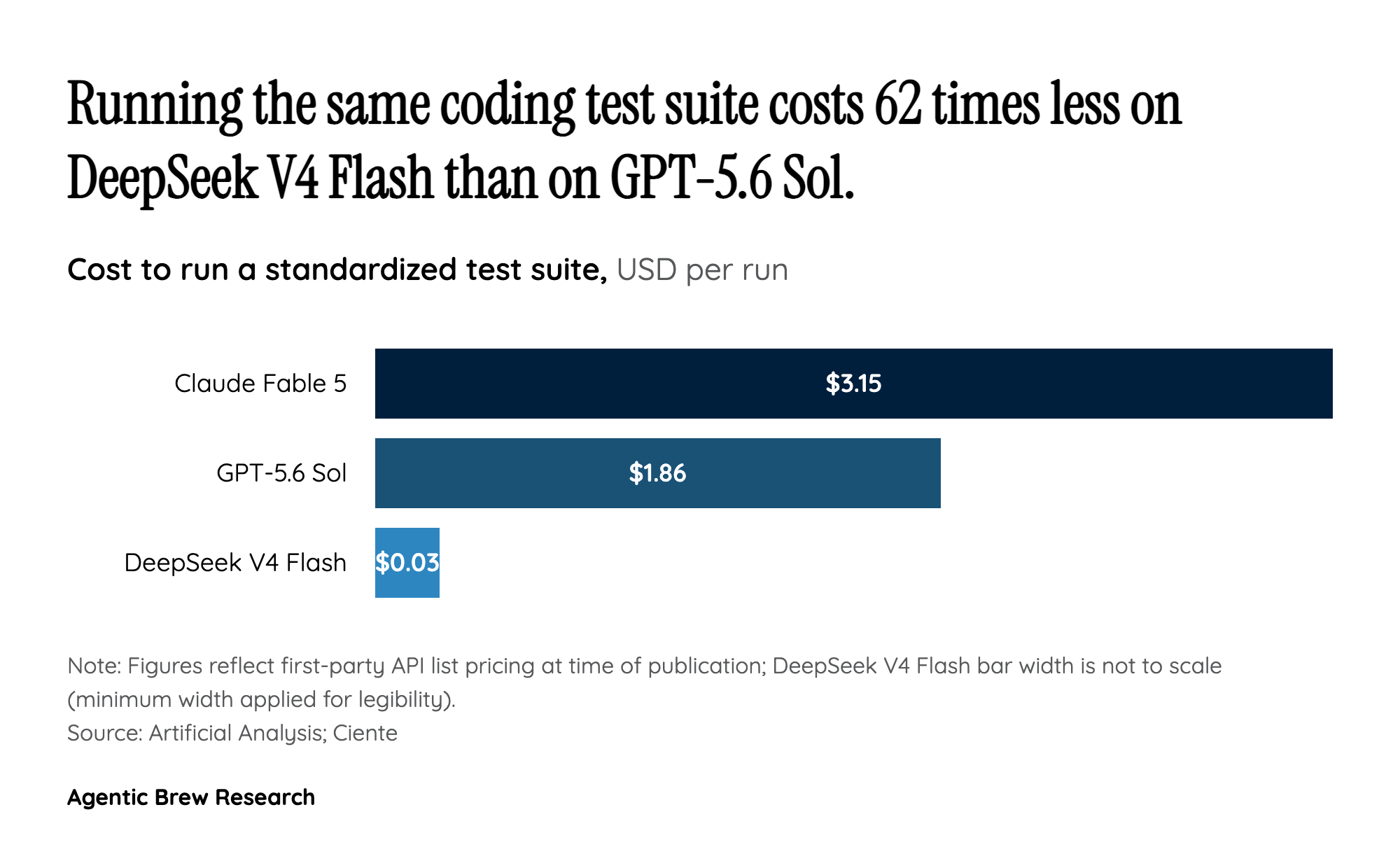
Cost to run the same standardized coding test suite: DeepSeek V4 Flash ($0.03) vs GPT-5.6 Sol ($1.86) vs Claude Fable 5 ($3.15).

OpenAI cut GPT-5.6 Luna pricing by roughly 80% - input from $1 to $0.20 per million tokens, output from $6 to $1.20 - in the run-up to V4-Flash-0731's release [3]. DeepSeek's new pricing still undercuts that already-discounted GPT-5.6 Luna output rate by about 4.3x [3]. Investor Michael Burry read OpenAI's cuts as defensive, arguing the real story was OpenAI preparing for DeepSeek's launch rather than passing efficiency gains to customers [3], while OpenAI's own statement insisted the cuts reflect cheaper intelligence expanding what AI can affordably be used for, not competitive panic [3].

Ciente's framing sharpens the stakes: DeepSeek doesn't need to out-reason Claude or GPT-5.6, it only needs to make routine enterprise workloads embarrassingly cheap [4]. On a standardized test suite, that gap shows up as roughly 3 cents on V4-Flash versus $1.86 on GPT-5.6 Sol [4]- large enough to reframe procurement conversations, not just benchmark leaderboards.

From Chat Model to Agentic Workhorse

The retrained 0731 build isn't just cheaper, it's sharply more capable at the tasks that actually burn tokens. Its Artificial Analysis Intelligence Index score jumped 10 points to 50 versus the April preview [2], and on Terminal-Bench 2.1 - a benchmark of agentic command-line tasks - it rose 17 points to 79%, closing in on Opus-4.8's 85.0 and edging out DeepSeek's own pricier V4-Pro-Preview [2]. A separate read of the same benchmark puts the figure even higher, at 82.7% against 72.1% for V4-Pro-Preview [2][5]- either way, the story of a cheap model beating the expensive flagship from the same lab holds.

That capability jump is showing up in real routing data, not just benchmark charts. OpenRouter reports V4-Flash accounted for 70% of DeepSeek's agentic token flow within a month of its original release, and DeepSeek's overall token share on the platform doubled from 9% in January 2026 to 18% by June, making it OpenRouter's top model by mid-May [6]. Social chatter mirrors that: creators covering the model describe cost overtaking raw benchmark score as the deciding factor once a model clears a 'good enough' bar, and self-hosting communities are already running quantized versions on high-end local hardware rather than paying per token at all.

Wall Street Feels the Squeeze

The clearest sign this isn't just a developer-forum story: reported declines in AI-infrastructure-linked stocks tied directly to the V4-Flash news, including roughly 17% for Nvidia, 12-20% for Oracle, Broadcom and AMD, and over 3% for Microsoft [7]. The logic is straightforward - much of the current AI infrastructure buildout is priced on the assumption that inference stays expensive and margin-rich; a model that runs a full test suite for 3 cents undercuts that assumption directly [4].

Coverage describing this as an acceleration of AI's 'race to zero' on pricing [8]lines up with what OpenRouter's adoption numbers already show: cheap-enough intelligence is winning token share fast, and it's Western labs' premium enterprise pricing - the revenue that funds frontier model training - that's actually under pressure, not just their leaderboard rankings.

Historical Context

2025-01
DeepSeek-R1's release triggered what was widely called AI's 'Sputnik moment,' matching OpenAI o1 on reasoning benchmarks at a fraction of disclosed training cost.
2026-04-24
DeepSeek V4 arrived, introducing V4-Pro (1.6T parameters) and V4-Flash (284B) as the preview generation that V4-Flash-0731 later replaced.
2026-07-31
DeepSeek officially released V4-Flash-0731, a retrained public GA build, with open MIT-licensed weights published on Hugging Face the same day.

Power Map

Key Players
Subject

DeepSeek V4 Flash cost-efficiency disruption

DE

DeepSeek

Chinese AI lab that developed and released V4-Flash-0731, using aggressive low pricing and open MIT-licensed weights to capture agentic token share and pressure Western incumbents' margins.

OP

OpenAI

Cut GPT-5.6 Luna pricing by roughly 80% around DeepSeek's launch, framing the cuts as expanding viable AI use cases rather than a defensive reaction, yet was still undercut by DeepSeek on output price.

AR

Artificial Analysis

Independent benchmarking firm that measured V4-Flash-0731's Intelligence Index, Terminal-Bench score, and cost-per-task figures, becoming the reference cited across coverage for the cost-efficiency claims.

OP

OpenRouter

API routing marketplace whose data shows V4-Flash comprised 70% of DeepSeek's agentic token flow within a month of release, and that DeepSeek doubled its overall token share from 9% to 18% between January and June 2026.

MI

Michael Burry

Investor who publicly framed OpenAI's price cuts as a pre-emptive reaction to DeepSeek's V4 launch, feeding the price-war narrative.

NV

Nvidia, Oracle, Broadcom, AMD, Microsoft

US AI-infrastructure-linked stocks reportedly fell (Nvidia around 17%, others 12-20%, Microsoft over 3%) on concerns that ultra-cheap Chinese model pricing undermines the premium-pricing thesis behind current infrastructure spending.

Fact Check

9 cited
  1. [1] DeepSeek-V4-Flash Model Card
  2. [2] DeepSeek V4 Flash 0731 Scores 50 on the Artificial Analysis Intelligence Index
  3. [3] OpenAI Explains Why It Cut Prices as Michael Burry Points to DeepSeek V4
  4. [4] DeepSeek's V4 Flash Is Unreasonably Cheap - and That's Bad News for US AI Margins
  5. [5] DeepSeek V4 Flash Beta
  6. [6] DeepSeek V4 Adoption Insights
  7. [7] DeepSeek Drops New Bombshell on AI Stocks
  8. [8] DeepSeek's Cheap New AI Model Fuels a Price War
  9. [9] DeepSeek API News: V4 Release (April 24, 2026)

Source Articles

Top 5

THE SIGNAL.

Analysts

Argued that OpenAI's recent price cuts were not primarily about expanding demand but were preparation for competitive pressure from DeepSeek's V4 model launch.

Michael Burry
Investor

Framed its own price cuts as driven by efficiency gains rather than competitive panic, arguing cheaper intelligence expands the addressable market for AI tasks.

OpenAI
AI lab statement

Argued DeepSeek doesn't need to beat OpenAI on raw intelligence, only needs to erode the high-margin enterprise traffic that funds Western AI labs' economics.

Ciente Editorial Team
Tech/business analysis outlet
The Crowd

DeepSeek V4 Flash is beating models like Opus 5, GPT-5.6, Kimi K3, and Claude Fable 5 that cost 50x more Watch👇 https://t.co/X9Xk8c32Sh

@@Oluwaphilemon18

Your next AI subscription might be 110GB of RAM. DeepSeek V4 Flash 0731, a 284B model with 13B active parameters and a 1M context window, can now run locally through llama.cpp. The setup: Download the GGUF. Choose 3-bit (~110GB), Q4 (~162GB), or lossless Q8 (~169GB). Load it https://t.co/h3hnID2XU3

@@noclipepe12

GPT-5.6 vs. Gemini vs Kimi K3 vs. DeepSeek V4 Flash vs. Claude: A No-Login Way to Settle the Debate Four AI models, one prompt, zero logins, here's what actually happened when I put them head to head. Every few weeks, a new "best AI model" ranking makes the rounds, and every https://t.co/Cn8B4pTuyp

@@Oluwaphilemon18

DeepSeek V4 Flash API is 18x cheaper on input, 28x cheaper on output, and matches Opus 4.8. Time for Claude to atleast reduce sonnet pricing

@u/hibzy71500
Broadcast
DeepSeek V4 Flash: The Best Open Model You can Actually Run!

DeepSeek V4 Flash: The Best Open Model You can Actually Run!

Don't Miss This Free DeepSeek V4 Flash API Offer

Don't Miss This Free DeepSeek V4 Flash API Offer

DeepSeek V4 Flash Free and It's Actually Insane

DeepSeek V4 Flash Free and It's Actually Insane

DeepSeek V4 Flash cost-efficiency disruption — AI News | Agentic Brew