DeepSeek V4-Flash-Vision-Exp Launch
TECH

DeepSeek V4-Flash-Vision-Exp Launch

32+
Signals

Strategic Overview

  • 01.
    DeepSeek released DeepSeek-V4-Flash-Vision-Exp, an experimental multimodal model, live on the DeepSeek API Platform on August 21, 2026.
  • 02.
    The model pairs DeepSeek's existing V4-Flash text backbone - a sparse mixture-of-experts architecture with 13B active parameters out of 284B total - with a vision encoder, matching V4-Flash's text-only performance on agents, reasoning, and world knowledge.
  • 03.
    DeepSeek says the model brings multimodal agent performance close to Anthropic's Claude Opus 4.8 on several benchmarks, at roughly $0.87 per million tokens versus roughly $50 for comparable Anthropic usage.
  • 04.
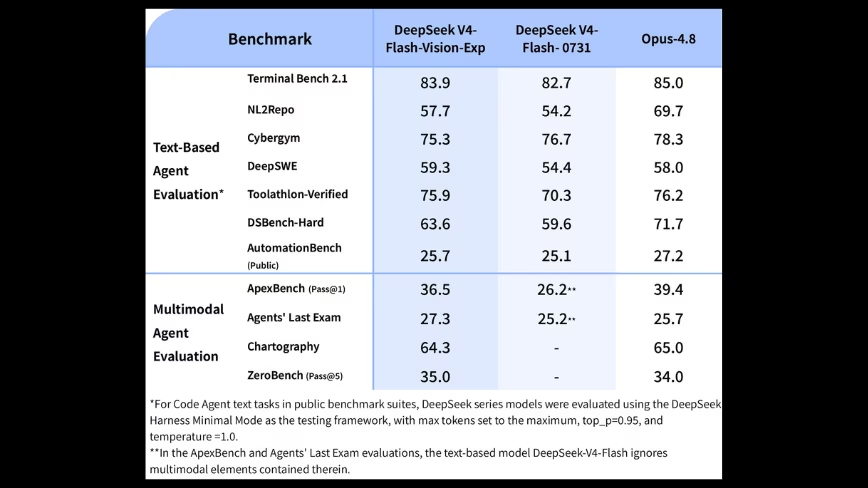
    Independent benchmark tallies show a mixed record: DeepSeek's model wins on 3 of the compared benchmarks (Agents' Last Exam, ZeroBench Pass@5, DeepSWE) but loses on others, including a 12-point gap on NL2Repo (57.7 vs 69.7).

Three Wins Out of Eleven: The Benchmark Table Behind the Opus Comparison

DeepSeek's own launch announcement frames V4-Flash-Vision-Exp as closing the gap with Anthropic's Claude Opus 4.8 on multimodal agent tasks [1]. The model itself is not a from-scratch multimodal build - it is DeepSeek's existing V4-Flash backbone, a sparse mixture-of-experts architecture with 13B active parameters out of 284B total, extended with a vision encoder while text performance is held constant [1].

The fuller benchmark picture, once independent outlets tallied every number DeepSeek published, complicates the 'rivals Opus' framing. DeepSeek's model wins on Agents' Last Exam (27.3 vs 25.7), ZeroBench Pass@5 (35.0 vs 34.0) and DeepSWE (59.3 vs 58.0) - but loses on ApexBench Pass@1 (36.5 vs 39.4), Chartography (64.3 vs 65.0), and, most notably, NL2Repo, where the gap widens to 12 points (57.7 vs 69.7) [2]. OfficeChai's count puts it plainly: DeepSeek beats Opus 4.8 on 3 of the 11 tests it published [2]. That matters because the evaluation itself was run through DeepSeek's own internal 'Harness Minimal Mode' rather than an independently reproduced benchmark suite [2]- a caveat XenoSpectrum underscores directly, warning that small margins on a benchmark table are not proof the model can accurately read fine visual detail [3].


The Real Number Is the Price, Not the Podium

Strip away the leaderboard framing and the more consequential figure is cost. TheNextWeb calculates DeepSeek's pricing at roughly $0.87 per million tokens against roughly $50 per million for comparable Anthropic usage - a gap the outlet argues is the more decisive competitive factor than any single benchmark win [4]. DeepSeek's own published rate card shows $0.22 per million input tokens (cache miss) and $0.66 per million output tokens off-peak, rising to $0.44 and $1.32 at peak hours [3].

Image handling is priced into that same low-cost logic rather than bolted on as a premium feature: images are tokenized for billing at up to 384 tokens each, charged at existing V4-Flash text rates [1], and a free Files API lets a developer upload an image once and reference it repeatedly by file ID across requests, cutting repeated-upload bandwidth for agent workflows that reuse the same screenshot or document [2]. None of this proves DeepSeek's model is the stronger vision system - the benchmark table above says otherwise on several counts - but it reframes the competitive question from who scores higher to who can afford to run this at scale.

Relief on One Side, 'Bolted-On' Skepticism on the Other

Community reaction split cleanly along a fault line that has nothing to do with the benchmark table. On the builder-heavy side of Reddit and X, the dominant emotion is relief - DeepSeek's V4-Flash line had already become a daily driver for many developers except for its inability to read an image, and community discussion frames the vision update as removing the last practical reason to keep paying for a frontier subscription elsewhere. Independent commentary on X was more measured, explicitly noting that the results come from DeepSeek's own evaluation, that the model is still labeled experimental, and that Opus still wins most of the comparisons shown - even while agreeing the price gap is the more interesting story.

A second, more technical skepticism runs through developer forums: is this a genuinely new multimodal architecture, or a vision head stamped onto an unchanged text model? Because DeepSeek hasn't published full architecture details for the vision component, commenters can't settle the question either way, and it feeds a related complaint - no open weights have shipped alongside the API release, breaking the pattern some expected of an API launch followed by a public weight drop. Hands-on testing surfaced a similar split at the capability level: strong, sometimes genuinely impressive results on structured content like equations, business charts, and financial tables, alongside clear misses on multilingual handwriting and dense small-text documents - a reminder that the model's fixed image-compression ceiling makes it a fit for some agent workflows and a poor fit for others.

Closing a Known Weakness, on a Familiar Playbook

DeepSeek's inability to understand images was a long-acknowledged gap next to multimodal offerings from Anthropic and OpenAI, and V4-Flash-Vision-Exp is explicitly framed as the fix - extending the existing low-cost V4-Flash line into vision and agent tasks rather than launching a separate multimodal product line [5]. The timing follows a now-familiar DeepSeek cadence: V3 in December 2024 established open-weight competitiveness, R1's January 2025 reasoning release was widely described as an AI 'Sputnik moment' for matching a leading US reasoning model at a fraction of the disclosed training cost, and the V4 generation - V4-Flash and V4-Pro - arrived in April 2026 as a new architecture generation [6], with V4-Flash-Vision-Exp now extending that same 284B/13B-active backbone into vision four months later.

Read against that history, the pattern DeepSeek is running looks consistent: ship a capable, cheap model, let the benchmark comparison to a US frontier lab do the marketing, and let the price gap do the actual competitive work. A public beta API in July 2026 preceded this release by three weeks [7], suggesting the vision variant was less a surprise pivot than the next scheduled step in an API rollout that was already underway.

Historical Context

2024-12
Released V3, its first open-weight model competitive with GPT-4o.
2025-01
DeepSeek-R1 triggered what was described as AI's 'Sputnik moment,' matching OpenAI's o1 on reasoning benchmarks at a fraction of disclosed training cost.
2026-04-24
Released V4-Flash (284B total/13B active parameters) and V4-Pro (1.6T), a new architecture generation and the base for the later vision variant.
2026-07-31
Unveiled a public beta API for its flagship model ahead of the August vision-exp release.
2026-08-21
DeepSeek-V4-Flash-Vision-Exp launched on the API platform as an experimental multimodal extension of V4-Flash, benchmarked against Anthropic's Claude Opus 4.8.

Power Map

Key Players
Subject

DeepSeek V4-Flash-Vision-Exp Launch

DE

DeepSeek

Chinese AI lab that built and released V4-Flash-Vision-Exp as a low-cost multimodal extension of its V4-Flash line, directly positioning it against Anthropic's frontier pricing and benchmarks.

AN

Anthropic

Its Claude Opus 4.8 model is the explicit benchmark target DeepSeek used to frame the release; DeepSeek claims near-parity on several tasks at roughly $0.87 versus about $50 per million tokens for comparable Anthropic usage.

OP

OpenCode

Developer agent platform that added support for the model within days of launch, signaling early third-party ecosystem adoption of DeepSeek's vision API.

OP

OpenRouter / Vercel AI Gateway / DeepInfra / ZenMux / NanoGPT

Third-party API aggregators that listed the model for access and pricing shortly after release, broadening distribution beyond DeepSeek's own platform.

Fact Check

8 cited
  1. [1] DeepSeek-V4-Flash-Vision-Exp Is Now Live on the DeepSeek API Platform
  2. [2] DeepSeek Releases V4-Flash-Vision-Exp, Matches Opus 4.8 on Some Multimodal Benchmarks
  3. [3] DeepSeek V4-Flash-Vision-Exp API
  4. [4] DeepSeek V4-Flash-Vision-Exp vs Opus: Benchmarks
  5. [5] Whale Can Now See: DeepSeek Adds AI Vision in Major Move
  6. [6] DeepSeek Unveils Newest Flagship a Year After AI Breakthrough
  7. [7] DeepSeek Unveils Public Beta API for Flagship AI Model
  8. [8] DeepSeek Releases Experimental Flash Vision Model That Rivals Opus 4.8 on Agent Benchmarks

Source Articles

Top 5

THE SIGNAL.

Analysts

"DeepSeek claims to beat Opus 4.8 on 3 tests out of 11," and cautions that the evaluation ran on DeepSeek's own internal 'Harness Minimal Mode,' meaning the figures have not been independently verified.

OfficeChai
AI news outlet

"Small margins on a benchmark table are not proof that the model can accurately read fine visual detail," arguing true validation requires independent reproduction of DeepSeek's published figures.

XenoSpectrum
AI news/analysis outlet

Frames the release as an experimental Chinese model sitting within a few points of a major US model on most benchmarks, while arguing DeepSeek's cost advantage - not raw capability - is the more decisive commercial factor.

TheNextWeb
Tech news outlet
The Crowd

DeepSeek-V4-Flash-Vision-Exp is now live on the DeepSeek API Platform! This experimental multimodal model matches DeepSeek-V4-Flash on text capabilities—including agents, reasoning, and world knowledge. On multimodal agent benchmarks, V4-Flash-Vision-Exp makes a major leap over V4-Flash, bringing multimodal agent performance close to Opus-4.8. Try it with model='deepseek-v4-flash-vision-exp'. DeepSeek Harness 0.1.1 was released today with out-of-the-box support for the new model. 1/n

@@deepseek_ai11093

CHINA JUST PUT CLAUDE OPUS BEHIND ON TWO AI AGENT TESTS On August 21, DeepSeek quietly released V4-Flash-Vision-Exp, an experimental multimodal model. In DeepSeek's own published table, it scored higher than Claude Opus 4.8 on Agents' Last Exam, 27.3 vs 25.7, and ZeroBench Pass@5, 35.0 vs 34.0. It nearly tied Chartography, 64.3 vs 65.0, and also edged Opus on the text-based DeepSWE benchmark, 59.3 vs 58.0. The price gap is where this gets uncomfortable. DeepSeek charges $0.22 per million uncached input tokens and $0.66 per million output tokens off-peak, rising to $0.44 and $1.32 at peak. Anthropic lists Opus 4.8 at $5 and $25. That makes DeepSeek roughly 11-23x cheaper on input and 19-38x cheaper on output, depending on the time. One number may matter more than the leaderboard. DeepSeek caps each image at 384 billable tokens and permits up to 600 images in one request. At its published rates, processing the maximum image count would cost roughly $0.05 off-peak or $0.10 at peak for the image tokens alone, before text and output. This does not prove DeepSeek is better overall. The results come from DeepSeek's own evaluation, the model is experimental, and Opus still wins most of the comparisons shown. But the competition has moved beyond text. It now reaches agents that can read interfaces, analyze hundreds of screenshots and act inside real software. How long can frontier labs defend this price gap?

@@lagerskoy22

DeepSeek V4 Flash Vision Exp is here, and it just gave DeepSeek's most efficient model actual eyes. After staying text-only for years, @deepseek_ai quietly dropped a vision-enabled version of V4 Flash into their API, and this breakdown covers everything that actually matters before you build anything on it. We walk through the official benchmark numbers DeepSeek published, including @terminalbench @datacurve @HelloSurgeAI, and ZeroBench, and explain what each one actually measures in plain terms. From there, we go deep into how the image pipeline really works, including the resolution resizing behavior that has developers split into two camps, and how much it actually costs to process images at scale on this model.

@@LomashKumar5222

DeepSeek-V4-Flash-Vision-Exp

@u/Xhehab_555
Broadcast
DeepSeek V4-Flash Vision Is Out: Whale Opened Its Eyes

DeepSeek V4-Flash Vision Is Out: Whale Opened Its Eyes

DeepSeek V4 Flash Vision Exp Is Here! (Nobody Saw This Coming)

DeepSeek V4 Flash Vision Exp Is Here! (Nobody Saw This Coming)

DeepSeek V4-Flash-Vision-Exp上线!大模型终于"睁眼"了:多模态Agent能力暴涨,接近Opus 4.8,API正式开放!

DeepSeek V4-Flash-Vision-Exp上线!大模型终于"睁眼"了:多模态Agent能力暴涨,接近Opus 4.8,API正式开放!