Anthropic Upgrades Claude Voice Mode With Opus, Sonnet, and App Connectors
TECH

Anthropic Upgrades Claude Voice Mode With Opus, Sonnet, and App Connectors

21+
Signals

Strategic Overview

  • 01.
    Claude's voice mode now runs on Opus and Sonnet models rather than only the Haiku model it launched with, and a new model picker lets users switch mid-conversation.
  • 02.
    Voice mode can now read from and act on connected apps - Gmail, Google Calendar, Slack, Canva, and Notion - once a user grants permission.
  • 03.
    The update, rolling out in beta across desktop, mobile, and web, adds support for roughly 11 languages and a refreshed UI with a model selector and push-to-talk option.
  • 04.
    Free-tier users remain limited to the Haiku model and a single connected app, while paid plans get full access to Opus, Sonnet, and all five connectors.

From Instant Answers to Real Thinking: Why the Model Upgrade Matters

Until this week, every voice conversation with Claude ran on Haiku, Anthropic's smallest and fastest model, which favored instant replies over deeper reasoning[1]. The new voice mode lets users switch mid-conversation to Sonnet or Opus, and selecting one of those models now actually routes the conversation through it instead of quietly falling back to Haiku[2]. The models aren't drastically different in raw capability - commentary on Sonnet's coding benchmarks put it at 95 to 99 percent of Opus's effectiveness for a fraction of the cost, according to Fireship[2]- but the previous Haiku-only setup reportedly worked fine for quick, simple questions while struggling with more complicated requests[8], a ceiling that, by definition, ruled out the kind of multi-step reasoning Claude's text interface has long offered. Paid accounts now default to whichever model was last used in text chat, carrying reasoning depth across modalities instead of resetting it at the microphone[2].


What Users Already Suspected About Haiku

Before this release, discussion in Claude's user community had settled on a specific gripe: voice mode felt shallower than typing to Claude because it was widely believed to be running on Haiku no matter what, it didn't seem to carry memory or context between turns the way text chats do, and turn-taking could feel clunky (though some threads noted an earlier update had already smoothed out hands-free interruptions). The Haiku part of that suspicion turns out to have been correct until now[1]- it's precisely the gap this update closes by letting voice sessions route to Sonnet and Opus instead[2]. What isn't addressed by anything in this release is the memory complaint: neither Anthropic's own framing nor the reporting around it claims voice sessions now retain context across turns the way text conversations do, so that specific frustration may persist even as reasoning depth improves.

Voice Mode Learns to Use Your Other Apps

The bigger structural change is that voice conversations can now read from and act on connected apps - Gmail, Google Calendar, Slack, Canva, and Notion - once a user grants permission[3]. Industry coverage keeps returning to this as the clearest point of contrast with rivals: OpenAI's voice mode still can't reach outside tools to get work done, while Claude's now can[2]. It extends a pattern set at launch in May 2025, when voice mode shipped with Google Workspace integration for Calendar and Gmail reserved for paying subscribers[4]- the connector list has simply grown alongside the reasoning models available to it. Anthropic frames this specific release as being about "intelligence and tool access," while flagging that more voice updates are still coming later in the year[5].

A Deliberate Bet Against Real-Time Speech

Unlike some rivals' bidirectional, speech-native voice systems, Claude's voice mode remains turn-based: it listens, pauses to think, then responds, rather than processing speech simultaneously[5]. TestingCatalog frames this as a deliberate strategic choice rather than a limitation: "Anthropic's strategy contrasts with OpenAI's bidirectional speech-native approach, instead layering stronger reasoning models onto conventional voice infrastructure."[2]The tradeoff shows up elsewhere too - language switching still requires manually selecting from the roughly 11 supported languages rather than being auto-detected mid-conversation[5]. Anthropic is betting that reasoning quality, not conversational latency, is the bottleneck worth fixing first.

Four Updates in Fourteen Months: Iteration, Not a Single Leap

This upgrade is the latest step in a steady cadence rather than a one-off launch. Voice mode debuted in May 2025 on Sonnet 4, English-only, with five voice options and roughly 20-30 free conversations before hitting usage caps[4]. In March 2026, Anthropic shipped a separate, push-to-talk voice mode built specifically for Claude Code, letting developers issue spoken coding commands at no extra cost[6]. Multilingual support and a push-to-talk toggle then rolled out gradually to Claude's mobile apps starting in June 2026, ahead of this month's model and connector upgrade[7]. Read against that timeline, the July 2026 release looks less like a single dramatic leap and more like Anthropic steadily closing the gap between what voice mode can do and what its text interface has long offered - a gap it was under pressure to close, since the update followed OpenAI shipping a new conversational model family and its own voice mode update[8].

What Free-Tier Users Still Don't Get

The upgrade is explicitly tiered: free-plan users remain capped at the Haiku model and a single connected app, while paid subscribers get the full run of Opus, Sonnet, and all five connector apps[3]. That gating mirrors how the original 2025 launch reserved Google Workspace integration for paying subscribers only[4]- access to Claude's most capable voice experience has tracked the same premium boundary since day one.

Historical Context

2025-05-27
Anthropic launched voice mode for Claude, initially defaulting to Claude Sonnet 4, English-only, on mobile apps, with Google Workspace (Calendar, Gmail) integration for paid subscribers.
2026-03-04
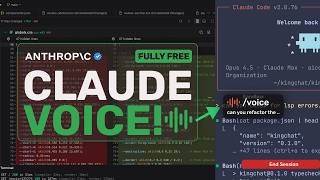
Anthropic rolled out a separate voice mode for Claude Code, letting developers issue spoken commands via push-to-talk at no extra cost for subscribers.
2026-06-17
Multilingual support and push-to-talk mode began rolling out gradually to Claude's mobile apps ahead of the July model upgrade.
2026-07-23
Anthropic announced voice mode now supports Opus and Sonnet models plus app connectors (Gmail, Calendar, Slack, Canva, Notion), rolling out in beta across desktop, mobile, and web.

Power Map

Key Players
Subject

Anthropic Upgrades Claude Voice Mode With Opus, Sonnet, and App Connectors

AN

Anthropic

Developer of Claude and its voice mode; shipped the model-routing and app-connector upgrade and controls the rollout timeline and free/paid gating

OP

OpenAI

Competitor via ChatGPT's Advanced Voice Mode, positioned in coverage as lacking the tool/app integration Claude's voice mode now has

GO

Google (Gemini app)

Competitor referenced for not offering an equivalent in-voice-session model selector

EL

ElevenLabs

Text-to-speech vendor reportedly powering Claude voice mode's spoken output pipeline

GO

Google Workspace / Gmail / Calendar / Slack / Canva / Notion

Third-party apps and connectors that Claude voice mode can now read from and act on with user permission

Fact Check

9 cited
  1. [1] Anthropic updates Claude voice mode with more capable models
  2. [2] Claude voice mode to get Opus and Sonnet model options
  3. [3] Think Through Hard Problems in Voice Mode
  4. [4] Anthropic launches a voice mode for Claude
  5. [5] Claude voice mode just got smarter
  6. [6] Anthropic Rolls Out Voice Mode for Claude Code
  7. [7] Claude voice mode upgrade rolling out
  8. [8] Anthropic updates Claude's voice mode amid OpenAI competition
  9. [9] Anthropic Claude voice mode UI update

Source Articles

Top 1

THE SIGNAL.

Analysts

"Highlighted the small performance gap between Opus and Sonnet on coding benchmarks, framing Sonnet as a near-equivalent at much lower cost"

Fireship
Technical commentary on the model cost/performance tradeoff behind routing voice mode to Sonnet vs. Opus

"Anthropic is layering stronger reasoning models onto conventional turn-based voice infrastructure rather than building a bidirectional, speech-native system"

TestingCatalog
Frames Anthropic's voice architecture as a deliberate strategic choice distinct from OpenAI's approach
The Crowd

"Voice mode now runs on Claude's more capable models and reaches the tools you've connected mid-conversation. Talk through the hard problems out loud, in many more languages."

@@claudeai7346

"We just shipped a huge update to Claude's voice mode! - Works with Sonnet and Opus models. - Has access to connectors including Slack, Gmail, Notion, etc - Can now speak in Spanish, French, Hindi, and more. tl;dr, you can now ask things like - Summarise what I missed in Slack"

@@RobertJBye410

"Claude’s voice mode is now available for Opus and Sonnet"

@@verge40

"Nobody mentions how much superior Claude is in voice chat?"

@u/Pathfinder-electron41
Broadcast
Claude is Taking Over: Every New Feature Explained (Full Guide)

Claude is Taking Over: Every New Feature Explained (Full Guide)

"I Had No Idea This Existed" | Claude's New Voice Mode for English Practice

"I Had No Idea This Existed" | Claude's New Voice Mode for English Practice

Claude Code Voice Mode : Anthropic just LAUNCHED their NEW VOICE Mode and it's AWESOME!

Claude Code Voice Mode : Anthropic just LAUNCHED their NEW VOICE Mode and it's AWESOME!