Destructive scanning of rare books for AI training
TECH

Destructive scanning of rare books for AI training

31+
Signals

Strategic Overview

  • 01.
    Destructive scanning means cutting the spine off a book with a hydraulic cutter so the loose pages can be fed through high-speed scanners processing 80-120 pages per minute, after which the original copy is pulped and recycled.
  • 02.
    Anthropic ran a secret internal initiative codenamed 'Project Panama' to destructively scan books for AI training, beginning in early 2024, with an internal document stating the company wanted to keep the program secret.
  • 03.
    In June 2025, Judge William Alsup ruled that digitizing legally purchased print books for LLM training is fair use, while separately ruling that Anthropic's retention of pirated books from sites like LibGen was not fair use, leading to a $1.5 billion settlement approved in July 2026.
  • 04.
    ISBNdb marketed bulk book-sourcing services of 1,000 to 1 million books explicitly for LLM training needs as a 'compliant path,' but later told Fortune the service was never launched and it never purchased or scanned books for AI companies.
  • 05.
    Zoom Books, a Canadian company describing itself as a book recycler, has been named by secondhand booksellers in the Netherlands, Germany, Australia, and New Zealand as the source of unusual bulk orders; it denies digitizing books and will not identify its customers.
  • 06.
    Anthropic has publicly denied that its data acquisition programs buy from Zoom Books or destroy rare or antiquarian books, stating it purchases books through regular commercial markets.

Deep Analysis

Inside Project Panama: The Memo Anthropic Didn't Want Found

Court filings unsealed in early 2026 revealed that Anthropic had been running a codenamed effort, 'Project Panama,' since early 2024 to acquire books at massive scale for AI training. The company hired Tom Turvey, the former head of partnerships for Google Books, to lead outreach to distributors and retailers, and internal vendor proposals discussed converting between 500,000 and two million books over a six-month period [1]. What makes the documents notable isn't just the scale, it's the candor: an internal planning document stated plainly, 'Project Panama is our effort to destructively scan all the books in the world,' followed by an explicit instruction to keep the effort quiet - 'We don't want it to be known that we are working on this' [2].

That internal admission sits awkwardly next to Anthropic's public posture. The company has told reporters it purchases books through regular commercial markets and that none of its data acquisition programs acquire or destroy rare or antiquarian books [3]. The gap between a leaked memo built around secrecy and a public statement built around reassurance is itself the story - not because the underlying legal purchase-and-scan model is illegal, but because the company that built it clearly anticipated the backlash it's now facing.
Destroying the Copy Is the Point: How Fair Use Turns on the Shredder

The legal foundation for all of this rests on a June 2025 ruling by Judge William Alsup in Bartz v. Anthropic, which split the company's book-acquisition practices into two very different buckets. Digitizing legally purchased print books and training on the resulting text was ruled transformative and protected under fair use. Retaining a library built from pirated ebooks, by contrast, was not, and that distinction cost Anthropic $1.5 billion in a settlement covering more than 400,000 registered works at roughly $3,000 apiece, the largest copyright settlement on record, finalized in July 2026 [4].

That legal architecture is what makes the physical destruction mechanically central rather than incidental. Hydraulic cutters slice the spine off a purchased copy so the loose pages can run through scanners at 80 to 120 pages per minute [5]. The book doesn't survive the process by design: once the original copy is gone, the company holds one lawfully purchased instance in digital form rather than an unauthorized duplicate sitting alongside a printed original. The unsettling part isn't merely that the books are destroyed, it's that destruction is closer to a compliance requirement than a byproduct - the mechanism by which digitization avoids looking like piracy in the eyes of a court.

The Sourcing Shell Game: Anthropic, ISBNdb, and Zoom Books All Point Elsewhere

Behind the scale that Project Panama required sits a supply chain nobody involved wants to fully own. ISBNdb, a book-metadata company, openly pitched bulk orders ranging from 1,000 to 1 million books as a 'compliant path' to LLM training data - explicitly free of AI-generated contamination since the books predate the AI boom - but later told Fortune the service was never actually launched and that it never purchased or scanned books for AI companies [3]. Zoom Books, a Canadian firm that calls itself a book recycler, has independently been flagged by secondhand booksellers across the Netherlands, Germany, Australia, and New Zealand as the source of unusually large, oddly timed, high-priced orders for obscure and local titles. Zoom Books denies digitizing books for AI purposes and refuses to name its customers [6].

Reporting has described this structure as AI companies outsourcing to middlemen specifically to buy up books for training material without directly identifying themselves to sellers [7]. Every party in the chain - the AI lab, the metadata broker, the recycler - has a story that ends with someone else responsible, which is precisely the dynamic the Project Panama secrecy memo anticipated: a program designed from the outset so its footprints wouldn't be traceable back to a single company's front door.

Overprinted Paperbacks or Priceless Rarities? The Fight Over What's Actually Being Lost

Cultural-heritage advocates argue the loss goes beyond text. First editions, handwritten marginalia, ownership inscriptions, and original bindings carry historical evidence that a scan can't capture, so when the physical copy is pulped, that evidence is gone regardless of whether the words survive digitally [8]. Compounding that, the digital copies that do survive typically enter private databases used exclusively for AI training rather than public archives, so a scanned book can be simultaneously 'preserved' and effectively unavailable to anyone outside the company that scanned it [9].

But the loudest online pushback challenges the premise itself: a vocal contingent of commenters on Reddit and elsewhere insists most of the destroyed volumes are mass-market overprints already headed for pulping and recycling anyway, not museum-grade rarities - arguing genuinely unique or valuable first printings would already be preserved in libraries or existing digital archives rather than routed through a bulk book recycler. Separately, some commentary has pushed back on the framing from the opposite direction, arguing the destruction narrative undersells a more mundane economic driver: existing digital scans of these books, where they exist at all, are often too low-quality for training, making a fresh, clean scan of a physical copy the more practical option regardless of how 'rare' any individual book is. Neither read fully resolves the tension, since nobody outside the AI labs and their brokers can verify exactly what's being cut apart. Even Musk's public response split the difference rather than rejecting destructive scanning outright: he directed his own team to preserve any genuinely rare books it encounters by scanning them the harder, non-destructive way instead of cutting off the spine [10]- implicitly conceding that most books in these bulk lots probably don't warrant that extra care, while insisting the ones that do shouldn't be sacrificed for scanning speed.

Historical Context

2024-02
Anthropic hired Tom Turvey, former head of partnerships for Google Books, to lead outreach to distributors and retailers for bulk book purchases.
2024
Project Panama began in early 2024, with internal vendor proposals discussing converting 500,000 to 2 million books over six months via destructive scanning.
2025-06-23
Court ruled that training AI on legally acquired, digitized books is fair use, but that retaining a library built from pirated books was not.
2026-01
Internal Anthropic planning documents describing Project Panama and its secrecy were unsealed in the federal case.
2026-07-20
Court gave final approval to the $1.5 billion settlement covering pirated books, the largest copyright settlement on record.
2026-07-31
Reports emerged of a Dutch antiquarian bookseller receiving a suspicious 3,001-book bulk order tied to AI training data sourcing.
2026-08-03
Local secondhand booksellers in Australia and New Zealand reported suspicious bulk orders from Zoom Books, suspecting a link to generative AI training data supply.

Power Map

Key Players
Subject

Destructive scanning of rare books for AI training

AN

Anthropic

AI lab that ran 'Project Panama,' buying millions of print books, cutting bindings with hydraulic cutters, scanning pages at high speed, and discarding originals to build a private training library; publicly denies buying from Zoom Books or destroying rare or antiquarian books; separately paid $1.5B to settle piracy claims.

ZO

Zoom Books

Canadian company describing itself as a book recycler; identified by booksellers in the Netherlands, Germany, Australia, and New Zealand as the source of unusually large, oddly timed bulk orders; denies digitizing or destroying books for AI purposes and will not name its customers.

IS

ISBNdb

Book metadata and data broker that publicly pitched bulk book acquisition of 1,000 to 1,000,000 books as a compliant path to AI training data, then later claimed to Fortune the service was never launched or used to supply AI companies.

JU

Judge William Alsup (N.D. Cal.)

Presided over Bartz v. Anthropic; ruled in June 2025 that training on legally acquired, digitized books is fair use, but that retaining pirated books was not; approved the $1.5B settlement in July 2026.

EL

Elon Musk

Publicly criticized the destructive-scanning practice and directed his SpaceXAI team to preserve rare books by scanning them non-destructively instead of cutting spines.

SE

Secondhand and antiquarian booksellers (Netherlands, Germany, Australia, New Zealand)

Report receiving suspicious bulk orders at odd hours, high prices, for obscure or local titles that they suspect are tied to AI training data sourcing, though they cannot definitively trace the books to AI scanning operations.

AU

Authors Guild and plaintiff authors (Andrea Bartz, Charles Graeber, Kirk Wallace Johnson)

Filed the copyright lawsuit against Anthropic over pirated books and secured the $1.5 billion settlement, roughly $3,000 per registered work.

Fact Check

10 cited
  1. [1] Anthropic's Secret Book-Scanning Operation, 'Project Panama'
  2. [2] Anthropic Is Secretly Destroying Books to Train Its AI
  3. [3] Dutch Bookseller Thought a 3,000-Book Order Was AI Spam - It Wasn't
  4. [4] Anthropic Is Paying $1.5 Billion Over Pirated Books, But It Can Still Legally Cut Up Purchased Ones
  5. [5] AI Firms Destroying Millions of Rare Books for Training Data, Raising Alarms Over Cultural Heritage
  6. [6] Local Secondhand Booksellers Suspect AI Companies Behind Bulk Orders
  7. [7] AI Companies Are Reportedly Shredding Millions of Books to Train Models
  8. [8] 'A Cultural Crime Against Humanity': AI Firms Are Destroying Ultra-Rare Books So Nobody Else Can Read Them
  9. [9] AI Companies Are Purchasing and Destroying Millions of Used Books for Training Data
  10. [10] Elon Musk Directs Team to Preserve Rare Books Instead of Destructively Scanning Them

Source Articles

Top 4

THE SIGNAL.

Analysts

Criticized destructive scanning and instructed his team to preserve rare books via non-destructive scanning methods instead of cutting spines.

Elon Musk
Public figure directing his SpaceXAI team

Argued the book corpus would teach the model to write well rather than mimic low-quality internet text, framing the rationale for the acquisition program.

Unnamed Anthropic co-founder
Anthropic leadership, per unsealed internal document

Described his suspicion of an unusually large bulk order request as looking like spam or phishing, illustrating how unfamiliar such bulk AI-linked orders are to traditional antiquarian dealers.

Pieter de Vries
Dutch antiquarian bookseller, Haarlem
The Crowd

THIS IS F*CKING DISTURBING!!! A leaked Anthropic document just came out in court. Their own words: "Project Panama is our effort to destructively scan all the books in the world." Next line: "We don't want it to be known that we are working on this." They planned to shred

@@EvanLuthra32458

ANTHROPIC BOUGHT MILLIONS OF BOOKS, SLICED OFF THEIR SPINES, AND SHREDDED THEM. THE INTERNAL NAME WAS PROJECT PANAMA. The planning document said it plainly: an "effort to destructively scan all the books in the world." The same document told staff: "we don't want it to be known

@@Sancho_Wizard11

Project Panama: The AI industry's biblioclasm In early 2024, Anthropic executives launched a secret project codenamed "Project Panama" with an audacious goal: "destructively scan all the books in the world". Please watch and share

@@ABridgen76

AI companies are buying rare and out-of-print books, scanning them for training data, then destroying the physical copies forever

@u/Delicious-Act-860117000
Broadcast
AI Companies Are Destroying Rare Physical Books To Feed Their Chatbots | Vantage on Firstpost | 4K

AI Companies Are Destroying Rare Physical Books To Feed Their Chatbots | Vantage on Firstpost | 4K

AI vendors destroying rare books to feed the chatbot

AI vendors destroying rare books to feed the chatbot

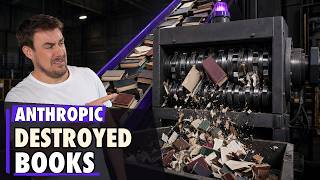
Anthropic Destroyed Millions of Books. Here's Why.

Anthropic Destroyed Millions of Books. Here's Why.

Destructive scanning of rare books for AI training — AI News | Agentic Brew