Meta releases Brain2Qwerty v2 non-invasive brain-to-text AI
TECH

Meta releases Brain2Qwerty v2 non-invasive brain-to-text AI

28+
Signals

Strategic Overview

  • 01.
    Meta AI (FAIR) released Brain2Qwerty v2, a non-invasive pipeline that decodes full typed sentences in real time from MEG brain recordings with no implant or surgery.
  • 02.
    It reaches 61% average word accuracy (a 39% word error rate), with the best participant hitting 78% word accuracy and over half of that person's sentences decoded with one word error or less.
  • 03.
    The system pairs a convolutional encoder and transformer with a character-level language model, trained on roughly 22,000 sentences from 9 volunteers each recorded about 10 hours on a MEG device.
  • 04.
    Meta open-sourced the full training code for v1 and v2 under a non-commercial CC BY-NC 4.0 license; the v1 dataset is released via partner BCBL while the v2 dataset stays embargoed pending paper acceptance.

It's not reading your mind - it's reading your fingers

The single biggest misconception to correct: Brain2Qwerty does not pull free-form thoughts out of your head. The 9 volunteers typed roughly 22,000 sentences while a MEG device recorded the brain activity that drove that typing [2]. The system is decoding the motor and intentional signature of moving toward keys, not raw semantic thought. The tell is in the errors themselves - the model confuses letters that sit next to each other on the keyboard, swapping in a neighbor key (the kind of mistake that turns 'girl' into 'firl' because f borders g). That error pattern is only possible if what the network has learned is the geography of typing, not the meaning of words. Meta's own pipeline reflects this: a convolutional encoder and transformer map raw brain activity to characters, and only then does a character-level language model assemble those characters into words and sentences [2]. The language model is doing heavy lifting to clean up a noisy motor signal, which is precisely why fine-tuning LLMs on neural data helps - it lets semantic context bridge the gap between messy recordings and coherent text [1]. Calling this 'mind-reading' oversells what is, mechanically, an extremely sophisticated read of imagined typing.
By the numbers: a 7.6x leap that still trails the implants

By the numbers: a 7.6x leap that still trails the implants
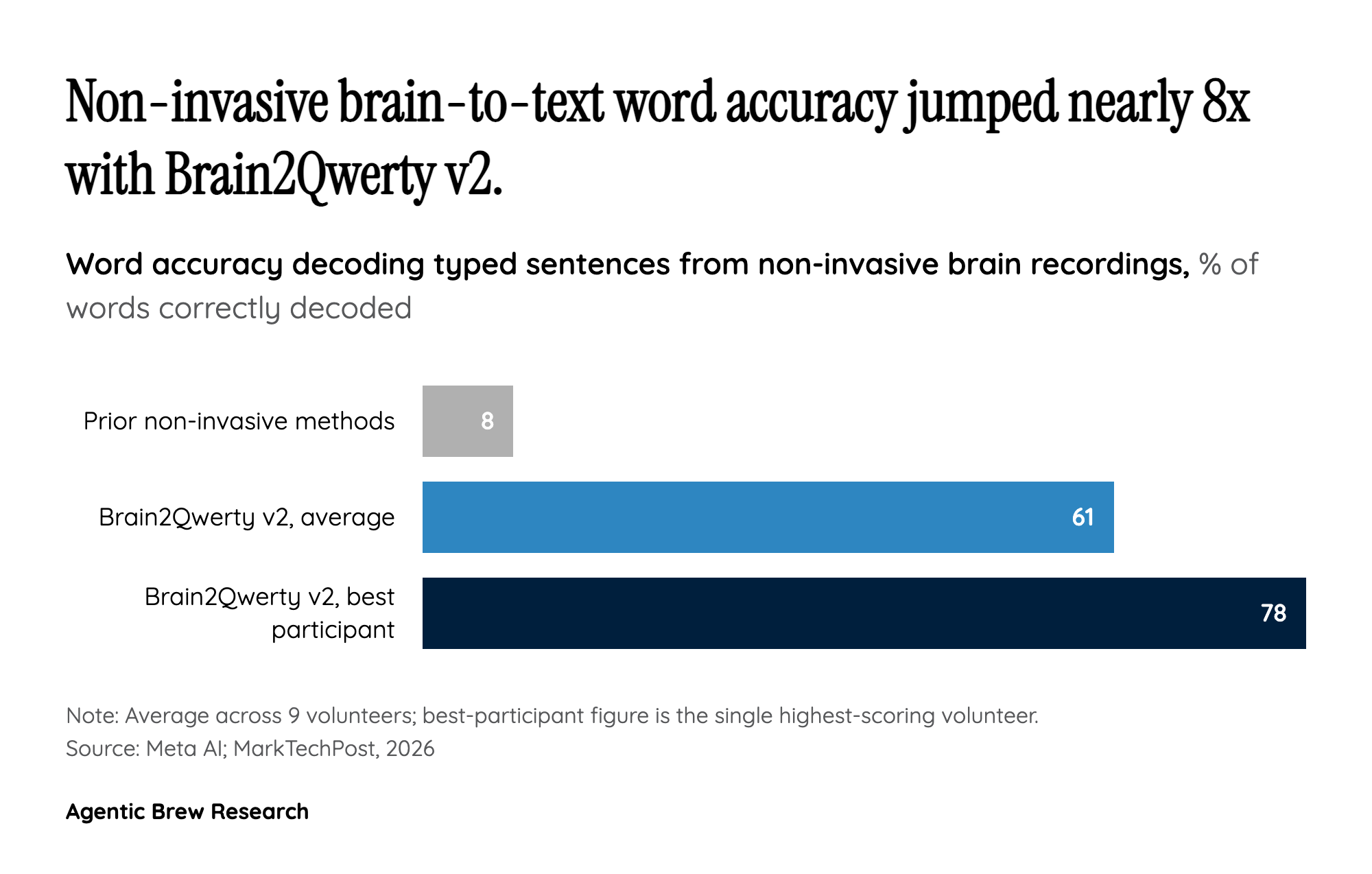
Word accuracy decoding typed sentences from non-invasive brain recordings: prior methods 8%, Brain2Qwerty v2 averages 61%, best participant 78%.

The accuracy story is genuinely dramatic. Prior non-invasive methods landed around 8% word accuracy; Brain2Qwerty v2 reaches 61% on average, with the best participant at 78% - more than a 7.6x jump over the old baseline [2]. For that top participant, over half of all sentences come out with one word error or fewer [1]. Context matters for the trajectory too: v1, also MEG-based, ran at roughly a 32% character error rate (versus about 67% for EEG), with the best v1 typist's letters detected up to about 80% of the time [4]. So the v1-to-v2 move is real progress, and Meta reports accuracy improving log-linearly with data volume - a scaling-law signature that suggests more recordings would push numbers higher [2]. But the honest framing is that 61% average accuracy means a 39% word error rate, which narrows but does not close the gap with surgical implant BCIs [2]. The headline is a milestone, not parity.

Why a record-setting model is permanently stuck in the lab

The performance is lab performance, and that distinction is load-bearing. Decoding runs on a magnetoencephalography scanner that weighs about half a ton, costs roughly $2 million, and only works inside a magnetically shielded room [4]. Worse for any real-world use, the signal collapses the moment the subject's head moves, which is why the lead researcher describes the path to a product as effectively closed rather than merely distant [4]. The stated motivation is also not a consumer device - Meta frames the research as a possible communication aid for the millions who suffer brain lesions that prevent them from communicating, even though every result so far comes from healthy volunteers, not brain-injured patients [1]. That is the central tension: a system good enough to make headlines, attached to hardware that no clinic, let alone a home, could realistically deploy. The advance is in the decoding science, not in anything you could wear.

Meta's contrarian bet: scale and openness instead of surgery

Strategically, Brain2Qwerty is Meta planting a flag opposite the implant camp. Where surgical interfaces buy a clean signal at the cost of brain surgery, Meta is betting that a non-invasive approach plus more data is the more scalable route to restoring communication, potentially reaching far more people without the risk of an implant [1]. The framing from Meta's Brain & AI team is telling: they treat decoding language as fundamental research into the principles of human intelligence, which they see as a foundation of AI, rather than a commercial roadmap [4]. The open-source decision reinforces that posture - the full v1 and v2 training code is public under a non-commercial CC BY-NC 4.0 license, and partner BCBL is releasing the v1 dataset, even as the v2 dataset stays embargoed pending paper acceptance [3]. Independent researchers in the BCI field have lent credibility to the underlying method, validating that deep networks paired with robust data yield genuine insight into how the brain processes language [4]. The bet is that openness plus scaling laws compounds faster than locked-down surgical hardware.

Historical Context

2025-02-07
Meta first publicized Brain2Qwerty (v1), decoding typed letters up to roughly 80% of the time for skilled typists but with an average 32% character error rate, and described as stuck in the lab.
2025-02-09
The v1 brain-to-text study was posted to arXiv (2502.17480), based on 35 healthy volunteers recorded at BCBL.
2026-06-25
Meta published Brain2Qwerty v2, raising non-invasive word accuracy to 61% and releasing training code for both versions, with a companion paper accepted at Nature Neuroscience.

Power Map

Key Players
Subject

Meta releases Brain2Qwerty v2 non-invasive brain-to-text AI

ME

Meta AI (FAIR) - Brain & AI team

Developer and publisher of Brain2Qwerty v1 and v2; released the model, training code, and research paper, and frames the work as fundamental research into intelligence rather than a commercial product.

BA

Basque Center on Cognition, Brain and Language (BCBL)

Research partner in San Sebastian, Spain that collected the MEG/EEG datasets from volunteers and is releasing the v1 dataset; owns the underlying data.

FO

Forest Neurotech (Sumner Norman)

Outside expert and BCI competitor offering independent technical validation of Meta's deep-learning approach.

Fact Check

4 cited
  1. [1] Brain2Qwerty: Toward non-invasive brain-AI communication
  2. [2] Meta AI Releases Brain2Qwerty v2: A Non-Invasive MEG Brain-to-Text Pipeline Decoding Typed Sentences at 61% Word Accuracy
  3. [3] facebookresearch/brain2qwerty
  4. [4] Meta has an AI for brain typing, but it's stuck in the lab

Source Articles

Top 5

THE SIGNAL.

Analysts

"Frames Brain2Qwerty as basic science rather than a product, citing fundamental difficulty - including that the signal is lost the moment the subject's head moves."

Jean-Remi King
Head of Meta's Brain & AI Research team

"Validates that deep neural networks paired with strong data yield real insight into how language is processed in the brain."

Sumner Norman
Founder and researcher, Forest Neurotech
The Crowd

"We're sharing the next major milestone in our non-invasive brain-to-text decoder research: Brain2Qwerty v2. Building on v1, which was published today in @Nature, Brain2Qwerty v2 is the highest-performing end-to-end pipeline capable of real-time sentence decoding from raw brain"

@@AIatMeta12666

"We're happy to announce 2 releases today: - Brain2qwerty v1 is published at @NatureNeuro - Brain2Qwerty v2 is now publicly released Explore how we decode sentences from non-invasive brain recordings: https://t.co/NFhDVMQoeR Links: v1 Nature Neuro: https://t.co/ZSumQLdEDh"

@@JeanRemiKing2567

"Meta says Brain2Qwerty v2 can decode natural sentences from non-invasive brain recordings in real time, reaching 61% word accuracy. The system was trained on about 22,000 sentences from 9 volunteers, each recorded for 10 hours with MEG while typing. Meta compares that with 8%"

@@kimmonismus421

"Meta improves Brain2QWERTY, a system that can decode text from brain activity to enable typing using non-invasive technologies, MEG and EEG"

@u/Distinct-Question-16680
Broadcast
Meta's Brain2qwerty converts your brain signals into a text

Meta's Brain2qwerty converts your brain signals into a text

Will Brain Scanners Replace Traditional KEYBOARDS? Meta's Brain2QWERTY Turns Your Thoughts into Text

Will Brain Scanners Replace Traditional KEYBOARDS? Meta's Brain2QWERTY Turns Your Thoughts into Text

Brain2QWERTY: AI Turns Thoughts into Text Using Brain Scans!

Brain2QWERTY: AI Turns Thoughts into Text Using Brain Scans!