Tech coalition letter defends open-weight AI
TECH

Tech coalition letter defends open-weight AI

37+
Signals

Strategic Overview

  • 01.
    A coalition of 25 American companies and organizations, including Nvidia, Microsoft, Meta, Palantir, Hugging Face and IBM, published a joint letter titled 'Open Weights and American AI Leadership' on July 24, 2026, urging U.S. policymakers to avoid premature restrictions on open-weight AI models. The letter states: 'Our AI leadership will be judged not by one frontier AI model, but by whether the United States builds a strong, open ecosystem.'
  • 02.
    The letter, hosted on Microsoft's corporate-responsibility site, explicitly defends distillation - using one model's outputs to help train or improve another - as legitimate practice rather than theft: 'Distillation ... is a widely used technique for model improvement, evaluation, and validation.'
  • 03.
    It also frames open models as a cybersecurity necessity, arguing that 'in a world where cybersecurity attackers use advanced AI, defenders need access to models with comparable capabilities so they can detect, simulate, and respond to emerging threats.'
  • 04.
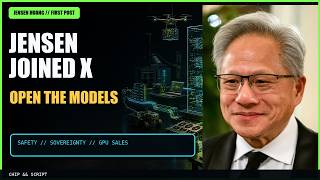
    Nvidia CEO Jensen Huang shared the letter in the first-ever post on his X account, writing: 'Open models strengthen safety and cybersecurity, accelerate innovation and diffusion, and enable sovereignty.'

Deep Analysis

Open Weight Is Not Open Source - and the Letter Bets Big on That Distinction

The coalition's argument rests on a definitional line that most of the public debate glosses over: open-weight models let anyone download, inspect and run the parameters on their own infrastructure, but that is not the same as open-source, which would also require open training data, code and recipes. The letter leans on that gap to make its central pitch - that open weights let 'startups, established businesses, universities, and public institutions ... build on advanced models without training one from scratch or paying frontier-model prices for every task' [1]. It is a practical, economic case for openness dressed up as a national-competitiveness argument, and it lands well with the infrastructure and chipmaking companies that profit either way once more organizations are running models on their own hardware.

The sharper move is the letter's defense of distillation as 'a widely used technique for model improvement, evaluation, and validation' rather than an unlawful extraction method [1]. That framing puts the signatories on a collision course with the two most prominent non-signatories: OpenAI has told the U.S. government that Chinese labs including DeepSeek used hidden techniques to distill its own models, and Anthropic has separately accused DeepSeek, Moonshot AI and MiniMax of creating fraudulent accounts to extract outputs [2]. Both fights are technically about the same behavior - training on another model's outputs - but one side calls it engineering practice and the other calls it theft, and nobody in this story has proposed a test that could cleanly separate the two.
The Signatories Who Didn't Sign Are the Real Story

OpenAI, Anthropic and Google are conspicuously absent from a 25-name list that otherwise reads like a cross-section of the American AI and infrastructure industry [2]. The absence tracks neatly with business model: companies that make money selling access to their own frontier models via API and subscription have the most to lose in a world where capable open alternatives are free, while companies that sell chips, cloud capacity, or enterprise tooling around whichever model wins benefit from a bigger, more open ecosystem regardless of whose weights are running [3].

That reading was not lost on readers outside the industry press. A heavily upvoted community thread converged almost immediately on the idea that this is self-interest dressed as principle - Microsoft and Nvidia gain from broader open-model adoption through cloud and chip sales, Meta's entire strategy is built around Llama's openness, and Palantir builds proprietary products on top of freely available weights - while OpenAI and Anthropic, whose commercial moats depend on keeping frontier capability behind an API, are read as the parties most likely to want restrictions in place. Whether or not that motive analysis is fair, the letter's signatory list is doing as much rhetorical work as its text.

A Ban Nobody Can Actually Enforce

The policy fight the letter is responding to is concrete: following Moonshot AI's July 16 release of Kimi K3 - roughly 1.4TB of weights, recommended to run across 64-plus accelerators - the Trump administration reportedly revived a push to restrict or ban Chinese open-weight models on cybersecurity grounds [4]. But once a model's weights are public, they are downloaded, copied, fine-tuned and mirrored across servers worldwide within days; unlike a chip export, which controls a physical, trackable good, there is no realistic mechanism to claw back software that already exists on thousands of machines [4].

That enforcement gap is part of why some policy analysts argue hardware controls, not model bans, are the more effective lever - restricting advanced chip sales targets an input the U.S. can actually control, rather than trying to legislate away files that are already distributed [5]. The letter implicitly makes the same case for openness generally, framing a world where AI capability concentrates behind a handful of closed providers as its own security risk, since closed systems 'can be breached or misused without outside detection' just as easily as open ones can be misused directly [6].

Jensen Huang's First Tweet Was a Policy Memo, Not a Product Launch

Huang has run Nvidia through years of product cycles, earnings calls and keynote demos without ever posting on X - and when he finally did, on July 24, it was not a GPU announcement but a policy letter, captioned simply: 'For my first post, I'm sharing a letter @NVIDIA signed on why open models matter' [7]. That choice amplified the letter's reach well beyond a normal corporate blog post, and it came just two days after Huang had separately and publicly praised Chinese open-source models by name, rejecting the idea that they function as backdoors for the Chinese government [8].

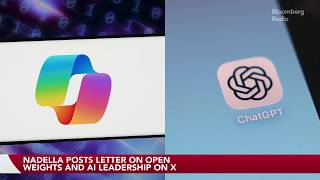
The timing reads less like coincidence and more like a coordinated signal: Nvidia's CEO stepping outside his usual product-focused public voice specifically to push back on a possible government restriction, at the exact moment Washington was reportedly reconsidering a ban. Microsoft's CEO echoed the same framing independently on the same day, tying open weights directly to 'American competitiveness' and 'national security' - language clearly designed to preempt the argument that openness itself is the security risk, rather than concede any ground to it.

Historical Context

2026-07-16
Released Kimi K3, described as the largest open-weight model yet released with roughly 1.4TB of weights, intensifying the U.S. debate over Chinese open-weight models.
2026-07-22
Publicly said Chinese open-source models like DeepSeek, Alibaba and Moonshot AI's models are excellent and rejected the idea they function as government backdoors, days before the coalition letter.
2026-07
Reportedly revived a push to restrict or ban Chinese open-weight AI models following the Kimi K3 release, citing cybersecurity concerns, though enforcement is difficult since weights are already downloaded and mirrored globally.
2025-08-05
Released its own open-weight models after DeepSeek's success demonstrated demand for open alternatives.

Power Map

Key Players
Subject

Tech coalition letter defends open-weight AI

NV

Nvidia

Signatory; CEO Jensen Huang used his first-ever post on X to share the letter

MI

Microsoft

Signatory; hosts the letter on its corporate-responsibility website

ME

Meta

Signatory

PA

Palantir

Signatory

OP

OpenAI

Notable non-signatory; has told the U.S. government that Chinese labs like DeepSeek used hidden techniques to distill its models

AN

Anthropic

Notable non-signatory; has accused DeepSeek, Moonshot AI and MiniMax of creating fraudulent accounts and has pushed for mandatory FAA-style testing regimes for frontier models

Fact Check

8 cited
  1. [1] Open Weights and American AI Leadership (letter, Microsoft)
  2. [2] Anthropic, OpenAI Not in List of 20+ US Companies That Have Backed Open Models in Joint Letter
  3. [3] Nvidia, Palantir Urge US to Back Open AI Models
  4. [4] Trump Administration Reportedly Reviving Push to Ban Chinese AI Models Following Kimi K3 Launch
  5. [5] Chinese Open-Weight Models and the Policy Risk Debate
  6. [6] Meta, Microsoft, Palantir, Nvidia and 21 Others Sign Letter Backing Open-Weight AI Models
  7. [7] Jensen Huang Posts on X for the First Time Ever and Uses It to Defend Open-Source AI
  8. [8] Jensen Huang: Chinese Open-Source AI Models Are Excellent and Shouldn't Be Banned

Source Articles

Top 5

THE SIGNAL.

Analysts

"Warns that a major capability jump in Chinese open-weight models could trigger a blanket ban regardless of technical merit: 'The only reasonable expectation if you're a fan of open weight models is that if there's a major step in chinese open-weight performance, there's a good chance the whole chinese llm sphere is banned. National security apparatus will happily give a big "fuck you" to open models.'"

Nathan Lambert (Allen Institute for AI / interconnects.ai)
Cautious supporter of open weight models, wary of political backlash

"Argues that action targeting Chinese open-weight models does not need to be well-justified to have a chilling effect: 'It needn't be that well justified. Enough uncertainty, and regulated enterprises retreat on their own.'"

Dean W. Ball (OpenAI)
Warns regulatory uncertainty can function as an informal restriction tool

"Says halting advanced chip sales, such as Nvidia H200s, to China targets inputs more effectively than trying to ban open models American developers already want to use."

Sam Bresnick (Georgetown)
Argues hardware export controls are more effective than banning open models
The Crowd

"For my first post, I'm sharing a letter @NVIDIA signed on why open models matter. AI will transform every industry, power every company, and be built by every country. Open models strengthen safety and cybersecurity, accelerate innovation and diffusion, and enable sovereignty."

@@JensenHuang81495

"Open-weight models are essential to a healthy AI ecosystem. Together with others across our industry, we are outlining a path for open-weight models to strengthen American competitiveness and expand economic opportunity, while protecting national security."

@@satyanadella8256

"GOOD READ. Jensen Huang's first post was not a product announcement. Instead, he shared a policy letter that NVIDIA signed alongside more than two dozen technology companies, AI laboratories, investors, and open-source organizations. Their argument is straightforward: America's..."

@@tslaming13

"Microsoft, NVIDIA, Meta, IBM, Palantir and more released a joint letter warning Washington not to kill open-weight models"

@u/TorturedPoet301300
Broadcast
US to Increase Scrutiny of Chinese AI Models | The China Show | 7/23/2026

US to Increase Scrutiny of Chinese AI Models | The China Show | 7/23/2026

US Tech Leaders Tout Open Weight AI Models in Letter

US Tech Leaders Tout Open Weight AI Models in Letter

Jensen Huang Joined X—and Dropped a Policy Bomb | Chip & Script EP.120

Jensen Huang Joined X—and Dropped a Policy Bomb | Chip & Script EP.120