FreeToken: UC Berkeley/MIT open-source inference engine runs 753B-parameter MoE models on a single consumer GPU
TECH

FreeToken: UC Berkeley/MIT open-source inference engine runs 753B-parameter MoE models on a single consumer GPU

25+
Signals

Strategic Overview

  • 01.
    FreeToken is an edge-native mixture-of-experts serving engine, open-sourced by researchers at UC Berkeley and MIT, that stores all model weights in system RAM and uses the GPU only as a cache of frequently used experts.
  • 02.
    This lets models far larger than a GPU's VRAM run at interactive speeds on consumer hardware: 35 billion parameters on an 8GB laptop GPU, 284 billion parameters on a gaming desktop GPU, and the 753-billion-parameter GLM-5.2 model on a single workstation GPU.
  • 03.
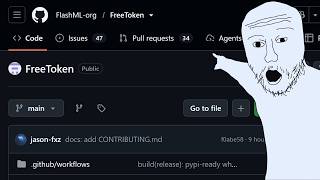
    The software is open source under the Apache 2.0 license, distributed via PyPI (freetoken v0.1.2), GitHub under FlashML-org, and a desktop GUI app for Windows and Linux at flashml.ai.
  • 04.
    On an RTX PRO 6000, FreeToken runs the 753B GLM-5.2 model at 14.9 tokens per second, compared with 7.3 tokens per second using llama.cpp on the same hardware.

How It Actually Works: RAM as the Model's Home, GPU as Cache

FreeToken flips the usual assumption that a model must fully fit in GPU memory. It keeps every weight in system RAM and treats the GPU as a global LRU cache that only holds the 'hot' experts - the mixture-of-experts submodules a given token actually routes through [2]. Because MoE models activate only a small subset of experts per token, most of a 753-billion-parameter model never has to touch the GPU at all in a given forward pass, which is the core trick that makes multi-hundred-billion-parameter inference possible on an 8-96GB card.

The harder engineering problem is hiding the latency of moving experts in and out of that cache. FreeToken benchmarks PCIe and CPU memory bandwidth once on first run, then dynamically splits cache misses between the PCIe transfer path and CPU-side execution in proportion to whichever is actually faster on that specific machine [3]. Prefill and decode are treated as separate bandwidth problems - prefill uses full-layer double-buffered streaming to overlap weight loading with compute, while decode leans on the adaptive LRU cache - and VRAM can be reallocated between the expert cache and the KV cache at runtime without restarting the engine. As one technical walkthrough of the codebase put it, the real bottleneck was never raw compute - it is where and when the expert weights move.

The Story Underneath the Headline Benchmarks

Every piece of press and social coverage around FreeToken's launch tells the same clean story: 2-4x faster than Ollama, a 753-billion-parameter model running at nearly double llama.cpp's speed on a single card. That version of events comes almost entirely from the paper's own benchmark tables and the researchers' own social posts. The most detailed independent scrutiny lives in a long r/LocalLLaMA thread that started as an enthusiastic hands-on report and turned into a pointed methodology fight.

The core objections: no disclosed llama.cpp baseline commit or flags, no documentation of the tuning options that materially change llama.cpp's own offloading performance, single-run numbers with no variance reported, and unresolved credit to prior llama.cpp offloading work. The sharpest claim - that FreeToken's own GitHub pull requests show its bandwidth-based hybrid-execution heuristic performing worse than plain CPU-only execution in some configurations - came from inside the project's own repository, not from an outside benchmark. One independent reproduction did find a real 2.2-3.1x decode speedup over llama.cpp on matched hardware, but with a much slower cold time-to-first-token (21.7 seconds versus 4.7 seconds) - a tradeoff the headline numbers don't mention.

Why This Lands Now: Frontier Weights Are Outrunning Consumer Hardware

The paper's own framing is straightforward: open-weight frontier models keep getting released, but the infrastructure to serve them still assumes a datacenter [1]. That gap has been widening as MoE releases have pushed total parameter counts past what any single consumer GPU could ever hold, even as the number of experts actually needed per token has stayed small.

Traditional CPU-GPU offloading has existed for a while, but it has always been bottlenecked by PCIe bandwidth alone, since it assumes the interconnect is the only variable that matters [1]. FreeToken's contribution is measuring the actual bandwidth available on a given machine, both PCIe and host memory, and adapting the execution split accordingly - a small idea that turns out to matter a lot when the difference between a usable chatbot and a frozen one is a few seconds per token.

The Fine Print: DDR5, CUDA Only, and the RAM You Still Need

The 8GB-VRAM headline obscures a real cost: running the largest supported configuration still requires roughly 512GB of system RAM, since that RAM is now doing the job the GPU used to do [4]. FreeToken's tiered hardware picture - 35B parameters on an 8GB laptop GPU, 284B on a 32GB desktop card, 753B on a 96GB workstation card - only holds if the corresponding host RAM is also available [5].

Community testing surfaced several rough edges the announcement didn't emphasize: the engine currently looks CUDA-only, with no Vulkan path, uncertain support for AMD cards or Apple Silicon, and the best results tied specifically to official NVFP4-quantized checkpoints rather than the GGUF or EXL3 formats most local-LLM users already have on disk. Testers also converged on a practical tip that has nothing to do with the GPU at all: DDR5 memory speed, not just capacity, has an outsized effect on realized throughput, since every cache miss now round-trips through system memory instead of staying on the card.

Historical Context

2026-08-17
FreeToken is released as an open-source project.
2026-08-23
MarkTechPost publishes coverage titled 'Meet FreeToken: An Edge-Native MoE Serving Engine that Runs 753B GLM-5.2 on a Single Workstation GPU.'
2026-08-24
Dataconomy publishes an article confirming FreeToken enables 753B model inference on a single workstation GPU.

Power Map

Key Players
Subject

FreeToken: UC Berkeley/MIT open-source inference engine runs 753B-parameter MoE models on a single consumer GPU

UC

UC Berkeley (EECS, incl. Kurt Keutzer, Ion Stoica, Matei Zaharia)

Lead academic institution behind FreeToken; several co-authors, including Shuo Yang, Kurt Keutzer, Ion Stoica, and Matei Zaharia, are Berkeley-affiliated researchers and professors who shaped the system's design and paper.

MI

MIT (Song Han)

Co-author Song Han, an MIT professor known for efficient machine learning systems research, contributes to FreeToken's design.

UT

UT Austin (Chenfeng Xu, Xiaoze Fan)

Additional collaborating institution; co-authors Chenfeng Xu and Xiaoze Fan are UT Austin-affiliated and contributed to the system and paper.

FL

FlashML-org

GitHub organization that maintains the FreeToken open-source repository and ships the flashml.ai desktop app.

Fact Check

5 cited
  1. [1] FreeToken: Efficient Edge-Native MoE Serving with Bandwidth-Adaptive Execution
  2. [2] FlashML-org/FreeToken
  3. [3] Meet FreeToken: An Edge-Native MoE Serving Engine that Runs 753B GLM-5.2 on a Single Workstation GPU
  4. [4] FreeToken 753B Local MoE: Single GPU Hardware Guide
  5. [5] FreeToken Brings Massive AI Models to a Single GPU

Source Articles

Top 5

THE SIGNAL.

Analysts

Highlighted FreeToken's cross-GPU-tier benchmark results as evidence that local AI inference is becoming practically viable.

Yuchen Jin
X/Twitter user (@Yuchenj_UW)

Summarized FreeToken's results across GPU tiers as a notable leap over Ollama for local MoE inference.

Akshay
X/Twitter user (@akshay_pachaar)
The Crowd

UC Berkeley just open-sourced FreeToken. (2–4x faster local LLM inference than Ollama) the results are wild: - Qwen3.6-35B on an 8GB GPU at 39.3 tokens/s - DeepSeek-V4-Flash 284B on a 32GB GPU at 22 tokens/s - GLM-5.2 753B on a 96GB GPU at 14.9 tokens/s a 35B model at 16-bit

@@akshay_pachaar2932

FreeToken is fast. Comparing to Ollama, we have 3–4× faster decode, and 6–30× faster prefill How? We introduce bandwidth-adaptive CPU–GPU execution + semantic-aware caching across agent turns. More details in the technical report: arxiv.org/abs/2608.16157

@@Andy_ShuoYang2536

A 20GB model doesn't fit in this RTX 5080's 16GB VRAM. It still runs at ~100 tok/s. NEW INFERENCE ENGINE! FreeToken is a new open-source inference engine designed specifically to run huge MoE models on hardware that doesn't have enough VRAM to hold them. ... and there

@@TeksEdge1122

Freetokens project is impressive

@u/ViRROOO47
Broadcast
FreeToken Is INSANE — Run Giant AI Models Locally

FreeToken Is INSANE — Run Giant AI Models Locally

FreeToken: Run Giant MoE LLMs on Local Hardware

FreeToken: Run Giant MoE LLMs on Local Hardware

FreeToken: Running Trillion-Parameter AI on Your Gaming GPU

FreeToken: Running Trillion-Parameter AI on Your Gaming GPU

FreeToken: UC Berkeley/MIT open-source inference engine runs 753B-parameter MoE models on a single consumer GPU — AI News | Agentic Brew