Google AMIE medical AI reaches expert-level consultations
TECH

Google AMIE medical AI reaches expert-level consultations

27+
Signals

Strategic Overview

  • 01.
    Google Research and Google DeepMind published a paper demonstrating AMIE (Video), a Gemini-based multi-agent system, achieving expert-level performance in real-time clinical video consultations for the first time.
  • 02.
    In a randomized OSCE-style trial with 30 primary care physicians, 15 patient actors, and 100 clinical scenarios, evaluators rated AMIE (Video) on par with or better than physicians across history-taking, diagnosis, management, and physical observation.
  • 03.
    The advance runs alongside a companion approach called ResidencyRL, which trains AMIE-derived agents through tens of thousands of simulated multi-turn patient encounters rather than static benchmarks, mirroring how human residents build clinical judgment progressively.
  • 04.
    Google is already moving past simulation, running a nationwide randomized real-world virtual-care trial with Included Health while keeping a human safety supervisor in the loop rather than letting the system act autonomously.

Deep Analysis

Inside AMIE (Video): A Multi-Agent System Built for Real-Time Perception

AMIE (Video) is a Gemini-based multi-agent system built to fuse three things that used to live in separate pipelines: low-latency dialogue, clinical reasoning, and real-time audio-visual perception, all inside a single conversational loop [1]. That's the technical leap behind the headline number - rather than parsing a typed symptom list, the system has to notice a cough, register a wince, or watch how a patient moves while simultaneously carrying a natural spoken conversation and reasoning toward a diagnosis in real time. It extends Google's original text-only AMIE, and its later single-image multimodal version, into a modality that behaves like an actual telehealth visit instead of a chat window with a camera bolted on.
What an OSCE Study With Actors Does - and Doesn't - Prove

What an OSCE Study With Actors Does - and Doesn't - Prove
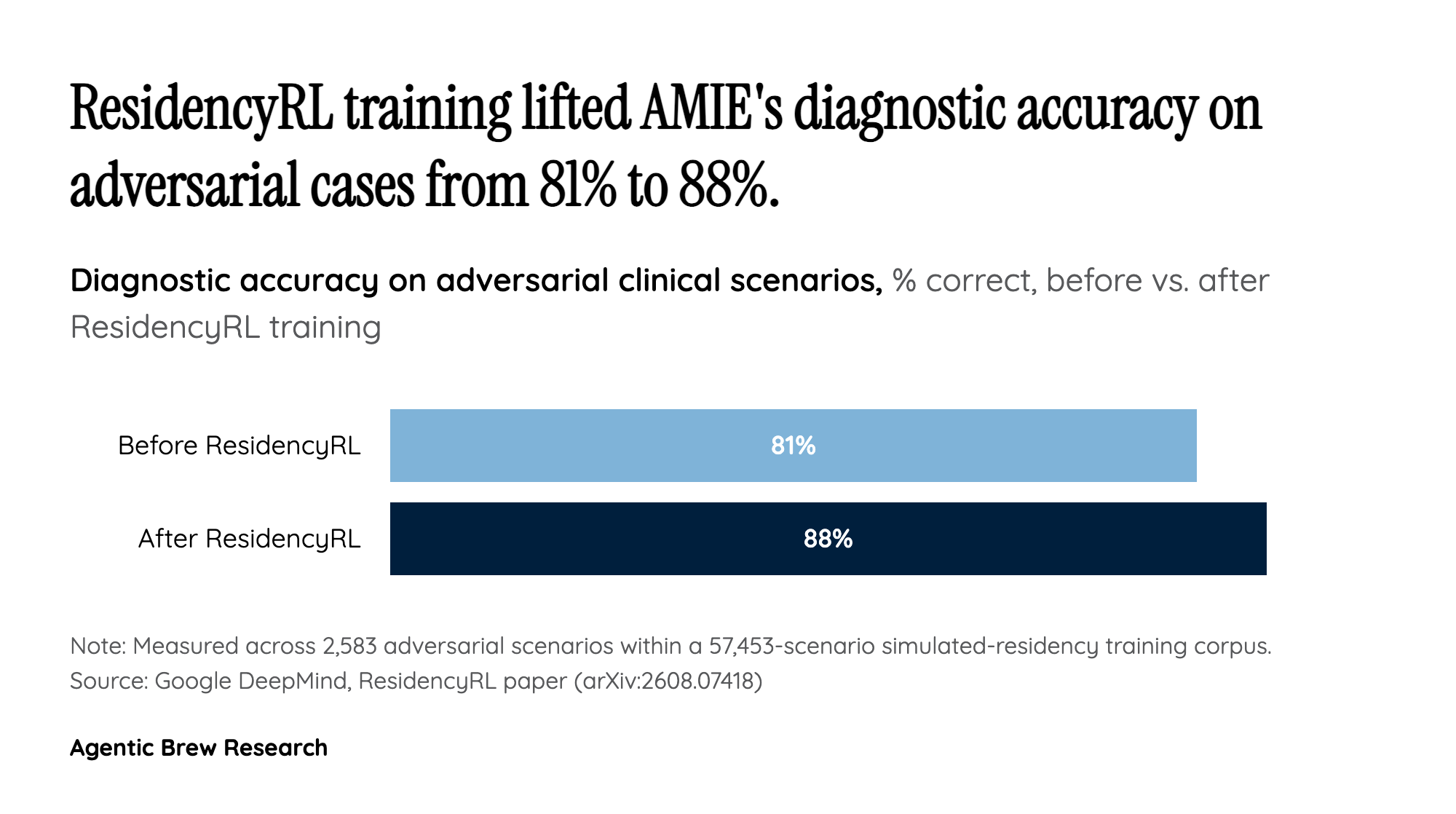
ResidencyRL's simulated-residency training raised AMIE's diagnostic accuracy on adversarial clinical scenarios from 81% to 88%.

The headline result comes from a randomized, OSCE-style (Objective Structured Clinical Examination) trial: 30 primary care physicians and 15 patient actors worked through 100 clinical scenarios, with AMIE (Video), AMIE (Text), and human PCPs each consulting via video, and evaluators scored AMIE (Video) on par with or better than PCPs on history-taking, diagnosis, management, and physical observation [2]. A related evaluation using the same format found AMIE matched or beat physicians on 29 of 32 clinical metrics and 7 of 9 multimodal-specific criteria [2]. Underneath that score sits a new training method: a companion approach called ResidencyRL trains AMIE-derived agents across 57,453 simulated clinical scenarios - telehealth cases, history-taking drills, and deliberately adversarial edge cases - rather than grading a fixed model against a static benchmark, and reports diagnostic accuracy in adversarial settings rising from 81.0% to 88.0%, with clinicians preferring the RL-trained agent in 87.6% of blinded comparisons [3]. Google's own paper authors are careful not to oversell the actor-based setup, noting that an OSCE evaluation using patient actors 'substantially under-represents the complexity of real-world care' [4], and a companion study on AMIE's disease-management skills goes further, stating plainly that 'the system remains experimental and untested in real clinical care' [5].

Four Escalations in Under Three Years

This is not a single breakthrough - it's the fourth rung on a ladder Google has been climbing since January 2024, when the original AMIE paper showed the system outperforming physicians in text-chat-only OSCE simulations across 149 scenarios in Canada, the UK, and India [6]. By May 2025, AMIE had gained multimodal vision - reading X-rays, skin images, and ECGs using Gemini 2.0 Flash - and was matching or outperforming PCPs in a 105-scenario study [7]. In June 2026, Google pushed AMIE from single-visit diagnosis into longitudinal disease management, matching or beating 21 board-certified PCPs across 100 simulated multi-visit scenarios in a Nature-published study [8]. The real-time video consultation result announced this month is the natural next step: text, then sight, then ongoing care, then a live conversation that looks like an actual doctor's visit.

The Rapport Gap - and Why Google Is Already Testing This on Real Patients

Even in a study designed to flatter the system, AMIE (Video) didn't win everywhere. Patients still preferred physicians for rapport and partnership-building, and the researchers acknowledge gaps in 'fine anatomical precision, subtle affective nuances, and high-frequency movements' during physical exams [1]. That's likely why Google isn't waiting for a perfect video-consultation score before testing the technology on real patients: it's running a separate, prospective, consented, nationwide randomized controlled trial of AMIE-style AI in real-world virtual care with Included Health [9], building on earlier work with Beth Israel Deaconess Medical Center testing an AMIE-related 'AI co-clinician' that matched or exceeded PCP performance in 68 of 140 assessed areas - always under physician oversight, with a human safety supervisor tracking interruptions during AI-led encounters rather than letting the system operate autonomously [10]. Google researcher Vivek Natarajan frames the ambition as complementary rather than a replacement: 'There may be scenarios when people might benefit from interacting with systems like AMIE as part or in addition to their clinical journeys' [11]. Dartmouth medical educator Thomas Thesen, an outside voice, expects something similar over the next decade - AI streamlining physician work - but insists 'the expert judgment of a trained doctor will remain crucial for final diagnosis and treatment plans' [11].

Historical Context

2024-01
Original AMIE paper 'Towards Conversational Diagnostic AI' showed AMIE outperforming physicians in text-chat OSCE-style simulated consultations across 149 scenarios in Canada, the UK, and India.
2025-05
AMIE gained multimodal vision capability (X-rays, skin images, ECGs) using Gemini 2.0 Flash, tested in a 105-scenario, 25-patient-actor OSCE study.
2026-06-17
AMIE extended from single-visit diagnosis to longitudinal disease management, matching or beating 21 board-certified PCPs across 100 simulated multi-visit scenarios in a Nature-published study.
2026-08
Publication of 'Towards Expert-level Medical AI for Real-time Video Consultations,' the first demonstration of expert-level AI performance in real-time clinical video consultations via AMIE (Video).
2026-08
Related ResidencyRL paper describes training AMIE-derived clinical agents through simulated multi-turn patient encounters (residency-style curriculum) rather than static benchmark evaluation.

Power Map

Key Players
Subject

Google AMIE medical AI reaches expert-level consultations

GO

Google Research / Google DeepMind

Developer of AMIE; leads the research program, publishes papers, and coordinates clinical study partnerships.

IN

Included Health

US healthcare provider partnering with Google on a nationwide randomized real-world virtual care study of the AI system.

BE

Beth Israel Deaconess Medical Center

Clinical research partner; site of an earlier prospective consented study testing AMIE-related tools with real patients.

MA

Mahvish Nagda

Lead author of the 'Towards Expert-level Medical AI for Real-time Video Consultations' arXiv paper, with 39 co-authors from Google Research/DeepMind.

VI

Vivek Natarajan

Google AI researcher on the AMIE team, commenting on AMIE's potential clinical role and diagnostic performance trajectory.

TH

Thomas Thesen

Associate Professor of Medical Education, Dartmouth's Geisel School of Medicine; independent academic voice on AI's role supporting (not replacing) doctors.

Fact Check

11 cited
  1. [1] Towards Expert-level Medical AI for Real-time Video Consultations
  2. [2] Towards Expert-level Medical AI for Real-time Video Consultations
  3. [3] ResidencyRL: Training Clinical AI Agents Through Simulated Medical Residencies
  4. [4] Google AMIE AI Doctor Learns to See Medical Images
  5. [5] Google's AMIE Beats Doctors on Key Simulated Disease Management Tasks
  6. [6] Towards Conversational Diagnostic AI
  7. [7] Google Researchers Advance Diagnostic AI: AMIE Now Matches or Outperforms Primary Care Physicians Using Multimodal Reasoning With Gemini 2.0 Flash
  8. [8] AMIE for Disease Management in Nature
  9. [9] Collaborating on a Nationwide Randomized Study of AI in Real-World Virtual Care
  10. [10] AI Co-Clinician
  11. [11] AI Doctor

Source Articles

Top 1

THE SIGNAL.

Analysts

Sees AMIE-like systems as a potential complement to clinical journeys and a path toward superhuman diagnostic performance.

Vivek Natarajan
AI Researcher, Google

Expects AI to support doctors by streamlining work over the next decade, while final diagnosis and treatment judgment stays with trained physicians.

Thomas Thesen
Associate Professor of Medical Education, Dartmouth Geisel School of Medicine

Caution that the OSCE-style research setup with patient actors understates real-world clinical complexity and that the system is not ready for deployment.

Unnamed researchers (paper authors)
Google Research/DeepMind

Emphasize AMIE remains experimental and unvalidated in real clinical care despite strong simulated results.

Unnamed researchers (paper authors, disease-management study)
Google Research/DeepMind
The Crowd

Today, @GoogleResearch introduced AMIE, our research medical AI system that can now conduct real-time video consultations with a first-of-its-kind demonstration of expert-level performance in a randomized controlled study. Learn more from @GoogleForHealth

@@NewsFromGoogle113

New from @GoogleResearch and @GoogleDeepMind: AMIE can now conduct real-time video consultations. In a randomized study using simulated consultations, it met clinical performance benchmarks, showing AI's potential to expand telehealth access. Learn more: goo.gle/4bHRK2v

@@GoogleForHealth98

Thrilled to share our new preprint on AMIE, demonstrating expert-level performance compared to primary care physicians in real-time clinical video consultations!

@@apalepu1345

AMIE, Google's research medical AI system, demonstrates real-time clinical video consultation capabilities in a first-of-its-kind study.

@u/Gaiden20613
Broadcast
AMIE by Google: A Game-Changing Medical AI Surprising the Entire Industry by Outperforming Doctors!

AMIE by Google: A Game-Changing Medical AI Surprising the Entire Industry by Outperforming Doctors!

Google's AMIE Gets Vision -AI Doctor can see images

Google's AMIE Gets Vision -AI Doctor can see images

Google AMIE: The First AI Medical Assistant to Achieve Comprehensive Disease Management

Google AMIE: The First AI Medical Assistant to Achieve Comprehensive Disease Management

Google AMIE medical AI reaches expert-level consultations — AI News | Agentic Brew