Firmus Technologies withdraws A$44 billion ASX IPO after investor pushback
TECH

Firmus Technologies withdraws A$44 billion ASX IPO after investor pushback

41+
Signals

Strategic Overview

  • 01.
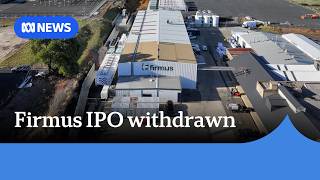
    Firmus Grid Ltd. withdrew its ASX listing application on October 9, 2026, after pricing shares at A$11 each, implying a valuation of roughly A$44 billion, and said it will now pursue capital from private markets instead.
  • 02.
    Firmus's board concluded that proceeding with the offer was not in the best interests of the company and its shareholders, citing 'recent market volatility and prevailing market conditions' as the reason for pulling the deal.
  • 03.
    The Nvidia-backed AI data center operator had only two operational sites, in Australia and Singapore, with five more under development across four countries, despite seeking a valuation rivaling some of the world's largest listed companies.
  • 04.
    Had it proceeded at its original asking price, the listing would have been the second-largest IPO in Australian history after Telstra's 1997 float, and the fourth-largest globally in 2026.

Deep Analysis

The Valuation Math That Broke Investor Patience

Firmus priced its IPO at A$11 a share, implying a valuation near A$44 billion, even though only about 5% of its sold capacity was actually operational versus roughly a quarter for comparable neocloud operators (cloud providers built specifically to rent out AI chip capacity to customers like OpenAI and Meta), and the company was projected to lose A$77 million in the first half of its financial year. University of Adelaide finance lecturer Marta Khomyn put it plainly: at that price, 'investors are betting that everything goes right.' [1]

That math only looks worse set against Firmus's own recent history. The company raised private capital at roughly A$1.85 billion in September 2025 - about 13 months, and a roughly 23-fold markup, before it asked public markets for A$44 billion. When institutional demand faltered, underwriters tried to rescue the deal by testing successively lower prices, reportedly cutting toward A$8.25 and then as low as A$5.50, before concluding no price would clear the market and withdrawing the offer altogether. [2]

Circular Financing: Nvidia as Investor, Supplier, and the Leverage Machine Underneath

Nvidia's relationship with Firmus is more than a customer deploying its chips: the chipmaker holds a 7.2% equity stake worth roughly US$2 billion in commitments while simultaneously being Firmus's main hardware supplier, a structure the Reserve Bank of Australia has separately flagged as a 'circular AI financing' risk across the sector. [3]Morningstar analyst Lochlan Holloway laid out why that matters operationally: Firmus and its neocloud peers are 'heavily geared,' borrowing against customer contracts to buy chips and then using rental income to repay the debt - a model that works smoothly only as long as contracted revenue keeps arriving on schedule. [4]

That leverage is exactly why Firmus needed outside capital so badly in the first place. In August 2026, barely two months before the IPO attempt, Nvidia joined Coatue Management, Blackstone, and Jane Street in a US$2 billion private funding round for Firmus, with Maas Group also chipping in A$300 million to lift its stake to 3.2%. [5]Betting the IPO on a valuation many multiples above that round is what ultimately made institutional buyers suspicious that the business's financing needs, not its growth story, were driving the timeline.

A Podcast Comment and a Collapsing Bookbuild: How Timing Undid the Deal

As recently as October 1, Firmus was still framing its ambitions around a roughly A$30 billion valuation target. [6]Within days, reports surfaced that more than half the IPO stock would be available for existing investors to sell with little to no lock-up, an overhang structure that made prospective buyers nervous about being diluted by insider selling almost immediately after listing. [7]By October 6, Bloomberg was reporting that this overhang alone was souring institutional appetite even before any news event moved the price. [8]

The moment that tipped hesitation into active order-pulling arrived on October 8, when CDC Data Centres chief executive Greg Boorer said on a podcast that a planned 1.6 gigawatt joint AI-factory development with Firmus was 'no longer underway.' That single comment, landing in the middle of the bookbuild, triggered a wave of investors withdrawing orders within hours. [9]Bankers scrambled to save the raise by weighing a postponement and a private-round alternative that same day, [10]while a separate report framed the cratering demand as a broader warning signal for AI infrastructure funding generally. [11]By October 9, the board concluded that proceeding was no longer in shareholders' interests and formally withdrew the listing application, citing 'recent market volatility and prevailing market conditions.' [12]

Maas Group: The Collateral Damage of an IPO That Never Happened

The clearest casualty of Firmus's collapse wasn't Firmus itself - it was Maas Group, the ASX-listed construction and materials company that holds a 3.2% Firmus stake and whose subsidiary JLE Group carries roughly A$1.1 billion in FY26-FY27 work orders tied to Firmus's data center build-out, of which A$373 million has already been paid. [13]When the IPO wobbled, Maas entered a trading halt and its shares fell somewhere between 22% and 28%, wiping out roughly A$517 million in market value in a single trading window - a far steeper proportional hit than anything Firmus itself absorbed, since Firmus never had to mark its own valuation down in a public market. [14]

That asymmetry is the real lesson for anyone assessing AI infrastructure exposure: the parties most exposed to a neocloud's valuation story are often not the neocloud itself but its contractors, construction partners, and minority shareholders, who have no direct say over pricing decisions yet absorb the market's verdict in full.

The Contrarian Case: A Healthy Correction, Not a Crisis

Not everyone read the collapse as bad news. Fund manager Jun Bei Liu argued the original ask was simply indefensible - 'almost three times what the valuation was when they raised money just a few months ago,' a reference point distinct from the 23-fold markup over the September 2025 private round cited earlier, since her comparison was to Firmus's own characterization of its most recent raise - and that the market's rejection was the system working as intended. [3]Wealth Within analyst Filip Tortevski framed the deeper structural problem: AI infrastructure demands that 'billions must be spent on chips, power and data centres before the expected cash arrives,' and investors are growing unwilling to fund that gap at any price. [15]Other reporting suggested the failed float could chill Australia's broader pipeline of AI and neocloud listings, as public investors apply more scrutiny to infrastructure valuations than private markets have so far. [11]

The reaction across social media echoed that split verdict. On X, posts mocked Firmus's valuation methodology for leaning on inflated future projections rather than today's numbers, and juxtaposed the company's heavy losses, mounting debt, and modest installed capacity against the A$44 billion ask; VanEck's head of digital assets research went further, calling the outcome 'good riddance' and arguing that the lead underwriters, not the market, were the ones who misjudged the deal. Reddit discussion in Australian finance communities ran in a similar register, dominated by skepticism over the valuation-versus-fundamentals gap and unease about lock-up terms seen as letting early backers cash out with few restrictions, though a minority pushed back that AI infrastructure investment still holds long-term value for Australia regardless of Firmus's own execution stumbles. YouTube coverage of the collapse floated SpaceX's 2026 direct-offering IPO model as a possible alternative path for similarly leveraged, pre-revenue infrastructure plays.

Notably, none of this skepticism has touched Firmus's actual customer relationships: OpenAI's multi-year deal covering two Malaysian sites still pushed Firmus past 900 megawatts of contracted capacity, [16]and Meta separately committed to Nvidia GB300 NVL72 capacity at Firmus's Melbourne site and across Southeast Asia. [17]The gap between enthusiastic private backers and skeptical public investors is itself the story - neocloud operators have typically priced at 20-30x forward revenue in private rounds versus the 10-15x multiples public markets apply to listed data center operators, [18]and Firmus's abortive listing, which would have been Australia's second-largest IPO ever (after Telstra's 1997 float) and the fourth-largest globally in 2026 at its original ask, [19]is the clearest evidence yet that those two pricing worlds haven't reconciled.

Historical Context

2019
Founded by Oliver Curtis, Tim Rosenfield, and Jonathan Levee in Tasmania, originally as a bitcoin mining operation.
2021
Firmus pivoted from bitcoin mining to high-performance computing and struck a partnership with Nvidia that became central to its later growth.
2025-09
Valued at approximately A$1.85 billion in a private funding round, roughly 13 months before its IPO sought a A$44 billion valuation.
2026-08
Announced a US$2 billion private funding round backed by Nvidia, Coatue Management, Blackstone, and Jane Street; Maas Group also added A$300 million, lifting its stake to 3.2%.
2026-09-08
Announced a multi-year deal naming OpenAI as anchor customer for two Malaysian data center sites, pushing contracted capacity past 900MW.
2026-10-01
Bloomberg/AFR reported Firmus was targeting roughly a $30 billion valuation ahead of one of Australia's biggest-ever IPOs.
2026-10-05
Reports emerged that Firmus planned to allocate roughly half of the IPO shares to existing early backers, raising stock-overhang concerns among prospective investors.
2026-10-06
Bloomberg reported the stock/escrow overhang was making some institutional investors wary of participating in the IPO.
2026-10-08
CDC's CEO said on a podcast that its planned 1.6 gigawatt AI-factory joint development with Firmus was no longer underway, prompting investors to pull IPO orders; Maas Group shares fell over 20% and entered a trading halt the same day.
2026-10-09
Formally withdrew its ASX listing application, citing market volatility, and said it would pursue private capital instead.

Power Map

Key Players
Subject

Firmus Technologies withdraws A$44 billion ASX IPO after investor pushback

MA

Maas Group (ASX:MGH)

Australian construction and materials company holding a 3.2% Firmus stake via A$300 million in ordinary and preference shares; entered a trading halt and fell roughly 22-28% after the IPO collapsed, erasing about A$517 million in market value.

NV

Nvidia

Holds a 7.2% Firmus stake worth roughly US$2 billion in commitments while also serving as Firmus's chip supplier, a dual role flagged by the RBA as a circular-financing risk in AI infrastructure.

OP

OpenAI

Anchor customer contracting compute capacity from two Firmus data centers in Malaysia under a multi-year deal announced September 8, 2026, pushing Firmus past 900MW of contracted capacity.

ME

Meta

Anchor customer at Firmus's Melbourne data center using Nvidia GB300 NVL72 systems, and separately signed agreements for GPU capacity at Southeast Asian facilities.

CD

CDC Data Centres (CEO Greg Boorer)

Partner whose podcast remark that a planned 1.6 gigawatt joint AI-factory development with Firmus was 'no longer underway' triggered a wave of investor order pullbacks mid-bookbuild.

OL

Oliver Curtis and Tim Rosenfield

Co-founders and co-CEOs of Firmus, who started the company as a bitcoin mining operation in Tasmania in 2019 before pivoting to HPC/neocloud AI infrastructure around 2021.

UN

UniSuper (CIO John Pearce)

Major Australian institutional investor whose public valuation skepticism - voiced by its chief investment officer - contributed to weakening demand ahead of the IPO's collapse.

Fact Check

19 cited
  1. [1] Can data centre company Firmus live up to its blockbuster $43 billion listing value? Why some investors doubt it
  2. [2] Firmus IPO Collapse: $44 Billion Valuation Unravels
  3. [3] How Firmus, the biggest IPO in three decades, fell over
  4. [4] Firmus float gets pulled following lacklustre investor demand
  5. [5] Nvidia-Backed AI Data Center Firm Firmus Weighs IPO
  6. [6] Firmus Eyes $30 Billion Valuation in Australian IPO, AFR Reports
  7. [7] Firmus Said to Plan Allocating Half of IPO to Existing Investors
  8. [8] Firmus Stock Overhang Said to Make Some Investors Wary on IPO
  9. [9] Australian Nvidia-Backed AI Data Centre Operator Firmus Shelves IPO
  10. [10] Nvidia-Backed Firmus Is Set to Postpone IPO, Weigh Private Round
  11. [11] Nvidia-Backed IPO's Cratering Demand Sends Warning on AI Funding
  12. [12] Nvidia-Backed Firmus Pulls IPO as AI Market Volatility Bites
  13. [13] Maas Group Enters Trading Pause After Firmus Pulls IPO
  14. [14] Australia's Maas Enters Trading Halt After Nvidia-Backed Firmus Shelves $5 Billion IPO Plan
  15. [15] Firmus IPO Collapse Raises Questions Over AI Boom as Analyst Warns Investors Face Valuation Risks
  16. [16] Firmus Names OpenAI Anchor Customer in Malaysia, Pushes Past 900MW Ahead of ASX IPO
  17. [17] Firmus to Supply Meta With GPU Capacity in Southeast Asia
  18. [18] Firmus Technologies IPO Withdrawal
  19. [19] Firmus - Neoclouds

Source Articles

Top 5

THE SIGNAL.

Analysts

“Said Firmus has a genuinely good underlying business story but the IPO price did not match that story, and flagged concern the company would need repeated future debt and equity raises.”

John Pearce
Chief Investment Officer, UniSuper

“Explained the structural leverage risk baked into the neocloud business model underlying Firmus and its peers, where debt is serviced by rental income from customer contracts.”

Lochlan Holloway
Morningstar analyst

“Argued the original asking valuation was unjustifiably high relative to Firmus's prior private round months earlier, and that the market's rejection was ultimately the correct outcome.”

Jun Bei Liu
Fund manager, Ten Cap

“Argued the IPO price assumed near-flawless execution given Firmus's thin operational base and heavy losses, and noted the premium relative to comparable listed data-center companies.”

Marta Khomyn
Senior Lecturer in Finance and Data Analytics, University of Adelaide

“Warned that investors are increasingly questioning the enormous capital outlay AI infrastructure requires before revenue materializes, pressuring the valuation logic behind data center buildouts.”

Filip Tortevski
Senior analyst, Wealth Within
The Crowd

“Firmus pulled its IPO because it seriously thought someone will buy its EV+1/EBIT+2 "valuation" metric -> Enterprise value based on debt in one year (lower of course), divided by projected EBIT in 2 years (higher of course). No, really”

@@zerohedge341

“In FY2026 Firmus lost $68 million on $51 million in revenue. Firmus has $30 billion in debt. Firmus has 46 MW of installed datacenter capacity. Firmus wants a $44 billion IPO valuation. Firmus just called off their IPO. Ya think?”

@@JG_Nuke227

“Good riddance to Firmus' failed $30B IPO and shame on the lead bankers (JPM, MS, BofA) who tried to dump this crap on public investors. The failure hammered public data center stocks yesterday, but longer term, it's healthy for the sector that investors rejected this extractive”

@@matthew_sigel188

“Data centre operator Firmus pulls share market float following lacklustre investor demand”

@u/Expensive-Horse5538517
Broadcast
Firmus IPO in trouble, ASX falls on mining sell-off | Finance Report | ABC NEWS

Firmus IPO in trouble, ASX falls on mining sell-off | Finance Report | ABC NEWS

Data centre operator Firmus pulls IPO after lacklustre interest | ABC NEWS

Data centre operator Firmus pulls IPO after lacklustre interest | ABC NEWS

Firmus to pursue private funding, ASX rebounds | Finance Report | ABC NEWS

Firmus to pursue private funding, ASX rebounds | Finance Report | ABC NEWS

Firmus Technologies withdraws A$44 billion ASX IPO after investor pushback — AI News | Agentic Brew