OpenAI publicly launches GPT-5.6 (Sol, Terra, Luna)
TECH

OpenAI publicly launches GPT-5.6 (Sol, Terra, Luna)

36+
Signals

Strategic Overview

  • 01.
    OpenAI is publicly launching the GPT-5.6 family - Sol (flagship), Terra (lower-cost, high-volume), and Luna (fastest and cheapest) - to everyone on Thursday, July 9, 2026, after a limited preview and a U.S. government review.
  • 02.
    The U.S. Department of Commerce, through its Center for AI Standards and Innovation (CAISI), cleared OpenAI for a broad public rollout after additional testing, lifting restrictions that had limited GPT-5.6 to a small set of government-vetted partners since June.
  • 03.
    For weeks GPT-5.6 was available only to roughly 20 organizations whose identities OpenAI had shared with the government - reported as the first time an American lab gated a frontier model behind a state-approved roster.
  • 04.
    The public launch lands the same week xAI moved Grok 4.5 to public availability, setting up renewed head-to-head competition between OpenAI and xAI.

The First Frontier Model That Needed Washington's Sign-Off

The headline is not GPT-5.6 - it is the process that produced it. For weeks the model was available only to roughly 20 organizations whose identities OpenAI had disclosed to the government, described as the first time an American lab gated a frontier model behind a state-approved roster [1]. The Commerce Department, acting through its Center for AI Standards and Innovation (CAISI), ran the evaluation and only this week lifted the restrictions that had constrained OpenAI's ability to distribute the model widely [2]. One report went further, calling it the first time an AI model passed through formal U.S. government vetting before launch [3].

The mechanism is an executive order that created a voluntary review framework for 'covered frontier models,' letting companies hand advanced systems to the government for up to 30 days before broad release so national security risks can be assessed first [4]. In practice, voluntary starts to look mandatory: a government that can grant access can withhold it, and a curated list of approved organizations begins to function as licensing. The uncomfortable implication, spelled out in independent analysis, is that a body able to gate a launch can also stop one - a power the administration has reportedly already exercised by ordering a rival lab to shut down two models [5].

An Approval Process With a Classified Rulebook

What makes the vetting contentious is not that it exists but that no one can see the criteria. Dean Ball, a former White House AI adviser, put it bluntly: nobody knows what the requirements are to get licensed, and the administration itself does not seem to know [5]. With no finalized uniform standards, the government is evaluating systems case by case, and the concrete standards for 'covered frontier models' were reportedly still classified and unfinalized - an ad-hoc, negotiation-driven regime rather than a published rulebook [2].

That opacity feeds a competitiveness argument. Alex Stamos, former Facebook Chief Security Officer, warned that the process kneecaps a U.S. champion in a race with China [5]. The counterpoint sitting inside the same analysis is that the gate may not even work: Chinese open-weight models reportedly ship freely under permissive licenses at comparable performance, so restricting U.S. labs does little to slow the overall spread of capability [5]. OpenAI, for its part, said publicly that it does not believe this kind of government access process should become the long-term default [5]- a rare instance of a company arguing against a rule that just cleared its own product.

Two Launches, One Week: The Codex-vs-Fable Front Reopens

The timing is not a coincidence. The same week GPT-5.6 goes public, xAI moved Grok 4.5 to public availability, built on its 1.5-trillion-parameter V9 foundation, with xAI claiming performance close to or exceeding Claude Opus and a stated plan to ship new from-scratch models monthly through the end of 2026 [6]. That reframes GPT-5.6's launch as one shot in a fast-cadence release war rather than a solo event [7].

The developer community, though, is fighting a narrower battle. Discussion clustered around the coding-agent contest between OpenAI's Codex, powered by GPT-5.6 Sol, and Anthropic's Fable 5, with the sharpest energy coming from a subscription controversy: Fable 5 moving to API-only access is pushing coding users toward Codex. Early testers working from routing leaks described Sol as roughly twice as fast as its predecessor and capable of one-shotting prompts the way Fable 5 does. Notably, the government-review and Grok 4.5 angles that dominate the news barely surfaced in that developer chatter - the practitioners care about which agent ships working code, not about who signed off on the model.

GPT-5.6 By The Numbers

GPT-5.6 By The Numbers
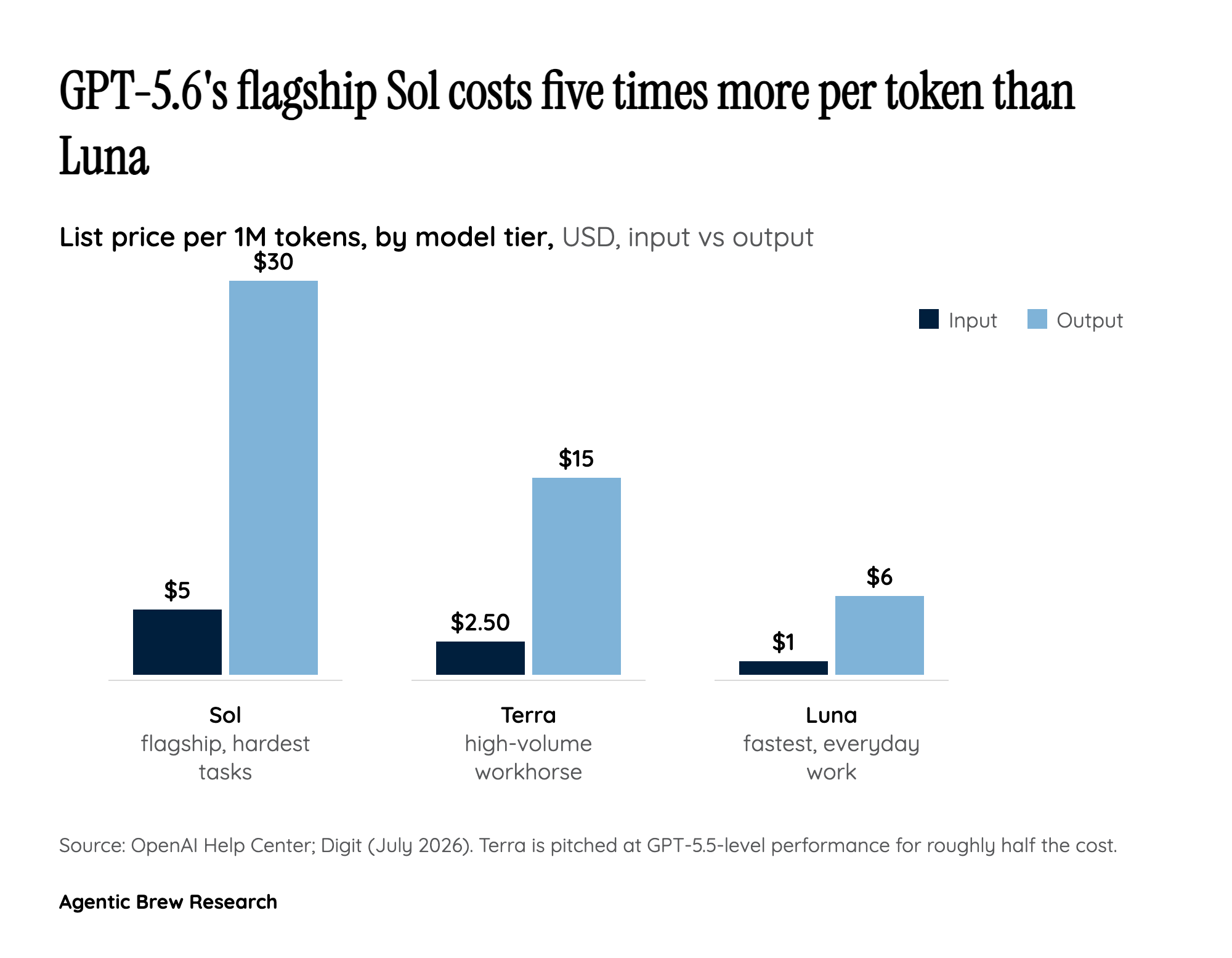
GPT-5.6 list pricing per 1M tokens across the Sol, Terra, and Luna tiers (input vs output).

The economics tell their own story. GPT-5.6 arrives as three tiers priced by capability. Sol, the flagship for the hardest problems like complex coding and security research, runs about $5 per 1M input tokens and $30 per 1M output [8]. Terra, the high-volume workhorse, is roughly $2.50 input and $15 output and is pitched as delivering performance comparable to GPT-5.5 at half the cost [9]. Luna, tuned for speed on everyday work, is about $1 input and $6 output [8].

Wrapped around that pricing are two numbers that define the launch: the roughly 20 government-vetted partner organizations that had exclusive preview access [1], and the up-to-30-day pre-release window the review framework grants the government before a broad public launch [4]. The Terra tier is the tell - halving the cost of the prior generation's capability is the kind of move that pulls high-volume production workloads onto the new family regardless of which model tops the benchmarks.

Sol, Terra, Luna: A Ladder, Not a Lineup

The three-model split is a deliberate segmentation rather than a marketing flourish. Sol is positioned as OpenAI's most powerful model yet, aimed at the hardest work - complex coding, biology, and cybersecurity - and it ships with the company's most robust safeguards to date, emphasizing identifying and fixing security vulnerabilities while holding safety boundaries [9]. Terra is the strong, lower-cost option built for high-volume business tasks, and Luna is the fastest and most cost-efficient choice for everyday work [9].

The practical read is a capability-versus-cost ladder. A team pays flagship rates only for the small share of requests that genuinely need frontier reasoning, routes the bulk of production traffic to Terra where the cost is halved for comparable quality, and pushes latency-sensitive or high-frequency calls to Luna. The safety framing is not incidental either: launching the flagship as 'safest yet' is exactly the posture a model would take coming out of a federal security review, and it drew immediate skepticism from developers wary that 'safest' can shade into more restrictive.

Historical Context

2026-06
GPT-5.6's release was delayed and restricted to a small set of government-vetted partners over national security concerns.
2026-07-08
The Commerce Department cleared OpenAI for the broad public rollout of GPT-5.6, ending weeks of restricted access.
2026-07-09
Scheduled public launch of GPT-5.6 Sol, Terra, and Luna for all users.

Power Map

Key Players
Subject

OpenAI publicly launches GPT-5.6 (Sol, Terra, Luna)

OP

OpenAI

Developer of GPT-5.6; shared its preview partner roster with the government, stationed technical staff in Washington to answer the review agency's inquiries, and publicly pushed back on the gated-access approach while expanding preview access globally ahead of the Thursday launch.

U.

U.S. Department of Commerce / Center for AI Standards and Innovation (CAISI)

Regulator that ran the frontier-model evaluation and granted clearance for the broad rollout, gaining de facto power to gate - and potentially stop - a frontier model launch.

TR

Trump administration / White House

Signed the executive order creating a voluntary review framework for 'covered frontier models' that allows up to 30 days of government access before public release, and approved the broad GPT-5.6 launch.

XA

xAI (Elon Musk) / Grok 4.5

Competitor moving Grok 4.5 to public availability the same week on its 1.5-trillion-parameter V9 foundation, with xAI evals claiming performance close to or exceeding Claude Opus and plans to ship new from-scratch models monthly through the end of 2026.

AN

Anthropic

Rival lab cited as a precedent for the same government limits on advanced models and, per one analysis, reportedly ordered to shut down two of its models - underscoring that the gate can also become a stop.

Fact Check

10 cited
  1. [1] OpenAI GPT-5.6 broad rollout gets US approval - The Next Web
  2. [2] GPT-5.6 Launch Cleared for OpenAI - Cyberpress
  3. [3] OpenAI Scores First Federal Approval for GPT-5.6 Launch - TechBuzz
  4. [4] OpenAI gets US government clearance for broad GPT-5.6 launch - Quartz
  5. [5] GPT-5.6, government-gated - paddo.dev
  6. [6] Grok 4.5 Public Launch vs OpenAI - BeInCrypto
  7. [7] OpenAI expands AI lineup with GPT-5.6 after delayed public launch - Invezz
  8. [8] A preview of GPT-5.6 Sol, Terra and Luna - OpenAI Help Center
  9. [9] OpenAI confirms GPT-5.6 Sol, Terra and Luna rollout after US govt review - Digit
  10. [10] Previewing GPT-5.6 Sol - OpenAI

Source Articles

Top 5

THE SIGNAL.

Analysts

"Nobody knows what the requirements are to get licensed, and the administration itself does not seem to know."

Dean Ball
Former White House AI adviser

"They are laughing at us in Beijing right now. One of America's champions is being kneecapped by the US government while we're in a race with the Chinese."

Alex Stamos
Former Facebook Chief Security Officer

"We don't believe this kind of government access process should become the long-term default."

OpenAI
Official statement
The Crowd

"GPT-5.6 Sol, along with Terra and Luna, will launch publicly this Thursday. We're expanding preview access globally now."

@@OpenAI38590

"Based on strong positive feedback from customers in our beta test program, @SpaceXAI will make Grok 4.5 available to the public tomorrow. It is an Opus-class model, but faster, more token-efficient and lower cost."

@@elonmusk34610

"JUST IN: US government grants OpenAI approval to fully release its new GPT 5.6 AI model."

@@WatcherGuru3981

"It's happening GPT 5.6 is releasing this Thursday"

@u/xw1y764
Broadcast
GPT-5.6 is here, and we can't use it

GPT-5.6 is here, and we can't use it

GPT 5.6 explained in 8min..

GPT 5.6 explained in 8min..

GPT 5.6 Sol Just Blew Up The AI World

GPT 5.6 Sol Just Blew Up The AI World