Loop Engineering for agentic AI
TECH

Loop Engineering for agentic AI

37+
Signals

Strategic Overview

  • 01.
    Loop Engineering is the practice of designing an autonomous system that prompts an AI coding agent on a schedule - act, observe, verify, repeat - instead of typing each prompt by hand. The slogan that crystallized it: 'You shouldn't be prompting coding agents anymore. You should be designing loops that prompt your agents.'
  • 02.
    The term was named and structured by Google engineer Addy Osmani in an essay titled 'Loop Engineering' published June 7, 2026, and republished on O'Reilly Radar on June 22. Osmani frames it as building 'a recursive system with a defined purpose that iterates until completion' rather than directly prompting an agent.
  • 03.
    Osmani's framework rests on five modular blocks: Automations for scheduled discovery and triage, Worktrees for isolated parallel execution, Skills that codify project knowledge, Plugins and Connectors for MCP tool integration, and Sub-agents that separate implementation from verification. A loop's turn moves through discovery, handoff, verification, persistence, and scheduling.
  • 04.
    It became a buzzword in the second week of June 2026 after a single X post compressed the idea, positioning Loop Engineering as the successor to prompt engineering. As one explainer put it, the moment 'reorganized how a lot of people talk about working with AI.'

What a loop actually is, and the one idea holding it up

Strip away the branding and a Loop Engineering setup is a small autonomous system that does five things on a turn: discovery, handoff, verification, persistence, and scheduling [3]. Instead of a human typing the next instruction, an automation triages what needs doing, hands the implementation to an agent, checks the result, writes state somewhere durable, and schedules the next pass. Osmani packages this as five modular blocks - Automations, Worktrees, Skills, Plugins and Connectors, and Sub-agents - that turn a chat session into a standing machine [1][6].

The load-bearing idea is not the scheduling, it is the separation of who builds from who judges. Osmani is blunt that 'an independent skeptical evaluator is far more tractable than making a generator critical of its own work' [3]. A model grading its own homework tends to pass itself; a separate evaluator agent, or a hard-coded gate the output must clear, is what keeps the loop honest. That single design choice is the difference between an agent that converges on a working result and one that confidently loops forever on broken code.
The telephone game: a verification method that failed to verify itself

The telephone game: a verification method that failed to verify itself
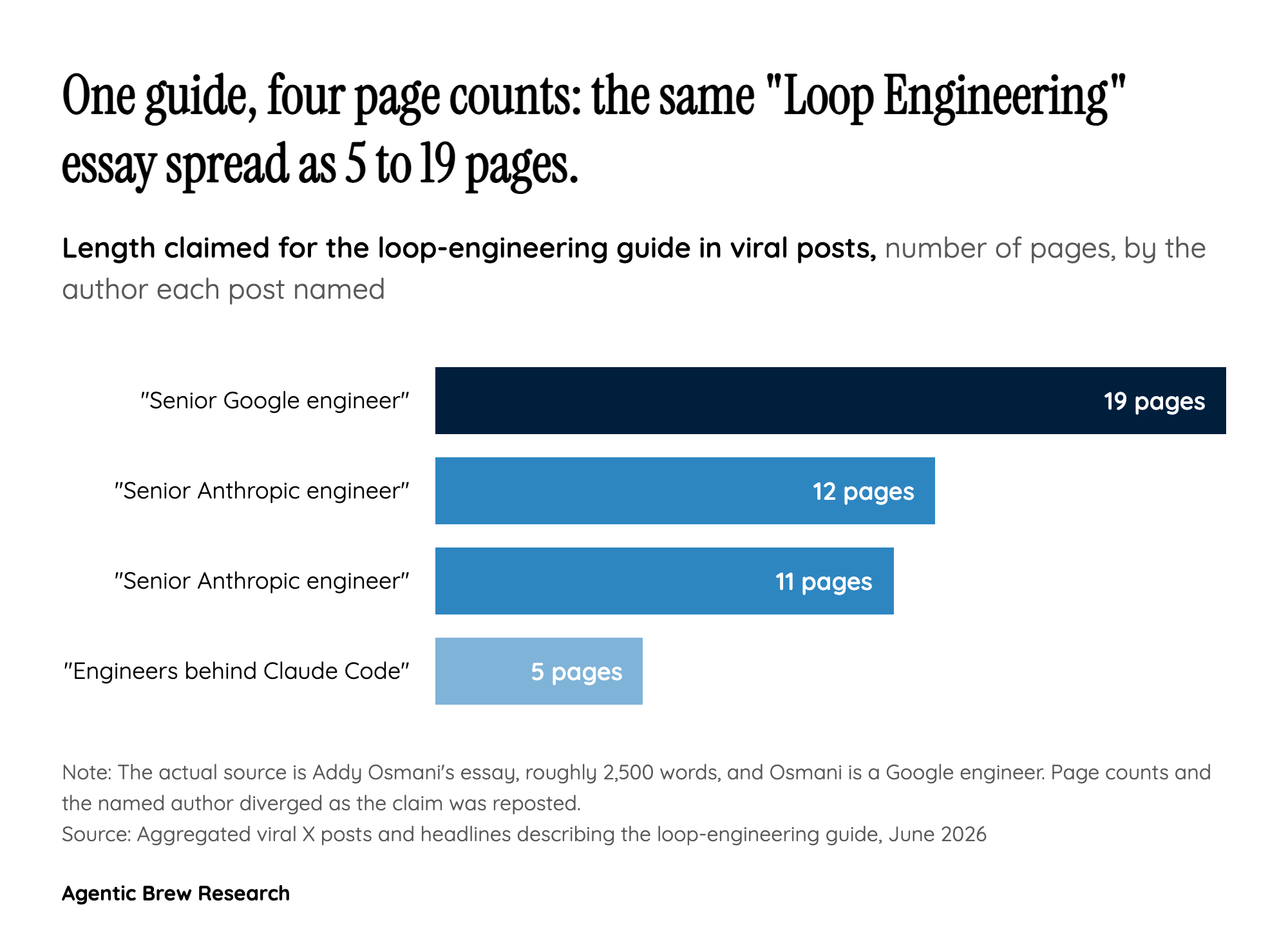
The same loop-engineering guide circulated as 5, 11, 12, and 19 pages, attributed variously to Anthropic or Google engineers. The real source is Addy Osmani at Google, about 2,500 words.

Here is the irony at the center of the story. Loop Engineering is a method built on the premise that you cannot trust unverified output - yet the thing that made it famous was a wave of near-identical viral posts that never verified their own claims. The same guide was passed around as a '5-page PDF' from 'the engineers behind Claude Code,' an '11-page' or '12-page PDF' from 'a senior Anthropic engineer,' and a '19-page PDF' from 'a senior Google engineer.' The actual essay is Osmani's, roughly 2,500 words, and Osmani is at Google [1][3]. Page counts and employers mutated with every repost because nobody checked the source.

The loop shape got scrambled in transit too, circulating both as act-observe-learn-repeat and as Discover-Handoff-Verify-Persist-Schedule. The discourse mirrored the divergence: evangelical threads on X borrowed authority from named figures like Karpathy and Cherny, dev YouTube reframed loops as 'the new prompting method' and the 2026 default workflow, and Reddit split sharply. It is a clean demonstration of exactly the failure mode the method warns about - generation without an independent check produces confident, plausible, wrong output, whether the generator is a language model or a crowd of reposters.

Follow the tokens: the cui bono critique

The sharpest pushback is not technical, it is financial. Unattended loops run continuously, and continuous runs consume tokens - which is great business for the companies selling them. The Register reports that Boris Cherny, who created Claude Code at Anthropic, spends upwards of 130,000 dollars a month in tokens [2]. Critic Ed Zitron needled the obvious conflict with a single line: 'Does OpenAI bill itself for its token spend?' [2].

Reddit's skeptic camp put it less politely, on r/Anthropic, noting that 'people who sell tokens recommend using as many tokens as possible,' and dismissing brute-force iteration as 'try random stuff until it succeeds,' a step backward from deliberate engineering. The Register's editorial bottom line is the same caution dressed as a warning: 'Automate at your peril. If you set an inherently non-deterministic AI model on a task and expect flawless operation, you deserve to clean up the inevitable mess' [2]. Even proponents concede the human stays on the hook - Osmani's own line is that 'the loop changes the work, it does not delete you from it' [1].

Is any of this new? The ReAct and Reflexion lineage

The structural answer is no. The agent loop dates to ReAct in 2022, which paired Reason with Act so the agent observed each result before its next step [4]. Reflexion followed in 2023, bolting memory and self-critique onto ReAct so a failed attempt left a verbal lesson in episodic memory for the next iteration [4]. Scheduling agent runs on a cron is older still. The Register sharpens the rebrand charge by noting that Karpathy implemented AI loops months before the viral posts that supposedly introduced the idea [2].

What is genuinely new is not the loop but the tooling that finally made unattended runs practical: slash-command loops, cron scheduling, hooks, worktrees, codified skills, MCP connectors, and sub-agents reached maturity together [1]. That is the honest version of the claim - Loop Engineering is less a discovery than a name for a workflow that the 2026 generation of agent tooling made accessible to people who are not building it from scratch. Whether that warrants a new term or just better documentation of ReAct-with-infrastructure is the argument the field is currently having.

Historical Context

2022
Established the base agent loop: Reason plus Act, observing the result before deciding the next step. This is the structural ancestor of every later coding-agent loop.
2023
Added memory and self-critique on top of ReAct: after a failed attempt the agent writes a verbal lesson to episodic memory so the next iteration is informed by the last.
2026-06-07
Published the essay 'Loop Engineering' naming the practice - roughly 2,500 words organized around five building blocks.
2026-06-22
Republished Osmani's essay, lending the term institutional reach beyond his personal blog.
2026-06-24
Published critical coverage, noting Karpathy had implemented loops months earlier and questioning whether the buzzword rebrands cron and existing agent loops.

Power Map

Key Players
Subject

Loop Engineering for agentic AI

AD

Addy Osmani

Google engineer (Director-level, Google Cloud AI) who named and structured Loop Engineering and authored the originating guide laying out its five building blocks.

PE

Peter Steinberger

Engineer and creator of OpenClaw, reported now at OpenAI, who compressed the concept into the viral 'stop prompting, design loops' sentence on June 8, 2026.

BO

Boris Cherny

Head and creator of Claude Code at Anthropic, an influential proponent whose 'my job is to write loops' framing is widely quoted; reported to spend upwards of 130,000 dollars per month in tokens.

AN

Andrej Karpathy

AI researcher who, per The Register, implemented AI loops months before the viral posts, a point critics use to undercut the novelty claims around the term.

ED

Ed Zitron

Tech critic who questioned the financial incentives behind the loop push, needling vendors over who pays for the token spend.

Fact Check

6 cited
  1. [1] Loop Engineering
  2. [2] Loop engineering, latest AI buzzword, still needs humans in the loop
  3. [3] Loop Engineering
  4. [4] Agentic Loops Explained: From ReAct to Loop Engineering
  5. [5] What Is Loop Engineering for AI Coding Agents
  6. [6] Google Engineer: Loop Engineering's Five Building Blocks Let AI Automatically Find and Fix Work

Source Articles

Top 5

THE SIGNAL.

Analysts

"Here's your monthly reminder that you shouldn't be prompting coding agents anymore. You should be designing loops that prompt your agents."

Peter Steinberger
Engineer, creator of OpenClaw, reported at OpenAI

"I don't prompt Claude anymore. I have loops running that prompt Claude and figuring out what to do. My job is to write loops."

Boris Cherny
Head of Claude Code, Anthropic

"The loop changes the work, it does not delete you from it."

Addy Osmani
Google engineer, Director, Google Cloud AI

"Automate at your peril. If you set an inherently non-deterministic AI model on a task and expect flawless operation, you deserve to clean up the inevitable mess."

The Register
Editorial

"Does OpenAI bill itself for its token spend?"

Ed Zitron
Tech critic
The Crowd

"Loops explained: Claude, GPT, Mira and what actually works. AI has been in everyone's hands for years. Most people who use it every day still use it the slowest way there is: type a request, wait, fix it, ask again, all by hand."

@@AnatoliKopadze4629

"A senior Anthropic engineer just dropped 11-page PDF on "Loop Engineering" for agentic systems. The shift: you stop prompting the agent. You build the system that prompts it instead. Schedule -> Discover -> Build -> Verify -> Repeat Every loop runs one turn, five moves:"

@@0xCodez4389

"Andrej Karpathy: "Remove yourself as the bottleneck. Maximize your leverage. Put in very few tokens, and a huge amount of stuff happens on your behalf." loop engineering is the exact thing that gets you there."

@@akshay_pachaar2201

"/loop Is a Skill. Here's the Architecture Behind a Loop"

@u/Best_Volume_312676
Broadcast
The New AI prompting Method Everyone Is Talking About: Loops (And How To Use Them)

The New AI prompting Method Everyone Is Talking About: Loops (And How To Use Them)

Forget Everything You Know About Writing Code in 2026 (Loop Engineering)

Forget Everything You Know About Writing Code in 2026 (Loop Engineering)

WTF Is an "AI Agent Loop"? Genius or Hype?

WTF Is an "AI Agent Loop"? Genius or Hype?