Meta Alberta AI data center
TECH

Meta Alberta AI data center

36+
Signals

Strategic Overview

  • 01.
    Meta is breaking ground on a 1 GW AI data center in Sturgeon County, Alberta - its first in Canada, its 33rd globally, and its largest facility outside the United States.
  • 02.
    The project represents an investment of more than CAD $13 billion (about $9.17 billion USD), with the 1 GW facility built to scale up to 1.8 GW.
  • 03.
    The campus will be powered by a dedicated 932 MW natural gas plant - the Greenlight Electricity Centre - built behind the meter by Pembina Pipeline, Morgan Stanley Infrastructure Partners, and Kineticor, at a cost of roughly $4.6 billion.
  • 04.
    Meta says the facility uses a closed-loop, liquid-cooled system with dry cooling that eliminates operational water use, and that it will fund new generation to match 100% of the site's annual electricity with clean energy.

Deep Analysis

The Real Deal Is the Power Plant, Not the Data Center

The headline is a $13-billion Meta campus, but the load-bearing part of this deal is a separate 932 MW natural gas plant - the Greenlight Electricity Centre - built and owned not by Meta but by a partnership of Pembina Pipeline, Morgan Stanley Infrastructure Partners and Kineticor [1]. Meta buys the power under contract rather than operating the station itself, a structure that lets it secure gigawatt-scale, dedicated generation without carrying a power utility on its books. The tell is in the timing: the partnership locked in a final investment decision on the plant on July 2, roughly six days before Meta's public groundbreaking on July 8 [1]. The power path was settled before the data center was even announced.

That sequencing is the whole story of how the AI buildout has changed. As one industry analyst put it, "the hyperscaler race is moving from site acquisition to power-path control" [2]. Meta coordinated with AESO and Alberta utilities years in advance, and reporting notes that power conversations for gigawatt-scale projects now start three to five years out, versus a 6-to-12-month window not long ago [2]. Alberta's pitch - internally branded 'bring your own power' - is explicitly designed to attract this pattern, and the province says 60 data centre proponents are already in discussions. Meta is the proof point, and the gas plant, not the servers, is the scarce asset everyone is racing to lock up.

Who Actually Pays: The Gas Lock-In and the Consumer Bill

Who Actually Pays: The Gas Lock-In and the Consumer Bill
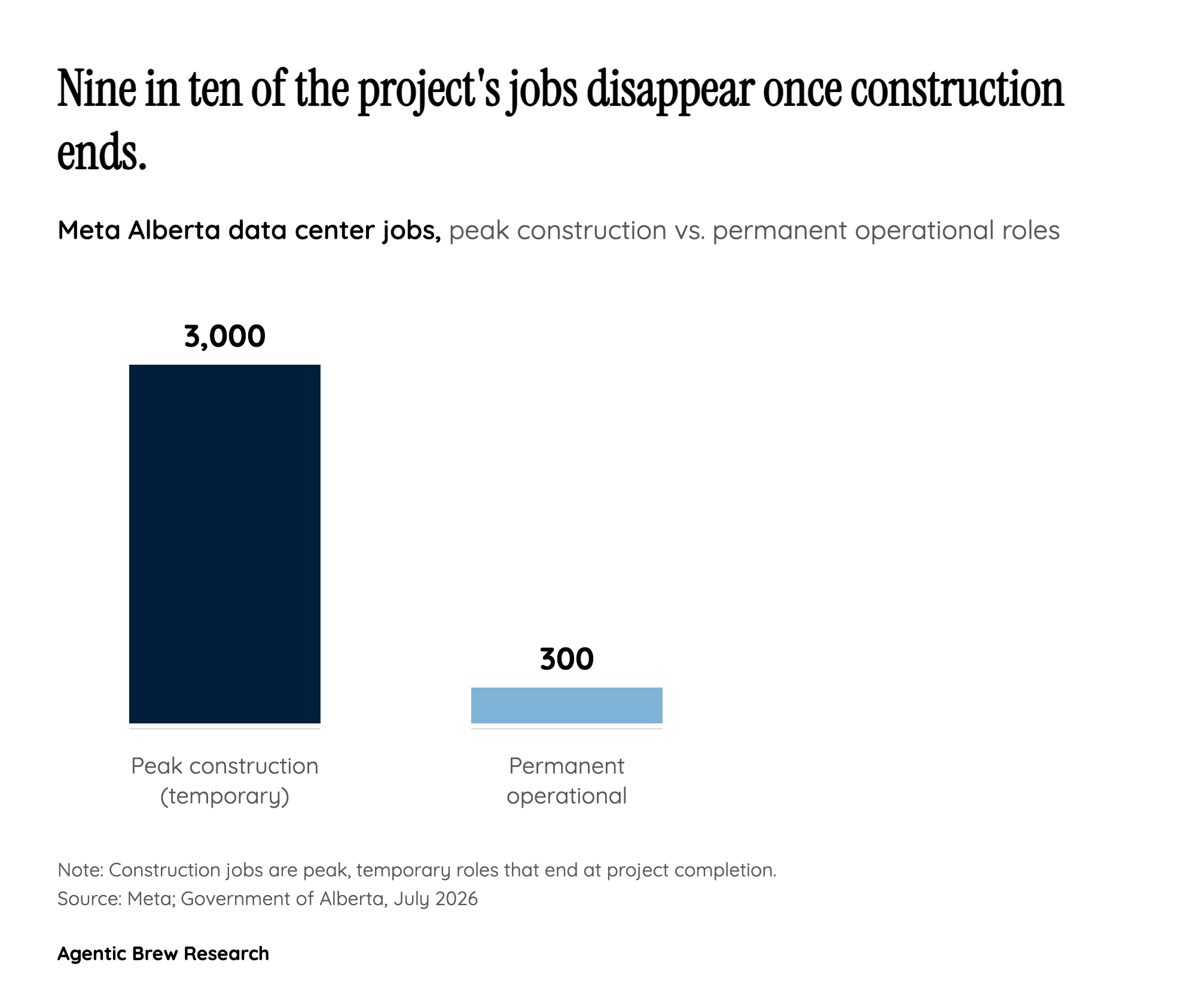
Meta projects roughly 3,000 peak construction jobs but only about 300 permanent operational roles once the data center is running.

Meta says it will fund new generation and grid infrastructure to match 100% of the site's annual electricity with clean energy and to improve reliability across the Alberta grid [3]. The skeptics' objection is about what gets built now versus later. The Pembina Institute argues Alberta's framework favours natural gas over cheaper low-carbon alternatives and could push power prices up for ordinary consumers; its electricity director framed the arrangement bluntly: Alberta and Meta "have alternatively agreed to lock in gas today and build renewables later" [4]. Developers in Minnesota and Texas are pairing new AI load with wind and solar hybrids, while Alberta is anchoring a decade-scale facility to a gas plant that targets an in-service date in the second half of 2030 [4].

That is where the economics get contested. The province projects roughly $250M in annual benefits from royalties, taxes and fees, and Meta is putting about CAD $60M into local roads and water [5]. But the community argument - loudest on Reddit's Alberta and Canada forums - is that those figures understate the externalized costs: grid strain, emissions, road wear, water, and eventual reclamation, set against only about 300 permanent jobs after roughly 3,000 construction jobs disappear [5]. The dominant grassroots reaction was that the province is giving away long-term value for a resource-heavy project, with several threads demanding Meta cover the full external cost rather than socializing it onto ratepayers.

The Water Claim That Nobody Quite Believes

Meta's most repeated reassurance is environmental: a closed-loop, liquid-cooled system with dry cooling that it says eliminates operational water use, limiting water to domestic use, fire protection and equipment maintenance [2]. The company frames annual water use as less than a typical Alberta golf course or a 50-acre canola farm [6]. On paper this directly addresses the fear that data centers drain scarce water in a drought-prone region.

The claim has not landed cleanly. Mainstream Canadian news coverage on YouTube and television repeatedly returned to the Pembina Institute as a recurring skeptic, questioning both the 100%-renewable-match promise and the gas strategy's effect on bills. On Reddit, the water reassurance ran into open distrust, with worldnews commenters flagging water use in a drought-prone region as a reason for doubt rather than comfort. Part of the credibility gap is comparative memory: communities elsewhere have pushed back hard, with Hamilton imposing a data-centre moratorium and Manitoba rejecting a large proposal. In that context, a corporate water figure - however favourable - reads to hostile audiences as marketing, and the burden of proof has shifted onto Meta to demonstrate the closed loop performs as advertised over a multi-decade operating life.

The Stranded-Asset Bet Hiding Inside an AI Boom

Underneath the boosterism is a wager that AI demand justifies a purpose-built, decade-scale gas plant. TD Economics notes Alberta's available grid capacity for new data centers is limited - the first phase of the AESO large-load integration program offers just 1.2 GW - and that gas turbine shortages plus higher capital costs could slow new generation [2]. That scarcity is exactly why the dedicated-plant model exists, but it also concentrates risk: a 932 MW asset with an in-service target in the second half of 2030 is being committed against demand nobody can fully underwrite.

That is the fear animating the harshest community reaction. Reddit's Alberta forum surfaced explicit stranded-asset framing - what happens to a dedicated gas plant and its reclamation liability if the large-language-model buildout cools before the plant even switches on. The skepticism has moved beyond commentary into organizing, with a federal House of Commons petition (e-7550) calling to cease AI data-centre incentives, and Greenpeace Canada demanding a moratorium until legislated environmental and human-rights protections exist [5]. The bull case is that Meta's contract de-risks the plant for its builders; the bear case, voiced loudest by the people who live next to it, is that Alberta has tied a long-lived fossil asset and a consumer-facing power market to a single hyperscaler's capex cycle.

Historical Context

2026-07-02
Pembina, MSIP and Kineticor announced a positive final investment decision on the 932 MW gas plant about six days before Meta went public.
2026-07-08
Meta publicly announced and broke ground on its first Canadian data center in Sturgeon County, Alberta.

Power Map

Key Players
Subject

Meta Alberta AI data center

ME

Meta

Owner and developer of the data center. It is buying power under contract rather than owning the plant, funding grid infrastructure and about CAD $60M in local roads and water - a structure that lets it lock in gigawatt-scale power without operating a power station.

PE

Pembina Pipeline Corporation

Calgary-based partner building the Greenlight gas plant. It frames dedicated gas-to-power as a new growth platform that drives fresh demand for Western Canadian natural gas.

MO

Morgan Stanley Infrastructure Partners and Kineticor

Co-partners in the Greenlight Electricity Centre Limited Partnership financing and building the behind-the-meter 932 MW gas plant that anchors the whole deal.

GO

Government of Alberta (Technology Minister Nate Glubish)

Provincial backer citing a deliberate regulatory approach and about $250M in projected annual benefits. It reports 60 data centre proponents in discussions, making Meta a proof point for its 'bring your own power' strategy.

ST

Sturgeon County (Mayor Alanna Hnatiw)

Host municipality welcoming the project on environmental-standards and land-stewardship grounds, and the local level absorbing construction, road, and water impacts.

AE

AESO, AltaLink and Capital Power

Grid operator and utilities Meta coordinated with years in advance to plan energy needs; they gate how much large-load capacity Alberta's grid can actually offer.

Fact Check

6 cited
  1. [1] Pembina Congratulates Meta and the Government of Alberta on New Data Centre Investment
  2. [2] Meta's First Canadian AI Campus Was Planned Around the Grid
  3. [3] Breaking Ground on Meta's First Data Center in Canada
  4. [4] Meta's $13-billion Alberta data centre
  5. [5] Meta to build $13B data centre in Alberta, its first in Canada
  6. [6] Meta AI data centre in Sturgeon County, Alberta

Source Articles

Top 5

THE SIGNAL.

Analysts

"Calls for a moratorium on mega-data centres until there are legislated environmental and human-rights protections on AI. He argues: "We're seeing these kinds of promises made all by AI data centre proponents around the world, but the reality is that these are billionaires trying to steal our water and pollute the air so they can double our electricity while taking away our jobs.""

Keith Stewart
Senior energy strategist, Greenpeace Canada

"Warns Alberta's policy favours natural gas over cheaper low-carbon alternatives and could raise power prices for consumers: "Alberta and Meta have alternatively agreed to lock in gas today and build renewables later.""

David Pickup
Director, electricity program, Pembina Institute

"Reads the deal as evidence that hyperscaler competition has moved from land to electricity: "The hyperscaler race is moving from site acquisition to power-path control.""

Neil Osnato
Data center industry analyst

"Frames the arrangement as a strategic opening for the gas industry: "Dedicated, contracted gas-to-power infrastructure represents a promising new growth platform, and we are proud of the role Greenlight is playing in supporting this exciting new industry.""

Scott Burrows
President and CEO, Pembina Pipeline

"Notes Alberta's grid headroom is limited - the first phase of the AESO large-load integration program offers 1.2 gigawatts for data centers - and that gas turbine shortages plus higher capital costs could slow new generation."

TD Economics
Bank research unit
The Crowd

"One of the largest private sector investments in Canadian history is coming home to Alberta. @Meta has chosen Alberta for its first Canadian AI data centre, a historic $13 billion investment that will create thousands of jobs, strengthen our economy, and help position our https://t.co/f8iDO7M7tE"

@@ABDanielleSmith3047

"Meta's first Canadian data center needs its own dedicated gas power plant to run. Meta is investing more than C$13 billion in a 1 gigawatt data center in Sturgeon County, Alberta Pembina Pipeline, Morgan Stanley Infrastructure Partners and Kineticor are building a dedicated https://t.co/db1DhGEiUu"

@@jackprandelli36

"Meta to build $13 billion Alberta data centre, its first in Canada https://t.co/8hrCQ5XiHv"

@@CTVNews417

"Meta unveils massive $13B, gigawatt-scale development in Alberta, Canada's largest data centre"

@u/joe4942893
Broadcast
Meta to build $13 billion data centre in Alberta | CTV National News for July 8, 2026

Meta to build $13 billion data centre in Alberta | CTV National News for July 8, 2026

Meta to build $13B data centre near Edmonton | Hanomansing Tonight

Meta to build $13B data centre near Edmonton | Hanomansing Tonight

Meta to invest billions in Alberta AI data centre

Meta to invest billions in Alberta AI data centre