The rival-as-supplier paradox: a TPU maker renting Nvidia silicon from a rocket company
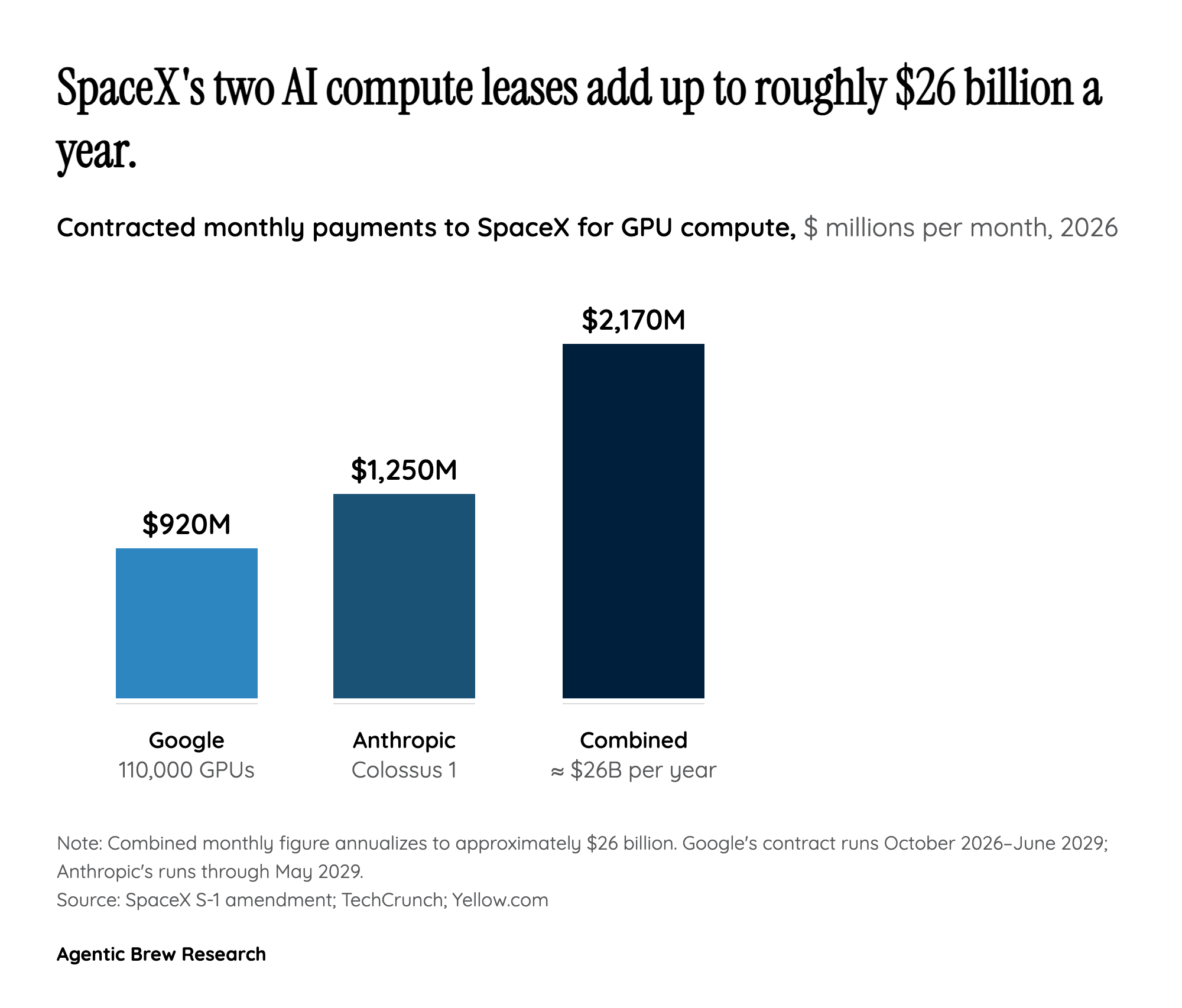
The strangest thing about this deal is who is on each side of it. Google designs and runs its own tensor processing units precisely so it does not have to rent compute from anyone, yet here it is paying $920 million a month for roughly 110,000 NVIDIA GPUs housed in data centers that belong to a rocket company [1]. Those GPUs are not new SpaceX hardware — they are the Colossus assets SpaceX inherited when it merged with xAI in February 2026, the same clusters Elon Musk built to train Grok, a direct competitor to Google's Gemini [6]. Google, an AI rival to xAI, now depends on Musk's infrastructure for the compute that powers its flagship enterprise product.
What makes the arrangement workable is that SpaceX is selling capacity, not capability. It functions as a GPU landlord: Google keeps its models, its data, and its software stack, and simply rents the racks [2]. That framing is also what lets Google publicly call this 'bridge capacity' rather than a strategic dependency — a stopgap to absorb demand for its Gemini Enterprise agent platform that, by Google's own account, ran higher than the company expected [1]. The deal is a reminder that in a compute-starved market, even the most vertically integrated AI player will rent from a competitor when its own buildout cannot keep pace.