Google–SpaceX $30B GPU Compute Deal
TECH

Google–SpaceX $30B GPU Compute Deal

33+
Signals

Strategic Overview

  • 01.
    Google signed a contract to pay SpaceX $920 million per month from October 2026 through June 2029 for access to roughly 110,000 NVIDIA GPUs plus associated CPUs, memory, and other components, a deal totaling about $30 billion.
  • 02.
    The arrangement was disclosed in an amended SpaceX S-1 filing on June 5, 2026, roughly one week before SpaceX's planned IPO, and Google framed it as short-term bridge capacity for surging Gemini Enterprise demand that ran higher than expected.
  • 03.
    The GPUs sit in xAI Colossus data centers that SpaceX absorbed through its February 2026 merger with xAI; SpaceX provides compute capacity only, functioning effectively as a GPU landlord while Google keeps its models and data.
  • 04.
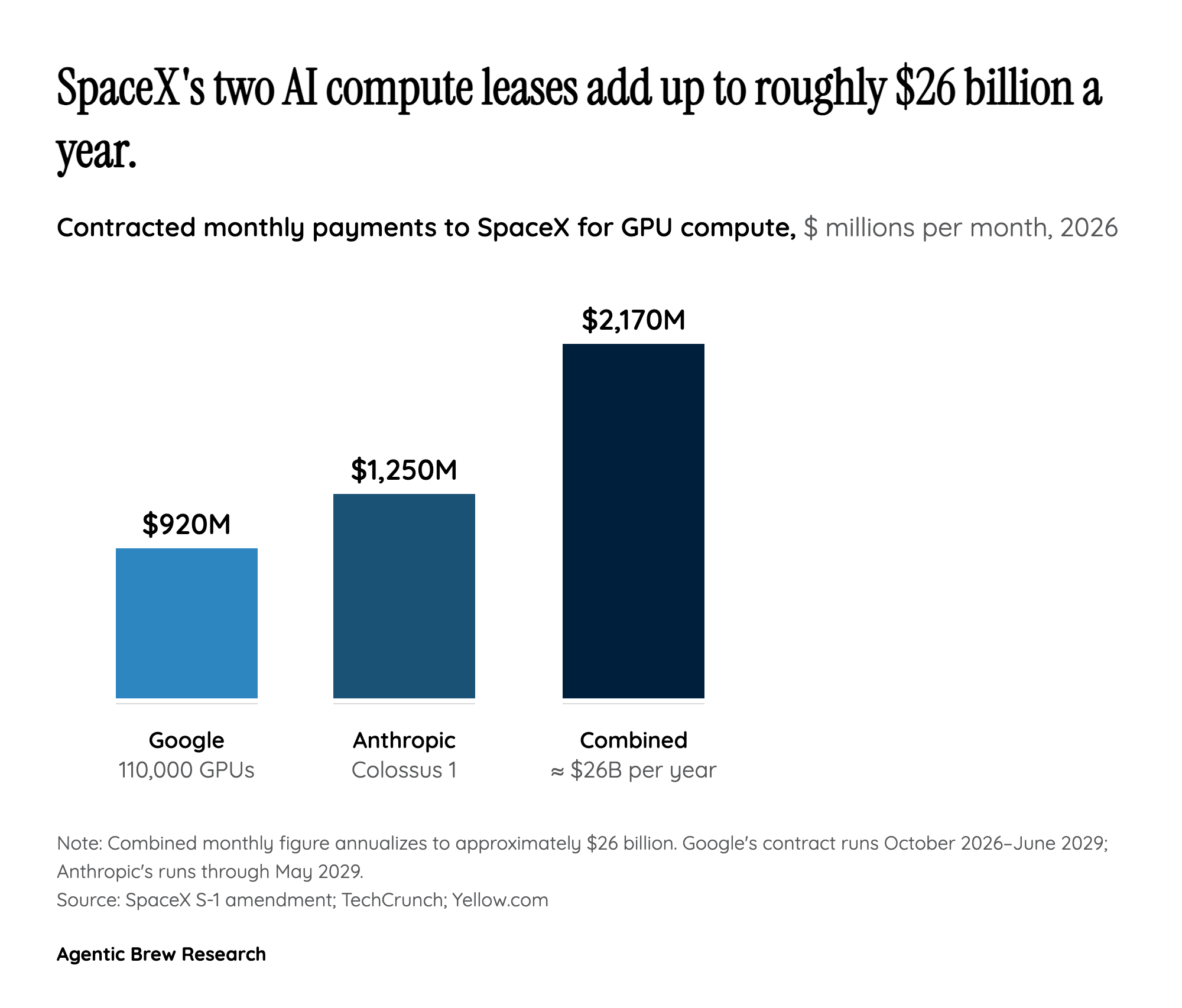
    SpaceX separately rents compute to Anthropic for $1.25 billion per month through May 2029, giving it about $26 billion in annualized contracted AI compute revenue across the two customers.

Deep Analysis

The rival-as-supplier paradox: a TPU maker renting Nvidia silicon from a rocket company

The strangest thing about this deal is who is on each side of it. Google designs and runs its own tensor processing units precisely so it does not have to rent compute from anyone, yet here it is paying $920 million a month for roughly 110,000 NVIDIA GPUs housed in data centers that belong to a rocket company [1]. Those GPUs are not new SpaceX hardware — they are the Colossus assets SpaceX inherited when it merged with xAI in February 2026, the same clusters Elon Musk built to train Grok, a direct competitor to Google's Gemini [6]. Google, an AI rival to xAI, now depends on Musk's infrastructure for the compute that powers its flagship enterprise product.

What makes the arrangement workable is that SpaceX is selling capacity, not capability. It functions as a GPU landlord: Google keeps its models, its data, and its software stack, and simply rents the racks [2]. That framing is also what lets Google publicly call this 'bridge capacity' rather than a strategic dependency — a stopgap to absorb demand for its Gemini Enterprise agent platform that, by Google's own account, ran higher than the company expected [1]. The deal is a reminder that in a compute-starved market, even the most vertically integrated AI player will rent from a competitor when its own buildout cannot keep pace.

Follow the money: a $30B contract disclosed days before the IPO it props up

The timing is the part that drew the most cynicism. The contract was revealed not in a press release but in an amended S-1 registration statement filed on June 5, 2026 — roughly a week before SpaceX's planned IPO [1]. Across Reddit's investing communities the dominant read was blunt: this looks like a pre-IPO revenue story engineered to dress up SpaceX's loss-making AI segment right before the company goes public, with skeptics zeroing in on Google's own equity stake in SpaceX and the conveniently generous termination clause. On X, the reaction was closer to disbelief — that Google, of all companies, would be the marquee customer.

The circularity is real. Google is not just a customer; it is a major SpaceX shareholder whose stake is expected to exceed $100 billion after the offering [2]. So Google is helping underwrite the very revenue line that supports the valuation of an asset it owns a slice of. As one CNBC correspondent put it on X, Google and Anthropic now pay rent on the hardware Grok could not use, and that rent is the AI revenue story SpaceX takes public. Implicator.ai's analysis captures the analytic version of the same point: naming Google and Anthropic as customers transforms SpaceX's AI segment from a cost center into a revenue story [2]. Whether that story is durable or a well-timed pump is exactly what the skeptics are debating.

Compute as an asset class: SpaceX quietly becomes an AI cloud

Step back from the optics and there is a genuine structural shift underneath. SpaceX is not a hyperscaler, but with two named anchor tenants it is now running an AI compute leasing business at hyperscaler-adjacent scale. Add Google's $920 million a month to Anthropic's separate $1.25 billion a month — the latter buying exclusive use of Colossus 1's 220,000-plus NVIDIA GPUs on 300 MW in Memphis — and SpaceX has roughly $26 billion in annualized contracted AI compute revenue [1][3][4]. Tom's Hardware notes that SpaceX's projected annual data center revenue is on track to exceed its combined proceeds from Starlink, launch services, and AI [5].

Dell'Oro Group analyst Sameh Boujelbene reads this as evidence that compute is becoming its own strategic asset class rather than mere excess capacity, with specialized infrastructure providers now competing for AI labs as customers [2]. Yellow.com pushes the point further: capacity has become more strategically valuable than the models themselves, which is why even a rival lab will lease rather than wait [3]. The merger that created this business was the largest ever, valuing the combined SpaceX-xAI at roughly $1.25 trillion [6]— and the Google and Anthropic contracts are the first external proof that the infrastructure bet can be monetized beyond Musk's own labs.

The numbers, and why analysts call it surge pricing

The numbers, and why analysts call it surge pricing
SpaceX collects about $2.17 billion a month combined from its Google and Anthropic GPU leases, roughly $26 billion annualized.

The pricing is aggressive enough that even bullish observers flagged it. One widely-shared analyst estimate pegged the SpaceX/Anthropic-scale deals at roughly $33 million per megawatt per year — about three times typical market rate — and characterized it explicitly as short-term 'surge pricing' rather than a normal long-term lease. The same instinct showed up in Reddit's cost-math threads, where users worked out that Google's $920 million a month across 110,000 GPUs implies something on the order of $8,000-plus per GPU per month, debated as either outrageous or merely expensive once full data-center overhead is included.

The surge-pricing read fits the underlying economics. SpaceX's AI segment is deeply unprofitable: it lost $2.5 billion on $818 million of revenue in Q1 2026, and the company absorbed a $4.94 billion loss tied to the xAI merger [2]. Against that backdrop, premium short-term contracts are exactly what you would expect a provider to extract from compute-desperate labs — and exactly what a company would want on its books heading into the largest IPO ever [2]. The capacity also ramps in during a reduced-fee window before the full $920 million rate kicks in on October 1, 2026, which is consistent with a deal priced for urgency rather than for the long haul [4].

Execution risk: the September 30 deadline and the 90-day exit

Buried in the contract terms is the clause that makes the IPO-week framing precarious. SpaceX must deliver the committed GPU capacity by September 30, 2026; if it fails, Google can either walk away after a one-month grace period or accept whatever hardware is available at proportionally reduced payments [1][2]. Separately, after December 31, 2026, either party can terminate the agreement on just 90 days' notice [1]. So the $30 billion headline is contingent on delivery and is cancelable within months of the IPO.

Implicator.ai frames this as the deal's central vulnerability: missing the September 30 GPU deadline triggers Google's exit options, a significant exposure for a company selling this contract as a revenue anchor [2]. The same termination flexibility is what fuels the skeptics' 'pump' thesis — a contract you can exit on 90 days' notice supports a valuation today without committing either side for the full 33 months. For SpaceX, the bet is that Gemini Enterprise demand stays hot and the Colossus hardware comes online on schedule. If either assumption slips, the headline number that helped take the company public could shrink fast.

Historical Context

2026-02-02
SpaceX acquired xAI in an all-stock transaction valuing the combined company at roughly $1.25 trillion, the largest merger ever, absorbing xAI's Colossus data center assets.
2026-05-06
Anthropic agreed to use all compute capacity at SpaceX's Colossus 1 data center in Memphis (220,000+ NVIDIA GPUs, 300 MW), paying $1.25 billion per month through May 2029.
2026-05
SpaceX filed for what is described as the largest IPO ever, absorbing a $4.94 billion loss tied to the xAI merger; its AI business lost $2.5 billion on $818 million revenue in Q1 2026.
2026-06-05
The Google compute deal was disclosed in an amended S-1 filing, roughly one week before SpaceX's planned IPO.

Power Map

Key Players
Subject

Google–SpaceX $30B GPU Compute Deal

GO

Google

Customer paying $920M/month for bridge GPU capacity to serve Gemini Enterprise demand; also a major SpaceX shareholder whose stake is expected to exceed $100 billion post-IPO.

SP

SpaceX

Compute provider leasing GPU capacity inherited from xAI; recasting itself as an AI infrastructure provider ahead of its IPO.

XA

xAI

Acquired by SpaceX in February 2026; its Colossus data center infrastructure now underpins SpaceX's compute leasing business.

AN

Anthropic

Separate SpaceX compute customer paying $1.25 billion per month through May 2029 with exclusive access to Colossus 1 in Memphis, Tennessee.

NV

NVIDIA

Supplier of the ~110,000 GPUs in the Google deal and the 220,000+ GPUs at Colossus 1 underpinning these contracts.

Fact Check

6 cited
  1. [1] Google will pay SpaceX $920M per month for compute
  2. [2] Google signs $30 billion SpaceX compute deal ahead of IPO
  3. [3] AI rivals: Google's $30B SpaceX deal
  4. [4] SpaceX-Google AI compute deal
  5. [5] Google signs $920M monthly compute deal with SpaceX
  6. [6] Musk's xAI-SpaceX biggest merger ever

Source Articles

Top 5

THE SIGNAL.

Analysts

"The SpaceX arrangement signals that compute is becoming its own strategic asset class rather than mere excess capacity, marking a market shift toward specialized infrastructure providers competing for AI labs as customers."

Sameh Boujelbene
Analyst, Dell'Oro Group

"By naming Google and Anthropic as customers, SpaceX converts its AI segment from a cost center into a revenue story, but Google's 90-day termination right and the September 30 delivery deadline create real IPO-week execution risk."

Implicator.ai
Industry analysis publication

"The deal is a striking inversion of competitive dynamics — Google, an AI rival to xAI's Grok, must rely on Elon Musk's infrastructure, reflecting that compute capacity has become more strategically valuable than the AI models themselves."

Yellow.com
Industry/market news publication
The Crowd

"Wait. Google is paying SpaceX $920 million per month for GPUs? Google. The company that builds its own TPUs. That runs one of the largest cloud infrastructures on earth. Is renting 110,000 Nvidia GPUs from a rocket company. I'm honestly not sure what to make of this. Either"

@@aaditsh7776

"“.. So now Google and Anthropic pay rent on the hardware Grok couldn't use, and that rent is the AI revenue story SpaceX takes public on Thursday.”"

@@carlquintanilla315

"We now know the SpaceX / Anthropic deal was for 325k GPUs! Have to make some assumptions on the mix shift of type of GPUs, but this probably translates to ~450mw This translates to ~$33m / MW / Year. About 3x "market rate" but this feels like a short term "surge pricing" deal"

@@jaminball262

"Google Buying Computing From SpaceX in $920-Million-a-Month Deal"

@u/King-of-Limbs-073500
Broadcast
UNBELIEVABLE: Google & SpaceX MASTER PLAN

UNBELIEVABLE: Google & SpaceX MASTER PLAN

Google to pay SpaceX $920 million a month for compute capacity at xAI data centers

SpaceX Inks $30 Billion Computing Power Deal With Google

SpaceX Inks $30 Billion Computing Power Deal With Google