Opus 4.6 running locally on consumer hardware
TECH

Opus 4.6 running locally on consumer hardware

31+
Signals

Strategic Overview

  • 01.
    Alibaba released Qwen3.8-27B, a 27.78-billion-parameter open-weight model under Apache 2.0 license, positioned as running entirely on a personal laptop with no internet connection required and landing in the same performance neighborhood as Claude Opus 4.6.
  • 02.
    Qwen3.8-27B has a native 262,144-token context window (expandable to 1M via YaRN), accepts text, image and video input, and was released August 14, 2026 by Alibaba's Tongyi Lab.
  • 03.
    SGLang reported over 200 tokens per second on a single RTX 5090 for Qwen3.8-27B using NVFP4 quantization plus speculative decoding, at roughly 16.5GB of weights - the specific 'RTX 5090 at ~200 tok/s' figure central to this story.
  • 04.
    Independent community benchmarks on RTX 5090 with generic GGUF quantizations (not the optimized SGLang/NVFP4 path) landed much lower, around 73-119 tokens/second depending on quant level and context length.
  • 05.
    Andrew Zhu ran DeepSeek V4 Flash 0731 (284B total / 13B active parameters, 104GB of GGUF weights) locally on a 5x RTX 3090 rig, describing it as reaching 'Opus-level intelligence, zero token cost' at 20-30 tokens/second decode speed.
  • 06.
    Simon Willison tested Alibaba's Qwen3.6-35B-A3B (20.9GB Q4 quant) running locally via LM Studio on a MacBook Pro M5, and judged it beat Claude Opus 4.7 on a 'pelican riding a bicycle' SVG generation benchmark.
  • 07.
    On five overlapping benchmarks compiled by explainx.ai, Qwen3.8-27B beat Claude Opus 4.6 Max on only one (SWE-bench Pro, 61.7 vs 53.4) and trailed on four others including GPQA Diamond (89.2 vs 91.3) and Humanity's Last Exam (30.8 vs 40.0).
  • 08.
    A larger companion model, Qwen3.8-Max (2.4T total parameters, ~95B active), was announced August 3, 2026 with open weights promised 'next week'; it matched Claude Opus 4.7 on the Vals Index (66.1 vs 66.1) at roughly 2.3x lower cost per test, but Claude Opus 4.8 beat it on SWE-bench (89.2% vs 87.3%).

It's not Opus running locally - it's a 27B challenger benchmarked against it

The tweets and posts driving this story describe 'running Opus 4.6 locally,' but that isn't literally what's happening. What shipped on August 14, 2026 is Qwen3.8-27B, a 27.78-billion-parameter open-weight model from Alibaba's Tongyi Lab, released under Apache 2.0 and small enough to run entirely on a laptop with no internet connection [1]. It's being positioned as landing in the same performance neighborhood as Claude Opus 4.6 - not as Opus itself running on consumer hardware [2]. The benchmark record backs a mixed picture, not a clean win: on five overlapping tests compiled by explainx.ai, Qwen3.8-27B beat Opus 4.6 Max on only one, SWE-bench Pro (61.7 vs 53.4), while trailing on GPQA Diamond (89.2 vs 91.3) and Humanity's Last Exam (30.8 vs 40.0) [3]. A 27B model edging a closed frontier model on one coding benchmark is genuinely notable - it is not the same claim as Opus 4.6 running on a laptop.
The viral '200 tokens/second on an RTX 5090' number is a tuned best case

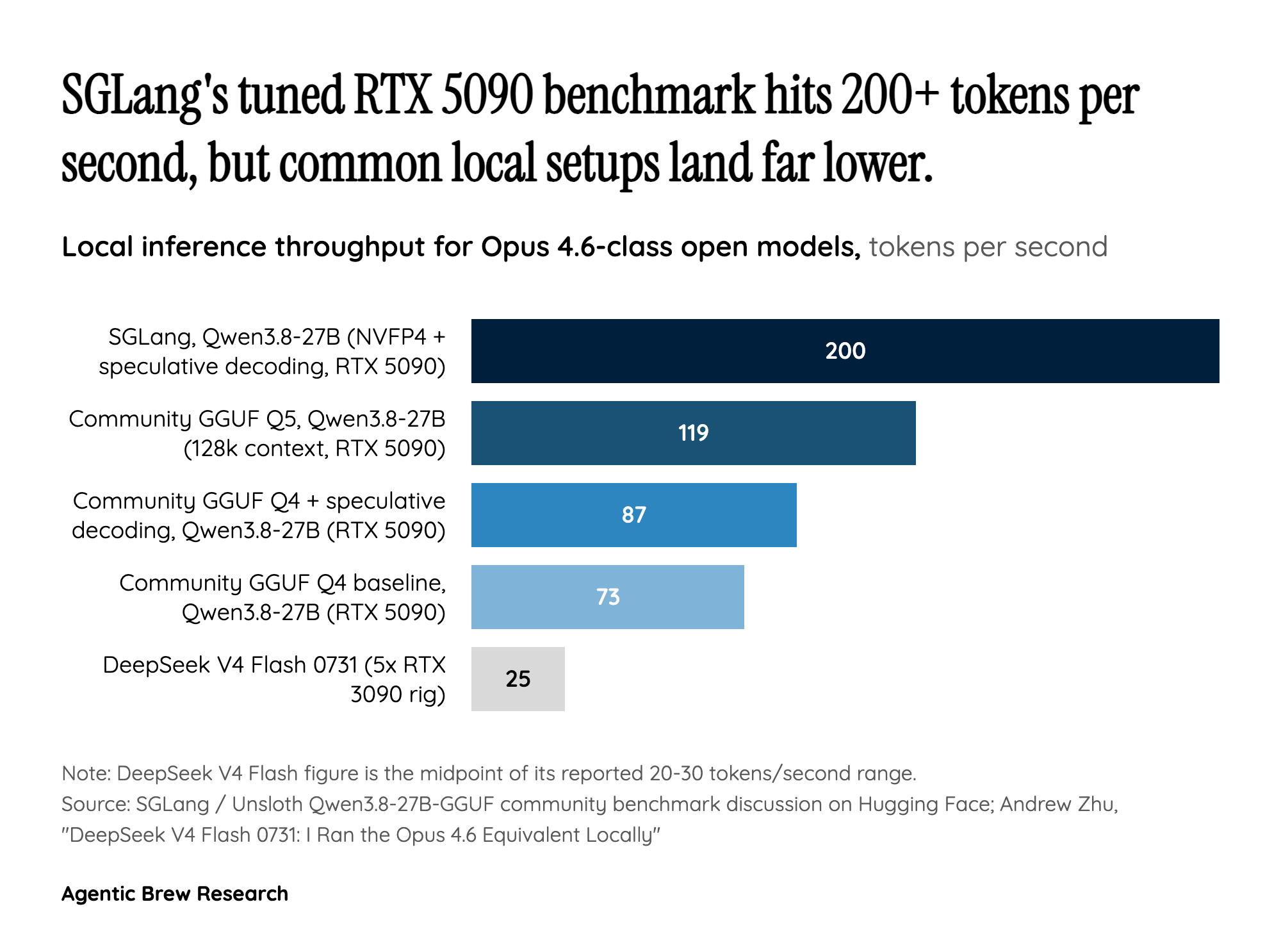
The viral '200 tokens/second on an RTX 5090' number is a tuned best case
SGLang's optimized RTX 5090 benchmark (200+ tok/s) vs. common community GGUF quantizations (73-119 tok/s) and DeepSeek V4 Flash on a 5x RTX 3090 rig (20-30 tok/s).

The specific speed figure anchoring this story - 200+ tokens per second on a single RTX 5090 - comes from SGLang's launch-day benchmark, achieved with NVFP4 quantization plus speculative decoding on roughly 16.5GB of weights [4]. That is not what most people running the model at home will see. Community benchmarks using generic GGUF quantizations on the same RTX 5090 measured well below that: around 73 tokens/second at baseline Q4 quantization, rising to about 87 tok/s with speculative decoding, and reaching about 119 tok/s at a lower quant level (Q5) [4]. The gap shows up in a related local-Opus claim too: when a hobbyist ran DeepSeek V4 Flash 0731 - a 284-billion-parameter model claimed to reach 'Opus-level intelligence' - locally on a stacked 5x RTX 3090 rig, decode speed landed at just 20-30 tokens per second [5]. Local frontier-adjacent inference is real, but the headline throughput numbers assume an optimized setup most users won't replicate.

In direct coding tests, cloud Opus still wins on speed

Community testing that pitted locally-run Qwen models against cloud-hosted Claude Opus 4.6 on actual coding tasks - rather than static benchmark tables - found Opus still faster in head-to-head runs, finishing tasks in roughly half the time or less even against a dual-RTX-3090 local setup, with the local model's throughput sitting in the 22-50 tokens/second range. Reviewers running these comparisons still called the local model's output quality competitive, but the speed advantage implied by the loudest social posts has not shown up in side-by-side coding runs.

This is the second 'local model beats Opus' moment in six months - and the fine print keeps recurring

Claude Opus 4.6 launched on February 5, 2026, and has already been superseded twice, by Opus 4.7 and Opus 4.8 [6]. Local-model-beats-Opus claims have become a recurring genre rather than a one-off event. In April 2026, developer Simon Willison tested Alibaba's Qwen3.6-35B-A3B running locally on a MacBook Pro M5 via LM Studio and judged it beat Claude Opus 4.7 on a specific creative benchmark - generating an SVG of a pelican riding a bicycle [7]. In August, Alibaba followed with a much larger companion model, Qwen3.8-Max (2.4 trillion total parameters), announced with claims of matching Opus 4.7 on the Vals Index at roughly 2.3x lower cost per test - but loading its weights alone requires more than 1TB of memory and at least 8 H100 or B300 GPUs, the opposite of consumer-hardware accessible [8]. Each release narrows the on-paper gap to frontier closed models; each also arrives with caveats that get lost in the viral framing.

Even the comparison method is contested

Beyond the hardware caveats, analysts flagged that the benchmark comparisons themselves rest on shaky ground: Qwen's self-reported scores and the cited Opus numbers come from different agent harnesses, temperature settings, and prompting setups, making apples-to-apples claims hard to verify - and raising suspicion that some models are tuned specifically to top leaderboards rather than to improve general capability [3]. That skepticism showed up loudly in community reaction to the release too: on Reddit, top commenters argued the model performs closer to Anthropic's mid-tier Sonnet than Opus in practice, and that comparing a 27B open model to a closed model reported to be multiple trillion parameters is misleading no matter what a shared benchmark score suggests.

Historical Context

2026-02-05
Claude Opus 4.6 launched, establishing the frontier benchmark that local/open-weight models are now measured against.
2026-04-16
Qwen3.6-35B-A3B released and tested locally on a MacBook Pro, with Willison judging it beat Claude Opus 4.7 on a pelican-drawing benchmark - an early instance of the 'local model beats Opus' narrative.
2026-08-03
Qwen3.8-Max (2.4T parameters) announced with open weights promised for the following week, alongside benchmark claims of matching Claude Opus 4.7 at much lower cost.
2026-08-14
Qwen3.8-27B released under Apache 2.0, explicitly marketed as running on a personal laptop and comparable to Claude Opus 4.6 - the specific event driving this news cluster.

Power Map

Key Players
Subject

Opus 4.6 running locally on consumer hardware

AL

Alibaba / Tongyi Lab

Released Qwen3.8-27B and Qwen3.8-Max as open-weight (Apache 2.0) models explicitly framed as narrowing the gap to closed frontier models like Claude Opus 4.6, enabling free local/offline deployment on consumer hardware.

AN

Anthropic

Maker of Claude Opus 4.6 (released February 5, 2026, since followed by Opus 4.7 and 4.8), the closed frontier model used as the benchmark yardstick for every local-model claim in this story.

DE

DeepSeek

Released DeepSeek V4 Flash 0731, a re-post-trained 284B/13B-active model claimed to reach Claude Opus 4.6-level on agentic benchmarks, run locally by a hobbyist on a 5x RTX 3090 rig.

SG

SGLang project

Published the launch-day optimized serving benchmark showing 200+ tokens/second for Qwen3.8-27B on a single RTX 5090 via NVFP4 quantization and speculative decoding - the source of the specific speed claim driving this story.

SI

Simon Willison (independent developer/blogger)

Prominent AI commentator who publicly tested Qwen3.6-35B locally on a MacBook Pro M5 and judged it superior to Opus 4.7 on a specific creative benchmark, amplifying the 'local model beats Opus' narrative months before this release.

UN

Unsloth / Hugging Face community

Published quantized GGUF versions of Qwen3.8-27B and crowdsourced real-world tokens-per-second benchmarks across consumer GPUs including RTX 5090, exposing the gap between the headline speed claim and typical local performance.

Fact Check

8 cited
  1. [1] Qwen3.8-27B: Specs, Benchmarks, and Local Hardware Requirements
  2. [2] Alibaba's Local Qwen3.8-27B Model Is Comparable to the Frontier Claude 4.6 From Just 6 Months Ago
  3. [3] Qwen3.8-27B Open-Weight Model vs Claude Opus Comparison
  4. [4] Qwen3.8-27B-GGUF Community Benchmark Discussion
  5. [5] DeepSeek V4 Flash 0731: I Ran the Opus 4.6 Equivalent Locally
  6. [6] Qwen3.8-27B Local Inference
  7. [7] Qwen Beats Opus
  8. [8] AI News: Qwen3.8-Max (2.4T) and 27B

Source Articles

Top 5

THE SIGNAL.

Analysts

Expressed astonishment that a 27B open-weight model running locally on a laptop matches the model that was the best and most expensive just six months earlier.

Paul Couvert
AI commentator, X/Twitter (@itsPaulAi)

Argued that the era of needing a data center to approximate Opus 4.6-class capability is ending.

teiferer
Hacker News commenter

Contended open-source/open-weight local models now trail frontier closed models by less than a year.

doug_durham
Hacker News commenter

Pushed back on the 'runs anywhere' framing for the larger Qwen3.8-Max model, noting true local deployment of the flagship-scale model still requires data-center-grade hardware, unlike the smaller 27B variant.

Jamin Ball
Analyst, cited in Latent Space AI News digest

Documented firsthand that a re-trained open model could deliver Opus-level intelligence entirely offline on consumer-grade (if stacked) GPU hardware, at the cost of much slower token throughput than cloud APIs.

Andrew Zhu
Independent AI practitioner, Medium blogger
The Crowd

So yeah, you can now run Opus 4.6 max locally. Just let that sink in. https://t.co/4qFnfrFAF2

@@kimmonismus7052

I can't believe it Qwen3.8-27B is matching Opus 4.6 Max... the model that was the best (and the most expensive) just 6 months ago. And you can run it on your laptop. Locally. Fully open weights and under apache license. This level of intelligence in such a small model is sooo

@@itsPaulAi4383

201 days later, Opus 4.6 Max quality fits on a single RTX 5090 and not even an RTX PRO 6000 https://t.co/gjAkZOzZla

@@TheAhmadOsman3323

Local uncensored Opus 4.6 at home - Qwen3.8 27B heretic

@u/Temporary_Idea8880858
Broadcast
Qwopus3.6 27B MTP vs Claude Opus 4.6 | Local vs Cloud Head-to-Head

Qwopus3.6 27B MTP vs Claude Opus 4.6 | Local vs Cloud Head-to-Head

I Bought an RTX 5090 to Run AI Locally — Here's Why

I Bought an RTX 5090 to Run AI Locally — Here's Why

Qwen3.6 27B vs Claude Opus 4.6 | Local Head-to-Head

Qwen3.6 27B vs Claude Opus 4.6 | Local Head-to-Head