HPE AI Factory expansion with NVIDIA Vera CPU for agentic AI
TECH

HPE AI Factory expansion with NVIDIA Vera CPU for agentic AI

24+
Signals

Strategic Overview

  • 01.
    At HPE Discover Las Vegas 2026, HPE and NVIDIA expanded the HPE AI Factory to support secure, governed, production-grade agentic AI, adding the NVIDIA Vera CPU, the NVIDIA Agent Toolkit, and NVIDIA Confidential Computing across HPE Private Cloud AI.
  • 02.
    The NVIDIA Vera CPU is positioned as a new processor category purpose-built for AI agents, handling the rapid tool calls, orchestration, and real-time data processing of the agent loop with deterministic, low-latency performance for thousands of autonomous agents.
  • 03.
    Vera is delivered in the HPE ProLiant Compute DL394 Gen12 server as a compute-optimized foundation for agentic AI, with the NVIDIA Vera CPU reaching general availability in Fall 2026 and the DL394 Gen12 server arriving with HPE Private Cloud AI in 2027.
  • 04.
    The expansion adds governance and resilience features, including the NVIDIA Agent Toolkit as an agentic AI operating system, extended HPE Zerto continuous data protection to detect and rewind rogue agent actions, and NVIDIA-Certified HPE Alletra storage to accelerate inference.

Deep Analysis

Why Build a CPU for Agents at All

The premise behind NVIDIA's Vera is that the agent loop is fundamentally CPU-bound, not GPU-bound. While a large language model's token generation runs on GPUs, the surrounding work that makes an agent useful — issuing tool calls, orchestrating multi-step plans, executing code, and processing real-time data — is sequential, branchy logic that lands squarely on the CPU [2]. As enterprises move from single-shot prompts to fleets of autonomous agents, that orchestration overhead compounds, and a conventional x86 host becomes the latency bottleneck rather than the accelerator.

Vera is pitched as the answer: a processor category purpose-built to handle the rapid tool calls, complex orchestration, and real-time data processing required to support thousands of autonomous agents with deterministic, low-latency performance [3]. In HPE's portfolio it ships inside the ProLiant Compute DL394 Gen12 as a compute-optimized foundation for agentic AI [1]. The architectural bet is that the next bottleneck in AI infrastructure is not raw matrix-multiply throughput but the speed and predictability of the control plane that coordinates agents around the model.
The Governance Wrapper Is the Real Enterprise Differentiator

Silicon alone does not move a regulated enterprise into production; the harder problem is trusting an autonomous agent with real systems. HPE's expansion leans into this with a stack of controls layered on top of the Vera hardware. The NVIDIA Agent Toolkit — bundling Nemotron open models, NemoClaw blueprints, and the OpenShell secure runtime — is framed as an agentic AI operating system for monitoring agent behavior and enforcing governance policies [1]. Local agent registration lets organizations approve which AI models, tools, and skills are allowed to run through centralized governance [1].

The most concrete safety mechanism is operational resilience against agents that go off-script. HPE extended Zerto's continuous data protection so it can monitor and detect rogue or unauthorized agent actions and rewind the environment to a clean, known-good state when necessary [4]. Alongside that, NVIDIA Confidential Computing is now available across HPE AI Factory at Scale, HPE Sovereign AI Factory, and HPE Private Cloud AI, with the ProLiant Compute DL380a certified for the program [1]. For buyers, this is the actual pitch: not just faster agents, but an audit trail, an approval gate, and an undo button — the prerequisites for letting agents touch production data.

The Skeptic's Read: 2027 Hardware, x86 Incumbency, and Captive Bundling

The announcement is heavy on positioning and lighter on near-term availability. The Vera CPU itself reaches general availability in Fall 2026, but the flagship ProLiant DL394 Gen12 server that carries it does not ship with HPE Private Cloud AI until 2027 [3]. That gap means production deployment of the centerpiece hardware lags the headline by roughly a year, leaving early adopters like the NYSE in an exploratory phase rather than live operation.

Hardware-enthusiast forums have been interested but pointedly skeptical, and notably the discussion centers on the Vera silicon itself rather than HPE's AI Factory branding. Commenters debated whether NVIDIA can actually pry enterprises off entrenched x86 infrastructure on the strength of vendor-favorable benchmarks, and raised the concern that bundling Vera into Grace Blackwell and Vera Rubin superchips leaves customers little real CPU choice. A separate contentious thread questioned NVIDIA's framing of CPU revenue, with the company issuing corrections to clarify that the figures reflect a combined superchip total rather than standalone Vera sales. The technical reception was warmer — observers noted Vera is a monolithic design that sidesteps the NUMA latency of chiplet approaches — but the open question is commercial, not architectural: whether a captive, GPU-coupled CPU can displace a decades-old x86 install base.

By the Numbers

By the Numbers
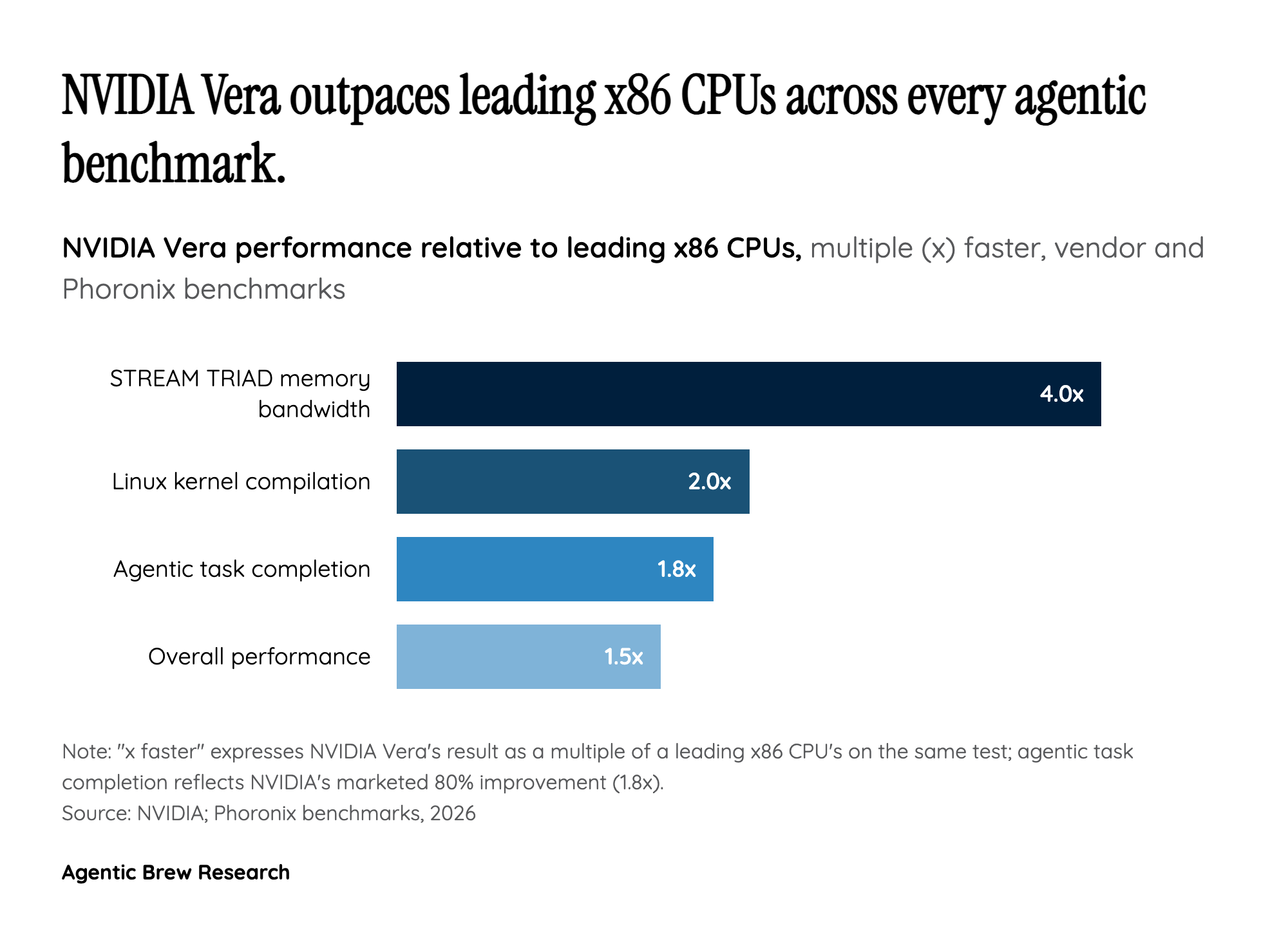
NVIDIA Vera performance as a multiple of leading x86 CPUs across vendor and Phoronix benchmarks.

NVIDIA's performance claims for Vera anchor the agentic pitch. The company markets the chip as delivering 80% faster agentic task completion compared with x86 CPUs — equivalently framed as roughly 1.8x faster task completion [2]. Under the hood, Vera packs 88 custom Olympus cores, 1.2TB/s of LPDDR5X memory bandwidth, and 1.8TB/s of coherent CPU-GPU bandwidth over NVLink-C2C [2]. Vendor-cited benchmarks also point to around 1.5x overall performance versus leading x86 parts.

The surrounding HPE stack contributes its own figures aimed at inference efficiency. The NVIDIA-Certified HPE Alletra Storage MP X10000 is credited with up to a 20x reduction in token response times and as much as a 20% improvement in token throughput, with multi-node inference scaling to up to 256 GPUs [5]. For sheer density, the upcoming HPE Compute XD700 supports up to 128 Rubin GPUs per rack using the NVIDIA HGX Rubin NVL8 architecture [3]. Read together, the numbers describe a system tuned for two things at once: faster agent orchestration on the CPU and cheaper, lower-latency inference around it.

Historical Context

2026-05-31
HPE introduced its CPU server, the ProLiant Compute DL394 Gen12 with NVIDIA Vera CPU, purpose-built for agentic AI, via press release.
2026-06-16
At HPE Discover Las Vegas 2026, HPE expanded the AI Factory with the NVIDIA Agent Toolkit, Confidential Computing, Zerto governance, and Alletra storage certification for production agentic AI.

Power Map

Key Players
Subject

HPE AI Factory expansion with NVIDIA Vera CPU for agentic AI

HP

HPE (Hewlett Packard Enterprise)

Lead vendor integrating the NVIDIA Vera CPU, Agent Toolkit, Confidential Computing, Zerto, and Alletra storage into its AI Factory and Private Cloud AI portfolio to bring agentic AI to enterprise production.

NV

NVIDIA

Co-engineering partner supplying the Vera CPU, Agent Toolkit (Nemotron models, NemoClaw blueprints, OpenShell runtime), Confidential Computing, Blackwell and Rubin GPUs, and networking that power the expansion.

NE

New York Stock Exchange (NYSE)

Early enterprise customer exploring the Vera CPU with the HPE ProLiant Compute DL394 Gen12, in collaboration with Redpanda and HPE, to scale capacity and optimize latency for AI-ready market infrastructure.

RE

Redpanda

Streaming-data collaborator working with NYSE and HPE on early Vera CPU exploration.

Fact Check

5 cited
  1. [1] HPE AI Factory With NVIDIA Expands for the Era of Agents
  2. [2] NVIDIA Unveils Vera, the CPU for Agents
  3. [3] HPE expands Private Cloud AI Factory portfolio to support next-gen autonomous agents
  4. [4] HPE AI Factory adds features to improve your experience with agents
  5. [5] HPE Expands AI Factory Portfolio for Agentic AI Deployments

Source Articles

Top 5

THE SIGNAL.

Analysts

"Argues that autonomous AI demands a fundamentally new architecture so enterprises can run it securely, govern it responsibly, and scale it economically, and frames the expansion as a full-stack effort to move customers from experimentation to production."

Antonio Neri
President and CEO, HPE

"Contends that every layer of the computing stack is being reinvented for the age of AI agents, and positions Vera as the first CPU designed for that future, built for agentic AI at hyperscale."

Jensen Huang
Founder and CEO, NVIDIA
The Crowd

"The first CPU built for AI agents, from NVIDIA. In collaboration with @redpandadata and @HPE, using NVIDIA Vera CPUs, NYSE plans to scale our capacity while further optimizing latency to power a high-performance, resilient and AI-ready market infrastructure. Read more from"

@@NYSE17

"The age of AI needs a new kind of CPU. Introducing NVIDIA Vera. The CPU for agents, delivering 80% faster agentic task completion compared with x86 CPUs. Vera is built to power the CPU-intensive work behind modern AI factories, from agentic AI and reinforcement learning to data"

@@nvidianewsroom1386

"We built the NVIDIA Vera CPU for agentic AI, and the latest benchmarks from @Phoronix confirm it delivers. 1.5x overall performance vs. leading x86 processors 2x faster Linux kernel compilation 4x greater STREAM TRIAD memory bandwidth Vera achieves the performance that AI"

@@nvidia935

"First full system we've seen running NVIDIA's Vera CPU: HPE ProLiant DL394 Gen12 (cracked open at Discover)"

@u/StorageReview14
Broadcast
NVIDIA Vera—The CPU for Agents

NVIDIA Vera—The CPU for Agents

From Prompt to Production: Scaling Enterprise Agentic AI with NVIDIA and HPE

From Prompt to Production: Scaling Enterprise Agentic AI with NVIDIA and HPE

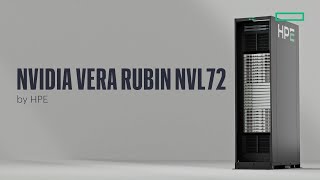
Pioneering the next era of gigascale AI with NVIDIA Vera Rubin NVL72 by HPE

Pioneering the next era of gigascale AI with NVIDIA Vera Rubin NVL72 by HPE