Samsung's record profit fails to impress on AI-chip jitters
TECH

Samsung's record profit fails to impress on AI-chip jitters

24+
Signals

Strategic Overview

  • 01.
    Samsung Electronics guided to roughly 89.4 trillion won (about $58.4 billion) in second-quarter operating profit, a 19-fold jump from a year earlier and its largest quarterly operating profit ever.
  • 02.
    Despite beating the consensus estimate by about 6%, Samsung shares fell as much as 10.1% and closed down about 6.9%, erasing more than $100 billion in market value.
  • 03.
    South Korea's KOSPI dropped 4.9% and triggered a circuit-breaker halt as SK Hynix and other chip stocks sold off alongside Samsung, and Nasdaq futures also slid.
  • 04.
    The profit surge was driven by soaring memory prices, with DRAM average selling prices up 44% and NAND up 53% quarter-on-quarter, according to Citi Research figures cited in earnings coverage.

Deep Analysis

A Record That Read as a Warning
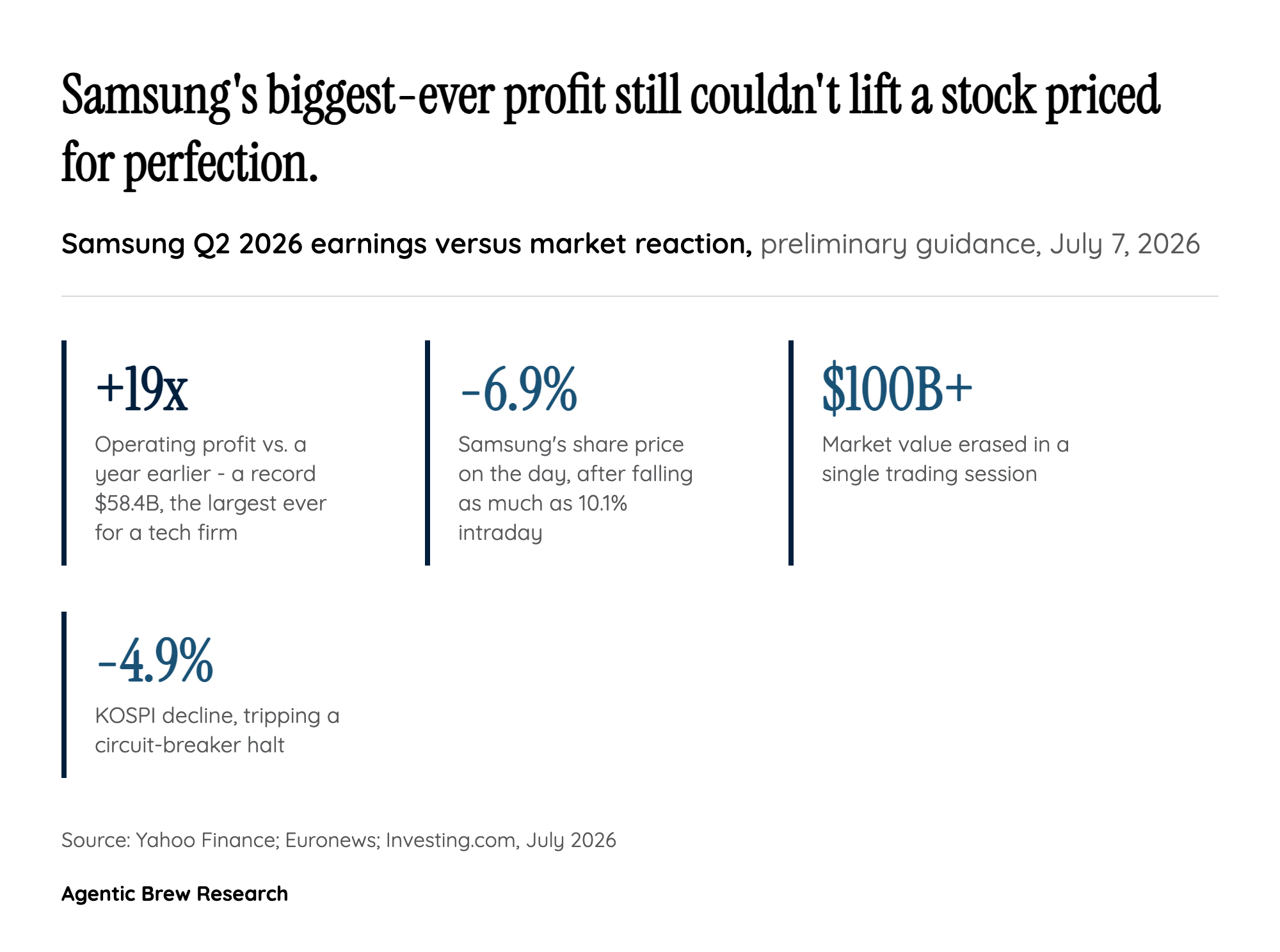
A Record That Read as a Warning
Samsung's record 19-fold profit surge was met with a share-price drop, over $100 billion in lost market value, and a KOSPI circuit-breaker.

Samsung guided to roughly 89.4 trillion won, about $58.4 billion, in second-quarter operating profit - a 19-fold jump from a year earlier and the largest quarterly operating profit the company has ever reported, beating the consensus LSEG SmartEstimate of 87.3 trillion won by about 6% [1]. On paper it was a blowout. In the market it read as a warning: Samsung shares fell as much as 10.1% and closed down about 6.9%, erasing more than $100 billion in market value in a single session [2].

The disconnect has a simple mechanic behind it. Samsung stock had already climbed roughly 150% over the year, pricing in exactly this kind of AI-memory windfall [1]. When a stock is priced for perfection, even a record only matches expectations, and a 6% beat is not the sort of upside surprise that pulls in new buyers. Albert Yong of Petra Capital Management said the earnings were widely expected and had largely been priced in after the pre-earnings rally [1]. What looked like disappointment was really textbook profit-taking on a trade that had already run.


The Bill Lands on Your Next SSD

Strip away the market drama and the source of the profit is unusually concrete: memory prices are exploding because AI has created a genuine scarcity. Average selling prices for DRAM rose 44% and for NAND flash 53% quarter-on-quarter, according to Citi Research figures cited in the earnings coverage [3]. Rapid expansion of high-bandwidth memory - the stacked, high-speed memory that AI accelerators depend on - has absorbed manufacturing capacity, tightening supply of the ordinary memory that goes into phones, laptops and servers.

That is why the reaction outside trading desks has been closer to anger than applause. On Reddit, the loudest threads were not about the earnings beat but about the consumer bill behind it, with builders complaining that an SSD now costs several times what it did a year ago and framing the record profit as AI-era price gouging rather than a triumph. The community mood skewed heavily toward bubble and gold-rush metaphors, and a recurring worry that margins this fat cannot survive the moment supply catches up. It is a useful counterweight to the Wall Street framing: the same scarcity that produced a historic profit is a rising cost for anyone buying computer hardware.

The Smart Money Starts Rotating Out

The most consequential reaction came from the sell side. Morgan Stanley told clients that the narrow, semiconductor-centered rally is ending and that it prefers to reduce chip exposure in favor of hyperscalers, arguing chip earnings momentum has passed its peak [4]. That call matters because it reframes the selloff from a one-day wobble into a possible turn: if the biggest memory names have already delivered their best numbers, the trade that carried them up all year loses its engine.

The timing amplified everything. South Korea's KOSPI fell 4.9% and tripped a circuit-breaker halt, reported as the market's sixth this year, as SK Hynix and other chip names sold off alongside Samsung [5]. The jitters crossed the Pacific too, with Nasdaq futures sliding after the record profit failed to reassure investors about the durability of AI capital spending [6]. Analysts also flagged a structural quirk: 2026 estimates are front-loaded into the first half, so any easing of the memory shortage or new discipline in hyperscaler spending could tip the second half into a correction [4].

Bubble or Supercycle - What the Bears May Be Missing

There is a serious case on the other side, and it is not just retail optimism. Samsung and SK Hynix have warned that AI-driven memory shortages could persist through 2027 and beyond, with customers already reserving HBM supply years in advance [7]. Together with Micron, the two Korean giants control well over 90% of the global DRAM market, a triopoly now valued in the trillions - a level of pricing power that looks less like a bubble and more like a structural repricing of memory as a scarce input to AI [7].

The real disagreement, then, is about duration, not direction. Bulls see a multi-year supercycle in which memory makers finally capture durable margins; skeptics like Morgan Stanley see a peak already in the rear-view mirror [4]. Both can point to the same July print. What breaks the tie is not this quarter's profit but next year's supply - whether new fab capacity and any softening in hyperscaler capex arrive fast enough to puncture prices, or whether the shortage, as the memory makers insist, has years left to run. Samsung's detailed divisional results, due July 30, will be the next real test of which story is winning [3].

Historical Context

2026-01-07
Samsung posted a record profit after AI supercharged the memory market, kicking off the AI-memory supercycle narrative that drove the 2026 rally.
2026-04-27
First-quarter 2026 memory margins soared as AI demand lifted pricing, with SK Hynix reaching about 72% operating margin and Samsung nearing 70%.
2026-05-01
Samsung's semiconductor division posted 53.7 trillion won in first-quarter operating profit, about 94% of total company profit, on record AI memory sales.
2026-07-06
Samsung released preliminary second-quarter guidance flagging the 19-fold profit jump, and shares fell over 6% despite the beat.

Power Map

Key Players
Subject

Samsung's record profit fails to impress on AI-chip jitters

SA

Samsung Electronics

The world's largest memory chipmaker and the source of the record print. Its roughly 150% share run-up over the year had already priced in the AI boom, leaving even a blowout quarter little power to lift the stock.

SK

SK Hynix

Samsung's chief memory rival, whose shares fell about 6% in sympathy. Together with Samsung and Micron it controls well over 90% of the global DRAM market, so its trajectory shapes the whole AI-memory trade.

MI

Micron Technology

The US member of the memory triopoly. With Samsung and SK Hynix it forms the group controlling over 90% of DRAM supply, and all three are now valued above $1 trillion on continued AI capex.

US

US hyperscalers

The big-tech buyers of AI memory and HBM whose capital spending sustains the boom. Morgan Stanley flagged their capex discipline as the key swing factor for whether the memory rally continues.

MO

Morgan Stanley

The sell-side voice that told clients to reduce memory-chip exposure and rotate into hyperscalers, arguing chip earnings momentum has passed its peak - a call that amplified the selloff.

Fact Check

7 cited
  1. [1] Samsung estimates 19-fold rise in Q2 operating profit
  2. [2] Samsung loses over $100bn in market value despite record AI-driven profit
  3. [3] Samsung estimates 19-fold rise in Q2 operating profit, beating expectations
  4. [4] Morgan Stanley warns sell chips as Samsung stock tumbles
  5. [5] S.Korea's KOSPI triggers circuit breaker despite Samsung earnings windfall
  6. [6] Nasdaq futures fall after Samsung's record profit fails to allay chip jitters
  7. [7] Samsung and SK Hynix warn AI-driven memory shortages could last until 2027 and beyond as HBM demand explodes

Source Articles

Top 3

THE SIGNAL.

Analysts

"Samsung's strong earnings were widely expected and had largely been priced in after its shares rallied ahead of the results, leaving investors worried about the sustainability of the AI boom."

Albert Yong
Petra Capital Management

"The slight revenue miss was largely driven by more moderate DRAM price hikes than expected, which likely spooked investors who are increasingly pricing in structural strength in memory prices."

Jing Jie Yu
Analyst, Morningstar

"Confident the earnings will come through, but expects a moderation in returns going forward."

Raisah Rasid
Global Market Strategist, JPMorgan Asset Management

"The narrow, semiconductor-centered rally is ending and market leadership is broadening; in the short term the firm prefers to reduce chip exposure and favor hyperscalers, seeing chip earnings momentum past its peak."

Morgan Stanley
Morgan Stanley research
The Crowd

"Samsung Electronics flagged a 19-fold jump in second-quarter operating profit from a year earlier, but its shares slid as the results failed to ease concerns about the durability of the AI-driven chip boom https://t.co/Tmf6NhqqgW"

@@Reuters44

"Despite a massive 19-fold jump in quarterly profit that beat market expectations, Samsung shares fell as much as 10% as investors locked in profits following this year's AI-fueled rally. https://t.co/z8AohksN2i"

@@YahooFinance15

"TECH SELLOFF OVERSHADOWS SAMSUNG'S RECORD PROFIT • Global stocks slip • Samsung reported ₩89.4T in Q2 operating profit • Samsung and SK Hynix sold off anyway • Investors questioned whether the AI-chip boom can keep delivering"

@@StocksToTrade2

"Samsung's Profit In 2026 Will Exceed Its Cumulative Profit Generated Over The Past 40 Years."

@u/HeavenlyDemonEmperor11000
Broadcast
Samsung's Record Profit Fails to Impress | The Asia Trade 7/7/2026

Samsung's Record Profit Fails to Impress | The Asia Trade 7/7/2026

Samsung Posts Biggest Quarterly Profit in Company's History on AI Chip Boom | Firstpost Live | 4K

Samsung Posts Biggest Quarterly Profit in Company's History on AI Chip Boom | Firstpost Live | 4K

Samsung's Soaring Profit Fails to Impress, Yen Outlook | Bloomberg Daybreak: Asia Edition

Samsung's Soaring Profit Fails to Impress, Yen Outlook | Bloomberg Daybreak: Asia Edition