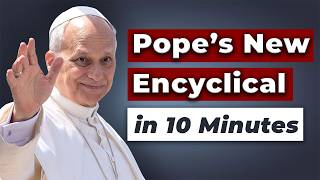
Pope Leo XIV Magnifica Humanitas AI encyclical
TECH

Pope Leo XIV Magnifica Humanitas AI encyclical

24+
Signals

Strategic Overview

  • 01.
    Pope Leo XIV released his first encyclical, Magnifica Humanitas: On Safeguarding the Human Person in the Time of Artificial Intelligence, on May 25, 2026, after signing it on May 15, 2026.
  • 02.
    The 42,300-word document carries 224 references including Tolkien, Viktor Frankl, and Hannah Arendt, and is the first papal encyclical published without an initial Latin translation.
  • 03.
    Leo XIV became the first pope to personally present an encyclical to the world, with Anthropic co-founder Christopher Olah seated among cardinals and theologians at the Vatican.
  • 04.
    The encyclical's central argument is that technology is never neutral because it absorbs the values of those who design, finance, regulate, and use it.

Deep Analysis

An Anthropic co-founder stood with cardinals — and that staging is the argument

Pope Leo XIV became the first pope to personally present an encyclical to the world, and he did it with Anthropic co-founder Christopher Olah seated among the cardinals and theologians on the Vatican dais [1]. The optics are not incidental. Olah used the platform to say something a frontier-lab founder is not supposed to say from his own podium: every frontier AI lab including Anthropic operates inside a set of incentives and constraints that can sometimes conflict with doing the right thing [2]. He went further at the press conference, asking the Church to staff a role the labs cannot staff for themselves — informed critics who will tell the labs when they are failing, moral voices that the incentives cannot bend [3].

Read together with Leo XIV's own framing — that, like the earlier Leo, he feels entrusted to look upon another huge transformation with eyes of faith [3]— the launch is staging an institutional handshake: a 2,000-year-old moral authority and a young AI lab agreeing in public that neither markets nor governments are currently equipped to hold AI accountable. That is the news before any paragraph of the 42,300-word text [4].
Alignment reframed as monopolistic control

The encyclical's most contrarian move is rhetorical: it refuses to treat centralized AI safety as obviously virtuous. AsiaNews captures the pivot — Leo XIV calls for freeing technology from monopolistic control and opening it to discussion and debate, making it human-friendly and restoring it to the plurality of human cultures and ways of life [5]. The Vatican text names the structural cause directly: the main drivers of development are private, often transnational, parties that are endowed with resources and the capacity to intervene that surpass those of many Governments [6].

The diagnosis is theological as much as political — AsiaNews summarizes the framing as a choice between centralized power that homogenizes and excludes, in the metaphor of the Tower of Babel, and a shared rebuild where families, communities, and institutions each own a section of the wall, in the metaphor of Nehemiah's Jerusalem [5]. The encyclical itself frames the contrast as a choice not between AI and no-AI but between technology shaped by the few and technology shaped by the plural human cultures it is meant to serve, which is what makes the document legible to engineers: Leo XIV is not opposing alignment work, he is opposing the assumption that a handful of labs should be the ones doing it on behalf of everyone.

'New forms of slavery' names a specific supply chain

The line that drew the loudest reaction was Leo XIV's invocation of slavery, and he pre-empted the pushback: the word is strong, but it has been chosen deliberately because this moment demands words capable of capturing attention [7]. What makes the framing operational rather than rhetorical is that he attaches it to a specific labor map — the new forms of slavery propagated by technological developments include people condemned to data labeling, model training, and content moderation, as well as those who labor to extract rare minerals for tech devices [7]. The Pope ties this to a historical confession, asking pardon for the Church's own past role in slavery as a wound in Christian memory from which the Church cannot consider itself detached [7].

MIT Technology Review echoes the materialist edge: AI is displacing writers, coders, analysts, designers, educators, and others who work with information, while current AI systems require enormous amounts of energy and water, significantly influencing carbon dioxide emissions, and place heavy demands on natural resources [8]. The encyclical refuses the AI-is-just-another-tool frame by insisting the workers behind and around the tool are visible.

The concrete enforcement mechanism is already running: $400B in shareholder pressure

Buried under the theology is the actual lever the document gestures at. MIT Technology Review reports that coalitions including the membership of the Interfaith Center on Corporate Responsibility, representing investors managing over $400 billion in assets, have filed resolutions demanding transparency, risk assessment, and accountability around AI deployment [8]. That is not a future call to action — it is a live pressure campaign that now has a 42,300-word theological backstop.

The encyclical's procedural ask aligns with what ICCR is already demanding: decisions must be understandable, contestable, and subject to oversight, so that individuals are not reduced to mere profiles [8]. David Kirchhoffer of the Queensland Bioethics Center frames the underlying stake — there is a real danger of people giving up their moral responsibility to AI or having it taken from them [8]. MIT Technology Review's authors put the political theory plainly: when governments fail to meaningfully regulate, and corporations cannot be trusted to do what is beneficial beyond their own bottom line, people in society still have the power to set us on the right path [8]. The unspoken implication for AI governance teams: future major frontier-lab shareholder meetings are likely to see Magnifica Humanitas cited in resolution language, and 'we are aligned with Catholic social teaching' becomes a defense that cuts both ways.

Why the date matters: this is staged as Rerum Novarum 2.0

The signature date is the cleanest signal of intent. Leo XIV signed the document on May 15, 2026 — the 135th anniversary of Pope Leo XIII's Rerum Novarum, the 1891 encyclical that defined the Church's response to industrial-era labor exploitation [9]. Vatican News makes the lineage explicit, situating the new text within the tradition that runs from Rerum Novarum through Centesimus Annus and Laudato Si' [10]. The encyclical's structural choices reinforce the framing: 42,300 words and 224 references reaching as far as Tolkien, Viktor Frankl, and Hannah Arendt — the first papal encyclical published without an initial Latin translation [9]. Leo XIV underscores the continuity himself, saying that, like the earlier Leo, he feels entrusted to look upon another huge transformation with eyes of faith [3].

The press response read the ambition: the Wall Street Journal called it a text poised to define Leo's papacy [9], while the New York Times' Matthew Walther dissented that it was disappointingly measured and cautious [9]. The consistent read across audiences is that Leo XIV is trying to do for AI what his namesake did for the factory floor. Whether the historical analogy holds is the open question; the staging is unambiguous.

Historical Context

1891-05-15
Issued Rerum Novarum, the foundational Catholic social encyclical on industrial-era labor rights, which Leo XIV deliberately echoes by signing Magnifica Humanitas on its 135th anniversary.
2026-05-15
Signed Magnifica Humanitas on the 135th anniversary of Rerum Novarum, locating the new text in the Catholic social-teaching lineage running through Centesimus Annus and Laudato Si'.
2026-05-25
Personally presented the encyclical at the Vatican alongside Anthropic co-founder Christopher Olah, the first time a pope has launched an encyclical in person.

Power Map

Key Players
Subject

Pope Leo XIV Magnifica Humanitas AI encyclical

PO

Pope Leo XIV

Author of the encyclical; frames AI governance as a successor problem to the industrial-era labor question his namesake Leo XIII addressed in Rerum Novarum.

CH

Christopher Olah

Anthropic co-founder; the first frontier-AI-lab leader to present an encyclical alongside a pope, publicly conceding that lab incentives can conflict with doing the right thing.

IN

Interfaith Center on Corporate Responsibility

Investor coalition managing over $400 billion in assets, already filing shareholder resolutions demanding AI transparency, risk assessment, and accountability at major labs.

WA

Wall Street Journal

Major press outlet that characterized Magnifica Humanitas as a defining text of Pope Leo XIV's papacy, amplifying its weight inside elite policy and finance audiences.

NE

New York Times (Matthew Walther)

Critical press voice that called the encyclical disappointingly measured and cautious, framing the dissent that the document is too restrained on economic prescriptions.

Fact Check

10 cited
  1. [1] Pope Leo, Anthropic co-founder call for church-tech ethics partnership at 'Magnifica humanitas' launch
  2. [2] Chris Olah's remarks at the Vatican presentation of Magnifica Humanitas
  3. [3] Vatican unveils 'Magnifica Humanitas': Pope Leo XIV's first encyclical on AI
  4. [4] Pope Leo XIV's first encyclical 'Magnifica humanitas' published
  5. [5] 'Magnifica Humanitas': protecting humanity by 'disarming' artificial intelligence
  6. [6] Encyclical Letter Magnifica Humanitas of the Holy Father Leo XIV
  7. [7] Leo XIV calls for disarming artificial intelligence in first encyclical, links it to historical slavery
  8. [8] How the Pope's Magnifica Humanitas offers a template for individuals to meet the AI moment
  9. [9] Magnifica humanitas
  10. [10] Pope Leo XIV releases encyclical 'Magnifica Humanitas' on artificial intelligence

Source Articles

Top 5

THE SIGNAL.

Analysts

"Every frontier AI lab including Anthropic operates inside incentives and constraints that can sometimes conflict with doing the right thing, and outside moral voices are needed that the incentives cannot bend."

Christopher Olah
Co-founder, Anthropic

"AI development is concentrated in a handful of wealthy nations, there is no mechanism to ensure the gains of AI are shared globally, and it is an unsolved problem of the kind the Church has historically refused to let the world ignore."

Christopher Olah
Co-founder, Anthropic

"There is a real danger of people giving up their moral responsibility to AI or having it taken from them."

David Kirchhoffer
Director, Queensland Bioethics Center, Australian Catholic University

"When governments fail to meaningfully regulate, and corporations cannot be trusted to do what is beneficial beyond their own bottom line, people in society still have the power to set us on the right path."

MIT Technology Review (Finn and Francois)
Authors, MIT Technology Review essay on Magnifica Humanitas
The Crowd

"Anthropic co-founder Chris Olah was invited to speak at today's presentation of Pope Leo XIV's encyclical "Magnifica humanitas." Read the full text of his remarks:"

@@AnthropicAI4431

"Anthropic's Chris Olah at the Vatican press conference to present Pope Leo XIV's encyclical on AI: "There is a real possibility that AI will displace human labor at very large scale. If that happens, supporting those displaced will be a moral imperative of historic proportions.""

@@catholicourtney2561

"The questions posed by AI are bigger than the AI community. We urgently need the world – religions, civil society, academics, governments – to participate in creating a positive outcome. I'm glad the Catholic Church is engaging, and honored to speak at the presentation."

@@ch4021324

"ENCYCLICAL LETTER - MAGNIFICA HUMANITAS"

@u/domesticchurchprayer524
Broadcast
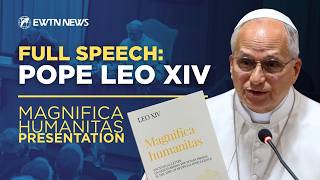
Pope Leo XIV Full Speech at Magnifica Humanitas Vatican Launch | EWTN News

Pope Leo XIV Full Speech at Magnifica Humanitas Vatican Launch | EWTN News

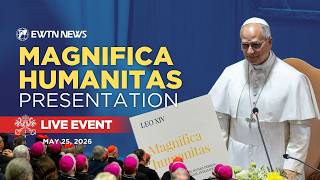
LIVE | Presentation of Pope Leo XIV's Encyclical Magnifica Humanitas from the Vatican | May 25, 2026

LIVE | Presentation of Pope Leo XIV's Encyclical Magnifica Humanitas from the Vatican | May 25, 2026

Pope Leo XIV's First Encyclical Explained in 10 minutes - Magnifica Humanitas

Pope Leo XIV's First Encyclical Explained in 10 minutes - Magnifica Humanitas