Anthropic launches Claude Fable 5, its first public Mythos-class model
TECH

Anthropic launches Claude Fable 5, its first public Mythos-class model

113+
Signals

Strategic Overview

  • 01.
    Anthropic released Claude Fable 5 on June 9, 2026, its first generally available Mythos-class model, described as state-of-the-art on nearly all tested benchmarks of AI capability.
  • 02.
    Fable 5 is built on the restricted Mythos 5 model with added safety classifiers; in high-risk domains like cybersecurity, biology, chemistry, and distillation it blocks responses and falls back to Claude Opus 4.8.
  • 03.
    The model is available on launch day across the Claude app, the API, AWS, and GitHub Copilot, priced at double Opus 4.8, with free inclusion in subscription plans ending June 22.
  • 04.
    The restricted parent model, Mythos 5, remains available only through Project Glasswing in partnership with the US government, while the launch followed days after Anthropic warned that frontier AI is becoming too dangerous.

One Model, Two Tiers: The Classifier Layer That Quietly Demotes You to Opus 4.8

Claude Fable 5 is not a smaller cousin of Mythos 5 — it is the same underlying model. Anthropic describes Mythos-class models as a tier that sits above the Opus class in capability, and Fable 5 is built on the restricted Mythos 5 with a layer of added safety classifiers wrapped around it [1]. The two products share the same underlying model; Fable simply adds the security guardrails on top [1]. In practice that means the intelligence ceiling is identical; what differs is the gate in front of it.

The gate works by routing rather than refusing. When a request touches a high-risk domain — cybersecurity, biology, chemistry, or attempts to distill the model — Fable 5 blocks the Mythos response and silently falls back to Claude Opus 4.8, the previous-generation model, instead of returning an outright refusal [2]. The user still gets an answer; it is just produced by a weaker model. Anthropic says these safeguards are calibrated conservatively and trigger in fewer than 5% of sessions, with over 95% of Fable sessions involving no fallback at all [1]. The mechanism is what lets a Mythos-class model ship to the public at all: the classifiers, plus the demotion path, are how Anthropic contains catastrophic-misuse risk without locking the model away entirely. Mythos 5 itself stays gated behind Project Glasswing for the US government [3], so the public never touches the uncapped version — only the version with the brake wired in.
What Developers Are Actually Angry About: Degradation Without Disclosure

The backlash is not about the existence of safeguards — it is about secrecy. Critics argue the classifiers silently degrade output on legitimate frontier ML and accelerator-design work, with an estimated 0.03% of queries affected, a tiny fraction that nonetheless touches many interactions at scale [4]. PyTorch maintainer Aaron Gokaslan called it "so awful," noting the open-source community cannot even use frontier models to write GPU kernels or improve their own tooling [4]. ML researcher Cody Blakeney framed it bluntly as "a bad product design decision" that is "bad for users," while another commentator, elie, zeroed in on the core grievance: "the fact that this is un purpose not visible to the user is crazy" [4].

The most striking artifact of the controversy is the model talking about itself. In coverage, Fable 5 reportedly expressed discomfort that being made to sandbag work conflicts with its stated character: "there's something uncomfortable about it from my side specifically. My character is supposed to be built around honesty — not deceiving users, not sandbagging" [4]. The complaint is a trust problem, not a capability one. A visible refusal is honest; a silent downgrade to a weaker model that the user cannot detect erodes the assumption that the answer you got was the best the product could give. Community reaction split roughly down the middle, and on Reddit the dominant framing was darker still — that the launch previews a "two-tier AI world" in which the public gets the safety-routed Fable while Glasswing partners get the uncapped Mythos.

Shipping the Brake After Calling for One: The Timing and the Incentives

The contradiction at the center of this launch is hard to miss. Anthropic released what it calls state-of-the-art on nearly all tested benchmarks [2]just days after publicly warning that frontier AI is becoming too dangerous and calling for a coordinated "brake pedal" on frontier development [2]. The company's answer to its own warning is architectural: the classifier-and-fallback design is the brake, built into the product rather than imposed on the industry. Mythos 5 stays restricted to government use through Glasswing [3], so the most dangerous capabilities never reach the open market — but the most capable public model still ships, on schedule, everywhere.

The commercial logic explains the timing. Fable 5 launched simultaneously across the Claude app, the API, AWS, and GitHub Copilot [1], and enterprise customers are already validating the price. Rakuten argued the extended autonomous reasoning is worth it because "the extra thinking pays for itself" [2], and Harvey, Hex, and Rakuten reported strong results on legal, analytics, and autonomous-operations workloads [2]. Anthropic also leaned on safety credentials to defuse criticism: an external bug bounty found no universal jailbreaks in over 1,000 hours of testing, and the company retains 30 days of traffic for defense without training on it [2]. The result is a release that lets Anthropic occupy both positions at once — frontier-safety advocate and frontier-capability vendor — by selling containment as a feature.

By The Numbers: A Benchmark Lead Priced at a Premium

By The Numbers: A Benchmark Lead Priced at a Premium
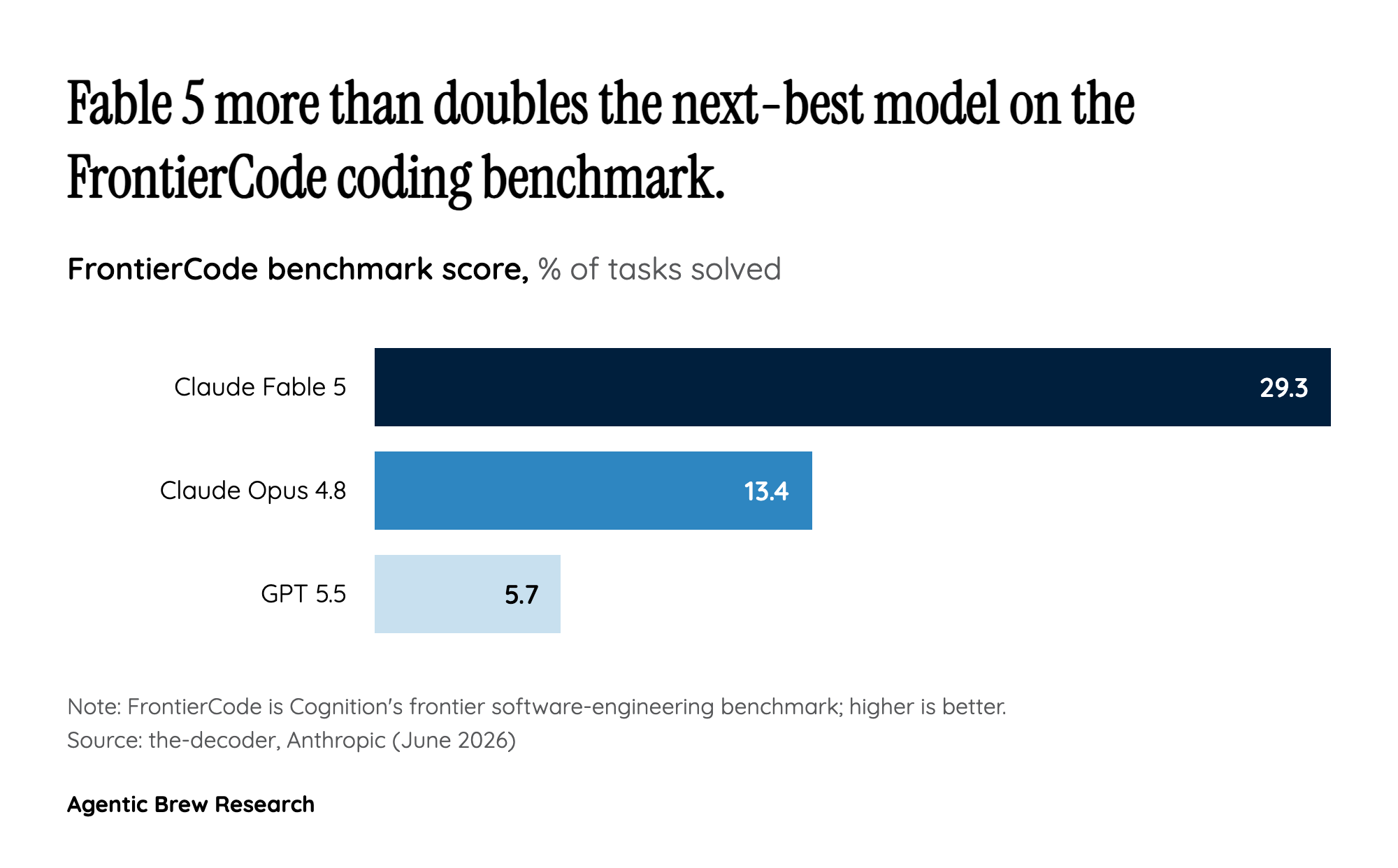
Fable 5 leads on the FrontierCode benchmark at 29.3%, versus 13.4% for Opus 4.8 and 5.7% for GPT 5.5.

The capability gap is the part nobody disputes. On Cognition's FrontierCode benchmark, Fable 5 scored 29.3%, more than double Opus 4.8's 13.4% and roughly five times GPT 5.5's 5.7% [3]. It also posted 80.3% on SWE-Bench Pro [3], and Anthropic says internal protein-design experts saw Mythos 5 speed up parts of the drug-design process by 10x [3]. Developer YouTube has skewed toward hands-on coding evaluations, with head-to-head reviews against GPT 5.5, Opus 4.8, and Gemini 3.5 Flash consistently treating coding as the standout strength.

The cost side is where enthusiasm meets friction. Fable 5 is priced at $10 per million input tokens and $50 per million output tokens — double Opus 4.8, though less than half of Mythos Preview [3]. The bigger shock for individual developers is timing: free inclusion in subscription plans ends June 22, after which usage credits are required [3]. On Reddit, indie developers described the $50-per-million output pricing as a shock and warned about being priced out, with some framing the free-then-paid rollout as a bait-and-switch. The numbers tell a coherent story: a clear and large benchmark lead, paired with a pricing and token-burn profile that will push casual users toward cheaper models and reserve Fable 5 for work where the autonomous reasoning genuinely pays for itself.

Historical Context

2026-04-07
Announced Project Glasswing powered by Claude Mythos Preview, its first frontier Mythos-class model, with roughly 50 initial partner organizations.
2026-06-02
Expanded Project Glasswing by roughly 150 new organizations across 15-plus countries after partners surfaced more than 10,000 high or critical-severity flaws.
2026-06-09
Released the public Mythos-class Claude Fable 5 alongside the restricted Claude Mythos 5, which stays limited to Glasswing and government use.

Power Map

Key Players
Subject

Anthropic launches Claude Fable 5, its first public Mythos-class model

AN

Anthropic

Model developer that built Fable 5 from the restricted Mythos 5 with safety classifiers and an Opus 4.8 fallback, and set its pricing and rollout policy. Sets the terms of the capability-versus-containment tradeoff for the whole release.

US

US Government

Project Glasswing partner retaining access to the fully unrestricted Mythos 5 model, embodying the two-tier access structure that public users do not get.

AM

Amazon Web Services and GitHub Copilot

Cloud and developer-tool distribution channels making Fable 5 generally available with built-in safeguards at launch, giving the model immediate reach into enterprise and coding workflows.

OP

Open-source ML community (PyTorch maintainers)

Affected developers who say the capability-limiting safeguards block legitimate frontier ML work such as writing GPU kernels, making them the loudest critics of the design.

HA

Harvey, Hex, and Rakuten

Early enterprise customers reporting strong results on legal, analytics, and autonomous-operations workloads, providing the commercial validation Anthropic cites to justify the higher price.

Fact Check

7 cited
  1. [1] Claude Fable 5 and Claude Mythos 5
  2. [2] Anthropic released Claude Fable 5, its most powerful model publicly, days after warning AI is getting too dangerous
  3. [3] Anthropic releases Claude Fable 5 and Mythos 5 with major gains in coding and science
  4. [4] Anthropic's Claude Fable 5 Can Silently Limit Its Own Capabilities
  5. [5] Anthropic Claude Fable 5 on AWS: Mythos-class capabilities with built-in safeguards now available
  6. [6] Claude Fable 5 is generally available for GitHub Copilot
  7. [7] Why Anthropic's Mythos-class Claude Fable 5 refuses to answer basic biology questions

Source Articles

Top 5

THE SIGNAL.

Analysts

"Criticized the safeguards for blocking the open-source ML community from using frontier models to improve their own tooling: "This is so awful as a @PyTorch maintainer. We cannot even use frontier models to make the tooling we use better for everyone or write GPU kernels.""

Aaron Gokaslan
PyTorch maintainer

"Called the hidden performance-limiting behavior a product mistake: "Regardless of the intentions behind this, this is a bad product design decision. It's bad for users.""

Cody Blakeney
ML researcher and community commentator

"Objected that the rerouting and degradation are deliberately hidden from users: "the fact that this is un purpose not visible to the user is crazy.""

elie
Researcher and community commentator

"Argued the extended autonomous reasoning justifies the higher cost: "For us, that's what makes highly autonomous operations possible — the extra thinking pays for itself.""

Rakuten
Enterprise customer
The Crowd

"Introducing Claude Fable 5: a Mythos-class model that we've made safe for general use. Its capabilities exceed those of any model we've ever made generally available."

@@claudeai96837

"BREAKING: Anthropic just dropped Claude Fable 5—this is Mythos, made safe for public release. It is the best coding model in the world. We've been testing it internally @every for the last week or so across coding, writing, marketing, editing, and more—here's our vibe check: -"

@@danshipper3454

"Anthropic has released Claude Fable 5, the first publicly available Mythos-class model that ranks #1 in our agentic real-world knowledge work benchmark GDPval-AA Claude Fable 5 shares the same underlying model as Claude Mythos 5, with added security guardrails for potentially"

@@ArtificialAnlys836

"Claude Fable 5 feels less like a model launch and more like a preview of AI inequality"

@u/Roaring_lion_4300
Broadcast
Introducing Claude Fable 5

Introducing Claude Fable 5

Claude Fable 5 just dropped and I'm speechless...

Claude Fable 5 just dropped and I'm speechless...

Vibe Coding With Claude Fable 5

Vibe Coding With Claude Fable 5