Nvidia PAIR pools idle home GPUs for local AI inference
TECH

Nvidia PAIR pools idle home GPUs for local AI inference

28+
Signals

Strategic Overview

  • 01.
    Nvidia PAIR is a free, open-source beta virtual inference router that discovers other compatible machines on a home network and schedules each incoming AI request to a single node - it does not merge GPU memory or shard a model across machines.
  • 02.
    Devices find each other automatically via mDNS local-network discovery and pair through a PIN-based trust step, after which all node-to-node traffic is secured with mTLS and generated certificates.
  • 03.
    Nvidia unveiled PAIR at IFA 2026 in Berlin alongside the RTX Spark N1X laptop platform, positioning it as free software that makes multi-PC households more useful for local AI work.
  • 04.
    In Nvidia's own demo, a five-sub-agent workload built on Nous Research's Hermes Desktop dropped from 18 minutes on one RTX Spark laptop to under 9 minutes once spread across a three-device PAIR cluster.

What PAIR Actually Does vs. Nvidia's 'AI Cluster' Framing

Nvidia's own launch messaging leans hard on cluster and supercomputer language, but the tool's documentation draws a much narrower box around what it actually does: PAIR routes each independent request to a single node for its complete lifetime and explicitly does not pool GPU memory, combine GPUs into a larger logical GPU, or shard one model across machines [1]. In practice it behaves as a scheduling layer sitting above existing local inference engines, deciding which single machine on the network should handle a given request based on node readiness, whether the target model is already loaded, current workload, and how much of each GPU other apps are already using [2]. That distinction matters: a 'cluster' in the data-center sense pools memory so one oversized model can run across many GPUs, while PAIR simply picks the best single machine for each job - closer to a smart load balancer for a home network than to multi-GPU model sharding.
Why Now: Agentic Sub-Agent Swarms Are Bottlenecking a Single GPU

The timing traces to a specific new failure mode: agent frameworks that fan a task out into multiple simultaneous sub-agents can queue and stall when every sub-agent competes for the same GPU, which is exactly the workload PAIR is built to spread across whatever machines on the network have spare capacity [3]. Nvidia is pairing that fix with a household-hardware argument, citing that more than half of US households already own two or more PCs, many of them idle for most of the day, as the untapped capacity PAIR is designed to recruit rather than leave dormant [4]. Framed together, the pitch is less 'buy a bigger GPU' and more 'stop wasting the GPUs already in the house' - though that only pays off for households that actually own multiple compatible machines running at the same time.

The Ecosystem Play: RTX Spark Hardware and the Hermes Desktop Demo

PAIR did not launch in isolation - Nvidia unveiled it at IFA 2026 in Berlin alongside the RTX Spark N1X laptop platform, which ships in two configurations with up to 128GB of unified memory and an October 2026 release window, with Lenovo already announcing Yoga Pro 9n and Yoga 9n 2-in-1 laptops built around the same silicon [5][6]. The flagship demo leaned on Nous Research's Hermes Desktop agent rather than a generic benchmark: a five-sub-agent workload running the Qwen 3.6 35B A3B model dropped from 18 minutes on a single RTX Spark laptop to under 9 minutes once PAIR spread the work across a three-device cluster of that laptop, a DGX Spark, and an RTX 5090 [7][8]. The choice of partner is not incidental - Hermes Agent is one of the most widely used open agent stacks, giving Nvidia a high-visibility showcase for why RTX Spark buyers would want PAIR running in the background.

Independent Testers Push PAIR Well Beyond Its Advertised Scope

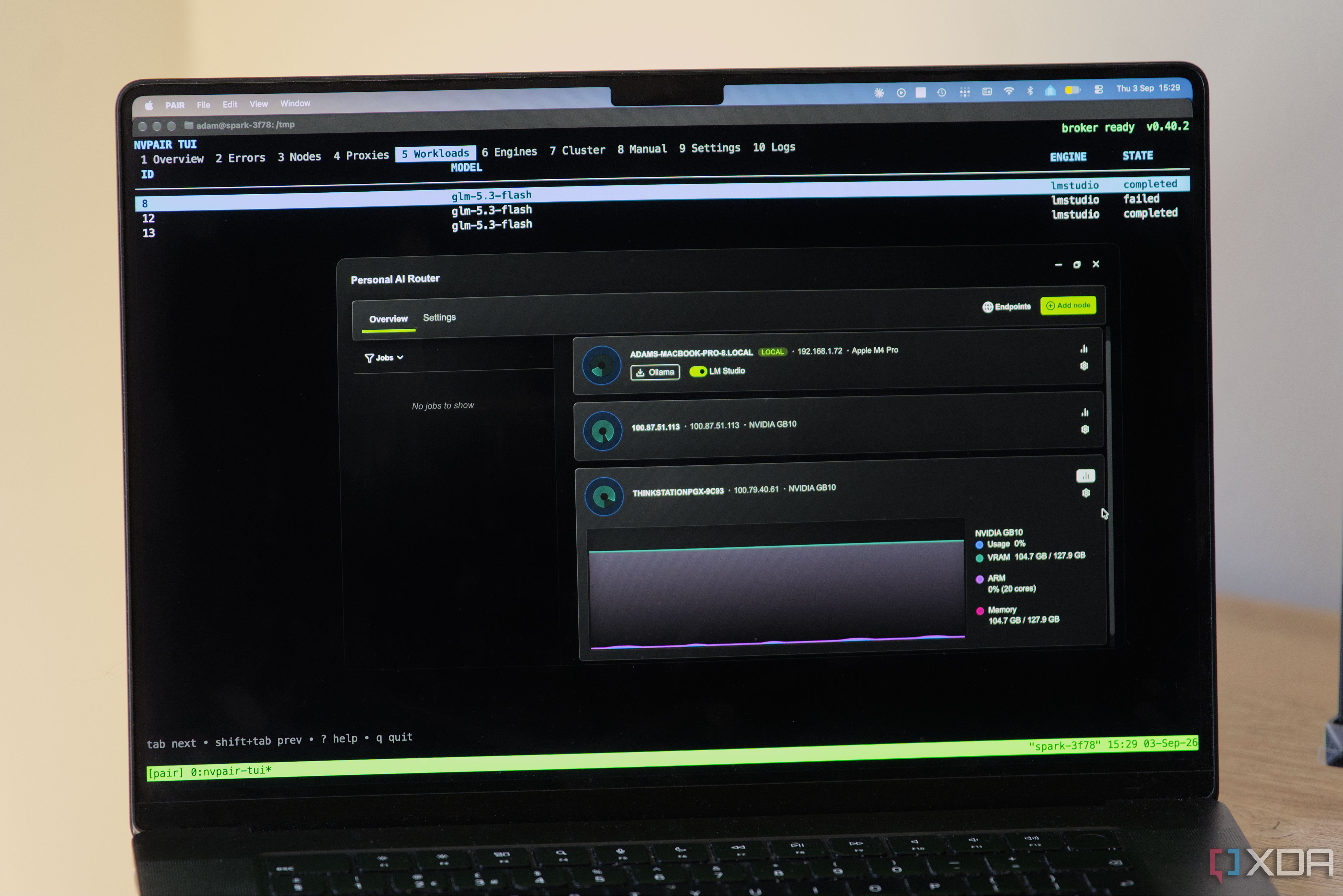
Reviewers who poked at the beta found PAIR more capable, and more improvised, than Nvidia's own materials suggest. XDA Developers discovered that adding a new inference engine is just a declarative JSON manifest rather than a hardcoded integration, which let them route requests between two entirely different models - Qwen-3.8-Flash-Next and GLM-5.3-Flash - running on two different machines through a single endpoint, then stretch the same trick across a Tailscale tunnel to pair a Mac in Portugal with a DGX Spark in Ireland, and eventually scale a cluster to 18 GPUs [9]. None of that is documented or supported behavior for a 0.1.1 beta, and the same testing surfaced a real limitation: the scheduler only reads coarse GPU-utilization bands, node readiness, and whether a model is already present, with no awareness of warm-cache state, per-node hardware differences, or measured latency - so a technically 'available' node can still be the slow choice.

Historical Context

n/a
Prior open-source distributed-inference projects took a different approach than PAIR: Exo mixes Nvidia GPUs, Apple Silicon, and AMD GPUs in one heterogeneous cluster, Petals shards very large models (405B+) across machines that each host a piece of the model, and llama.cpp RPC abstracts GPU backends behind a network protocol. PAIR explicitly avoids this kind of memory-pooling or model-sharding, instead routing whole independent requests to a single node.
2026-09-03
PAIR announced as a free public beta at IFA 2026 in Berlin, alongside new local-AI agent partnerships and the RTX Spark N1X laptop reveal.

Power Map

Key Players
Subject

Nvidia PAIR pools idle home GPUs for local AI inference

NV

Nvidia

Developer and publisher of PAIR; unveiled it at IFA 2026 in Berlin alongside RTX Spark hardware as part of a broader local-AI push

NO

Nous Research

Maker of Hermes Desktop / Hermes Agent, the agent framework used in Nvidia's flagship PAIR demo; Hermes Agent reportedly passed 140,000 GitHub stars in under three months and is described as the most-used agent on OpenRouter

LE

Lenovo

Hardware partner shipping RTX Spark-based Yoga Pro 9n and Yoga 9n 2-in-1 laptops in October 2026, giving PAIR an initial retail hardware base

OL

Ollama

Local inference engine natively supported by PAIR at launch; PAIR exposes an Ollama-compatible endpoint on top of it

LM

LM Studio

Second local inference engine natively supported by PAIR at launch

AP

Apple

M4-and-later Apple Silicon Macs are supported as PAIR cluster nodes alongside Nvidia GPU systems

Fact Check

10 cited
  1. [1] NVIDIA/Personal-AI-Router (GitHub)
  2. [2] NVIDIA PAIR: Virtual Inference Router Expands Available Compute on Your Local Network
  3. [3] NVIDIA PAIR Utility Joins Every GPU in Your Home into a Cluster for Agentic AI Tasks (Tom's Hardware)
  4. [4] NVIDIA IFA 2026: PAIR Distributed AI Computing for the Home Network (Engadget)
  5. [5] NVIDIA Launches PAIR, a Free Tool That Distributes Local AI Inference Across Devices (AI Weekly)
  6. [6] Local AI at IFA: Next-Gen Agents, NVIDIA PAIR and RTX Spark
  7. [7] RTX AI Garage: Hermes Agent on DGX Spark
  8. [8] NVIDIA Connects Home Computers into One AI Inference Cluster with PAIR (Unite.AI)
  9. [9] We Connected Two PCs to One AI Endpoint with NVIDIA's New Router-Serving Engine (XDA Developers)
  10. [10] NVIDIA AI on RTX: Personal AI Router product page

Source Articles

Top 5

THE SIGNAL.

Analysts

Found PAIR more flexible than advertised because adding a new inference engine is just a text-file manifest rather than a hardcoded integration, which let them route between two different models on two different machines through one endpoint and even pair a Mac in Portugal with a DGX Spark in Ireland over Tailscale. They also flagged that the scheduler ignores warm-cache state, cross-node hardware differences, and measured latency, relying only on coarse GPU-utilization bands.

XDA Developers
Positive but clear-eyed about beta limitations

Nvidia's own GitHub documentation pushes back on the 'cluster' shorthand used in its marketing, stating plainly that PAIR routes whole requests to single nodes and does not merge GPU memory, combine GPUs into a larger logical GPU, or split an in-flight request between machines.

Nvidia (official documentation)
PAIR is deliberately a routing layer, not a GPU-pooling layer

Describes PAIR as an orchestrator sitting between AI agents and inference servers - RTX Windows/Linux boxes, DGX Spark, and Macs - that dispatches jobs to whichever node has capacity behind a single proxy endpoint, with any node able to act as router and nodes able to join or leave dynamically. Explicitly clarifies PAIR does not pool VRAM the way NCCL and vLLM do for a single large model; each node still runs its own separate model instance.

Raid Owl (YouTube hands-on)
Practical and accurate about what PAIR is, distinct from XDA's stretch-testing angle
The Crowd

Your devices are stronger together. 🖥️🤝🖥️ Just announced at IFA, NVIDIA PAIR automatically links systems across your local network and sends inference requests wherever there's available capacity, helping agents run more efficiently.

@@NVIDIARTXSpark2371

🚨 NVIDIA just quietly changed what a "personal AI computer" can mean. Meet NVIDIA PAIR: Personal AI Router. Instead of buying one massive machine to run local AI, PAIR lets you connect the computers you already have and turn them into a personal AI inference cluster. Your RTX...

@@aijoey1272

PAIR is designed to get your desktop and laptop working together on local AI tasks when not in use.

@@verge45
Broadcast
NVIDIA Pair - The open source AI clustering software

NVIDIA Pair - The open source AI clustering software

NVIDIA Just Turned Your House Into an AI Cluster… This Is HUGE

NVIDIA Just Turned Your House Into an AI Cluster… This Is HUGE

NVIDIA's Free AI Tool Turns Your Home PCs into a Supercomputer

NVIDIA's Free AI Tool Turns Your Home PCs into a Supercomputer

Nvidia PAIR pools idle home GPUs for local AI inference — AI News | Agentic Brew