Uber-Wayve London robotaxi launch
TECH

Uber-Wayve London robotaxi launch

36+
Signals

Strategic Overview

  • 01.
    Uber and Wayve launched London's first public robotaxi service on September 3, 2026, the first supervised autonomous ride-hailing service in the UK.
  • 02.
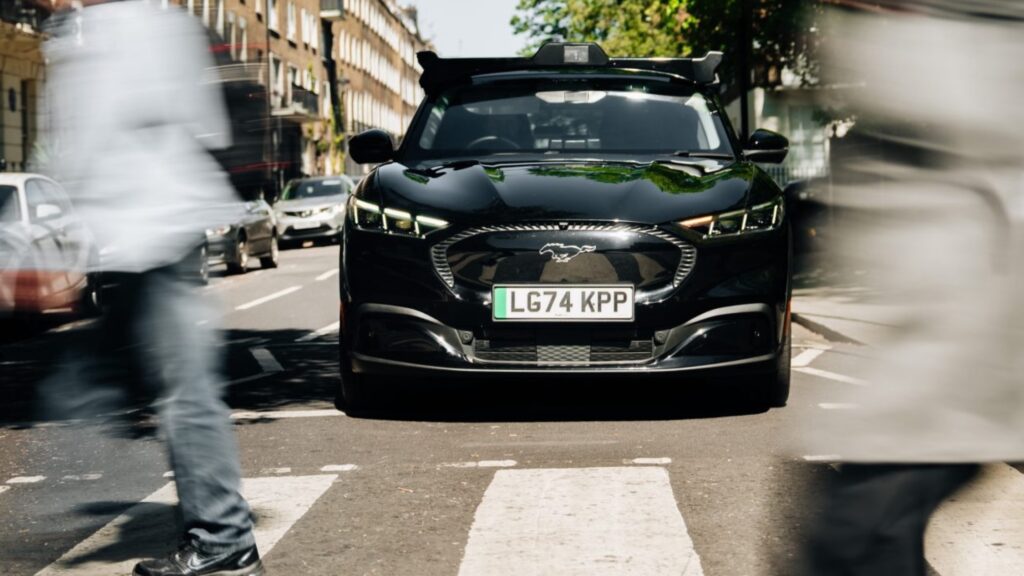
    The fleet consists of 15 Wayve-equipped Ford Mustang Mach-Es, approved by Transport for London for a one-year trial, with each vehicle licensed as a private hire vehicle, carrying a trained, TfL-licensed safety driver, and featuring in-vehicle displays that support 64 languages.
  • 03.
    Riders booking UberX, Uber Comfort, or Uber Electric may be matched with a Wayve vehicle at no extra cost, cannot request it directly, and can decline the match; the service covers London excluding airport zones.
  • 04.
    The launch puts Uber and Wayve ahead of planned London robotaxi entries from Waymo and Baidu, though a separate DVSA permit required for fully driverless operation has not yet been obtained.

Deep Analysis

Supervised, Not Driverless: What London Actually Approved

The headlines call it a robotaxi launch, but the legal mechanics are narrower than that: Transport for London approved up to 15 vehicles for a one-year trial [1], and each Ford Mustang Mach-E is licensed as a private hire vehicle, not as an automated vehicle. That distinction is what keeps a trained, TfL-licensed safety driver on board every trip, hands off the wheel unless intervention is needed [2]. The separate Automated Passenger Services permit that would let Wayve and Uber run without a human on board sits with the UK's Driver and Vehicle Standards Agency and has not yet been issued to either company [1]. Riders can't even opt into the experience directly - anyone booking UberX, Uber Comfort, or Uber Electric may simply be matched with a Wayve-powered car at no extra cost, and can decline the match if they'd rather have a human driver [3]. How much supervision the system still needs became visible in practice: a Bloomberg reporter's test ride required the safety driver to take over twice [4].
The Mapless Bet: Cameras Instead of Lidar and HD Maps

Underneath the launch is a genuine technology gamble. Wayve's driving system runs on cameras and other onboard sensors rather than lidar, and it doesn't lean on pre-made high-definition maps of every street - an approach the company has been refining on London's notoriously tangled, narrow, non-grid roads since 2018 [5]. That's a deliberate contrast with the dominant robotaxi playbook, where operators pre-map an entire operating area in painstaking detail and layer lidar on top for redundancy: expensive to build, but proven at scale. Wayve's bet is that a single AI model trained end-to-end on driving footage can generalize to streets it has never explicitly mapped, the same way a human driver adapts to an unfamiliar neighborhood rather than needing to memorize it first. Whether that generalization holds up beyond a 15-car trial confined to non-airport London is the open question the next year of TfL data is meant to answer.

Racing Waymo and Baidu to Be First in London

Timing is doing a lot of work here. Uber and Wayve secured their private hire vehicle licenses for the supervised service in August 2026 [6], deliberately getting the launch out ahead of planned London entries from Waymo and Baidu [4]. It fits a broader pattern for Uber, which now counts more than 30 autonomous-vehicle partners globally, is targeting autonomous trips available in up to 15 cities by the end of 2026, and has set a goal of becoming the world's largest AV trip facilitator by 2029 [7]. London is one node in that expansion - Uber, Wayve, and Nissan separately announced plans in March 2026 to bring a robotaxi service to Tokyo later this year using Nissan Leaf vehicles [8]. Consumer appetite in London looks real too: more than 140,000 Londoners joined Uber's 'Ride Preferences' waitlist ahead of the launch, against roughly 100,000 total Ubers operating in the city [5][7], and the stakes match that scale - the global robotaxi market is projected to grow from $2.77 billion in 2024 to $188.91 billion by 2034 [9]. Yet the market's reaction to the London launch was muted: Uber's stock actually reversed roughly 1% on the news, and analysts don't expect regulatory authorization for wider, fully driverless deployment across London until 2027 or even 2028 [9]. Winning the license race, in other words, hasn't yet translated into a re-rating of the business case.

The Knowledge vs the Algorithm: A Divided Public Reaction

The clearest tension around the launch isn't technical, it's social. London's black-cab drivers built their careers on 'The Knowledge,' the licensing exam that requires memorizing roughly 25,000 streets - a qualification so demanding it has been shown to physically enlarge drivers' hippocampi. That backdrop has made job displacement the loudest thread in the public conversation, with commenters citing roughly 200,000 London driving-related jobs at stake and drawing comparisons to earlier waves of automation that hollowed out factory work, typing pools, and switchboard operation. Sentiment splits sharply by platform: on X, the framing skewed celebratory, with the loudest posts casting Wayve as a homegrown European AI success story that beat American rivals to market. On Reddit, the mood ran more skeptical - commenters in London's own community pushed back on headlines implying full driverless operation when a safety driver is still required, questioned whether a 15-car fleet justified the promotional rollout, and traded pricing complaints, including one widely shared anecdote of a Heathrow fare quote jumping from £66 to £110. Safety arguments cut in both directions too: some point to existing crash-rate research to argue autonomous vehicles are already statistically safer than human drivers, with several commenters specifically noting they'd feel safer without a human stranger behind the wheel, while skeptics raise two distinct contrarian risks: pedestrians exploiting autonomous vehicles' overly cautious braking to jaywalk with impunity, and separate concerns that empty repositioning trips could add to street congestion.

Historical Context

2017
Founded by Alex Kendall and Amar Shah, pioneering end-to-end deep-learning autonomous driving tested on public roads.
2018
Began developing and testing its mapless, camera-based AI-driving approach on London roads.
2022-01
Raised a $200 million Series B round led by Eclipse Ventures.
2024-05
Raised $1.05 billion in a Series C round led by SoftBank with Nvidia and Microsoft participating, the UK's largest-ever AI fundraise.
2025-06
Partnered to launch Level 4 autonomy trials in the UK, an earlier step toward the September 2026 public launch.
2026-02
Raised $1.2 billion in a Series D round at an $8.6 billion post-money valuation, led by Eclipse, Balderton, and SoftBank Vision Fund 2, with Microsoft, Nvidia, and Uber participating.
2026-03
Announced a plan to launch a robotaxi service in Tokyo later in 2026, using Nissan Leaf vehicles.
2026-06
Opened a 'Ride Preferences' waitlist for Londoners ahead of the robotaxi launch.
2026-08-05
Won private hire vehicle licenses for the supervised robotaxi service in London.
2026-09-03
Publicly launched the supervised robotaxi service in London.

Power Map

Key Players
Subject

Uber-Wayve London robotaxi launch

UB

Uber Technologies, Inc.

Owns and operates the vehicles and provides the ride-hailing app and matching platform for the service

WA

Wayve Technologies Ltd.

British AI startup supplying the camera-based 'AI Driver' software stack powering the vehicles

TR

Transport for London (TfL)

Licenses the vehicles as private hire vehicles and licenses the safety drivers who must stay on board

DR

Driver and Vehicle Standards Agency (DVSA)

UK body that would issue the Automated Passenger Services permit needed for fully driverless operation, not yet obtained

UK

UK Department for Transport / Transport Secretary Heidi Alexander

Publicly endorsed the launch as a transport-policy milestone for London

JO

Jonathan Reynolds, UK Business Secretary

Publicly highlighted Wayve as a homegrown British AI success story

WA

Waymo (Alphabet) and Baidu

Rival autonomous-vehicle operators with planned London rollouts that Uber-Wayve launched ahead of

Fact Check

9 cited
  1. [1] Uber and Wayve's London robotaxi launch still needs a safety driver
  2. [2] Wayve and Uber launch autonomous rides in London
  3. [3] Uber and AI firm Wayve launch London's first robotaxis
  4. [4] Uber, Wayve launch robotaxi service in London to compete with Waymo
  5. [5] Ford Mustang Mach-E becomes the face of the UK's first robotaxi service
  6. [6] Uber and Wayve win licenses for supervised robotaxis in London
  7. [7] Wayve and Uber Launch First-Ever Autonomous Rides in the UK
  8. [8] Uber, Wayve and Nissan plan to launch a robotaxi service in Tokyo this year
  9. [9] Uber stock reverses despite UK robotaxi rollout

Source Articles

Top 4

THE SIGNAL.

Analysts

Says autonomous driving technology 'will complement the city's rich transport network,' positioning the launch as additive infrastructure rather than disruption.

Alex Kendall, Wayve CEO and co-founder
Frames autonomous driving as complementary to London's existing transport network, not a replacement

Calls London 'a world-class hub for transportation innovation' and says 'this launch is a major milestone' for the company's autonomous ambitions.

Sarfraz Maredia, Uber executive overseeing autonomous mobility
Frames London as a strategic launch market within Uber's global AV strategy

Calls it 'a major milestone for the future of transport in London, as British innovation brings this technology onto our roads and gives passengers more choice.'

Heidi Alexander, UK Transport Secretary
Government endorsement of the launch as a transport-policy milestone

Reported that during her test ride the safety driver had to take over twice, underscoring that the system still requires active human supervision in practice.

Olivia Solon, Bloomberg technology journalist
Independent reporter who test-rode the service

Say regulatory authorization for wider, driverless deployment across London roads may not arrive until 2027 or even 2028.

Market analysts (per Tipranks aggregation)
Cautious on the timeline for full driverless deployment despite bullish Uber stock sentiment
The Crowd

Autonomous taxis have arrived to London. Wayve, Europe's leading autonomous driving system that has been trained on London's road since 2018, has beat out their competitors from America. A success story for a European startup!

@@NXT4EU244

Uber and Wayve launch supervised robotaxi service in London, after years of testing on the city's notoriously challenging streets

@@business66

Uber and AI-firm Wayve launch London's first robotaxis

@@Reuters31

Wayve just launched the first ever public self-driving taxis in London (British company)

@u/Snugglosaurus182
Broadcast
Robotaxis coming to London pose threat to cabbies who memorize 25,000 streets to earn licenses

Robotaxis coming to London pose threat to cabbies who memorize 25,000 streets to earn licenses

Wayve and Uber prepare to launch self-driving taxis in London (UK) 8/Jun/2026

Wayve and Uber prepare to launch self-driving taxis in London (UK) 8/Jun/2026

Waymo vs Wayve: The Self-Driving Showdown Coming to London

Waymo vs Wayve: The Self-Driving Showdown Coming to London