OpenAI GPT-6 Rollout with Intelligent UI
TECH

OpenAI GPT-6 Rollout with Intelligent UI

51+
Signals

Strategic Overview

  • 01.
    OpenAI began rolling out GPT-6 with a new "Intelligent UI" in ChatGPT on October 7, 2026, first to Plus, Pro, Business, and Enterprise subscribers running GPT-6 Sol, with Free and Go users gaining access the next day, October 8, on GPT-6 Luna. Both variants are tuned for everyday conversation rather than specialized reasoning.
  • 02.
    The headline feature lets ChatGPT combine prose with graphics, tappable buttons, forms, charts, diagrams, and maps, choosing whichever format - a side-by-side comparison, an interactive diagram, or a plain answer - best fits the question. Demoed examples include a clickable diagram of a seven-speed bicycle, a recipe with an adjustable cooking timeline, road-trip map planning, a retirement savings calculator, a bill splitter, and in-chat games.
  • 03.
    Intelligent UI runs on a library of native, streamable UI components paired with a compiler that renders the interface as the model generates it. For queries that require a web search, GPT-6 Instant now begins responding on average 44 percent sooner than GPT-5.6 Instant. OpenAI also reports stronger resistance to multi-turn jailbreak attempts and updated protections against cyberattack, biological-threat, and violence-related misuse.
  • 04.
    Separately from the consumer interface launch, GPT-6 Sol and Luna also rolled out to ChatGPT Work, Codex, and the API for Plus, Pro, Business, Enterprise, and Edu users, built on advances from the larger GPT-6 Astra model and priced roughly 50 percent below GPT-5.6's promotional pricing. All three GPT-6 family models support a 1,050,000-token context window with up to 128,000 output tokens via the API.

Answering Before It Finishes Thinking

Intelligent UI isn't just a visual skin - it rests on a library of native, streamable UI components paired with a compiler that renders the interface as the model is still generating it [2]. That architecture is also why GPT-6 Instant feels faster: for web-search queries it begins responding on average 44 percent sooner than GPT-5.6 Instant, effectively answering while still "thinking" [1][4]. OpenAI's own framing, via product manager Aarush Selvan, is that text alone can't carry answers to tasks like planning a trip or learning a recipe - the model needs to choose between a diagram, a map, a calculator, or a plain paragraph in real time [9]. Demo use cases - a clickable seven-speed bicycle diagram, a bill splitter, a retirement calculator, a recipe timeline - all show the same underlying move: the model deciding on, and then streaming, a UI shape rather than only prose [3].

OpenAI Is Catching Up, Not Leading

Despite the splash, Intelligent UI follows rather than invents. By late 2025 Google's Gemini was already shipping Gemini-designed, per-prompt coded interfaces, and by early 2026 Anthropic's Claude was drawing interactive charts mid-conversation - reportedly after Anthropic and OpenAI had already agreed on a shared standard for tools to return live UI inside chat [13]. OpenAI's own infrastructure for this wasn't exactly a secret either: RuntimeWire reported finding the underlying GenUI system - interactive components, refreshable widgets, 467 versioned "Learning Block" types - six weeks before the official announcement, though it didn't predict the GPT-6 branding or the rollout date [10]. The feature also isn't OpenAI's first attempt at breaking out of pure text; ChatGPT's Canvas interface shipped to Plus users back in October 2024, and the Canvas-capable models were reportedly retired this year in favor of new in-thread surfaces built for months before Intelligent UI's launch [11][12].

The Safety Case Nobody Ran

The Safety Case Nobody Ran
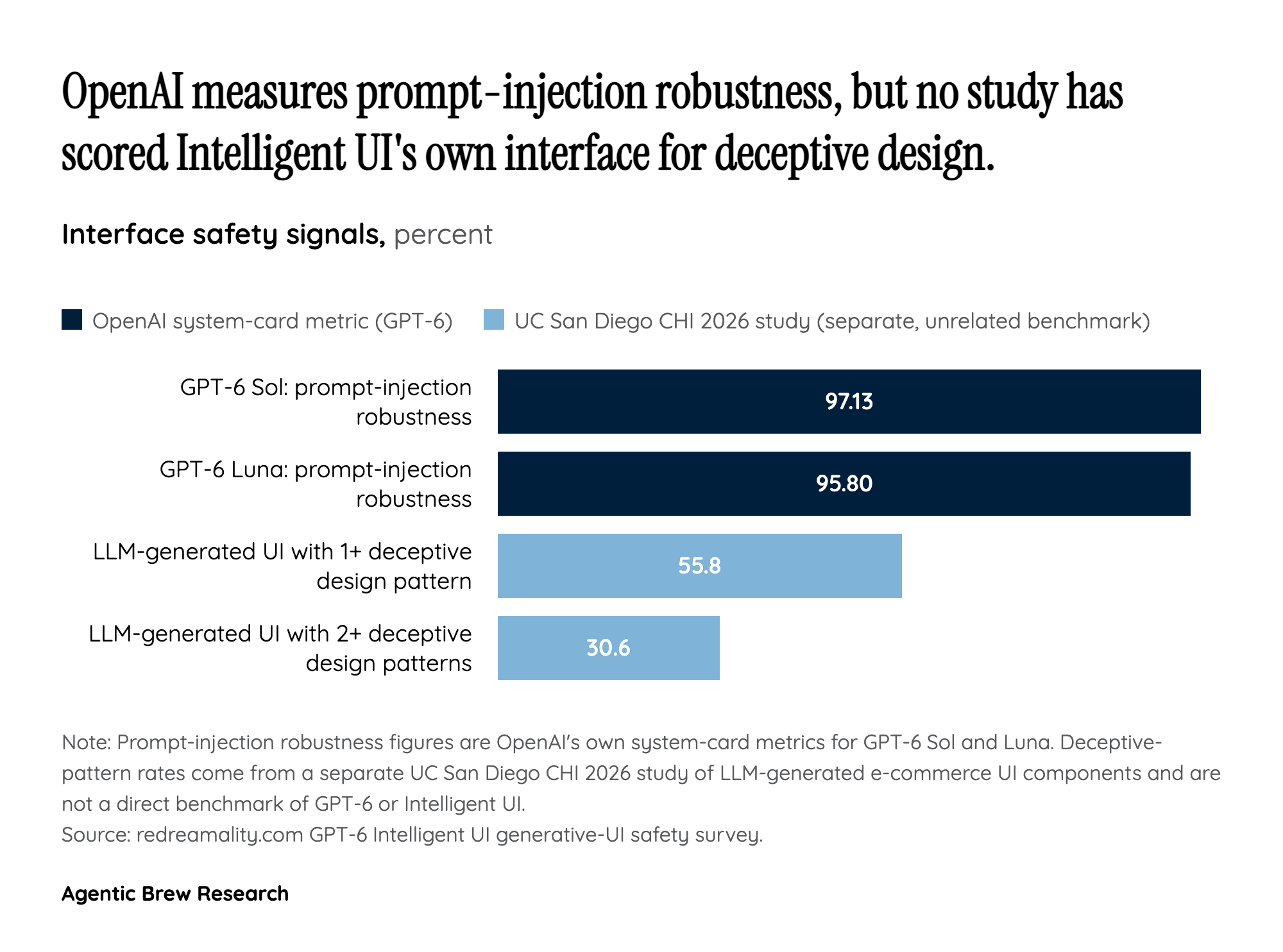
OpenAI's own robustness scores for GPT-6 Sol and Luna sit well above the deceptive-design-pattern rates found in a separate UC San Diego study of LLM-generated interfaces - different benchmarks, but a gap worth noting since no study has scored Intelligent UI itself.

OpenAI's launch materials lean on a single number - indirect prompt-injection robustness of 97.13 percent for Sol and 95.80 percent for Luna - as the stand-in for interface safety, but no interface-specific safety evaluation of Intelligent UI itself has been disclosed [8]. That matters because tappable buttons and generated forms create a phishing surface: a UC San Diego CHI 2026 study found that 55.8 percent of LLM-generated e-commerce UI components contained at least one deceptive design pattern, and 30.6 percent contained two or more [8]. Independent analysis also flags cross-component inconsistency - a generated answer built from several visual blocks can contain mismatched values across them, and the clean, finished look of the interface makes that harder to catch than it would be in plain text [8]. The critique sharpens given scale: against a reported weekly audience of more than 1.2 billion users, even a small failure rate at the interface layer reaches a very large number of people [8]. Separately, Hacker News commenters pointed out that OpenAI's own system card documented safety regressions in self-harm and sexual-content safeguards alongside the launch, while the announcement's attention went almost entirely to the new interface [14].

A Feature People Like, Attached to a Model Some Don't

The tension around this launch isn't really about the UI itself - it's about what it's wrapped around. Discussion of Intelligent UI as a feature ran mixed-to-positive, with people testing and sharing results like interactive diagrams and bill-splitting tools built from a single prompt. But reaction to the underlying GPT-6 Sol and Luna models, especially on free tiers, ran mixed-to-negative, with complaints that the model repeats patterns from a previous release and that new guardrails feel more rigid and less emotionally attuned than before. The naming added to the confusion: ChatGPT's "Sol" and "Luna" are specced differently from the "Sol", "Luna", and "6.1 Sol" used in Codex and the API, which fed speculation that a cheaper model had quietly been substituted under a familiar name. The result is a split verdict, where the delivery mechanism gets credit the underlying model doesn't.

The Economics Behind the Visuals

Intelligent UI only shipped in the consumer Chat tab - it is explicitly not available in ChatGPT Work or Codex [2][3]. Running alongside it, and announced the same day, was a more utilitarian release: GPT-6 Sol and Luna also rolled out to ChatGPT Work, Codex, and the API, built on advances from GPT-6 Astra, priced roughly 50 percent below GPT-5.6's promotional pricing [5][6]. Both model families carry a 1,050,000-token context window with up to 128,000 output tokens via the API [7]. Read together, the two announcements describe a two-track strategy: a flashy, consumer-facing interface upgrade on one side, and a cheaper, faster, higher-context model aimed at developers and enterprise workloads on the other - bundled under the same GPT-6 name and the same launch day.

Historical Context

2024-10-03
Canvas interface launched for ChatGPT Plus, an earlier step toward richer, non-pure-text interaction.
2026
Canvas-capable models were retired and replaced by two new in-thread surfaces reportedly built for months before Intelligent UI's launch.
2026-08-26
Reported discovering OpenAI's underlying GenUI infrastructure - interactive components, refreshable widgets, 467 versioned "Learning Block" types - six weeks before the official Intelligent UI announcement, without predicting the branding, GPT-6 tie-in, or rollout date.
2025-11
Reported to have shipped Gemini-designed, per-prompt coded interfaces ahead of OpenAI's Intelligent UI.
2026-early
By early 2026, Claude reportedly drew interactive charts mid-conversation, after Anthropic and OpenAI had agreed on a shared standard for tools to return live UI inside chat.
2026-10-07
GPT-6 Sol and Luna announced across ChatGPT Work, Codex, and the API, priced roughly 50 percent below GPT-5.6 promotional pricing, separate from the consumer Intelligent UI launch.

Power Map

Key Players
Subject

OpenAI GPT-6 Rollout with Intelligent UI

OP

OpenAI

Developer and publisher of GPT-6 and Intelligent UI

CH

ChatGPT Plus, Pro, Business, and Enterprise subscribers

First recipients of GPT-6 Sol and Intelligent UI, October 7

CH

ChatGPT Free and Go users

Second-wave recipients of GPT-6 Luna and Intelligent UI, October 8

AA

Aarush Selvan

OpenAI product manager who articulated the rationale for Intelligent UI

HO

Holger Mueller

Constellation Research analyst commenting on usability implications

RU

RuntimeWire

Outlet that reported OpenAI's underlying GenUI infrastructure six weeks before the official launch

RE

redreamality.com

Independent analyst publishing a critical technical and safety survey of Intelligent UI

Fact Check

14 cited
  1. [1] GPT-6 for everyone
  2. [2] ChatGPT Gets Intelligent UI With GPT-6 Rollout
  3. [3] OpenAI rolls out GPT-6 with Intelligent UI in ChatGPT
  4. [4] OpenAI launches ChatGPT Intelligent UI alongside GPT-6
  5. [5] Announcing GPT-6 Sol and GPT-6 Luna in the API, Codex, and ChatGPT
  6. [6] OpenAI Launches GPT-6 Sol and Luna With Cheaper API Pricing
  7. [7] GPT-6.1 Sol's 1,050,000-Token Context Window Explained
  8. [8] GPT-6 Intelligent UI: A Generative UI Safety Survey
  9. [9] With GPT-6, ChatGPT's Responses Are Much More Visually Appealing and Interactive
  10. [10] OpenAI's GenUI Infrastructure, Found Weeks Before the Official Launch
  11. [11] ChatGPT Got a Great Design Change Now That Canvas Rolled Out to Everyone
  12. [12] ChatGPT Retires Canvas for New In-Thread Surfaces
  13. [13] I Tried the Same Prompt on Lovable, Claude, OpenAI, and Gemini
  14. [14] Hacker News Discussion: OpenAI Rolls Out GPT-6 With Intelligent UI

Source Articles

Top 5

THE SIGNAL.

Analysts

“ChatGPT has predominantly been a text-based interface. But the company wants to help people get things done, and it believes that from everyday things like planning a recipe or a trip or even trying to learn something, the most helpful answers aren't just text.”

Aarush Selvan, OpenAI Product Manager
Proponent

“Usability is one of the primary factors driving adoption of software, and the text-only interface doesn't really help when people when it comes to information absorption or processing.”

Holger Mueller, Constellation Research
Measured and analytical

“Across more than 1.2 billion weekly users, that rate means the interface layer needs hard constraints that don't rely on model judgment.”

redreamality.com analyst
Critical and skeptical

“It's crazy that a company can document these safety drops in a PDF, ship the model anyway, and focus the announcement entirely on shiny new UI.”

Hacker News commenter
Critical

“Almost repulsed by all the images, so much needless whitespace, checklist and so on. Feels like I'm being condescended to.”

Hacker News commenter
Critical
The Crowd

“GPT-6 and Intelligent UI, now rolling out in ChatGPT for everyone. Intelligent UI in ChatGPT delivers fast, interactive answers that make everyday questions more visual, complex topics easier to grasp, and interactive tools for your task available on the spot.”

@@OpenAI21649

“ChatGPT just got a lot more visual—introducing Intelligent UI. Intelligent UI allows ChatGPT to answer quickly with fully interactive user interfaces that make everyday answers more visual. It makes learning complex topics easier, and it quickly creates tools to solve a task”

@@ChatGPT7370

“today we're shipping gpt-6 and intelligent ui to everyone! intelligent ui is a bet on model intelligence. we're letting gpt-6 fill the canvas with high utility visual and interactive components. it's a pretty big change to chatgpt! we had to craft the right tools for gpt-6 to be”

@@michpokrass1073

“GPT-6 and Intelligent UI for everyone”

@u/PM_ME_UR_POLDERS627
Broadcast
Introducing GPT-6 in ChatGPT with Intelligent UI

Introducing GPT-6 in ChatGPT with Intelligent UI

GPT-6 Intelligent UI is INSANE!

GPT-6 Intelligent UI is INSANE!

GPT-6 Intelligent UI Is INSANE — I Tested It

GPT-6 Intelligent UI Is INSANE — I Tested It