OpenAI's GPT-6 Intelligent UI Rollout to ChatGPT
TECH

OpenAI's GPT-6 Intelligent UI Rollout to ChatGPT

22+
Signals

Strategic Overview

  • 01.
    OpenAI began rolling out GPT-6 and Intelligent UI in ChatGPT on October 7, 2026, first to Plus, Pro, Business, and Enterprise tiers running a model called GPT-6 Sol, with Free and Go tiers following a day later on GPT-6 Luna; the feature is limited to the Chat tab and Enterprise access depends on workplace admin settings.
  • 02.
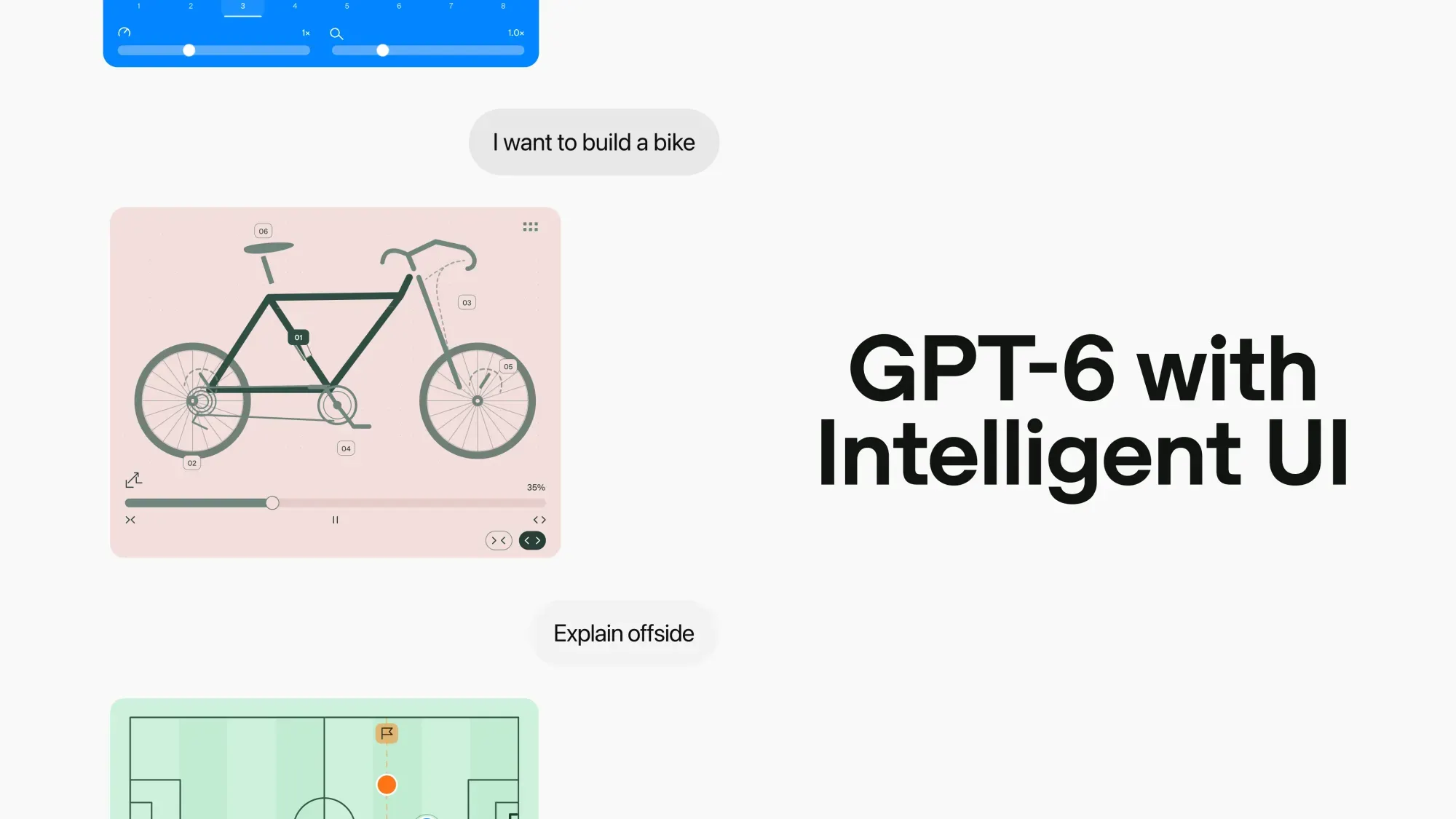
    Intelligent UI lets ChatGPT build the format of an answer around the task instead of forcing everything into plain text, mixing in charts, tappable buttons, and on-the-spot interactive tools like calculators or bill splitters, and the model can begin streaming a response while it is still thinking or using tools.
  • 03.
    OpenAI's own deployment safety documentation discloses that, relative to GPT-5.6, GPT-6 Sol shows a statistically significant regression on self-harm benchmarks and GPT-6 Luna regresses on self-harm, gore, and sexual content benchmarks, though OpenAI says manual review found the violations borderline.

Deep Analysis

What Intelligent UI Actually Does, Mechanically

Intelligent UI is not a visual skin bolted onto plain text. OpenAI built a library of native, streamable interface components paired with a compiler that renders them progressively as GPT-6 generates its answer [1]. That means a response to a budgeting question can arrive as an editable calculator a user can adjust in place rather than a paragraph telling them to do the math themselves, and the model chooses the format based on what the question actually needs [2]. Users can also ask directly for a purpose-built tool mid-conversation, a bill splitter, a savings calculator, a small game, and GPT-6 can start streaming partial output while it is still thinking or calling tools instead of making the user wait for a finished answer [3]. OpenAI backs the speed claim with a concrete number: GPT-6 Instant begins responding to search-dependent questions 44 percent sooner on average than GPT-5.6 Instant [4]. None of this has been independently benchmarked outside OpenAI's own reporting, so the UI's real-world task-completion and accuracy rates remain OpenAI's claim to prove.


A Redesign That Arrives After Gemini and Claude, Not Before

The timing undercuts the idea that Intelligent UI is a novel invention. Google shipped a comparable 'Neural Expressive' redesign of the Gemini app at Google I/O back in May 2026, treating AI responses as designed visual objects instead of text blocks, for an app with roughly 900 million monthly users [5][6]. Social discussion of the OpenAI launch made the same point from a different angle, with commenters noting Claude has had interactive, artifact-style HTML inside chat for about a year already. OpenAI's own internal work predates the public unveiling too: RuntimeWire reported on an undocumented GenUI architecture inside ChatGPT, including a 467-type versioned 'Learning Block' component catalog, a full six weeks before the official Intelligent UI announcement [7][8]. Read together, the evidence points less to OpenAI inventing generative interfaces and more to OpenAI formalizing and shipping, at ChatGPT's roughly 1.2 billion weekly user scale, something competitors had already normalized.

The Interface Got Smarter, But Did the Model

The sharpest criticism of the launch is not about the interface at all, it is about what powers it. ChatGPT's paid tiers run Intelligent UI on a model OpenAI calls GPT-6 Sol, while Free and Go tiers get a smaller, cheaper model called GPT-6 Luna [9]. Social discussion of the rollout converged on a shared complaint: the chat-facing GPT-6 Sol feels like a downgrade or sidegrade from GPT-5.6 Sol, and users spent real energy arguing over whether Chat was shipping base Sol or a reportedly stronger GPT-6.1 Sol, confusion the staggered regional rollout did nothing to resolve. The sharpest version of that critique argues reasoning effort in chat has been excessively clamped down to save compute, producing an instant preliminary answer that updates live rather than a fully-reasoned response. A competing view on the same threads calls the interactive UI itself a genuine game changer for everyday use regardless of what benchmarks say, which means the feature and the model underneath it are being judged on different, sometimes contradictory, axes by the same user base.

Safety Regressions Disclosed, Not Discussed

Buried in OpenAI's own deployment safety documentation, released alongside the launch, is an admission that both new models move in the wrong direction on some safety benchmarks relative to GPT-5.6: GPT-6 Sol shows a statistically significant regression on standard self-harm evaluations, and GPT-6 Luna, the version going to free users, regresses on self-harm, gore, and sexual content benchmarks simultaneously [10][11]. OpenAI's position is that manual review judged the flagged violations borderline and that both models still refuse to facilitate self-harm, which is why they shipped regardless. That explanation did not satisfy everyone who read the system card; Hacker News commenters flagged the disclosure directly, framing it as safety taking a back seat to a feature-forward launch [12]. What is contested is not the numbers, which come from OpenAI's own report, but whether a manual-review judgment of 'borderline' is an adequate bar to clear before rolling a feature out to roughly 1.2 billion weekly users.

Historical Context

2026-05-19
Launched the 'Neural Expressive' redesign of the Gemini app at Google I/O 2026, treating AI responses as designed visual objects rather than plain text blocks, widely seen as the precedent OpenAI's Intelligent UI responds to.
2026-08-26
First reported on OpenAI's undocumented GenUI architecture inside ChatGPT, including a 467-type versioned 'Learning Block' component catalog, six weeks before the official Intelligent UI launch.
2026-09-03
Rolled out GPT-6 Astra with added cybersecurity guardrails ahead of the broader GPT-6/Intelligent UI rollout.
2026-10-07
Officially launched GPT-6 and Intelligent UI in ChatGPT, rolling out first to Plus, Pro, Business, and Enterprise tiers.

Power Map

Key Players
Subject

OpenAI's GPT-6 Intelligent UI Rollout to ChatGPT

OP

OpenAI

Creator and publisher of GPT-6 and Intelligent UI; controls the staggered rollout schedule across ChatGPT tiers and frames the launch around its roughly 1.2 billion weekly ChatGPT users.

GO

Google (Gemini)

Competitor that shipped a comparable generative-interface redesign, 'Neural Expressive,' for the Gemini app in May 2026 at Google I/O; reporting frames OpenAI's launch as a response to this.

RU

RuntimeWire

Tech outlet that reported on OpenAI's undocumented 'GenUI' interface architecture six weeks before the official Intelligent UI launch, revealing a 467-type 'Learning Block' component catalog.

CH

ChatGPT end users / Hacker News community

Mixed reaction group: some excitement for educational use, with notable criticism of excessive visual design and disappointment that Chat ships base GPT-6 Sol rather than a reportedly stronger GPT-6.1 Sol.

Fact Check

12 cited
  1. [1] ChatGPT Gets GPT-6 and a New 'Intelligent UI'
  2. [2] OpenAI Rolls Out GPT-6 With Intelligent UI in ChatGPT
  3. [3] ChatGPT's New GPT-6 Intelligent UI Explained
  4. [4] OpenAI Brings GPT-6 With Intelligent UI to All ChatGPT Tiers
  5. [5] Google I/O 2026: Gemini App Gets a Visual Redesign
  6. [6] Google Updates Its Gemini App to Take on ChatGPT and Claude at I/O 2026
  7. [7] OpenAI Is Building an Interface Platform Inside ChatGPT
  8. [8] OpenAI's GPT-6 Intelligent UI Launch, Explained
  9. [9] GPT-6 and Other Models in ChatGPT
  10. [10] GPT-6 October Deployment Safety Report
  11. [11] GPT-6 October System Card (PDF)
  12. [12] GPT-6 and Intelligent UI for Everyone (Hacker News Discussion)

Source Articles

Top 1

THE SIGNAL.

Analysts

“Reported the feature's capabilities and noted that on-the-spot tool generation could challenge Google's existing generative-UI elements, such as calculator and converter pages, inside AI Overviews.”

Matt G. Southern
Senior News Writer, Search Engine Journal

“Described Intelligent UI as a deliberate bet on model intelligence, saying OpenAI built the underlying tooling so GPT-6 could fill the chat canvas with high-utility visual and interactive components instead of returning plain text.”

Michelle Pokrass
OpenAI
The Crowd

“today we’re shipping gpt-6 and intelligent ui to everyone! intelligent ui is a bet on model intelligence. we’re letting gpt-6 fill the canvas with high utility visual and interactive components. it’s a pretty big change to chatgpt! we had to craft the right tools for gpt-6 to be https://t.co/3sFyDvgxkR”

@@michpokrass702

“OpenAI is updating ChatGPT for all users with an “Intelligent UI” that’s more visual—generating interactive elements as part of the chatbot’s outputs. https://t.co/k2fi3DRXZt”

@@WIRED50

“OpenAI is redesigning ChatGPT replies around tappable buttons, editable graphs and calculators built for a single question, through a feature called Intelligent UI. OpenAI says the goal is making "learning complex topics easier," and users who find the visuals excessive can dial”

@@rohanpaul_ai15

“GPT-6 and Intelligent UI for everyone”

@u/PM_ME_UR_POLDERS439
Broadcast
Introducing GPT-6 in ChatGPT with Intelligent UI

Introducing GPT-6 in ChatGPT with Intelligent UI

GPT-6 Rolls Out in ChatGPT, Claude Haiku 5.5 Costs a Tenth, SynthID Checker Opens | Oct 7 AI Update

GPT-6 Rolls Out in ChatGPT, Claude Haiku 5.5 Costs a Tenth, SynthID Checker Opens | Oct 7 AI Update

ChatGPT Intelligent UI (Interfaces Inteligentes): A prueba

ChatGPT Intelligent UI (Interfaces Inteligentes): A prueba

OpenAI's GPT-6 Intelligent UI Rollout to ChatGPT — AI News | Agentic Brew