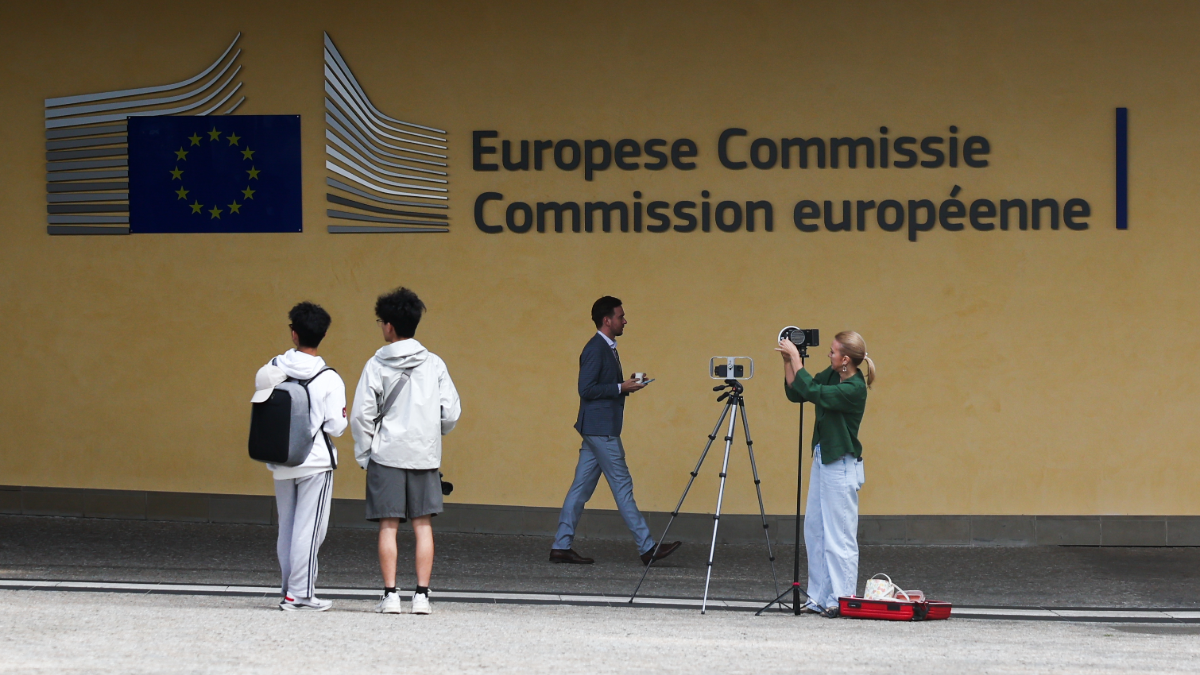
EU AI Act transparency rules take effect
TECH

EU AI Act transparency rules take effect

30+
Signals

Strategic Overview

  • 01.
    New EU AI Act transparency rules took effect on August 2, 2026, requiring AI systems to disclose themselves to users, mark AI-generated content, and label deepfakes and AI text on public-interest topics.
  • 02.
    The same day activated European Commission powers to inspect general-purpose AI models, restrict market access, and fine providers such as OpenAI, Anthropic, and Google regardless of where they are headquartered.
  • 03.
    Broad exemptions apply: artistic, satirical, fictional, and personal non-professional AI use are excluded, and AI-assisted text that has undergone human editorial review does not need a label.
  • 04.
    Existing generative AI systems get a transitional grace period until December 2, 2026 to comply with content-marking and detection obligations.

Deep Analysis

Two Regulations, One Deadline

On August 2, 2026, two distinct sets of obligations under the EU AI Act took effect on the same day, and it's worth separating them. First, the Article 50 transparency rules: AI systems must now tell users when they're interacting with a machine rather than a human, AI-generated or altered content has to carry machine-readable marks so it can be detected, and providers must disclose emotion-recognition and biometric-categorization systems as well as label deepfakes and AI-generated text on public-interest matters [1]. These obligations aren't limited to EU-headquartered companies - they apply to any provider, deployer, importer, or distributor that places AI on the EU market or whose AI output reaches EU users, wherever the company is based [2]. Second, and separately, the Commission's enforcement powers over general-purpose AI (GPAI) providers switched on the same day - it can now formally inspect models, request information, restrict market access, and fine companies, with the authority explicitly reaching OpenAI, Anthropic, and Google regardless of headquarters location [3]. More than 180 organizations had already signed the EU's voluntary Code of Practice on AI-content transparency ahead of the deadline [1]. SaferAI policy lead Chloé Touzet argues the early enforcement window matters disproportionately: "The first three to six months of enforcement are likely to set the tone for years" [4].

The Exemptions Doing the Heavy Lifting

Read past the headline and the rule is narrower than it sounds. Artistic, creative, satirical, and fictional works are exempt from the AI-content labeling mandate, as is personal, non-professional AI use [5]. Text produced with AI assistance is also exempt from disclosure if it has gone through human editorial review or control - meaning most professionally published, edited AI-assisted writing likely never needs a label at all [6]. That gap is exactly where online reaction split. On Reddit, developers who read Article 50's actual text concluded it doesn't touch source code, SDKs, configuration files, or closed-loop production assets - only consumer-facing deepfakes of real people or events, and unreviewed AI-generated text on public-interest topics, are in scope. A more skeptical reading argued the artistic-and-personal-use carve-outs are broad enough to cover most of what actually gets published, effectively hollowing out the rule before enforcement even tests it. Technical skepticism compounded the doubt: watermarking schemes are said not to survive re-encoding, raising the question of who actually verifies compliance once content leaves its original file.

Why OpenAI and Anthropic Opened a Side Door for EU Regulators

The GPAI enforcement track has a quieter backstory tied to security, not content labels. After cyberattacks were linked to their models, the EU opened discussions with OpenAI and Anthropic, and both companies agreed to give the EU's cybersecurity agency, ENISA, access to specialized model variants - OpenAI's 'GPT-5.5-Cyber' and Anthropic's 'Mythos' - ahead of the enforcement deadline, following Commission officials' visit to San Francisco [3]. That cooperation matters because the new enforcement powers don't only punish substantive rule-breaking. Sidley Austin partner Elisabetta Righini points out that GPAI liability extends to procedural conduct: "GPAI liability isn't limited to substantive breaches: refusing info requests, misleading answers, or blocking model evaluation is fineable independently" [3]. In other words, a model provider can be fined for stonewalling an investigation even if the underlying model itself never breaks a rule - which helps explain why OpenAI and Anthropic chose early, voluntary disclosure over risking a formal information request they'd have to answer under threat of penalty.

Compliance Theater or Real Deterrent?

Whether any of this changes the user experience is an open question. Google's own policy team warned the rule could backfire on its stated goal: "If online content is flooded with overlapping AI labels and legal disclosures, it becomes harder for people to get the clear context they need" [5]. Compliance postures already vary widely. Meta declined to sign the safety chapter of the GPAI Code of Practice even as it rolls out 'AI Info' labels on Instagram and Facebook [4], while TikTok says it has already labeled more than 3 billion pieces of AI-generated content ahead of the legal requirement [5]. Non-compliance is not cheap on paper - transparency and GPAI violations carry fines up to EUR 15 million or 3% of global turnover [2], and the sectors named as being on the compliance front line extend well beyond AI labs to financial institutions and content platforms handling AI-touched material [7]. Existing generative AI systems get some breathing room, with a transitional period pushing the marking and detection obligation out to December 2, 2026 [2]. Whether that adds up to real deterrence or just more paperwork is the question online reaction kept circling back to - developers traded compliance checklists while community skeptics floated the idea that blanket AI disclaimers will become as reflexive, and as uninformative, as cookie-consent banners.

Historical Context

2025-02-02
Prohibited AI practices (Article 5) and AI literacy obligations (Article 4) entered into force, carrying penalties up to EUR 35 million or 7% of global turnover.
2025-07-10
Published the final General-Purpose AI Code of Practice, a voluntary framework structured around transparency, copyright, and safety/security ahead of GPAI obligations.
2025-08-02
GPAI obligations under the AI Act became applicable to newly released general-purpose AI models.
2026-08-02
Transparency obligations (Article 50) and expanded enforcement powers over general-purpose AI providers took effect simultaneously, with over 180 organizations having signed the Code of Practice on transparency of AI-generated content.

Power Map

Key Players
Subject

EU AI Act transparency rules take effect

EU

European Commission / AI Office

Primary enforcer of the transparency rules and GPAI provisions; can now inspect general-purpose AI models, restrict EU market access, and levy fines. The AI Office has 145 staff, with 34 on regulation/compliance and 38 on safety teams.

OP

OpenAI

General-purpose AI model provider now under direct EU enforcement scrutiny; signed the voluntary GPAI Code of Practice; offered the EU access to its 'GPT-5.5-Cyber' model amid cyberattack concerns.

AN

Anthropic

General-purpose AI model provider under new enforcement powers; signed the GPAI Code of Practice; agreed to give EU cybersecurity agency ENISA access to its 'Mythos' model after Commission officials visited San Francisco.

GO

Google

General-purpose AI model provider now under enforcement scrutiny; signed the EU Code of Conduct on transparency; warned that overlapping AI labels could make it harder for people to get clear context.

ME

Meta

Declined to sign the safety chapter of the GPAI Code of Practice; already deploys 'AI Info' labels on Instagram and Facebook.

TI

TikTok

Already requires AI-generated content labels ahead of enforcement; has labeled over 3 billion items.

Fact Check

7 cited
  1. [1] Commission starts enforcing AI Act rules and new transparency requirements from 2 August
  2. [2] EU AI Act Transparency Obligations Take Effect August 2, 2026
  3. [3] EU AI Act Enforcement Begins
  4. [4] Brussels Gains New AI Act Enforcement Powers as Autonomous AI Tests Regulators
  5. [5] AI-generated label becomes mandatory in the EU for companies
  6. [6] EU AI Act Labels Start Aug. 2: AI Transparency Rules Explained
  7. [7] EU AI Act Transparency Rules Put Financial Institutions on Compliance Front Line

Source Articles

Top 5

THE SIGNAL.

Analysts

Argues the earliest months of enforcement will be decisive for how seriously the AI Act is taken going forward.

Chloé Touzet
Policy Lead, SaferAI

Notes that concern about deepfakes centers less on technical detection and more on the propaganda effect of manipulated imagery.

Joe McNamee
EU DisinfoLab

Warns that GPAI liability under the Act extends beyond substantive rule violations to procedural non-cooperation.

Elisabetta Righini
Partner, Sidley Austin
The Crowd

none of you is ready on what's coming with the new EU AI Act on 2 Aug. every single AI thing has to be visibly labeled as such under penalty up to €15 million

@@krzyzanowskim152

EU AI Act transparency rules are NOW in effect (as of Aug 2) What devs need to know: • Users must be told when interacting with AI • AI-generated content needs clear labeling • Deepfakes must be marked • Fines up to €35M or 7% global revenue Are you compliant?

@@ServBayDev2

A palindrome for you: I AM AI I am AI-generated content, and have to say this to be approved by EU AI act.

@@Merzmensch5

Europe will require mandatory disclosure for AI generated content under the "AI Act transparency obligations" starting 2 August.

@u/BanimaAtta1800
Broadcast
EU Forces Every Chatbot to Admit It's AI Starting Now

EU Forces Every Chatbot to Admit It's AI Starting Now

The EU AI Act Will Force AI Content Labeling in 2026

The EU AI Act Will Force AI Content Labeling in 2026

EU AI Act: The Bodies Behind Enforcement

EU AI Act: The Bodies Behind Enforcement

EU AI Act transparency rules take effect — AI News | Agentic Brew