Meta expands Louisiana AI data center to 5GW, $50B+ investment
TECH

Meta expands Louisiana AI data center to 5GW, $50B+ investment

37+
Signals

Strategic Overview

  • 01.
    Meta announced on July 13, 2026 that its Hyperion data center in Richland Parish, Louisiana will expand to 5 gigawatts of compute capacity, lifting disclosed investment in the region past $50 billion.
  • 02.
    The disclosed cost has climbed from roughly $10 billion at the December 2024 groundbreaking to $27 billion in the October 2025 Blue Owl joint venture, and now to more than $50 billion.
  • 03.
    Meta says it will invest over $1 billion in local infrastructure and has already awarded more than $1.6 billion in contracts to Louisiana businesses, with the site expected to support about 1,000 permanent jobs.
  • 04.
    Entergy Louisiana is building new natural gas plants, batteries, and transmission to supply the campus, while Meta separately explores renting out excess AI compute to outside customers.

Deep Analysis

From $10 Billion to $50 Billion in Eighteen Months
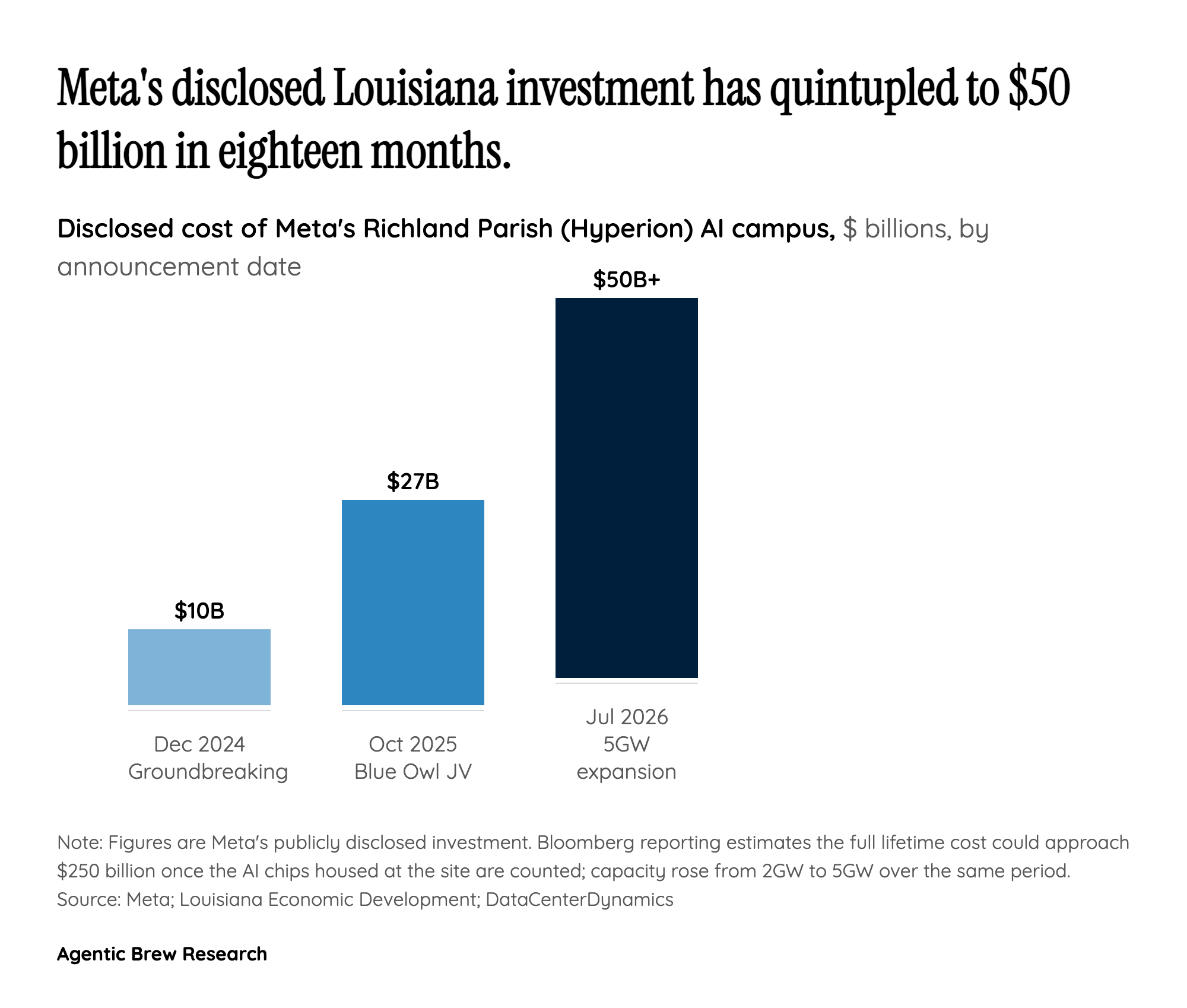
From $10 Billion to $50 Billion in Eighteen Months
Meta’s disclosed Louisiana investment climbed from $10B to $50B+ between the December 2024 groundbreaking and the July 2026 5GW expansion.

Meta's Richland Parish project has quietly become one of the most expensive single data centers ever attempted. When construction began in December 2024, the price tag was around $10 billion. By October 2025, when Meta and Blue Owl Capital formed their joint venture, it had climbed to $27 billion [3]. On July 13, 2026, Meta pushed the disclosed figure past $50 billion and lifted planned capacity from 2 gigawatts to 5 gigawatts [1]. Louisiana officials now describe the Hyperion campus as one of the largest data centers in history, spanning nearly 10 million square feet across as many as nine buildings [2].

But the word 'disclosed' is doing a lot of work here. Bloomberg's reporting, echoed across the financial commentary around the announcement, puts the full lifetime cost closer to $250 billion once the AI chips packed inside the buildings are counted - a figure Meta has pointedly declined to confirm. The distance between the $50 billion Meta will say out loud and the roughly $250 billion the site may ultimately consume is the actual headline. This is a wager large enough that Meta would rather the press release lead with teacher bonuses than with totals.
The Financing Sleight of Hand

The more revealing detail is not the number but how Meta is paying for it. Rather than carry the full cost on its balance sheet, Meta sold 80% of the campus to Blue Owl Capital through a $27 billion joint venture, keeping only about 20% for itself and taking a roughly $3 billion one-time distribution while Blue Owl contributed around $7 billion in cash [3]. The company then leases the facility back and runs it. In practice, one of the world's most cash-rich firms - Meta earns tens of billions in profit per quarter - structured its flagship AI project so most of the capital, and most of the downside, sits with an outside asset manager and its bond investors.

That structure is what has drawn regulatory fire. Critics argue the arrangement gives Meta an option to exit the project years earlier than a traditional owner would, precisely because it does not hold the majority stake [4]. For a company selling the expansion as a multi-decade commitment to Louisiana, the financing quietly says something different: keep the upside, offload the risk, and preserve the freedom to walk.

Who Pays When Meta Can Walk Away

The financing risk becomes concrete at the power plant. To feed a 5 gigawatt campus, Entergy Louisiana is building a fleet of new combined-cycle natural gas plants, grid-scale batteries, and hundreds of miles of transmission [2]. Those gas plants are built to run for roughly three decades. Meta's financing, critics say, could let it step away in a fraction of that time - and more than $500 million in transmission costs fall on all Entergy customers regardless of whether Meta stays [4].

That mismatch is the heart of the opposition. Earthjustice attorney Susan Stevens Miller warned that novel financing moves let a trillion-dollar company shift the long-term cost of fossil-fuel infrastructure onto ratepayers, and that regulators have a duty to scrutinize it [4]. The Alliance for Affordable Energy called the deal not in the public interest, and the Union of Concerned Scientists accused Meta of operating from the shadows by declining to participate formally at the Public Service Commission. In February 2026, the commission declined to open an investigation anyway [4]- a decision that, more than any single number, signals how much leverage a hyperscaler now holds over a state's energy policy.

The Excess-Compute Paradox

Here is the contradiction sitting inside the announcement. Only weeks before confirming a 5x expansion of a single campus, Meta was floating the idea that it might rent out excess AI compute to outside customers - a business the company is reportedly building under the banner of a cloud unit that would compete with AWS, Azure, and Google Cloud [5]. A firm does not usually 5x a megaproject and simultaneously advertise that it may have too much capacity to use itself.

One reading is confidence: Meta believes demand for AI compute is so deep that any surplus will find a buyer at a premium, echoing the model SpaceX uses for short-term, high-margin capacity. Bloomberg Intelligence has argued that once a company commits well over $100 billion a year to infrastructure, selling what it does not use stops being a side project and becomes a necessity, and estimates such a business could bring in more than $50 billion by 2028 [6]. The more skeptical reading is that the willingness to sublease at all is a tell - a company that was certain it would consume every gigawatt would not be workshopping a rental business before the concrete is dry. The market has been split accordingly: the compute-rental report lifted Meta's stock more than 10%, even as the shares have lagged big-tech peers over the past year on capex anxiety.

The PR Campaign and the Backlash

Meta clearly anticipated the fight. Its announcement was engineered for the constituency that decides whether data centers get built at all - local communities - and led with a headline about teachers and local businesses winning, quadrupled teacher bonuses to $50,000, a $5 million community-college gift, and testimonials from small-business owners [1]. With hundreds of cities and states now weighing data center bans, that goodwill is a strategic asset, not a nicety.

Online reception has been far less charitable. On Reddit, the loudest threads treated the subsidy math as the scandal: users repeatedly cited multi-billion-dollar tax abatements flowing to one of the richest companies on earth, and pointed out that the legislation underpinning the incentives requires only a small floor of permanent jobs to keep the benefits. Investor forums were more cynical still, reading the sublease-the-extra framing as a tell about the underlying economics. The gap between Meta's polished community narrative and the skeptical public conversation is itself the risk to watch: the project's social license, more than its engineering, is what remains genuinely contested.

Historical Context

2024-12
Construction of the Richland Parish, Louisiana data center began.
2025-10-22
Meta formed a $27 billion joint venture with Blue Owl, splitting ownership 80% Blue Owl and 20% Meta to fund the buildout.
2026-02-25
The commission declined to open a probe into Meta's Blue Owl financing restructuring despite consumer-advocate objections.
2026-07-13
Meta announced the 5 gigawatt expansion, lifting disclosed investment past $50 billion.

Power Map

Key Players
Subject

Meta expands Louisiana AI data center to 5GW, $50B+ investment

ME

Meta

Owner and operator of the Hyperion supercluster; it sets the capex trajectory and retains roughly 20% equity after selling the majority stake into a financing vehicle, so its demand assumptions drive the entire project.

BL

Blue Owl Capital

Alternative asset manager that owns 80% of the $27 billion joint venture and contributed roughly $7 billion in cash; it carries most of the balance-sheet risk if AI demand disappoints.

EN

Entergy Louisiana

The regulated utility financing power for the campus - new combined-cycle natural gas plants, grid batteries, and hundreds of miles of transmission - whose cost recovery decisions determine how much of the buildout lands on ordinary ratepayers.

GO

Gov. Jeff Landry and Louisiana Economic Development

The state leadership offering the tax incentives and permitting speed that make the project viable, framing it as a generational economic win for a poor region.

UN

Union of Concerned Scientists, Earthjustice, and the Alliance for Affordable Energy

Consumer and environmental advocates challenging the financing and gas buildout before regulators; their case shapes whether future data center deals face tougher public-interest scrutiny.

Fact Check

6 cited
  1. [1] Teachers and Local Businesses Win as Meta Expands Louisiana Data Center
  2. [2] Meta Commits More Than $50 Billion for North Louisiana Project, Becoming One of the Largest Data Centers in History
  3. [3] Meta forms $27 billion joint venture with Blue Owl to fund gigawatt-scale AI data center campus in Louisiana
  4. [4] Louisiana Won't Investigate Risky Meta Data Center Financing
  5. [5] Meta, like SpaceX, looks to turn excess AI compute into cash
  6. [6] Meta is building a cloud business to rent out its excess AI compute

Source Articles

Top 5

THE SIGNAL.

Analysts

"Argues Meta's financing lets it walk away from the project early, shifting the long-term cost of fossil-fuel infrastructure onto ratepayers, and that regulators have a responsibility to take a hard look."

Susan Stevens Miller
Attorney, Earthjustice

"Says the financing deal is not in the public interest and that the only parties benefiting from the arrangement are Meta and Entergy Louisiana."

Alaina DiLaura
Alliance for Affordable Energy

"Contends Meta operated from the shadows by refusing to participate formally at the Public Service Commission, and that commissioners chose to prioritize a trillion-dollar company over Louisiana ratepayers."

Paul Arbaje
Union of Concerned Scientists

"Estimates a Meta compute-rental business could generate more than $50 billion in revenue by 2028 and $100 billion by 2030, reasoning that once a company commits over $100 billion a year to infrastructure, finding buyers for unused capacity becomes a necessity rather than a side project."

Bloomberg Intelligence
Research analysts, Bloomberg Intelligence
The Crowd

"Meta is expanding its planned Louisiana Hyperion data center from 2GW to 5GW, lifting expected investment from $27B to $50B+ $META: https://t.co/i6cdbi3gIi"

@@TheTranscript_34

"TECH: META FUNDING SEVEN NEW GAS PLANTS TO POWER ITS LARGEST DATA CENTER @Meta is paying for the construction of seven new natural gas plants through Entergy Louisiana to power its Hyperion data center in Richland Parish. The plants will generate 5.2 gigawatts, roughly five https://t.co/UCNvGMgJGf"

@@BSCNews17

"Huge expansion of Meta data center heads to Louisiana regulators today. Here's what's at stake. https://t.co/Jps77AfXFr"

@@NOLAnews0

"Meta's Louisiana Data Center to Surpass $250 Billion Price Tag"

@u/Boraximus3500
Broadcast
Meta's $200 Billion Bet on a Remote Data Center

Meta's $200 Billion Bet on a Remote Data Center

Meta's $27 billion AI data center is transforming rural Louisiana

Meta's $27 billion AI data center is transforming rural Louisiana

Meta Funds Gas Plants to Power Mega Louisiana Data Center | Bloomberg Tech 3/27/2026

Meta Funds Gas Plants to Power Mega Louisiana Data Center | Bloomberg Tech 3/27/2026