Nvidia's AI infrastructure financing push
TECH

Nvidia's AI infrastructure financing push

36+
Signals

Strategic Overview

  • 01.
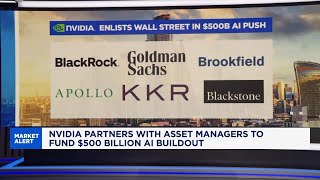
    On August 10, 2026, Nvidia announced a partnership with six major financial institutions - Apollo, BlackRock, Blackstone, Brookfield, Goldman Sachs, and KKR - to mobilize more than $500 billion in third-party capital for AI compute infrastructure, with Nvidia reportedly backstopping up to $125 billion of the total.
  • 02.
    A 13F filing made August 14, 2026 disclosed Nvidia holds a $21 billion equity stake in SpaceX and a $30 billion stake in Intel, while it has fully exited its Arm Holdings position.
  • 03.
    Nvidia is separately investing up to $3 billion in Lancium, a Blackstone-backed Texas power infrastructure developer behind the Stargate data center campus, in an initial $2 billion deal for a 20% stake.
  • 04.
    The financing push has intensified circular-financing concerns, with Nvidia's five-year credit default swap spread hitting a record 82 basis points and investor Michael Burry likening the arrangement to Enron-style circular spending.

Deep Analysis

Inside the $500 billion machine Nvidia built to keep its own balance sheet clean

On August 10, 2026, Nvidia announced it had partnered with six major financial institutions - Apollo, BlackRock, Blackstone, Brookfield, Goldman Sachs, and KKR - to establish AI compute infrastructure financing platforms designed to mobilize more than $500 billion in third-party capital[1]. The agreements are structured as memorandums of understanding rather than final contracts, and are designed so outside investors fund the data centers, power, and other AI infrastructure without adding that debt directly to Nvidia's own balance sheet[2]. Nvidia itself is reported to be backstopping up to $125 billion, roughly 25 percent of the potential deal volume - meaning a meaningful share of what looks like independent capital formation is actually Nvidia's own risk, one step removed[3].

The platform did not appear in isolation. Two weeks earlier, Nvidia was reported to be in talks to guarantee as much as $250 billion to help OpenAI lease computing capacity from a planned 10-gigawatt SoftBank-overseen data center hub in Ohio, part of a broader wave of AI infrastructure deals that topped $750 billion by late July 2026[10][11]. Stack the equity stakes, the guarantees, and the financing platform together and Nvidia is no longer simply selling GPUs - it is underwriting, insuring, and equity-financing the demand for them at nearly every layer of the AI buildout.

A $10 billion side bet turned into a $51 billion equity cushion - and it's already shrinking

Nvidia's own SEC 13F filing, made August 14, 2026, disclosed a $21 billion equity stake in SpaceX (about 122.8 million Class A shares) and a $30 billion stake in Intel (about 214.8 million shares), together accounting for roughly 80 percent of Nvidia's disclosed public equity portfolio[4][5]. Neither position started out that large. The SpaceX shares trace back to a $10 billion investment Nvidia made in xAI's Series E round in January 2026; when SpaceX acquired xAI in an all-stock deal the following month, Nvidia's xAI shares converted directly into SpaceX stock[6]. The Intel stake began as a $5 billion purchase tied to a September 2025 strategic partnership and has since generated a gain of roughly $25 billion[5]. The same filing confirmed Nvidia had fully exited its Arm Holdings position[7].

That windfall framing, however, is already out of date. By August 16, 2026, SpaceX's share price had slid from $170.86 to around $140, cutting the mark-to-market value of Nvidia's disclosed stake from $21 billion to roughly $17.2 billion in about six weeks[6]. It is a reminder that these are not fixed, bankable gains - they are volatile paper positions in the same AI infrastructure narrative that Nvidia itself is now bankrolling.

The circular financing debate Nvidia can't fully defuse

The sharpest pushback comes from investor Michael Burry, who has framed Nvidia's financing structures as circular spending pushed "to biblical proportions," comparing the arrangement to Enron-era financial engineering and pointing to a surge in Nvidia's credit default swap spreads as evidence markets are starting to price in the risk[12][13]. Those CDS spreads are not a fringe indicator: Nvidia's five-year credit default swap spread hit a record 82 basis points in late July 2026, and both the IMF and the Bank for International Settlements have separately flagged AI circular financing as a systemic downside risk[11]. Even Nvidia's own financing partner isn't fully clean on this front - Goldman Sachs analysts have warned that the accounting treatment of uncommenced leases tied to the AI buildout can understate leverage and future liquidity needs, since those commitments eventually convert into recognized liabilities once projects actually commence[14].

Reddit's reaction skewed sharply skeptical, with commenters coining terms like "Collateralized GPU Obligations" and comparing the whole structure to pre-2008 mortgage securitization, while a smaller contingent countered that physical compute infrastructure could outlast any financial bubble the way telecom fiber survived the dot-com crash. On X, the tone ran more analytical than alarmed, with several accounts framing the platform as Nvidia building a financing moat around its hardware rather than just a performance moat - though references to Wall Street skepticism about circularity kept surfacing even there. Nvidia's leadership has not denied the comparison outright, instead arguing the platform brings genuinely independent, long-term institutional capital into the market rather than recycling Nvidia's own money - a distinction skeptics say is impossible to verify while the deals remain non-binding memorandums of understanding rather than signed agreements.

Why Nvidia is buying land and power, not just chips, through Lancium

Beneath the headline financing numbers sits a much more physical problem: AI data centers need power and land before they need capital. Nvidia is investing up to $3 billion in Lancium, a Blackstone-backed Texas power infrastructure developer that owns the land and electrical infrastructure behind the Stargate data center campus - the SoftBank, OpenAI, and Oracle joint venture announced with a potential $500 billion investment scope[9]. The deal is structured as an initial $2 billion investment for a 20 percent stake, with another $1 billion contingent on Lancium hitting specific milestones, valuing the company and its asset portfolio at roughly $10 billion; Lancium is reportedly exploring an IPO as early as 2027[8].

The logic connects directly back to the financing platform. Analysts have identified capital availability, not chip supply or chip demand, as the primary bottleneck now constraining further AI infrastructure expansion[14]. But capital alone cannot conjure gigawatts of power or shovel-ready land - which is why Nvidia is reaching past its balance sheet and past Wall Street to buy a direct stake in the physical bottleneck itself. Securing power and land, not just financing chip purchases, is becoming as central to Nvidia's strategy as the GPUs themselves.

Historical Context

2025-09
Nvidia and Intel announced a strategic AI infrastructure partnership; Nvidia made a $5 billion investment in Intel stock as part of the deal.
2026-01
Nvidia invested $10 billion into xAI's $20 billion Series E funding round.
2026-01
Stargate joint venture announced with a potential $500 billion investment scope, including the Texas data center campus later linked to Lancium.
2026-02
SpaceX acquired xAI in an all-stock deal valuing the combined entity at $1.25 trillion; Nvidia's xAI shares converted into SpaceX Class A stock, forming the basis of its later-disclosed $21B SpaceX stake.
2026-07-26
Reports emerged that Nvidia was in talks to backstop as much as $250 billion to help OpenAI lease computing from a planned $500 billion, 10-gigawatt Ohio data center hub overseen by SoftBank.
2026-07-27
Reports of a fresh round of Nvidia AI deals exceeding $750 billion reignited circular-financing fears; Nvidia's five-year credit default swap spread surged to a record 82 basis points.
2026-08-10
Nvidia announced the $500B+ AI compute infrastructure financing platform partnership with six major financial institutions.
2026-08-14
Nvidia's SEC 13F filing disclosed the $21B SpaceX stake, $30B Intel stake, and complete exit from its Arm Holdings position, as of the June 30, 2026 reporting period.

Power Map

Key Players
Subject

Nvidia's AI infrastructure financing push

NV

Nvidia

Orchestrates the $500B+ financing platform, backstops roughly a quarter of it directly, and holds large equity stakes in the customers buying its chips.

AP

Apollo, BlackRock, Blackstone, Brookfield, Goldman Sachs, and KKR

The six asset managers and banks that signed memorandums of understanding with Nvidia to supply the $500B+ in third-party capital for AI compute infrastructure.

SP

SpaceX

Nvidia's second-largest disclosed equity holding ($21B), committed exclusively to Nvidia GPUs for its AI data centers.

IN

Intel

Nvidia's largest disclosed equity holding ($30B), strategic AI infrastructure partner since September 2025, pledged Nvidia chip exclusivity for some products.

LA

Lancium

Texas power infrastructure developer receiving up to $3B from Nvidia; owns the land and electrical infrastructure behind the Stargate data center campus and is exploring a 2027 IPO.

Fact Check

14 cited
  1. [1] NVIDIA Partners With Apollo, BlackRock, Blackstone, Brookfield, Goldman Sachs and KKR to Establish AI Compute Infrastructure Financing Platforms to Mobilize Over $500 Billion of Third-Party Capital
  2. [2] Nvidia Partners With Apollo, BlackRock and Others for AI Infrastructure Financing
  3. [3] Nvidia AI Financing Is The $500 Billion Risk Investors Aren't Watching
  4. [4] Nvidia discloses $21 billion stake in SpaceX at end of second quarter
  5. [5] Nvidia Has $21 Billion SpaceX Stake, $30 Billion in Intel Shares
  6. [6] Nvidia's Secret $21 Billion SpaceX Windfall: How One Chip Deal Turned Into a Rocket Fortune
  7. [7] Nvidia turns $5B Intel stock bet into $30B windfall - filing reveals new $21B SpaceX stake and complete exit from Arm stock
  8. [8] Nvidia to Invest Up to $3 Billion in Lancium for AI Infrastructure Development
  9. [9] Nvidia to Invest Up to $3 Billion in Blackstone-Backed Power Firm Behind Stargate
  10. [10] Nvidia in Talks on $250 Billion Backing for OpenAI Hub, WSJ Says
  11. [11] Nvidia's $750 Billion Deals Revive Fear of AI Circular Financing
  12. [12] Michael Burry Calls Nvidia's $500B Financing Plan Into Question
  13. [13] Michael Burry Warns Nvidia's 'Overreaching' Is Pushing Circular Spending to 'Biblical Proportions' Amid Surge in Credit Default Swaps
  14. [14] Nvidia Secures $500B for AI Infrastructure Financing

Source Articles

Top 5

THE SIGNAL.

Analysts

Frames Nvidia's compute as a new investable infrastructure asset class: "We began by building chips; today, we are helping create a new class of productive, investable infrastructure: AI factories."

Jensen Huang, Nvidia Founder/CEO
Proponent

Ties the deal to BlackRock's existing AI Infrastructure Partnership with Nvidia: "This partnership deepens our relationship with NVIDIA... and brings together NVIDIA's leadership in accelerated computing with BlackRock's ability to connect long-term capital to essential infrastructure."

Larry Fink, Chairman/CEO, BlackRock
Proponent

Argues Nvidia's financing structures push circular spending "to biblical proportions," compares the $500B platform to Enron-style financial engineering, and cites surging Nvidia credit default swap spreads as evidence of rising perceived risk.

Michael Burry, investor (Scion Asset Management)
Critic

Notes the $500B platform is only an unfinalized memorandum of understanding, draws a pointed comparison to Nvidia's earlier OpenAI MOU that later "radically shifted" from what was announced, and argues Nvidia is likely backstopping part of the total - meaning it functions as disguised debt for Nvidia itself.

Jay Goldberg, Seaport Global Securities
Skeptical

Warned that the accounting treatment of uncommenced leases tied to the AI buildout "can understate leverage and future liquidity needs" because such commitments eventually become recognized liabilities once projects commence.

Goldman Sachs analysts
Cautionary
The Crowd

Goldman Sachs has already started helping Nvidia build financing platforms aimed at pulling $500B+ into AI infrastructure. Nvidia is building a financing moat around its hardware, not just a performance moat. Lenders will get better terms when Nvidia supports residual value, and customers also will get a lower cost of capital for Nvidia-based infrastructure than for competing accelerators with similar operating economics Reuters reports Goldman is already talking to banks, insurers, asset managers and private-credit firms, while its own units can supply junior capital and place debt. Goldman can then bridge several capital pools by funding the junior layer, arranging private credit and eventually placing debt into broader markets.

@@rohanpaul_ai35

Nvidia $NVDA is said to invest up to $3 billion in power infrastructure developer Lancium, owner of the land and electrical infrastructure for the Stargate campus in Texas, with an initial $2 billion investment reportedly giving Nvidia a 20% stake in the firm. $ORCL $AMD

@@Beth_Kindig83

$NVDA's new $500B chip financing program is huge news for $SPCX investors @SpaceX wants to build 6-8GW of compute next year. That will cost $300B+ They only have $100B in cash. Now instead of selling stock to fund it they can get loans from @nvidia @grok is this right?

@@Gfilche239

Nvidia lines up $500 billion in financing as CEO Jensen Huang tells CNBC his chips are 'investable asset'

@u/MoesOtherBar2600
Broadcast
Inside Nvidia's $500B AI Financing Loop

Inside Nvidia's $500B AI Financing Loop

How Nvidia's $500B financing deal will entrench its AI dominance

How Nvidia's $500B financing deal will entrench its AI dominance

Nvidia Sparks Renewed Circular Financing Concerns with New Deals | Bloomberg Tech 7/27/2026

Nvidia Sparks Renewed Circular Financing Concerns with New Deals | Bloomberg Tech 7/27/2026