DuckDuckGo install surge after Google AI Search overhaul
TECH

DuckDuckGo install surge after Google AI Search overhaul

30+
Signals

Strategic Overview

  • 01.
    DuckDuckGo reported a sustained surge in U.S. app installs and traffic to its AI-free search page in the week after Google I/O 2026, where Google made AI Overviews and AI Mode the default with no consumer opt-out.
  • 02.
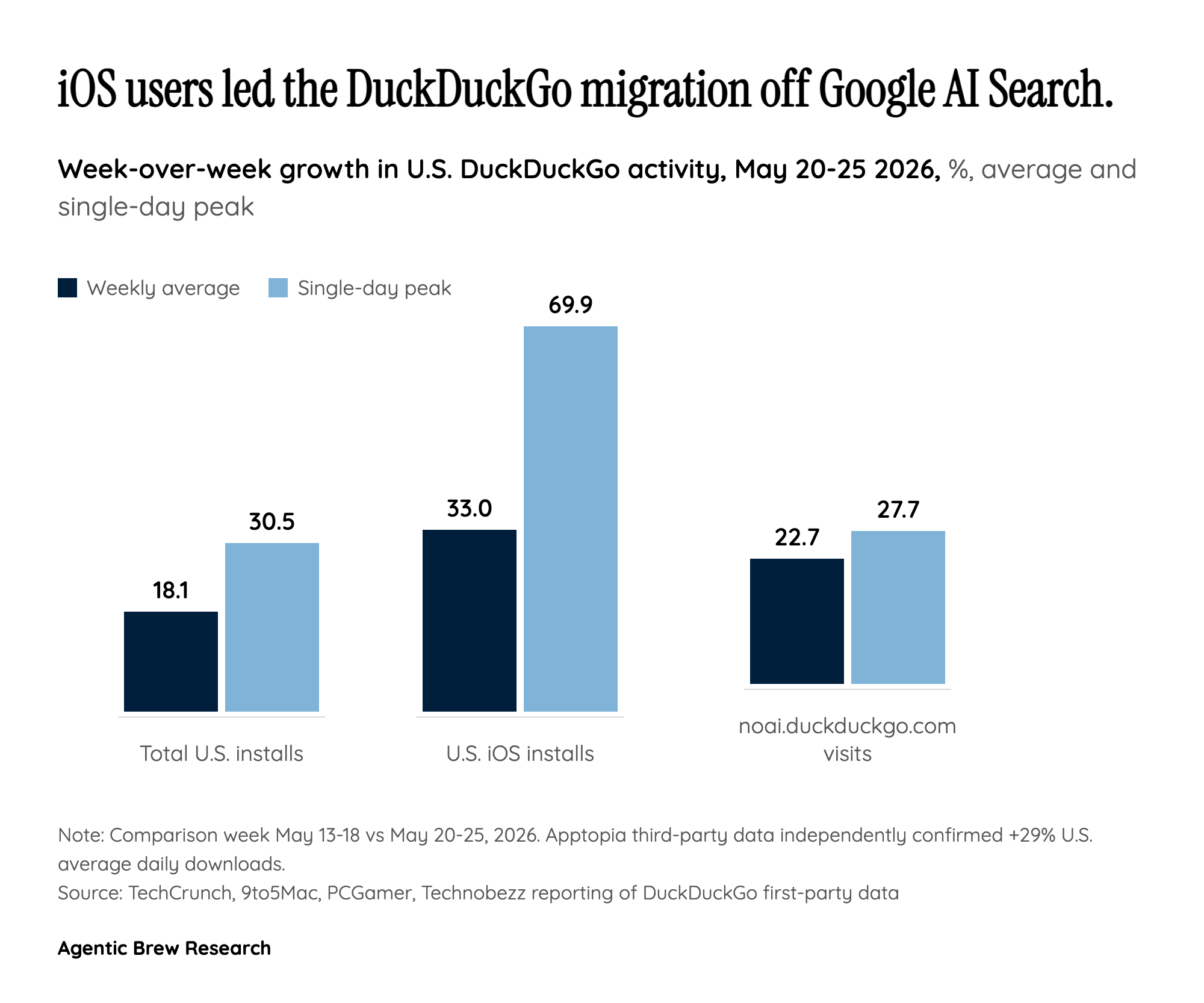
    U.S. app installs grew 18.1% week-over-week on average between May 20 and May 25, with six consecutive days of growth and a peak of 30.5% on May 25.
  • 03.
    iOS installs in the U.S. jumped 33% week-over-week on average and peaked at 69.9% on May 25, multiples of the international growth rate.
  • 04.
    Visits to DuckDuckGo's AI-free search page noai.duckduckgo.com rose 22.7% week-over-week on average and hit 27.7% on May 24, signaling that users were specifically seeking out an AI-free experience.
  • 05.
    Third-party analytics firm Apptopia independently confirmed the surge with a 29% increase in average daily U.S. DuckDuckGo downloads and a 12% global increase.

Deep Analysis

The opt-out is the product

DuckDuckGo did not respond to Google I/O 2026 with a marketing campaign. It responded with a URL. noai.duckduckgo.com is a literal opt-out endpoint that strips every AI feature from the search experience, and traffic to that specific page grew 22.7% week-over-week on average, peaking at 27.7% on May 24 [3]. That detail matters because it separates this story from a generic anti-AI mood. Users were not just downloading any alternative. They were typing in the exact URL designed to deliver an AI-free result page. The standard DuckDuckGo experience already lets users toggle AI features off in settings, so the company effectively turned its product surface into the structural argument: choice as a feature, not a slogan [1]. By contrast, Google's I/O announcement removed the option entirely from the consumer surface and offered no opt-out for AI Overviews or AI Mode [5]. When the dominant product takes away a switch, a tiny competitor that hard-codes that switch into its URL gets to convert frustration directly into installs.
Memorial Day weekend is the durability tell

Memorial Day weekend is the durability tell
iOS users led the migration: U.S. iOS installs peaked at 69.9% week-over-week growth on May 25, well ahead of overall installs and noai.duckduckgo.com visits.

Most install spikes are reactive bumps that fade within days. This one did the opposite. DuckDuckGo's growth not only held but accelerated through Memorial Day weekend, a period when app activity typically dips because people are away from desks and out of their normal search patterns [2]. Six consecutive days of week-over-week growth, peaking on May 25, suggest the surge is not a single news-cycle reaction to I/O coverage on May 20 but a behavioral shift triggered when users actually started running queries in the new AI-default Search and disliked what they saw [1]. Apptopia's independent third-party data corroborates the pattern with a 29% increase in average daily U.S. downloads, ruling out the possibility that DuckDuckGo cherry-picked a favorable window [1]. The Memorial Day acceleration is the signal that this is migration behavior, not a news bump.

The 1.84% share problem

Contrarian voices on Reddit are not wrong that DuckDuckGo's U.S. search market share sits at roughly 1.84% globally and around 30 million U.S. users, and that 30% growth on a small base is still a small base in absolute terms [6]. What makes this round different from prior privacy-news bumps is the combination of three signals. First, the iOS-specific growth rate of 33% week-over-week on average with a 69.9% single-day peak is multiples of the international rate, suggesting concentrated U.S. consumer response rather than ambient noise [4]. Second, the AI-free URL traffic confirms intent, not just curiosity [3]. Third, the surge held through a holiday weekend. The honest read is that 30% growth on 1.84% share will not reorder the search market, but it is the first measurable consumer migration tied to a specific Google product decision, and it gives DuckDuckGo a concrete behavioral data point to take to regulators and advertisers.

The regulatory and publisher backlash that multiplies the user signal

DuckDuckGo's surge is landing into a regulatory environment that was already moving. The UK Competition and Markets Authority designated Google with Strategic Market Status in October 2025 in general search and search advertising, giving the regulator power to impose binding conduct rules around AI features [5]. Publishers are reporting traffic declines of 1-25% and CTR drops as high as 79% on pages where AI Overviews appear, a parallel backlash from the supply side of search [7]. Google itself acknowledged in a March 2026 blog post that it was developing further opt-out controls for sites, but offered no timeline [5]. The consumer surge to DuckDuckGo turns a publisher and regulator narrative into a user data point Google has historically dismissed. A DuckDuckGo poll earlier this year drew over 175,000 respondents with more than 90% opposing mandatory AI in search results, and the I/O reaction is the first time that latent preference showed up in install charts [1]. The three pressure vectors (regulators, publishers, users) now point in the same direction.

Historical Context

2008-01-01
Founded by Gabriel Weinberg as a privacy-first search engine with no tracking or personalized profiling.
2020-04-01
Saw an earlier wave of growth at the start of the COVID-19 pandemic and continuing through the U.S. 2020 elections, then stabilizing.
2025-10-01
Designated Google with Strategic Market Status in general search and search advertising, giving regulators power to impose binding conduct rules around AI features.
2026-03-18
Published a blog post saying it is developing further controls to let sites opt out of generative AI features in Search, but offered no timeline for granular opt-out.
2026-05-20
Google announced its Search overhaul: AI Overviews answer questions first, AI Mode replaces default blue links, and a conversational Intelligent Search Box becomes the entry point.
2026-05-25
Reached the peak of its install surge: 30.5% week-over-week growth in overall U.S. installs and 69.9% on iOS.

Power Map

Key Players
Subject

DuckDuckGo install surge after Google AI Search overhaul

DU

DuckDuckGo

Privacy-focused search engine and direct beneficiary of the backlash. Positions itself as the place that lets users opt in or out of AI features, with a dedicated AI-free URL at noai.duckduckgo.com.

GO

Google

Triggered the backlash at I/O 2026 by transforming Search into a conversational AI-first engine with AI Overviews and AI Mode replacing default blue-link results, offering no consumer-facing opt-out.

GA

Gabriel Weinberg

DuckDuckGo founder and CEO who publicly framed the surge as a backlash against Google force-feeding AI and positioned DuckDuckGo as the user-choice alternative.

AP

Apptopia

Independent app analytics firm whose third-party data corroborates DuckDuckGo's first-party numbers, lending credibility to the surge claim.

UK

UK Competition and Markets Authority (CMA)

Regulator that designated Google with Strategic Market Status in October 2025 and is pushing publisher opt-out controls for AI Overviews, increasing regulatory pressure on Google's AI-default Search.

PU

Publishers and content websites

Reporting traffic declines of 1-25% and CTR drops as high as 79% when AI Overviews appear, fueling broader anti-AI-search sentiment that compounds the consumer backlash.

Fact Check

7 cited
  1. [1] DuckDuckGo installs are up 30% as users reject being 'force-fed' Google's AI Search
  2. [2] DuckDuckGo sees iPhone installs spike in the US following AI announcements at Google I/O
  3. [3] DuckDuckGo's AI-free search saw nearly 28% more visits in the week following Google's insistence that people love AI mode
  4. [4] DuckDuckGo iOS installs surged 70 percent after Google forced AI features on search users
  5. [5] Google's forced AI opt-out: what changes and what doesn't for publishers
  6. [6] DuckDuckGo Stats: Users, Demographics, Search Market Share
  7. [7] Google AI Search Opt-Out: A Guide for Website Owners and Publishers

Source Articles

Top 4

THE SIGNAL.

Analysts

"Google is force-feeding AI with no way to opt out. As a result, their results are getting worse, not better. We want to be the place that puts users in charge and allows them to decide how much or how little AI they want."

Gabriel Weinberg
Founder & CEO, DuckDuckGo

"Not only do we respect user choice, but also user privacy. Everything you do in DuckDuckGo is private, we don't collect search histories or chats and nothing is used for AI training."

Gabriel Weinberg
Founder & CEO, DuckDuckGo

"People just want a choice."

DuckDuckGo spokesperson
DuckDuckGo Communications
The Crowd

"People aren't just complaining about Google's AI search overhaul, they're leaving. Yesterday alone, our week over week installs surged 30% in the U.S. Momentum is growing. It's time to Fire Google."

@@DuckDuckGo2572

"DuckDuckGo installs are up 30% as users reject being 'force-fed' Google's AI Search"

@@TechCrunch831

"DuckDuckGo saw nearly 28% more visits in the week following Google's insistence that people love AI mode and forcing AI on people when were looking to search results."

@@nixcraft87

"DuckDuckGo Installs Jumped 30% as Frustration With Google's AI Search Grew"

@u/techzexplore247
Broadcast
Google's Going Full AI Mode. Here's how to avoid it (hopefully)

Google's Going Full AI Mode. Here's how to avoid it (hopefully)

Google Search is Over.

Google Search is Over.

DuckDuckGo Installs Just Spiked 70% on iPhone. Here's Why.

DuckDuckGo Installs Just Spiked 70% on iPhone. Here's Why.