World Humanoid Robot Games 2026: speed records give way to commercial trials
TECH

World Humanoid Robot Games 2026: speed records give way to commercial trials

37+
Signals

Strategic Overview

  • 01.
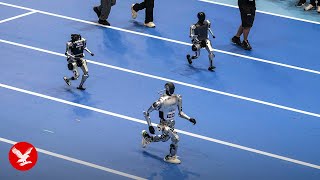
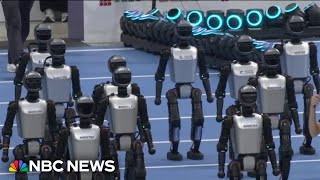
    The second World Humanoid Robot Games ran August 22-26, 2026 at Beijing's National Speed Skating Oval, drawing 666 teams and 2,056 robots from 16 countries across six continents.
  • 02.
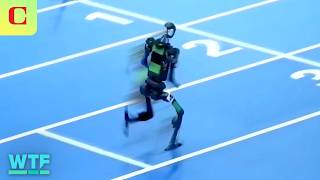
    Robots set new records in track-and-field events, including a 100m sprint in 9.39 seconds (beating Usain Bolt's human record of 9.58 seconds) and a standing high jump of 2.88 meters (versus the 2.45m human record set by Javier Sotomayor in 1993).
  • 03.
    The 2026 program expanded to 51 events (30 sports, 21 scenario-based) and 1,301 matches, up from 26 events and 487 matches in the 2025 inaugural Games, adding several new dexterous-hand categories among the scenario-based events, such as power-tool assembly, bricklaying, and precision picking.
  • 04.
    In the broader industry context, the US Federal Communications Commission announced a ban on imports of foreign-made humanoid robots citing national security, and the Pentagon separately added Unitree Robotics to a list of companies with alleged Chinese military ties.

Deep Analysis

The Sprint Was the Easy Part

Beijing's 2026 World Humanoid Robot Games grabbed headlines for the reason organizers wanted: a robot from X-Humanoid ran the 100m in 9.39 seconds, faster than Usain Bolt's 9.58-second human record, and another machine cleared a standing high jump of 2.88 meters against the 2.45m human mark. Those numbers are real, but track-and-field is also the category where humanoid robots have had the longest run of engineering practice - repetitive, symmetric, low-decision-density motion. The harder tell of where the industry actually stands sits among the 21 new scenario-based events added this year: several are dexterous-hand challenges - power-tool assembly, powder weighing, bricklaying, nail fastening, and precision picking [3]- judged on the speed and accuracy of a robot's hands rather than its legs.

Forbes contributor John Koetsier called the full event schedule 'one of the most honest documents in robotics right now, because it reveals which capabilities are solved and can be done by robots autonomously... and which ones are harder and still need a human at the controls' [1]. Wang Peng of the Beijing Academy of Social Sciences drew the same line more bluntly: 'Last year it was about whether they could run to the finish line. This year it's about whether they can get the job done' [1]. That reframing matters because Unitree founder Wang Xingxing, whose company's robots have dominated past Games, has said publicly that 'limited generalization capability is currently the biggest bottleneck facing the global humanoid robot industry' - performance falls off sharply the moment an object or environment changes from what the robot trained on [2]. A 9.39-second sprint on a straight, flat track says little about that problem; a dexterous hand fumbling a bottle cap says a great deal.

The program's growth underscores how much organizers are betting on the harder categories catching up: 51 events across 30 sports and 21 scenarios and 1,301 total matches, roughly double last year's 26 events and 487 matches [4].
From Spectacle to Supply Chain

China's robotics officials are not shy about what the Games are actually for. Liu Weiliang, deputy head of the Beijing Municipal Bureau of Economy and Information Technology, described each competition task as effectively 'a trial run in a real-world scenario,' adding 'there is no need to rebuild the same testing environment after the competition' [4]. His colleague Jiang Guangzhi framed the event as a funnel more directly still: 'once robots master these last-meter skills, they can turn medals into orders and move directly from the competition arena to real-world workplaces' [4]. That is a strikingly literal translation of sporting spectacle into a procurement pipeline, and it explains why the newest categories - hotel and restaurant service tasks, precision picking, cable connection - map so closely onto jobs that show up in factory and hospitality staffing.

UBTECH Robotics made the commercial logic explicit, defending the Games' performance-heavy format as reflecting 'real commercial demands' and pointing to manufacturing partnerships with Huawei and Foxconn [2]. RoboCup Federation vice president Zhou Changjiu framed the broader competition slate the same way - sprinting for speed, marathons for battery endurance, football for intelligence, manipulation, safety, cost and trust - as a battery of tests 'for humanoid robots to enter the real world' [2].

None of this is happening without state money behind it. Beijing has committed a 100-billion-yuan robotics fund, Shenzhen rolled out a roughly $1.4 billion AI and robotics fund in early 2025, and reports point to a national fund on the order of $137 billion under discussion, all building on the five-year robotics blueprint the central government issued in 2021 [3]. Falling component costs and a maturing domestic supply chain are doing the rest of the work [3].

A Robot Olympics as Geopolitical Flashpoint

Beijing's 2026 Games drew a record 666 teams and 2,056 robots from 16 countries [5]. Separately, the US Federal Communications Commission has announced a ban on imports of foreign-made humanoid robots citing national security, and the Pentagon has added Unitree Robotics - one of the Games' most decorated competitors - to a list of companies with alleged ties to the Chinese military [6].

China designated robotics the 'crown jewel' of advanced manufacturing back in 2014, held the first World Robot Conference in Beijing in 2015, and issued a five-year robotics development blueprint with subsidies, R&D tax breaks and financing support in 2021 [3]- a decade-long buildup that this event is meant to publicly cash in on. China's Games are built to signal industrial-policy success to a domestic and international audience; the US posture treats the same category of robots as a security risk rather than a product to be evaluated purely on its merits. Whichever government view prevails will do more to determine where these robots actually ship than any sprint time.

The Crash Reel and the Trust Gap

Not every robot at the Games behaved like a world-record holder. The X-Humanoid sprinter that broke Bolt's record 'slammed into a cushion and fell to the ground' moments after crossing the line, and some competitors elsewhere at the event tripped, fell, or were damaged in collisions [6]. Koetsier's own list of what the competition schedule does not test is instructive: no stairs, no ladders, no difficult terrain, no measure of battery endurance or energy consumption under load, no long-horizon reliability, and no test of following a verbal instruction [1].

Mainstream social accounts covering the Games gravitated toward the two easiest hooks. Bloomberg's account framed the story mainly around scale, emphasizing the jump to 666 teams and more than 2,000 robots, while the AP's account led with the sprint record as the moment most likely to travel - between them illustrating how coverage skews toward headcount and speed rather than the harder manipulation categories. On Reddit, engineers debated whether a viral clip of a robot crashing hard into a barrier during sprint practice was real or synthetic, ultimately concluding from multi-angle footage and the physics of the visible electrical short that it was genuine - while noting the resulting damage looked like a cheap, quick repair rather than a write-off. In a separate r/BGMStock thread, commenters made a more pointed argument: of the roughly 30 sport disciplines on this year's card, only about four actually require a robot to operate with full autonomy and no nearby operator or remote control, which they read as evidence against treating the Games as proof of broad real-world readiness. On X, one computational social scientist watched the livestream and found the moment-to-moment action 'quite boring,' arguing the real story isn't any single day's polish but the rate of change year over year.

That tension - genuine, hard-won engineering progress (a human-scale bipedal machine beating an Olympic sprinter's time is not a trivial feat) sitting next to failure reels and contested claims of autonomy - is probably the most accurate single-sentence summary of where humanoid robotics stands in 2026: real progress, real theater, and a gap between the two that neither side is fully honest about.

Historical Context

2014
Designated robotics the 'crown jewel' of advanced manufacturing, setting the policy tone that would eventually produce the Games.
2015
First held in Beijing, establishing the city as China's recurring venue for robotics showcases.
2021
Released a five-year robotics blueprint offering subsidies, R&D tax cuts, and financing support to the sector.
2025-08-15
Inaugural Games held in Beijing with 280 teams, 500+ robots, and 26 events.
2026-08-22
Second Games opened in Beijing with 666 teams and 2,056 robots, roughly quadrupling robot participation year over year.

Power Map

Key Players
Subject

World Humanoid Robot Games 2026: speed records give way to commercial trials

X-

X-Humanoid

Beijing-based manufacturer whose robot set the Games' official 100m sprint (9.39s) and standing high jump (2.88m) records, making it the most visible face of this year's event.

UN

Unitree Robotics

Founder Wang Xingxing named generalization capability as the industry's core bottleneck, its H1 robot completed a half-marathon without an accompanying engineer, and the Pentagon separately flagged the company over alleged military ties - making it a bellwether for both the technology and the geopolitics.

UB

UBTECH Robotics

Defended the Games' performance-heavy format as reflecting real commercial demand, citing active manufacturing partnerships with Huawei and Foxconn as evidence the format converts into revenue.

BE

Beijing Municipal Bureau of Economy and Information Technology

Co-organizer that explicitly frames the Games as a mechanism to convert competition wins directly into commercial procurement orders, shaping how the event is designed and marketed.

HO

Honor

Chinese smartphone maker whose robot posted an unofficial 9.32-second 100m trial, faster than the official record, signaling that consumer-electronics firms are now credible competitors in humanoid hardware.

GA

Galbot

Built the LATENT control system with researchers from Tsinghua University and Peking University and used it to have a Unitree G1 humanoid sustain a tennis rally against a human player, positioning the startup as a manipulation and reactive-control specialist within the Games' broader push toward dexterous, real-world tasks.

Fact Check

6 cited
  1. [1] The World Humanoid Robot Games Events Are A Market Map
  2. [2] Chinese robotics leaders defend commercial focus of Humanoid Robot Games
  3. [3] China's robot games evolve from science fair to strategic showcase
  4. [4] World Humanoid Robot Games returns to Beijing with record participation
  5. [5] Beijing hosts second World Humanoid Robot Games with record entries
  6. [6] Chinese robot beats Usain Bolt's 100-meter sprint record

Source Articles

Top 5

THE SIGNAL.

Analysts

Says limited generalization capability is the biggest bottleneck facing the global humanoid robot industry, with performance falling off sharply whenever the object or environment changes, and expects a breakthrough in two to ten years.

Wang Xingxing
Founder, Unitree Robotics

Frames the Games' event slate as a deliberate battery of real-world tests - sprinting for speed, marathons for battery endurance, football for intelligence, manipulation, safety and trust.

Zhou Changjiu
Vice President, RoboCup Federation

Calls the event schedule 'one of the most honest documents in robotics right now' because it reveals which capabilities are solved and autonomous versus which still need a human at the controls.

John Koetsier
Senior Contributor, Forbes

Contrasts this year's Games with last year's: 'Last year it was about whether they could run to the finish line. This year it's about whether they can get the job done.'

Wang Peng
Researcher, Beijing Academy of Social Sciences

Describes every completed task as effectively a real-world trial run, noting there is no need to rebuild the same testing environment after the competition ends.

Liu Weiliang
Deputy Head, Beijing Municipal Bureau of Economy and Information Technology
The Crowd

The 2026 World Humanoid Robot Games have begun. 666 teams from around the world are competing with more than 2,000 humanoid robots

@@business7058

WATCH: Chinese robot beats Usain Bolt's 100m world record on the opening day of the Olympics-like World Humanoid Robot Games in Beijing. Read more here: bit.ly/4qwJetf

@@AP1799

This morning my wife & I watched the live stream of the humanoid robot games. Most of the live stream is quite boring, with a camera wandering around the arena looking for action. But while many demos feel unimpressive, what is interesting is not the level, but the change. Bad...

@@cesifoti102

9.3 seconds…Humanoid robots now run faster than humans

@u/Overflame3500
Broadcast
First ever World Humanoid Robot Games kicks off in Beijing

First ever World Humanoid Robot Games kicks off in Beijing

Robots from 16 countries compete in World Humanoid Robot games in Beijing

Robots from 16 countries compete in World Humanoid Robot games in Beijing

Humanoid DOWN! Highlights From the First World Humanoid Robot Games | What The Future

Humanoid DOWN! Highlights From the First World Humanoid Robot Games | What The Future