OpenAI's $50B vs $70B Revenue Discrepancy Explained
TECH

OpenAI's $50B vs $70B Revenue Discrepancy Explained

22+
Signals

Strategic Overview

  • 01.
    OpenAI told investors its annualized revenue is approaching $50 billion as of late September 2026, roughly $20 billion below the ~$70 billion figure that had circulated earlier.
  • 02.
    The $20 billion gap is a measurement and accounting difference, not a sign of weakening AI demand.
  • 03.
    The earlier ~$70 billion figure traces to a September 29, 2026 Axios report, sourced anonymously, that applied Anthropic's gross-revenue methodology to OpenAI's growth rate.
  • 04.
    The Financial Times first reported the corrected ~$50 billion figure on October 8, 2026, triggering a broad tech-stock selloff.

Deep Analysis

The Accounting Trick Nobody Told You About
The Accounting Trick Nobody Told You About
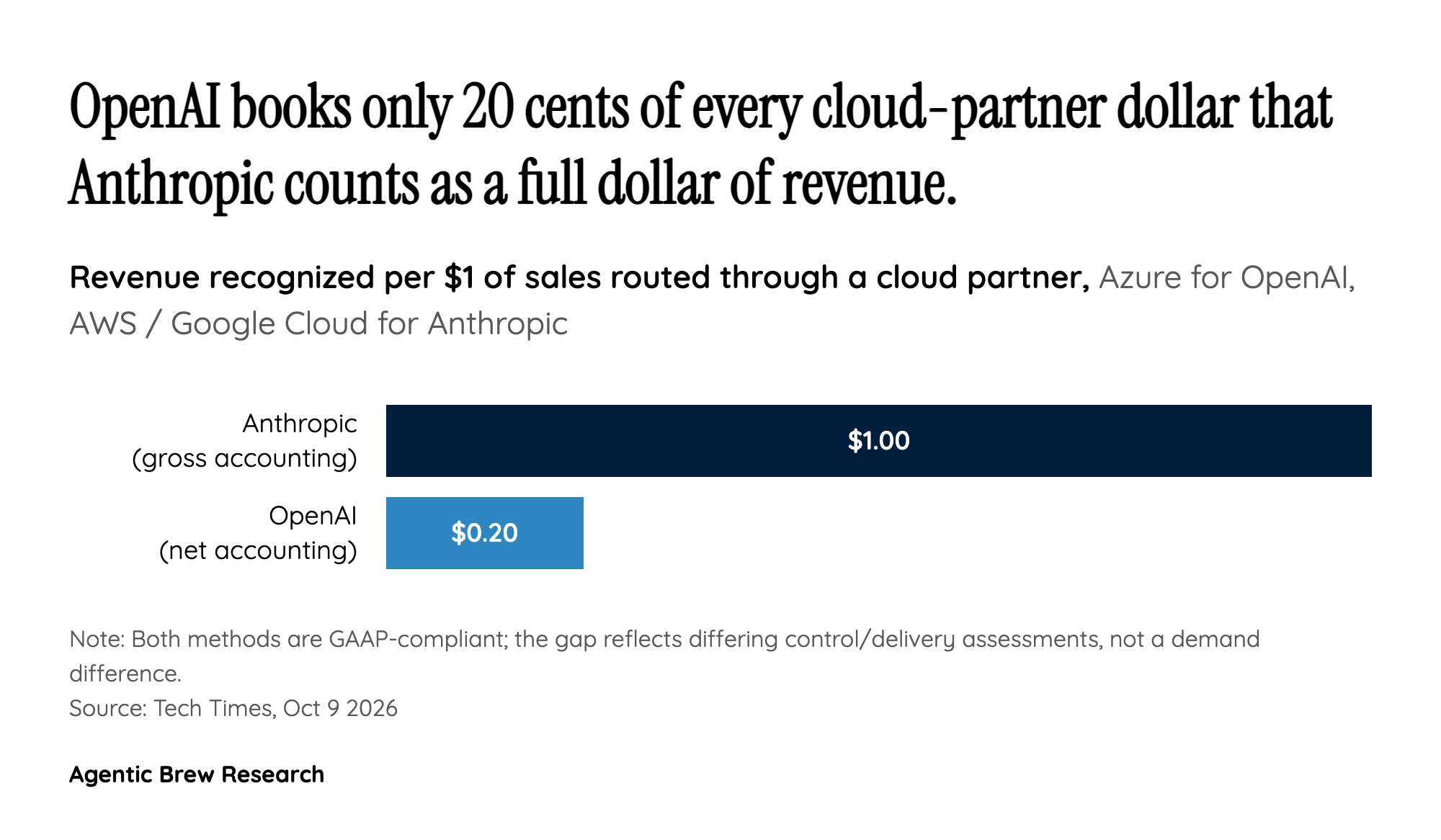
OpenAI books only 20 cents of every cloud-partner dollar that Anthropic counts as a full dollar of revenue.

OpenAI and Anthropic aren't lying to anyone - they're just counting money differently. When a customer buys OpenAI's models through Microsoft Azure, OpenAI records only its roughly 20-cent cut of every dollar spent; Microsoft keeps the rest [1]. Anthropic, by contrast, books the full dollar as revenue even when the sale runs through a cloud partner like AWS or Google Cloud, treating the partner's cut as a separate expense rather than a revenue reduction [1]. Both methods are legitimate, GAAP-compliant accounting choices tied to how each company assesses control of the customer relationship and delivery responsibility - but they produce wildly different headline numbers from similar underlying businesses [2].


Where the $70 Billion Number Actually Came From

The $70 billion figure that rattled markets never actually came from OpenAI. It traces back to a September 29, 2026 Axios report, citing an anonymous source, that applied Anthropic's gross-revenue method to OpenAI's known growth rate in order to make the two companies comparable [1]. Investors ran with that extrapolated number for over a week until the Financial Times reported on October 8 that OpenAI's actual annualized revenue - on its own net-revenue basis - was approaching $50 billion, about $20 billion below what had circulated [3]. OpenAI itself declined to comment on the specific gap [4].

Why Wall Street Panicked Anyway

Even though the gap was methodological, markets treated it like a demand signal. Nvidia shares fell about 3%, erasing roughly $169 billion in market value in a single session [5]. Oracle dropped more than 5%, a reaction amplified by its $664 billion in remaining performance obligations with no disclosed breakdown of OpenAI-specific exposure [5]. CoreWeave was hit hardest, falling nearly 8%, reflecting how its valuation rests on a $104 billion backlog funded largely through debt [5]. Analyst commentary converged on describing the reaction as disproportionate, noting the accounting difference doesn't change the underlying demand trajectory [6]. That tension showed up across social platforms too: X and YouTube commentary largely framed the selloff as an overreaction to a bookkeeping quirk, while Reddit's financial community split between a dominant explainer camp walking through the gross-versus-net mechanics (often via a gross-pay-versus-take-home-pay style analogy) and a more skeptical minority who argued that treating 'annualized run rate' as a hard financial metric, rather than an unaudited projection, was itself part of the problem.

The Growth Story Underneath the Noise

The accounting gap obscures a more interesting fact: OpenAI's underlying growth hasn't slowed. The company's own disclosures to investors show 77% total revenue growth and 107% enterprise revenue growth in the third quarter [7]. OpenAI has since told investors it expects to reach or exceed $70 billion in annualized revenue by the end of 2026 anyway, driven largely by enterprise expansion [8]- meaning the number investors panicked about missing may simply have arrived early in some reports, measured with the wrong yardstick.

Historical Context

2026-07
Reported gross annualized revenue figures in the $65-74 billion range using full cloud-partner-sale accounting, the benchmark investors later tried to match OpenAI against.
2026-09-29
First reported OpenAI's annualized revenue nearing $70 billion, a figure later shown to have used Anthropic-style gross-revenue extrapolation rather than OpenAI's own net-revenue basis.
2026-10-08
Reported that OpenAI's actual annualized revenue as of late September was approaching $50 billion, roughly $20 billion below the earlier $70B figure, triggering a tech-stock selloff.
2026-10-09
Following the correction, OpenAI said it expects annualized revenue to reach or exceed $70 billion by the end of 2026, driven largely by enterprise business growth.

Power Map

Key Players
Subject

OpenAI's $50B vs $70B Revenue Discrepancy Explained

OP

OpenAI

Subject of the revenue disclosure; reports net revenue (its retained share after cloud-partner cuts), and declined to comment on the specific $20 billion gap.

AN

Anthropic

Comparison benchmark; uses gross-revenue accounting counting the full customer payment through cloud partners, reporting $65-74B gross annualized revenue, the methodology investors mistakenly applied to OpenAI.

MI

Microsoft (Azure)

Cloud infrastructure partner that keeps roughly 80 cents of every dollar from OpenAI cloud-partner sales, the structural reason OpenAI's net-revenue figure runs lower than a gross calculation.

NV

Nvidia

AI chip supplier whose shares fell roughly 3%, erasing about $169 billion in market value on the news despite the gap being a demand-unrelated accounting issue.

OR

Oracle

Cloud/data-center partner tied to OpenAI contracts; shares dropped about 5.5-6% on fears tied to undisclosed OpenAI-linked exposure within its $664 billion remaining performance obligations.

CO

CoreWeave

GPU cloud provider hit hardest among suppliers (down ~7.8%); its valuation depends on a debt-funded $104 billion backlog, making it especially sensitive to OpenAI demand headlines.

Fact Check

8 cited
  1. [1] Investors Built $70B OpenAI Revenue Estimate Using Wrong Method, AI Stocks Fell When FT Corrected
  2. [2] Anthropic vs OpenAI: The Revenue Accounting Gap Explained
  3. [3] OpenAI Annualized Revenue at $50bn, Far Below Reports - FT
  4. [4] OpenAI Revenue Shock Sends Nvidia, Oracle and CoreWeave Stocks Lower Today - Here's What Happened
  5. [5] OpenAI's Revenue Is Reportedly $20 Billion Lower Than Thought - Nvidia Just Lost $170 Billion
  6. [6] OpenAI Revenue Concerns Weigh on Nasdaq Stocks
  7. [7] OpenAI Revenue Appears $20 Billion Lower Than Previously Reported
  8. [8] OpenAI Expects $70 Billion in Annualized Revenue by End of 2026

Source Articles

Top 4

THE SIGNAL.

Analysts
The Crowd

“OpenAI's annualized revenue neared $50 billion—$20 billion below earlier reports. The Information's @steph_palazzolo breaks down the discrepancy: "But the issue here is that that figure is $20 billion lower than another figure that was being reported last month by us and others... that figure was that the company was approaching $70 billion in ARR..." Read more: thein.fo/4ydQ8Wv”

@@theinformation13

“Let's talk about OpenAI's revenue "miss" yesterday, shall we? A lot of anti-AI trade types started prancing around how OpenAI "claimed" they were going to do 70 billion and then reported 50 billion was a 20 billion dollar "miss". ... The original 70 billion dollar figure was an investor-side gross-up that was intended to mimic how Anthropic reports its revenue (for those who don't know, Anthropic counts their cloud partner sales as revenue). OpenAI's model doesn't do that - they only want to report net, meaning they only want to report what they directly book, not the partners. The 50B ARR was always the target for them. This 20 billion dollar "miss" is a difference in accounting, not a sudden drop in token burn. ... The TL:DR here is the drop in the AI trade yesterday (which carried over a bit into today) is completely ridiculous, nobody understood what was going on behind the headline, and some buying opportunities were created - particularly amongst the neoclouds that were disproportionately hit.”

@@BonkDaCarnivore19

“The AI bubble has faced its first major blow! Tech stocks have finally fallen. What the market is witnessing this time is not merely a technical correction, but news capable of shaking the very narrative driving AI investment: OpenAI's actual revenue may not be as high as the market had imagined. OpenAI's latest investor documents indicate that its annualized revenue was approaching $50 billion as of the end of September. CNBC subsequently verified and reported this figure. The issue lies in the discrepancy: the market had previously circulated a figure of $70 billion, a gap of $20 billion. This shortfall in revenue expectations has sounded an alarm for the market... [thread continues with broader macro/rates analysis]”

@@OwenCarter_k1

“OPENAI'S ANNUALIZED REVENUE NEARS $50B, FAR BELOW EARLIER $70B REPORTS”

@u/Own_Capital_13952000
Broadcast
OpenAI's $20 BILLION MISS Wiped Out $370B from Tech Stocks

OpenAI's $20 BILLION MISS Wiped Out $370B from Tech Stocks

OpenAI's Revenue Run Rate is $20 Billion Less Than Reported

OpenAI's Revenue Run Rate is $20 Billion Less Than Reported

$20 billion gap: OpenAI's revenue forecast raises fresh concerns

$20 billion gap: OpenAI's revenue forecast raises fresh concerns