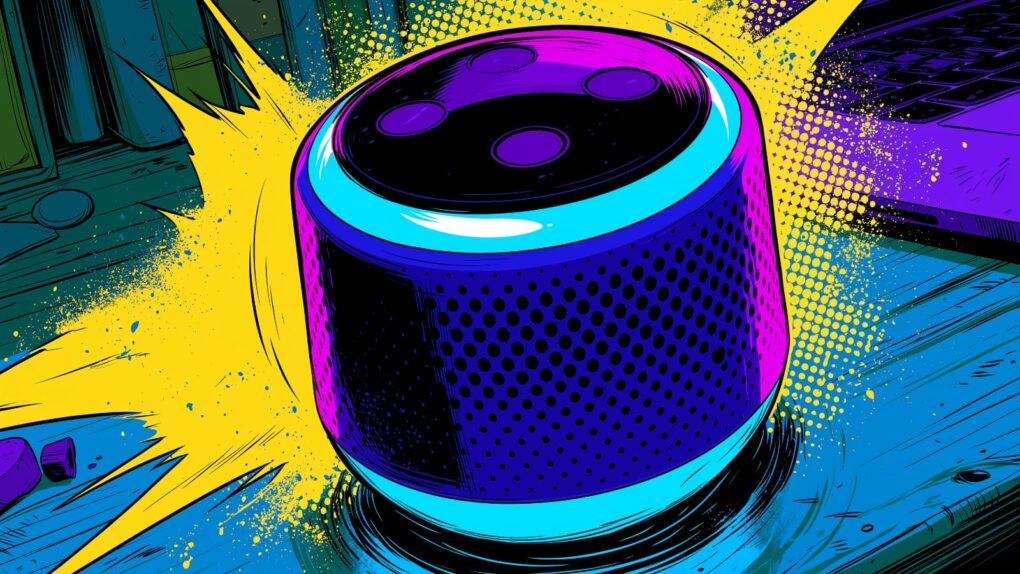
OpenAI's Jony Ive-designed AI smart speaker
TECH

OpenAI's Jony Ive-designed AI smart speaker

37+
Signals

Strategic Overview

  • 01.
    OpenAI's first hardware product is a doughnut-shaped, hockey-puck-sized, screen-free speaker priced between $300 and $400, designed by Jony Ive's LoveFrom studio and aimed at a late-2026 unveiling ahead of a 2027 launch.
  • 02.
    The device has an integrated camera with facial-recognition capability similar to Face ID, is designed to learn about who is using it and what's around them, and can be used to make purchases.
  • 03.
    The speaker is one of roughly five hardware products OpenAI is reportedly developing, and is intended to be carried between rooms rather than serve as a fixed smart-home hub.
  • 04.
    The launch comes as Apple pursues a trade-secrets lawsuit against OpenAI alleging systematic misappropriation via more than 400 former Apple employees, a case analysts warn could hamper OpenAI's hardware commercialization.

Deep Analysis

Why Does This Need to Exist at All

In a recorded conversation posted to OpenAI's own YouTube channel, Sam Altman and Jony Ive spent as much time interrogating whether a new device should exist as describing what it is. Altman said the default answer to any pitch for new AI hardware is 'we shouldn't do anything at all,' since phones already do nearly everything well and are general-purpose - there has to be a genuinely compelling reason to break from them. Ive pushed back that it would be 'absurd' to assume a real breakthrough in AI should keep shipping through hardware forms essentially unchanged since the 2007 multi-touch era. The two, who began quietly meeting around 2023, described a working process in which Altman's team frames a problem space and Ive's interdisciplinary creative team, assembled well before ChatGPT gave the group its 'purpose,' disappears for weeks and returns with 'an entirely new idea that seems obviously right.' That process reportedly produced fifteen to twenty distinct product concepts, of which the speaker is only one; Ive said the current challenge is narrowing focus rather than inventing further, and that nothing is shipping 'anytime soon.'
An Ambient Computing Layer, Not a Speaker

OpenAI's own executives are notably reluctant to pin down what the device actually is. In a Wall Street Journal interview, COO Brad Lightcap said OpenAI is trying to build 'an entirely new class of devices' tied to a new computing substrate, comparing the shift to the mainframe-to-PC-to-mobile progression. He argued that ChatGPT today is 'just an app on your phone' with too much interaction friction, and that the goal is an 'ambient computing layer' that detaches people from staring at screens and can handle 'social reasoning' - recognizing who it's talking to and adjusting its tone and context accordingly. Pressed on whether he actually knows what the device is, Lightcap answered 'I have no idea'; asked if it resembles Alexa, he offered only 'Close. No comment,' calling the project 'truly experimental' with many more versions to go before OpenAI feels good about it. That framing echoes a separate claim that OpenAI's platform ambition extends beyond app-based, screen-staring interaction toward ongoing natural conversation [1]. It also lines up with leaked internal materials circulating on Reddit, which reportedly describe the device not as a speaker at all but as 'the first of its kind: a computer built for AI to help make busy people more productive' - language closer to a productivity tool than a home speaker.

Apple's Lawsuit Casts a Shadow Over the Launch

OpenAI's hardware ambitions are unfolding against a 40-page trade-secrets lawsuit Apple filed in the Northern District of California, alleging systematic misappropriation via more than 400 former Apple employees [2][3]. The suit names OpenAI's chief hardware officer, Tang Tan, a 24-year Apple veteran who oversaw iPhone and Apple Watch design before joining Ive's io Products in December 2023, accusing him of directing recruits to bring Apple hardware parts to interviews and of sharing a stolen Apple security document [4]. Apple's complaint alleges the pattern was 'normalized and exemplified by leadership' and describes OpenAI's hardware business as 'rotten to its core,' resting on 'the shakiest of foundations' [3]. Supply-chain analyst Ming-Chi Kuo has warned that if the disputed trade secrets apply broadly across OpenAI's physical-AI product line, the litigation could substantially hamper the company's ability to commercialize hardware in the near term [5].

Not a Wearable - and a Lesson From Vision Pro

Independent reporting has narrowed down what the device is not. A legal filing cited in a hardware-focused breakdown video quotes OpenAI's chief hardware officer confirming the device is neither a wearable nor an in-ear product, ruling out the earbuds-style form factor some had speculated about. The same analysis draws a pointed comparison to Apple's Vision Pro, whose ambitions were throttled by a shortage of specialized Sony displays that capped production near 500,000 units a year, arguing that if OpenAI wants its speaker to be genuinely mass-market rather than a boutique curiosity, it will need to avoid the kind of exotic, hard-to-scale components that constrained Vision Pro's rollout.

Alexa 2.0, or the Next Leap Beyond Siri

Even sympathetic observers are unsure the device clears the bar for existing. Cult of Mac's Lewis Wallace frames it as a competitive threat to the HomePod and Alexa lineup rather than an iPhone killer, arguing adoption will hinge on utility, price, audio quality and whether the AI personality feels charming rather than sycophantic, especially with an improved Siri already giving iPhone owners a portable assistant in their pocket [6]. Reaction across r/OpenAI, r/ChatGPT and r/singularity skews skeptical to mocking: the most common complaints are that the functionality 'can just be an app,' comparisons to past hardware flops like the Humane AI Pin, Rabbit R1 and Vision Pro, and privacy concerns about an always-on camera and microphone in the home. A smaller contrarian thread argues the comparison is unfair, that a ChatGPT-powered home device with genuinely capable reasoning could represent as big a leap over 'incredibly limited' Alexa and Siri as ChatGPT itself was over earlier assistants, with one commenter separately noting real accessibility value for visually impaired users. At $300 to $400, the device sits well above what most buyers associate with a smart speaker, raising the stakes on whether OpenAI can make that leap feel obvious rather than gimmicky [7]. On X, reaction to Bloomberg's Mark Gurman breaking the design details echoed the same skepticism: separate posts from other accounts pointed out that the smart-speaker category has rarely been reliably profitable for anyone, and that Amazon already undercuts the announced price with its own lineup, reframing OpenAI's bet less as an obvious win and more as a bet on 'aliveness' overcoming a historically weak business model.

Historical Context

2023
Altman began quietly collaborating with Ive and his design firm LoveFrom on device concepts, well before any public acquisition announcement.
2023-12
Tang Tan, a 24-year Apple veteran and VP of iPhone/Apple Watch product design, left to join io Products, the hardware startup Ive co-founded with Scott Cannon, Evans Hankey and Tang Tan.
2025-05-21
OpenAI announced it would acquire io Products, Jony Ive's AI hardware startup, for approximately $6.4-6.5 billion in stock, OpenAI's largest acquisition to date; OpenAI had previously held a 23% minority stake in io.
2025-07-09
OpenAI formally closed the io Products acquisition, with Ive and LoveFrom remaining an independent company but taking on deep design and creative responsibilities across OpenAI.
2025-11-24
Altman described OpenAI's forthcoming AI device as aiming to feel more peaceful and calm than the iPhone, with the product still described as being in prototype stage roughly two years from availability.
2026-02-20
Early reporting pegged the device's price at $200-$300 with a February 2027 earliest launch, and described a companion smart lamp and smart glasses planned for 2028 or later.
2026-07-10
Apple filed its trade-secrets lawsuit against OpenAI in the Northern District of California, alleging systematic misappropriation via more than 400 former Apple employees.
2026-08-06
Bloomberg's Mark Gurman reported updated device specifics: a doughnut/hockey-puck-shaped, screen-free, battery-powered speaker priced $300-$400, aiming for a late-2026 unveiling ahead of 2027 launch.

Power Map

Key Players
Subject

OpenAI's Jony Ive-designed AI smart speaker

JO

Jony Ive / LoveFrom

Former Apple chief design officer; his studio LoveFrom leads industrial design on the device following OpenAI's roughly $6.5 billion acquisition of Ive's hardware startup io Products, which closed July 9, 2025. Ive and LoveFrom remain an independent company but hold deep design and creative responsibilities across OpenAI.

TA

Tang Tan, Chief Hardware Officer, OpenAI

24-year Apple veteran who rose to VP overseeing iPhone and Apple Watch design before joining io Products in December 2023 and becoming OpenAI's chief hardware officer after the acquisition; central defendant in Apple's trade-secrets lawsuit, accused of directing recruits to bring Apple hardware parts to interviews and of sharing a stolen Apple security document.

AP

Apple Inc.

Plaintiff in a 40-page trade-secrets lawsuit filed in the Northern District of California (July 10, 2026), alleging OpenAI misappropriated trade secrets via 400+ former Apple employees and that the scheme was 'normalized and exemplified by leadership,' calling OpenAI's hardware business 'rotten to its core' and resting on 'the shakiest of foundations.'

SA

Sam Altman, CEO, OpenAI

Publicly frames the device as an antidote to smartphone-induced anxiety; told employees it would be 'the coolest piece of technology the world will have ever seen'; has collaborated quietly with Ive and LoveFrom since 2023.

CH

Chang Liu, former Apple senior systems electrical engineer

Co-defendant in Apple's lawsuit; alleged to have failed to return an Apple-issued laptop after leaving for OpenAI in 2026 and to have used it to download confidential Apple technical documents.

Fact Check

7 cited
  1. [1] OpenAI Jony Ive Speaker Apple Theft Claim
  2. [2] Apple Sues OpenAI for Trade Secret Theft, Alleging Systematic Poaching of 400+ Employees
  3. [3] The Wildest Allegations in Apple's Trade Secrets Lawsuit Against OpenAI
  4. [4] Who Is Tang Tan? The Ex-Apple VP at the Core of OpenAI's Trade Secret Theft Lawsuits
  5. [5] Apple Sues OpenAI for Trade Secret Theft in Blockbuster Case
  6. [6] OpenAI Smart Speaker
  7. [7] OpenAI's ChatGPT Speaker

Source Articles

Top 5

THE SIGNAL.

Analysts

Frames the device as a competitive threat to the HomePod and Alexa lineup rather than an iPhone killer, arguing adoption hinges on utility, price, audio quality, and whether the AI personality feels charming rather than sycophantic, and notes an improved Siri already gives iPhone owners a portable assistant in their pocket.

Lewis Wallace
Writer, Cult of Mac

Warned that if the trade secrets at issue in Apple's lawsuit apply broadly across OpenAI's physical AI consumer product line, the litigation could tremendously hamper OpenAI's ability to commercialize near-term.

Ming-Chi Kuo
Industry/supply-chain analyst

Describes a personal sense of responsibility for smartphone-driven anxiety and loss of concentration, framing the device project as an attempt to correct problems smartphones caused, pursuing a design philosophy of near-naive simplicity.

Jony Ive
Co-designer, LoveFrom / OpenAI design lead

Describes the device as aiming to feel more peaceful and calm than the iPhone, contrasting the anxious, notification-driven feel of smartphones with a hoped-for ambient, contextually aware companion.

Sam Altman
CEO, OpenAI
The Crowd

NEW: OpenAI’s device - a human-like smart speaker - will look like a doughnut and be the size of a hockey puck. It meant to be held. It has a camera, speakers, microphones, lights and, most notably, moving parts to show interactivity. It’ll be $300-400.

@@markgurman1532

OpenAI's first hardware product is a doughnut-shaped smart speaker the size of a hockey puck, priced at $300 to $400 and set for release in 2027. Amazon sells an Echo Dot for $30 on sale. Jony Ive's LoveFrom studio designed it. Apple is currently suing OpenAI, claiming the...

@@HedgieMarkets612

OpenAI is building a $300-$400 AI smart speaker. Donut-shaped. Moving parts. Designed by Jony Ive. Amazon's best speaker costs $240. Smart speakers have never been reliably profitable. Apple is already suing OpenAI over hardware trade secrets. A premium talking donut...

@@rdominguezibar0

NEW LEAK: OpenAI's First Device Will Be Moveable, Screenless Speaker Built as AI Companion

@u/WholeSeason7147390
Broadcast
A Conversation with Sam and Jony

A Conversation with Sam and Jony

This is OpenAI & Jony Ive's secret Device

This is OpenAI & Jony Ive's secret Device

OpenAI COO on Jony Ive, New 'Ambient' Devices, Data Centers in UAE and More | WSJ

OpenAI COO on Jony Ive, New 'Ambient' Devices, Data Centers in UAE and More | WSJ

OpenAI's Jony Ive-designed AI smart speaker — AI News | Agentic Brew